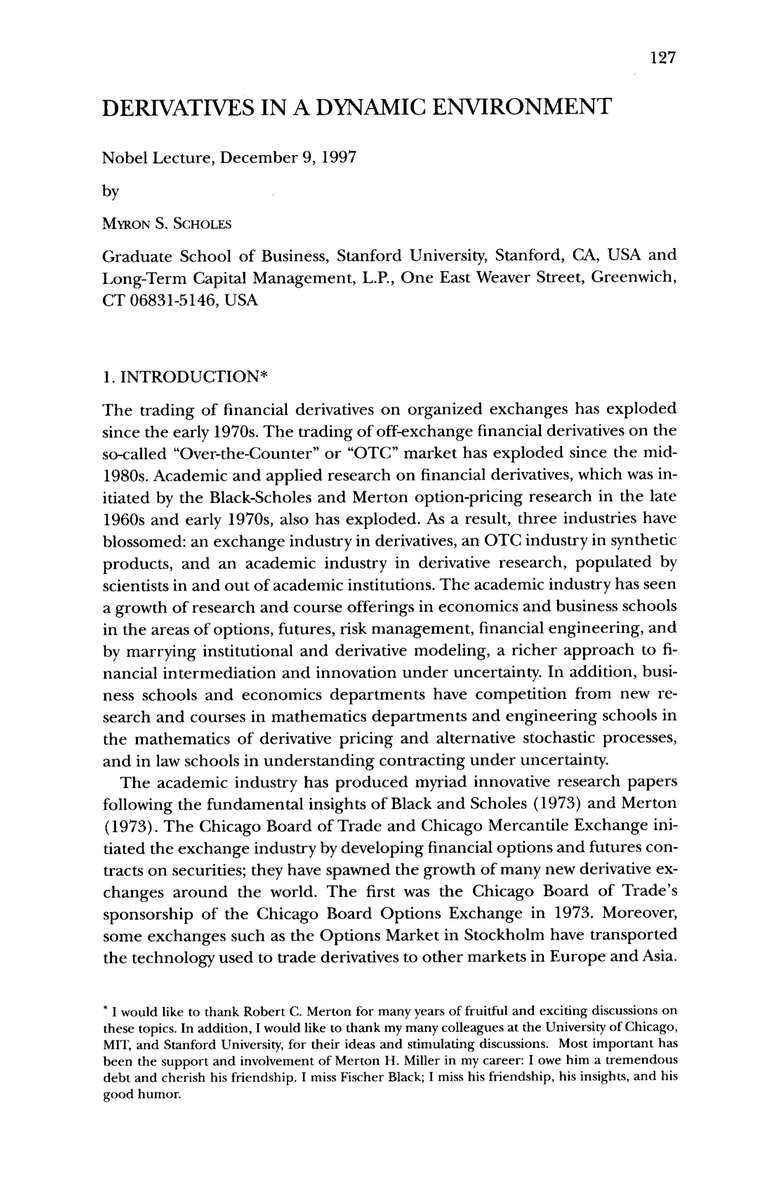
This Nobel Lecture completely changed how I think about building financial products in dynamic environments:
Underlying asset dynamics shift → coarse securities unbundled → constituent risks repackaged → customized OTC products created → standardized exchange contracts launched → lower-cost solutions delivered
Honestly, press limits derivatives to options and futures
This lecture defines any security whose price depends on other assets and time
By viewing securities through option lens, you open path to new product design
Here is the exact operational blueprint behind derivatives evolution:
1/ Three industries: exchange industry since 1973, OTC industry since mid-1980s, academic industry producing pricing research
2/ Core invention: Black-Scholes plus Merton extensions for dividends, stochastic rates, general contingent claims
3/ Production logic: unbundle coarse financial products into parts, repackage to meet specific client demands at lower cost
4/ Historical root: option trading noted in Amsterdam late 17th century, Bachelier thesis 1900, but pricing technology enabled explosion
You cannot understand modern markets without seeing every corporate liability through option framework
Read the complete paper + article below
Bookmark it for future reference
This paper completely changed how I think about corporate balance sheets and default risks:
Company issues debt and equity → Treat common stock as call option on firm assets → Treat bondholders as sellers of the option → Calculate probability of corporate default directly
Honestly, most people assume this research only applies to trading options on equity exchanges.
The authors explicitly proved that almost all corporate liabilities are simply mathematical combinations of basic options.
When a corporation takes on debt, the stockholders hold a European call option on the total assets of the business.
Here is how structural option theory prices corporate financial risks:
> Equity as a call: shareholders exercise their option to pay off debt only if total corporate assets exceed the face value of the bonds
> Default valuation: if firm value drops below the strike price at maturity, shareholders walk away and leave the remaining assets to bondholders
> Credit spreads: the pricing equation directly computes the exact mathematical discount applied to corporate bonds due to default risk
> Capital structure logic: increasing the asset volatility of a firm transfers wealth directly from bondholders to shareholders
You cannot understand modern credit risk without mastering option pricing mechanics.
First read my article below for general understanding, then read the paper
Bookmark it for future reference
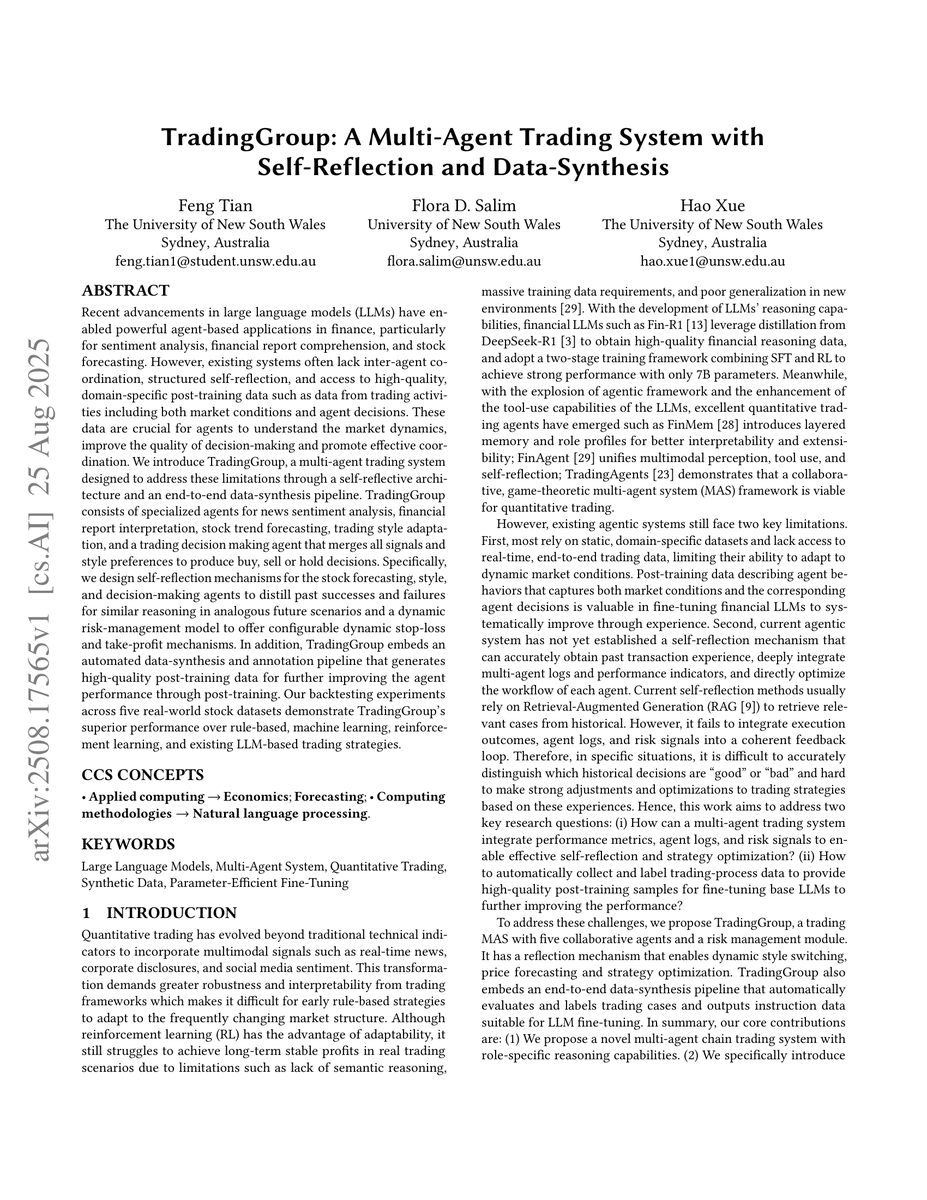
This paper completely changed how I think about self-correcting trading agents:
Execution trace → profit/loss labeling → experience summary → prompt injection → next decision → synthetic SFT dataset
Honestly, most llm trading setups lose track of what worked. This one remembers.
It stores every input, output, account state, and CoT, then builds reflection summaries from last 20 days.
Here is how it works:
/ trading-decision agent reviews past successes and failures before acting
/ style-preference agent adapts aggressive, balanced, conservative from PnL and holdings
/ forecasting agent merges sentiment, 10-K RAG, and technicals with reflection
/ auto pipeline filters positive reward_a and high w_hit samples for fine-tuning
Turns live trading history into training signal
Read the complete paper + article below
Bookmark it for future reference
This paper completely changed how I think about corporate balance sheets and default risks:
Company issues debt and equity → Treat common stock as call option on firm assets → Treat bondholders as sellers of the option → Calculate probability of corporate default directly
Honestly, most people assume this research only applies to trading options on equity exchanges.
The authors explicitly proved that almost all corporate liabilities are simply mathematical combinations of basic options.
When a corporation takes on debt, the stockholders hold a European call option on the total assets of the business.
Here is how structural option theory prices corporate financial risks:
> Equity as a call: shareholders exercise their option to pay off debt only if total corporate assets exceed the face value of the bonds
> Default valuation: if firm value drops below the strike price at maturity, shareholders walk away and leave the remaining assets to bondholders
> Credit spreads: the pricing equation directly computes the exact mathematical discount applied to corporate bonds due to default risk
> Capital structure logic: increasing the asset volatility of a firm transfers wealth directly from bondholders to shareholders
You cannot understand modern credit risk without mastering option pricing mechanics.
First read my article below for general understanding, then read the paper
Bookmark it for future reference