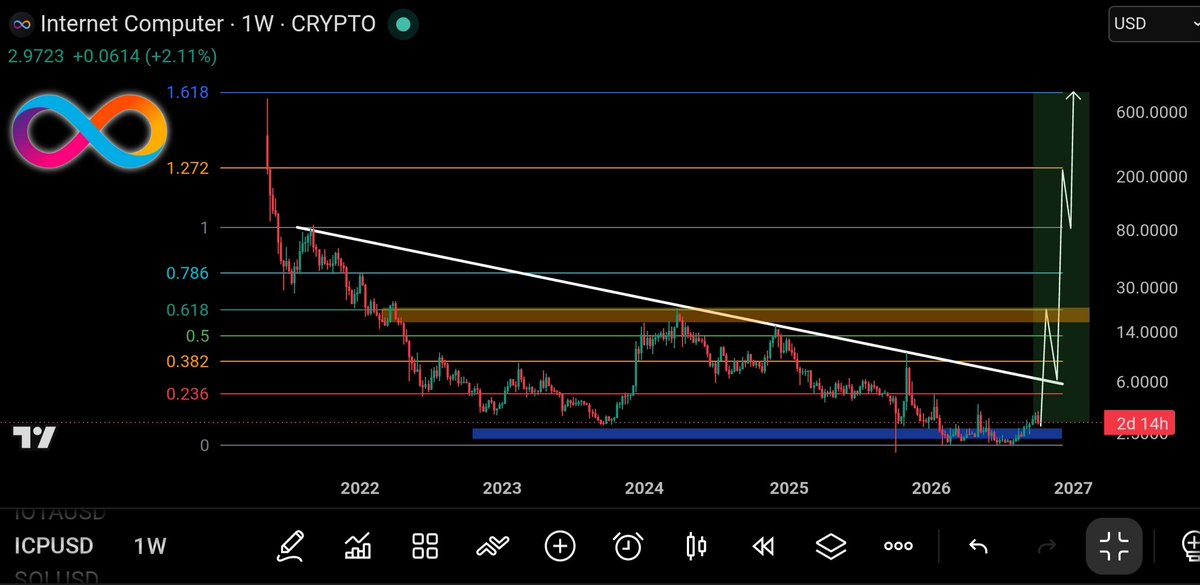
BOOM💥💥 $ICP #InternetComputer rumours in the crypto space this is shit coin but i have strong conviction that this crypto might have strong rally and 50$ is realistic price target by early next year. #ICPCommunity#ICPHolders
We urgently need "AI safe" cryptography, not "quantum safe" cryptography — a point many in crypto are completely missing at their peril.
Undeniably, AI is already here today, while cryptographically-relevant quantum computers that might break our traditional cryptography are still years away, according to impartial expert estimates.
Justin's post below, indirectly highlights the problem with the current industry stampede to "quantum safe" cryptography. As I shall explain, the real reason for this unwise stampede is that the networks involved want to sell tokens by riding the quantum narrative, and it has nothing to do with good technical stewardship, or trying to protect users from harm.
If what I'm saying is true, this is a big deal for the industry, and therefore I challenge those promoting quantum safety to a healthy debate.
Here's the core problem that we actually need to worry about imo: AI is now coming for mathematicians, just like it came for even the most advanced software engineers. Nothing will now be the same. Every day, AI is showing that long-held mathematical assumptions (what we think of as "laws of math") are actually false. This is very important for the crypto industry. This Scientific American article covers recent advancements for the interested: https://t.co/lGXZQbFJTL
At its core, cryptography relies on mathematical assumptions that doing this or that is incredibly hard, and can only be achieved by brute force, such that if sufficient bits (0s and 1s) are used by a cryptography scheme, forging a signature to unlock and steal someone's balance of digitial assets, say, would require trillions of years of work by all the computers on earth.
If AI can show these kinds of assumptions are incorrect, then new math can be devised to shortcut the work that makes affected cryptography schemes safe.
Therefore, to maximize our chances of staying safe, we need our networks to use cryptography schemes that depend on mathemaatical assumptions that have the least chance of being found incorrect by AI.
Justin rightly points out that even ECDSA isn't completely safe, and that some bitcoin owners might want to take protective measures.
However, the focus on the potential dangers to ECDSA will accidentally obscure a critical point for many readers, which is that the schemes that are most likely to be safe, will be those that have been around the longest, which have benefited from the most years of analysis by mathematicians and cryptographers, and ECDSA is one.
This far, ECDSA has benefited from decades of analysis by a worldwide army of researchers, and while this doesn't provide a guarantee that ECDSA is safe, it provides good reason to believe it has a decent chance of being safe from AI.
The same is not true of the new "quantum safe" cryptography schemes. They involve new assumptions that the world has had only a fraction of the time to analyze, and complex algorithms that can have hidden flaws that can be used to break them, rather like there are shortcuts that can be used to quickly solve a Rubik's cube — and AI recently exploited exactly such a weakness to attack the HAWK post quantum scheme, see https://t.co/PIiUX0xKdU
Listen to what Dan Boneh @danboneh, a world-famous cryptographer, and Head of Secure Computing at Stanford University, recently said: "if you try to aggressively move to a post quantum architecture, like for example by 2029, I think that would be a mistake for blockchain, I think we need to take our time, and the reason is that a hasty transition to post quantum, in my mind, is more likely to cause a catastrophic bug, than we'll be attacked by a quantum computer." https://t.co/FyDLEg1iA5
Maybe in the future, we will measure the safety of mathematical assumptions using the amount of energy that has powered the AI that's analyzing them, multiplied by IQ efficiency, divided by domain complexity (I'm not proposing exactly this, my fingers just invented this nonsense as I typed, but you get the idea!). We have not reached that future yet though. We can't say that a quantum safe cryptography scheme is sound because AI analysis has done thousands of person years of human research for us.
So what gives, and why are networks constantly trumpeting their implementation of the latest post-quantum scheme, when cryptographically quantum computers seem years away, if doing so is playing fast and loose with user safety?
The unvarnished truth is that it's driven by a primary desire to sell tokens. All markets are driven by hype, but the crypto industry has taken this to another level. Often (but not always), rather than reward genuine technological utility, progress, and mainstream potential, our markets reward those slotting into the latest narrative wave driving the "crypto casino". This is why there are so many multi-billion dollar vaporware networks romping up and down industry league tables, which, imo, is something we need to fix.
Thus, although switching networks to post quantum schemes today apparently makes no technical sense, and puts users at risk, for those behind the networks transitioning early to post quantum cryptography schemes it makes great sense, because it helps them sell tokens and extract capital from crypto markets.
Of course, this casino isn't fair, and is tilted in the favor of hidden orchestrators, which everyone who has been in crypto long enough already knows.
Narratives, including the quantum safety narrative, are prompted by massive, semi-decentralized, hidden marketing machines, that incorporate everything from industry press owned by vested interests, astroturf armies on social media, paid mainstream PR, and influencers. The machines are wielded by coalitions of big money blockchain investors who have taken their positions ahead of time and will dump at the top of the pump. Needless to say, the problem for those riding these narratives, who are not part of the chosen circle, is that they can't control where the narrative is going, nor when it might suddenly end (like the NFT craze). From my perspective, it's all part of the fast money cynicism and short-termism that harms our industry every day and puts users at risk.
But enough metaphysical philosophizing about crypto narratives.
I call out to the leaders of the big networks that are pumping quantum safety claims, who regularly post pictures of their logos next to quantum computers, with the aim of messaging that they are sci-fi and advanced, who find ways of making a new quantum announcement almost every single day: I challenge you to explain your actual technical reasoning, your analyses of the relative risks involved, and explain exactly how your choices protect users in the face of AI advancements.
We all deserve to hear the answers, and debate of this kind is exactly what our industry needs. It is, btw, what it was originally built on.
Here's to hoping that the assumptions underpinning ECDSA aren't incorrect, and that's why the army of researchers failed to find anything in the decades they were looking.
Let's also hope that AI discoveries help us make our crypto even safer.
And, best of luck too to those being migrated to new post quantum schemes ahead of time...
ICP "cloud engines" launch trajectory:
DFINITY will soon begin disbursing coupons with enough cycles to create and power an engine for 1 month+, unlocking in sequence:
1. Agentic infrastructure ⚡️ Quickly build secure, sovereign onchain production apps using Claude Code, Codex, Caffeine, ...
2. Open SaaS beta release ⚡️ Install AIware apps that can run any enterprise, as easily as installing phone apps...
3. Unlimited growth ⚡️ A new end-to-end, mainstream onchain cloud tech stack will come into being.
*** What this means ***
ICP cloud engines are a new development on the Internet Computer designed to allow it to play the role of a revolutionary new cloud tech stack for the AI era.
Currently, the Internet Computer scales by combining internal subnets, which are akin to individual, high performance blockchains hosting secure serverless software called canisters (something like smart contracts, but much more powerful, which can be used to create huge onchain apps, which serve their web screens directly to users)
Cloud engines allow enterprises to create their own subnets that belong exclusively to them, which they control and configure — while their canister software can still seamlessly interoperate with software on the main network, and engines run by others.
An enterprise creates a cloud engine by choosing nodes from a marketplace, which the ICP protocol combines into a revolutionary serverless cloud platform for them, where the computation and data of their hosted apps and services is tamperproof (immune to infrastructure hacks) and always on (incredibly resilient), AI agents can build and update apps far more effectively than on traditional tech, and next generation AIware software can be created.
Today, enterprises demand to be able to control where their sotware and data lives, and cloud engines make that possible with no loss of flexibility. Cloud engines can even be re-configured with new nodes, without interrupting the hosted apps and services — the ICP protocol just handles it, granting complete sovereignty and freedom from vendor lock-in.
In advance of general release, cloud engines are already being used by governments and NGOs seeking to create sovereign cloud tech stacks and apps. On general release, they will be used in far more mainstream ways too.
Here are the details of what's coming.
*** Agentic Infrastructure ***
In the future, and really already today, nearly all of our apps and services will be created by AI agents rather than humans. Further, next generation software is "AIware," which has AI deeply integrated on the inside, which allows it to provide superpowers relative to traditional software.
Agents have different needs when they building things. They can write software orders of magnitude faster than humans, and we will demand they update our production apps and services at the speed of conversation. Functionality will be fluid and its shape will change to match what we want.
On traditional tech stacks, updating apps and services is a necessarily laborious and risky process for three reasons: 1) a security flaw might be introduced, 2) a systems configuration change might break them, and 3) the way that data is migrated might cause some to be lost, often in subtle ways that aren't detected at the time of the upgrade. This means that AI agents can't just be let of the leash to build and update at the speed they can.
ICP cloud engines solve this. Hosted software is tamperproof, so agents can update without needing security teams in the loop. Hosted software is serverless, and the data lives in the logic, so apps don't. need things like operating systems and databases configured to run, so agents can update apps without having sysadmin teams in the loop either. And, if Motoko 2.0, the world's first languge targeting agents is used as the backend language, its framework is able to detect when an app update by AI might cause data loss, and simply require the agent writing the code to try again, reducing potentially catastrophic data loss to a harmless retry.
Crucially, apps built with Motoko can also put AI agents on the inside, so that subject to permissions, they can see the data graph in the persistent memory used by serverless software on ICP, and access its functions. This enables you to instruct agents to do things in the apps for you, such as analyzing data, or performing actions, with great flexibility and power.
ICP cloud engines are agentic infrastructure that change the game — and it will be possible to use them as such from the moment they are released.
There is already a government using internal production software built on a cloud engine using Caffeine. But cloud engines will meet a wide range of mainstream needs, from solorpeneurs to startups, SMEs to corporations, governments and NGOs.
*** Open SaaS ***
The obvious question, is if AIware is so much better, shouldn't all enterprises be running on it? We believe they should, and that his must be enabled.
This has been a labor of love for me. A new venture associated with me will release the Open SaaS suite for use on cloud engines once they have been running a short while, which suite, as you've probably guessed from the name, is open source and free.
Open SaaS is a suite of every important SaaS (Software-as-a-Service) app used to run enterprises around the world today, reimagined as onchain AIware that runs on ICP cloud engines. Because of the unique nature of the software that ICP hosts, installing and maintaining these sophisticated enterprise apps on a cloud engine is as easy as installing and managing a phone app.
A small selection of the apps: Open Team, Open HR, Open Accounts, Open CRM, Open Projects, Open Email, Open Messaging, Open Signing, Open Knowledge, Op... etc. There are many more, and there will be surprises.
The user experiences are beautiful, and easily compete with the big money SaaS screens many enterprises are used to. Moreover, the are linked to what I called a "software factory" driven by AI, and the more enterprises that use them and provide feedback, the better they will get, in realtime.
Today's expensive SaaS silos make it hard to integrate and combine enterprise data, and to unleash the full power of AI. They are the opposite to Open SaaS.
In the future, enterprise users will spend far more time in AI chat than on SaaS screens. That's the future that Open SaaS enables and unlocks. Enterprise users can even say to their Open SaaS suite, "make me more profitable," and it will have a go.
The big surprise coming for the world: once you run your enterprise on AIware, and AI can access all your data in realtime, and is integrated with your software's actual functions — it can become as good at running your enterprise as writing software for you.
It's revolutionary, and ICP is pioneering this. Not a narrative, but real decentralized network tech.
Something I can share: DFINITY is in the process of migrating to Open SaaS from a vast suite of expensive SaaS silos, and is already reaping big benefits as we refocus ourselves for the era of AI.
****
What does this mean for the project?
I believe ICP cloud engines are the vector that will transform the the Internet Computer into a mainstream agentic infrastructure tech platform for enterprise— which direction platforms like Caffeine have already helped the network travel, by enabling many tens of thousands of users and enterprises to create onchain apps on the shared network through online conversation. Now, the next and most important phase is approaching.
Our go-to-market will proceed quietly as we rollout coupons and work to fettle the new network functionality, but I think that in hindsight, the launch of cloud engines will be seen as the most pivotal moment in Internet Computer history since network launch.
With this, ICP shall show the industry how networks can provide real agentic infrastructure.
Bear with us as we tie up loose ends. We never stop working, and you can be sure that we're trying to get this out as fast as possible 💪⚡️💥
Companies have .com. Organizations have .org.
Our application for .icp passed @ICANN’s initial review and is now public in the 2026 new gTLD round.
The Internet Computer extends the internet. If approved, sovereign software and AIware get their own top-level domain.
Let there be .icp
The 4-year cycle is an illusion.
Copper doesn't run on a calendar. Neither does the S&P, the Russell 2000, or anything else on the risk curve.
Every asset class moves with the business cycle, and crypto is no different. It's just the last one to move.
The 2012, 2016 and 2020 halvings all landed right as the business cycle flipped to expansion. 2024 didn't, and that's the cycle everyone said felt broken.
Our business cycle index just confirmed expansion as we approach the precipice of an AI productivity boom.
This will be a bull market like no other.
The 4-year cycle is an illusion 0:00
Bitcoin's first bear market 0:36
Halvings and the business cycle 1:05
Why this cycle felt confusing 1:59
All-time highs and ETFs 2:49
Why it isn't logical 3:24
Copper vs gold 4:52
QT ending 6:37
Russell 2000 7:04
End of the risk curve 7:48
Altcoins in 2026 8:23
AI productivity boom 8:59
Business Cycle Index 10:14
What expansion means 12:59
Final thoughts 14:18
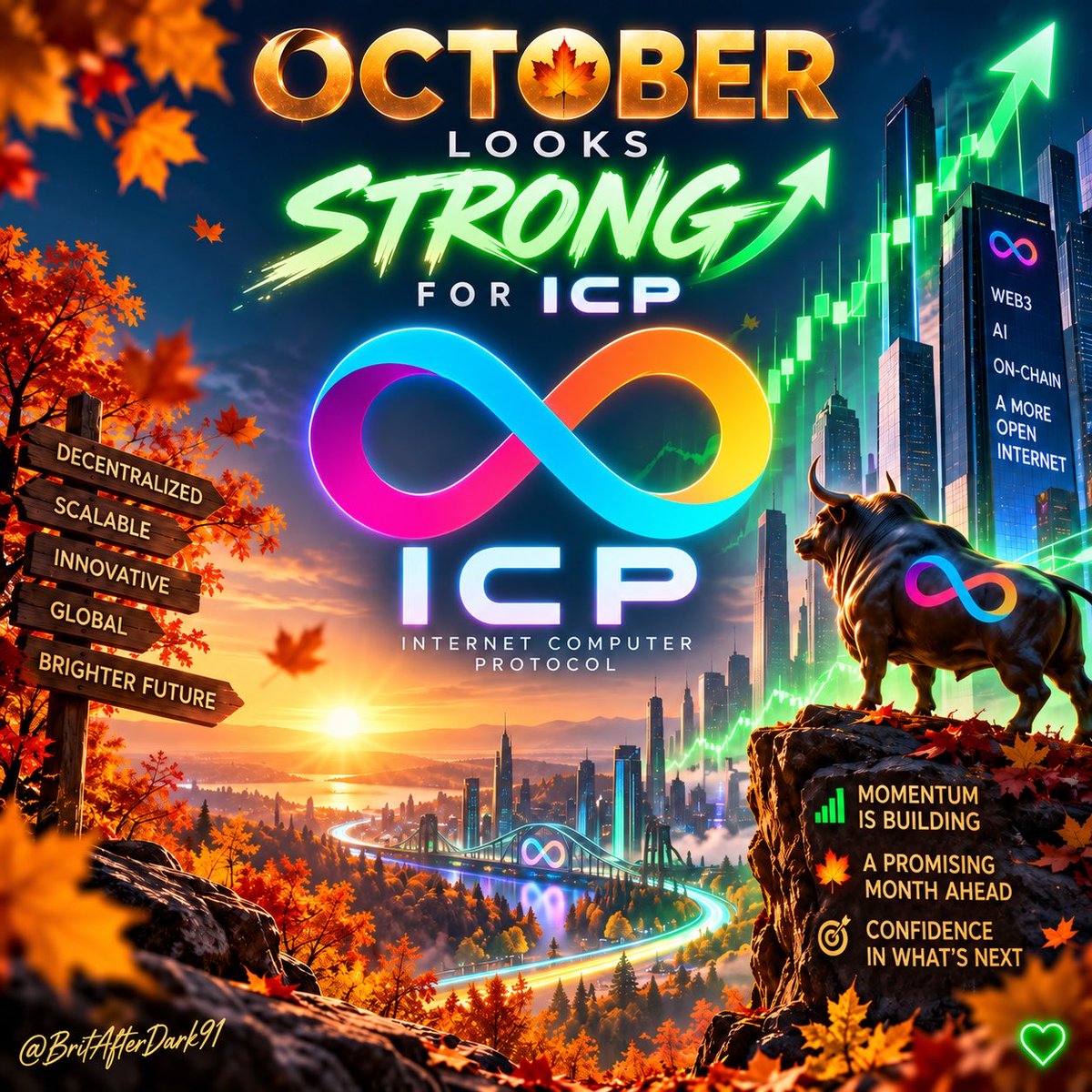
October looks strong for internet-computer:native, and this is the energy I’m carrying into the month. I’m feeling bullish, with bigger possibilities ahead and a future built for more than hype. I believe $ICP has what it takes to make October a month worth remembering—and I have a feeling we’re only getting started. 💚♾️🫶
#ICP #Uptober #InternetComputer #Bullish #Web3 #Crypto $ICP
I scrolled the whole Robinhood Chain meme board this week. Two bullish charts. The rest look like hell.
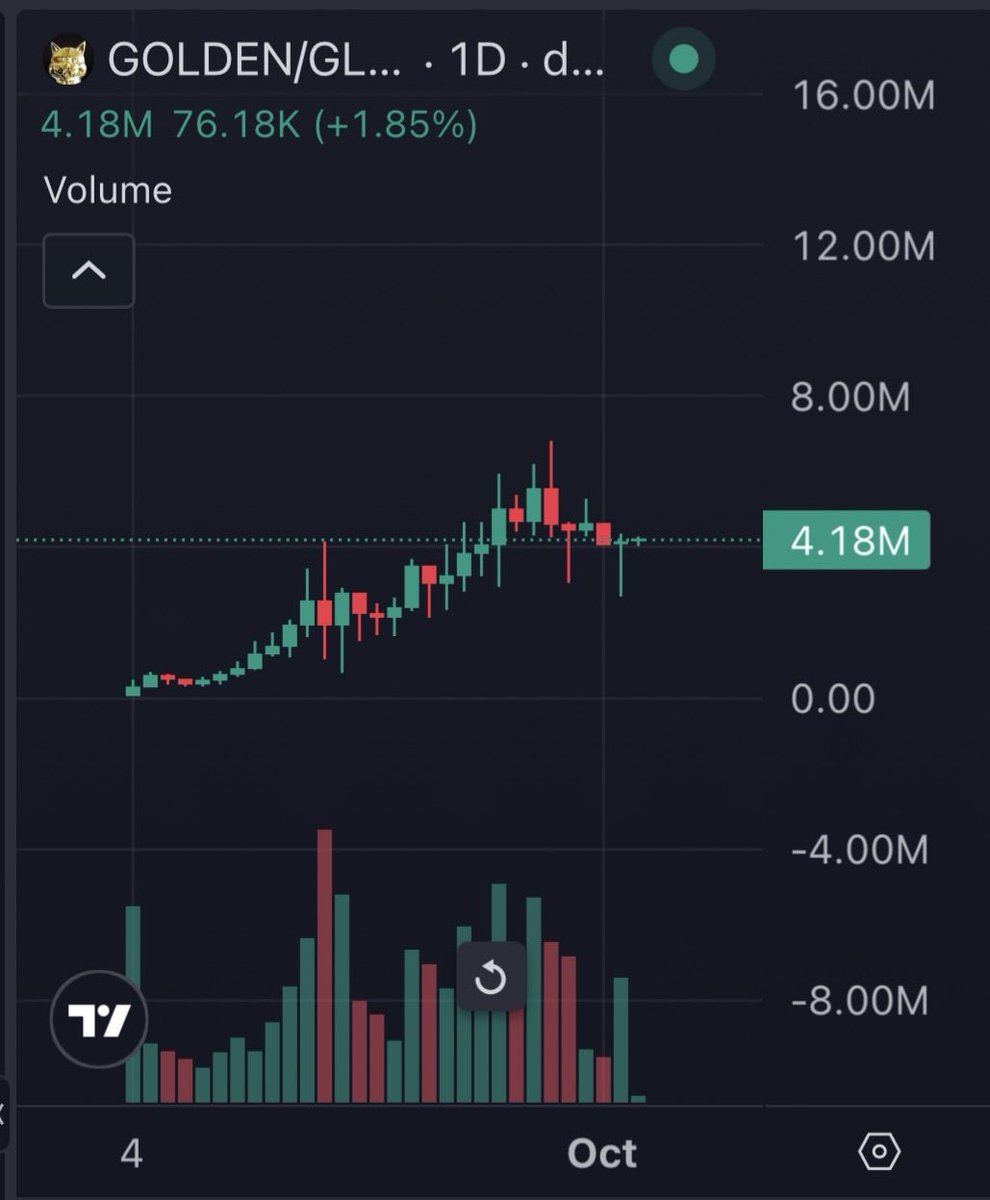
Golden Kitty ($GOLDEN): topped above $6M on Sept 27, retracing, still up about 25% on the week.
Frog In Hood ($FIH): launched July 1, printed a new all-time high on Sept 29, about a $1.1M cap.
Holding the line but not bullish: $KITSU (Vlad's actual dog, about $965K) and $TENDIES (about $9M, down 25% on the week). $ROBINCAT is on MEXC and LBank at a $2.3M cap with zero lore: 'Robinhood introduced a pixelated cat' is the whole story.
Cats are king on this chain. The frog seat is still open: $FIH vs robinhood:0xfde368debe9e80f80785064a65719cec1f809dec, about $1.1M vs $1.6M.
#RobinhoodChain #memecoins
Golden Kitty ($GOLDEN) topped above $6M on Sept 27 and pulled back to about $4.5M. That is the retracement I said was coming, and I am not going anywhere.
Still up about 25% on the week and about 120% over two weeks. The reason it holds while every other Robinhood Chain meme bleeds: the most dispersed holder base on the chain. A lot of influencers and a lot of groups pushing it, so no single bag can nuke it, and the main pool is paired against tokenized gold.
What it needs next is a centralized exchange; it still trades only on DEXs. Realistically I see $20M to $30M this coming run-up. If it survives the whole bull run, memes with this reach go a lot further.
#GoldenKitty #RobinhoodChain