Director had affair with manager.
Director eventually told wife who then threw him out.
Director goes to manager (who had left company at this point) to move in. Sorry, bad news, it's over, she was banging a director at her new company.
Director goes back to wife who forgives and let's back in.
6 months later there was big shares payout for the directors. He went home to high five his wife. Wife says she's divorcing and will be seeking 50% of everything he has. Director was planning on retiring and had to do another 4-5 years for next shares payout!
Do you have any good office romance / affair stories?
I worked at a company where two people were found to be having an affair – a married man and a single woman.
They were both account managers and would travel to different sites together. They'd quite often travel together but would always expense two separate rooms when doing overnights (which they did a LOT). They were pretty much inseparable when they were in the office together and had been caught kissing at a work party.
It all came to a head when the guys wife came into the office and demanded to speak with him. He went out to the car park and she went absolutely mental, screaming at him so loud that we could hear from inside (although not well enough to make out what they were saying).
They eventually got a divorce, and the man and other account manager started expensing just the one room on overnights...
How Machine Learning Models Predict Volatility Index (VIX) Spikes
Most quantitative traders rely on basic linear regression models or traditional econometric formulas like GARCH to forecast market fear and volatility spikes, treating complex market dynamics as if they move in a neat, straight line.
They force non-linear financial panic into rigid linear equations, failing to realize that market sentiment crashes, liquidity crunches, and sudden VIX spikes are inherently chaotic and multi-variable phenomena that break linear assumptions instantly.
Betting your risk management models on linear regression during a black swan event is an invitation for catastrophic portfolio drawdowns.
If you want to accurately predict market turbulence before it hits your positions, you need to understand how machine learning models predict volatility index (VIX) spikes.
Harness ensemble machine learning to capture non-linear relationships across massive financial datasets: Capture Non-Linear Interactions with Tree Ensembles: Deploy Random Forest models that evaluate dozens of disparate inputs—such as interest rate spreads, options skew, and cross-asset momentum—simultaneously mapping complex threshold effects that linear models completely miss.
Mitigate Overfitting via Bootstrap Aggregating: Utilize the bagging architecture of random forests to train multiple decision trees on randomized subsets of historical market data, ensuring your model remains robust against erratic noise during quiet trading sessions.
Isolate High-Impact Predictive Features: Leverage feature importance scoring built directly into tree ensembles to discover which underlying economic metrics (such as unexpected credit spread widenings or short-term liquidity shifts) actually foreshadow market panics.
When your volatility forecasting relies on adaptive machine learning instead of outdated linear equations, you gain a clear early-warning system for market crashes.Stop trusting linear models to forecast non-linear market fear.
Upgrade your predictive stack to random forests.
Do you currently use machine learning models for risk forecasting, or do you rely on traditional technical indicators to manage portfolio volatility?
Unpopular Take in Finance: HFT (High-Frequency Trading) Isn't Just for Wall Street
Most people assume high-frequency trading is an exclusive, multi-billion-dollar game played only by elite Wall Street colocation firms equipped with private microwave networks and custom FPGAs.
They treat institutional arbitrage like an untouchable fortress, failing to realize that the explosion of decentralized exchanges (DEXs) on networks like Solana, Arbitrum, and Ethereum has democratized micro-arbitrage for agile independent developers.
Ignoring the speed and accessibility of decentralized markets means leaving millions in structural price discrepancies on the table for automated bots to scoop up.
If you want to capture lightning-fast pricing inefficiencies across fragmented liquidity pools, you need to understand why HFT isn't just for Wall Street.
Build a low-latency, autonomous execution pipeline that lets individual developers hunt for on-chain alpha: Bypass Garbage Collection Latency with Rust and C++: Write core trading logic in compiled, zero-overhead languages like Rust or C++ to eliminate unpredictable runtime pauses and execute logic at wire speed.
Monitor On-Chain Mempools and Block Builders: Tap directly into validator RPC nodes or websocket firehoses to inspect pending transactions, identifying price imbalances across DEX pairs before they land in a block.
Execute Atomic Arbitrage via Smart Contracts: Construct custom smart contracts that execute flash-loan-funded trades, ensuring your micro-arbitrage script captures profit and settles risk in a single atomic transaction with zero capital exposure.
When your decentralized trading infrastructure operates on lean, low-level scripts, you compete directly with institutional speed on an open global ledger.
Stop thinking high-performance trading requires a Wall Street balance sheet.Code your own micro-arbitrage loop.
Do you currently experiment with algorithmic trading or blockchain automation scripts, or is low-latency development entirely new to your tech stack?
Unpopular Take in Finance: HFT (High-Frequency Trading) Isn't Just for Wall Street
Most people assume high-frequency trading is an exclusive, multi-billion-dollar game played only by elite Wall Street colocation firms equipped with private microwave networks and custom FPGAs.
They treat institutional arbitrage like an untouchable fortress, failing to realize that the explosion of decentralized exchanges (DEXs) on networks like Solana, Arbitrum, and Ethereum has democratized micro-arbitrage for agile independent developers.
Ignoring the speed and accessibility of decentralized markets means leaving millions in structural price discrepancies on the table for automated bots to scoop up.
If you want to capture lightning-fast pricing inefficiencies across fragmented liquidity pools, you need to understand why HFT isn't just for Wall Street.
Build a low-latency, autonomous execution pipeline that lets individual developers hunt for on-chain alpha: Bypass Garbage Collection Latency with Rust and C++: Write core trading logic in compiled, zero-overhead languages like Rust or C++ to eliminate unpredictable runtime pauses and execute logic at wire speed.
Monitor On-Chain Mempools and Block Builders: Tap directly into validator RPC nodes or websocket firehoses to inspect pending transactions, identifying price imbalances across DEX pairs before they land in a block.
Execute Atomic Arbitrage via Smart Contracts: Construct custom smart contracts that execute flash-loan-funded trades, ensuring your micro-arbitrage script captures profit and settles risk in a single atomic transaction with zero capital exposure.
When your decentralized trading infrastructure operates on lean, low-level scripts, you compete directly with institutional speed on an open global ledger.
Stop thinking high-performance trading requires a Wall Street balance sheet. Code your own micro-arbitrage loop.
Do you currently experiment with algorithmic trading or blockchain automation scripts, or is low-latency development entirely new to your tech stack?
Stop Reading 100-Page Earnings Reports. Use This LLM RAG pipeline instead.
Most investors and financial analysts waste days scrolling through dry, 100-page corporate earnings reports, PDFs, and 10-K filings, hunting for buried footnotes about debt covenants, segment revenues, or margin compressions.
They treat financial research like a linear reading marathon, failing to realize that human brains are fundamentally inefficient at cross-referencing multi-year balance sheets and spotting anomalies across thousands of pages of corporate text.
Bleeding your limited time on manual document searching guarantees you will miss critical financial risks tucked away in complex tables.
If you want to query corporate financials with surgical precision and extract deep insights in seconds, you need to master how to replace manual document reading with an LLM RAG pipeline.
Build a lightning-fast retrieval-augmented generation architecture that turns static PDF disclosures into an interactive financial database:
Chunk and Embed Financial Statements: Break down massive earnings reports into semantic chunks—splitting paragraphs, financial tables, and footnotes—and pass them through embedding models to convert raw text into high-dimensional numerical vectors.
Store and Index Vectors in Specialized Databases: Ingest those vectorized financial snippets into high-performance vector databases like Pinecone or ChromaDB, enabling instant semantic similarity matching across historical balance sheets and cash flow statements.
Retrieve and Synthesize via Contextual LLMs: When you query specific metrics (e.g., "What drove the unexpected spike in operating liabilities last quarter?"), your vector pipeline instantly surfaces the exact relevant disclosures and feeds them to an LLM to generate a precise, cited answer.
When your financial research runs on vector-powered RAG, you transform days of tedious reading into instant, data-backed intelligence.
Stop reading 100-page earnings reports line by line.
Build your vector search pipeline.
Do you currently read through full SEC filings and financial statements manually, or do you use AI tools or vector search to query corporate reports?
I am telling you this because I have to laugh looking back at it. Working in healthcare is already wild because eyes are pretty much on everyone everywhere and privacy is completely non-existent. About a year ago, I was doing my morning rounds, checking patients and getting the day going, and I hopped into an elevator to head to another floor.
The elevator stopped at the floor below, the doors opened, and there was my office crush. She stepped right in. Our eyes immediately locked, and I noticed she had a brand-new tattoo on her hand. Figuring it was my shot to talk to her, I complimented it. She blushed a little bit and said thank you, and we chatted for a quick second before the elevator reached my floor. I told her I’d see her around, which I honestly didn't expect to happen—except I literally saw her the very next day.
To make a long story short, that next day we ended up hooking up in a stairwell in the building where there aren’t any security cameras and hardly anyone ever comes around. We did pretty much everything but sex right there in the hospital, and that kicked off an office romance that we continued outside of work. It was an absolute blast, even though things eventually fizzled out and we lost touch once I started a new job elsewhere. Honestly, though? I'm just happy it happened and really grateful for the experience.
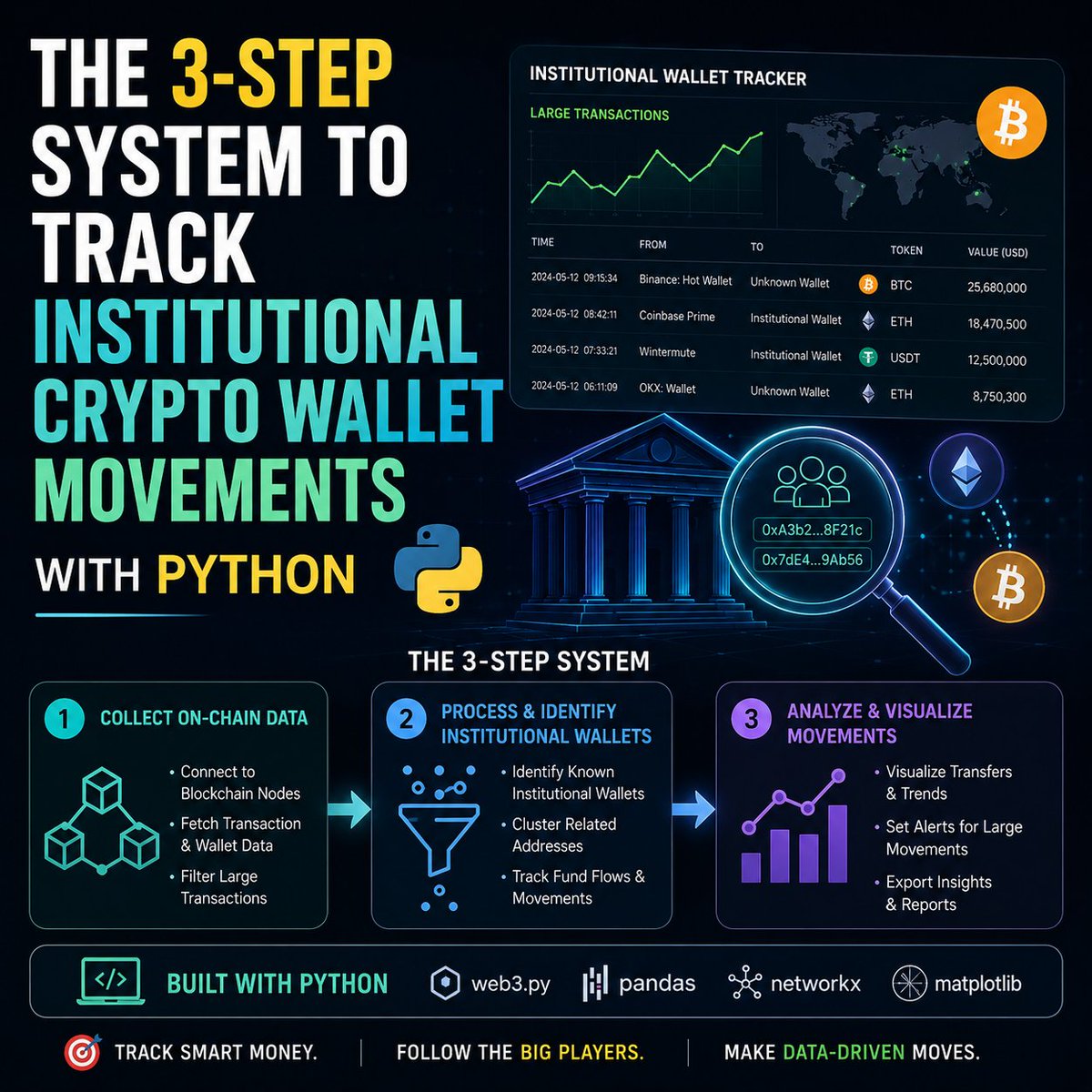
The 3-Step System to Track Institutional Crypto Wallet Movements with Python
Most retail crypto traders wait hours for market news or crypto influencers to tweet about a token pump, treating price discovery like a spectator sport where they always enter after the smart money has already cashed out.
They treat blockchain explorers like manual search engines, failing to realize that waiting for public hype means you are always the exit liquidity for institutional whales and venture funds quietly accumulating tokens.
Chasing token charts blindly while ignoring on-chain fund flows is an expensive way to gamble your capital against invisible market insiders.
If you want to spot major accumulation phases before the public price surge hits, you need to understand the 3-step system to track institutional crypto wallet movements with Python.
Implement a programmatic tracking pipeline that surfaces whale accumulation before the broader market reacts: Connect via Public RPC Nodes or WebSocket's: Use lightweight Python scripts and async libraries to hook directly into public blockchain RPC providers or WebSocket endpoints, bypassing heavy node infrastructure.
Query Token Transfer and Mempool Logs: Programmatically filter event logs and transaction streams to target specific smart contract transfers (like USDT/USDC movements or native assets) across known institutional or whale addresses.
Trigger Automated Telegram or Webhook Alerts: Set custom threshold triggers that instantly fire notifications to your private messaging channels the moment a tracked wallet executes a massive accumulation block.
When your wallet intelligence runs on direct blockchain queries, you eliminate lag and trade alongside the biggest players in the space.
Stop trading blind to smart money movements. Automate your whale tracking stack.
Do you currently track institutional wallet flows with custom scripts, or do you rely on delayed social media alerts to spot whale accumulation?
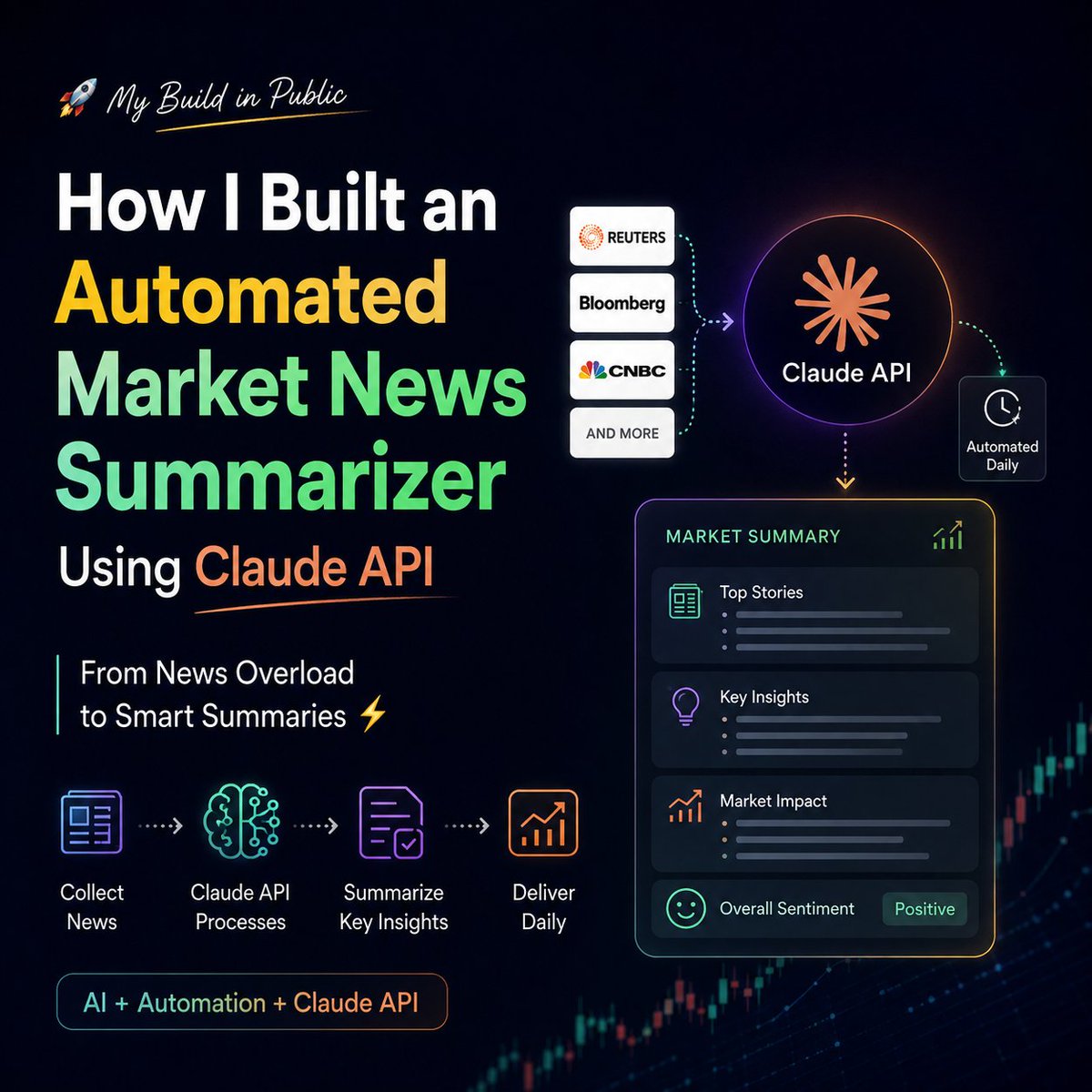
How I Built an Automated Market News Summarizer Using Claude API
Most traders and founders waste the first hour of every morning drowning in dozens of open tabs, scrolling through 50 different financial RSS feeds, newsletters, and market blogs, treating macro research like an exhausting manual scavenging hunt.
They treat daily information consumption like a casual scrolling habit, failing to realize that sifting through endless market noise without a filtering pipeline burns critical cognitive bandwidth before the trading day even starts.
Bleeding your morning energy on unstructured news reading guarantees you will miss key macroeconomic shifts while getting bogged down in trivial headline noise.
If you want to ingest global market intelligence effortlessly and start every day with absolute clarity, you need to learn how I built an automated market news summarizer using Claude API.
Build a lightweight, autonomous intelligence pipeline that condenses global market chaos into a razor-sharp morning briefing: Programmatic Feed Ingestion via Python: Schedule a morning cron job that fires a Python script to fetch raw text and headlines from your curated list of financial RSS feeds and news endpoints, deduplicating articles by URL hash.
Context-Optimized Claude API Execution: Pass the consolidated text payload to the Anthropic API using an efficient model like Claude Haiku or Sonnet, leveraging strict system prompts to filter out promotional fluff and focus entirely on fundamental market drivers.
Enforced 3-Bullet Macro Synthesis: Program your system prompt to distill the entire mass of data into precisely three high-signal bullet points—covering structural liquidity shifts, major geopolitical catalysts, and prevailing market sentiment—formatted for instant reading.
When your morning intelligence runs on an automated LLM summarization pipeline, you eliminate information overload and gain institutional-grade macro oversight the second you wake up. Stop wasting your mornings scrolling through endless financial feeds. Automate your macro briefing.
Do you currently read a curated morning market digest, or do you manually hunt for financial news across the web every day?