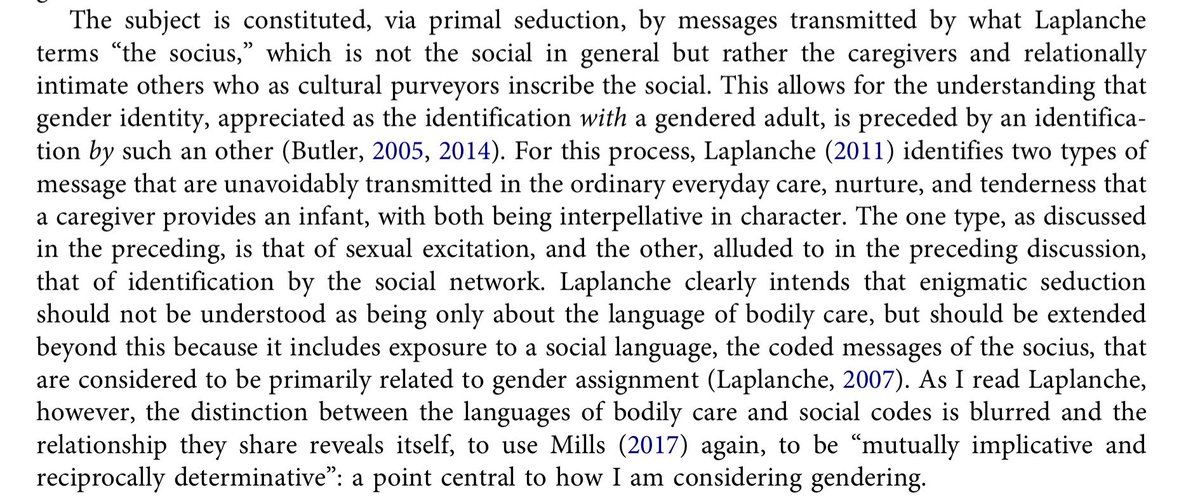
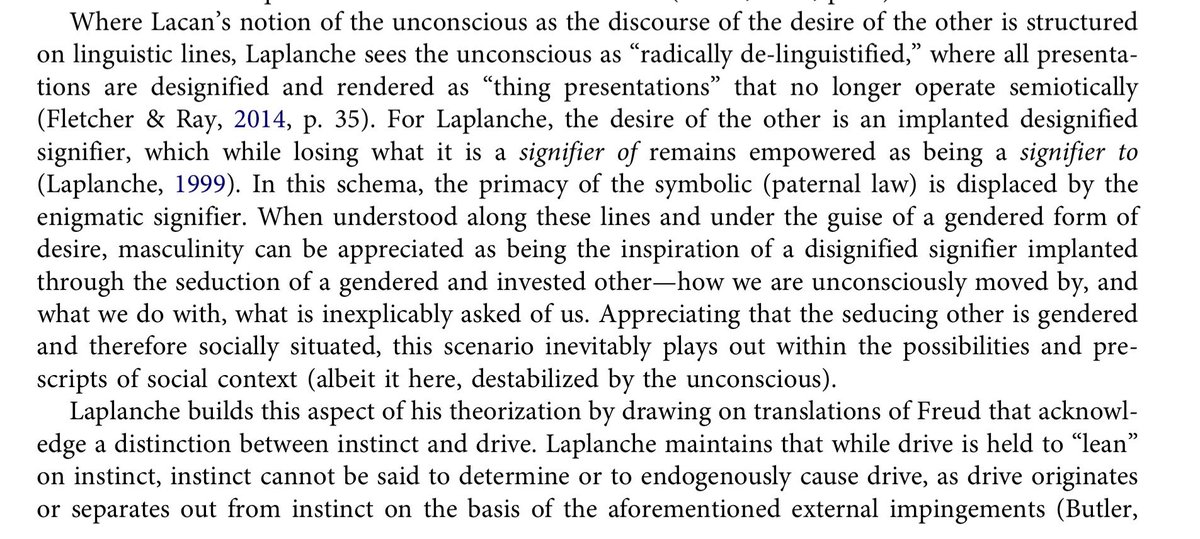
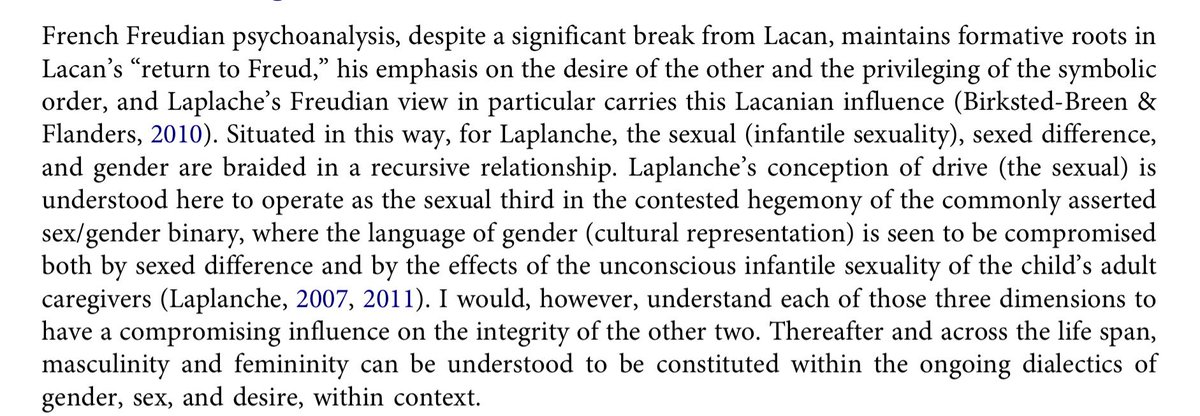
A very helpful summary of the relationship and difference between Lacan and Laplanche by Thomas Burkhalter which explains how to conceive of the unconscious as “a structured, like-a-language” rather than as “structured like a language.”
"If the psychoanalyst thinks he knows something, in psychology for example, then that is already the beginning of his loss, for the simple reason that in psychology nobody knows much, except that psychology is itself an error of perspective on the human being."
Jacques Lacan
(essayant d'expliquer geometry dash a gilles deleuze) il y a cette horde nomade indifférenciée ... des microscopicités... au sens de leibniz... engagés dans des devenirs-rythme.. elles se dirigent vers l'Oeuf, ou plutôt la structure-Oeuf selon un rythme.. nommons-le ritournelle..
After 1964 Lacan is querying more with these same analytic philosophers than any continental philosophers. Seminars 14-19 are largely based around Frege, Russell and set theory. Why? Precisely to show that “clarity” or meaning is an effect, not simply “there” to be uncovered
The analytic tradition in philosophy (arising from Frege, Russell, Carnap) and the psychodynamic tradition (exemplified best by McWilliams, Gabbard, @Mark_Solms , @JonathanShedler ) values clarity of language. In this mode of thinking everything is suspect if it can’t be
@P03823873 @BurnerC35073 Maybe not objectively, nor may even be fully “meaningful.” But hallucinations, and other symptoms that psychoanalysts deal with, are certainly not arbitrary and can shown in the course of treatment to be associatively linked to life experiences that have had some sort of impact
This book is fascinating. It’s about the history of how we went from having very few choices to everything being an object of choice. It talks, for instance, about the rise of shopping as an activity, but also dating. I’m writing about it for Jacobin, so I’ll have more to say …





![BillPourquoimec's tweet photo. Velvet Underground playing for the American Society of Clinical Psychiatrists [1966] https://t.co/MdOlSlOyp7](https://pbs.twimg.com/media/HKEkMKCWcAE9sAK.jpg)