💁LangFriend: a Journal with Long-Term Memory
One of the concepts we are most interested in at LangChain is memory 🧠
Whenever we are interested in a concept, we like to build an example app showing off that concept
✒️For memory, we decided to build a journaling app!
We're hosting a version of it that anyone can try out
⭐️We're also starting to work with a few alpha users on a developer facing API⭐️
Blog: https://t.co/iUFwdPa8tZ
YouTube: https://t.co/jlbEn8Mb63
Journal App: https://t.co/AaF5Upcalr
Developer API Access: https://t.co/1iYe2dL4Td
Ever feel like AI's trying too hard? Faced that head-on with our code reviews this week. It's a reminder that even AI needs to learn focus. But hey, no progress without challenges, right? #AIGrowingPains
Today we're excited to introduce Devin, the first AI software engineer.
Devin is the new state-of-the-art on the SWE-Bench coding benchmark, has successfully passed practical engineering interviews from leading AI companies, and has even completed real jobs on Upwork.
Devin is an autonomous agent that solves engineering tasks through the use of its own shell, code editor, and web browser.
When evaluated on the SWE-Bench benchmark, which asks an AI to resolve GitHub issues found in real-world open-source projects, Devin correctly resolves 13.86% of the issues unassisted, far exceeding the previous state-of-the-art model performance of 1.96% unassisted and 4.80% assisted.
Check out what Devin can do in the thread below.
✂️Semantic Chunking
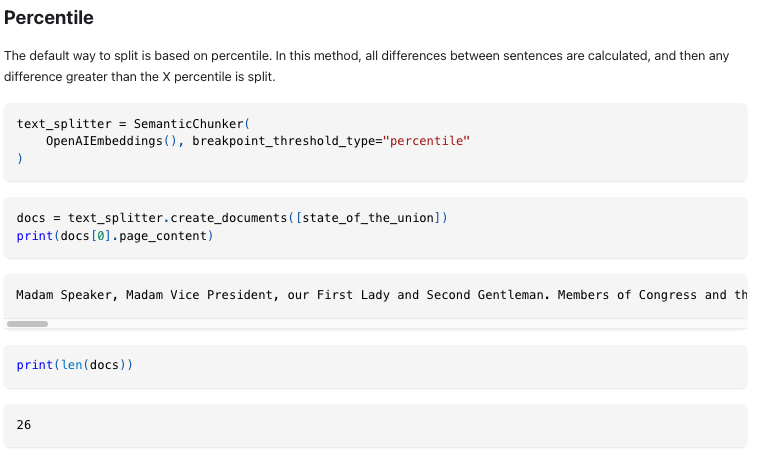
Semantic chunking using embedding distances between sentences to figure out how to split a document. A key decision is what threshold to split at.
We now support three methods:
📎Percentile
��Interquartile Range
👿Standard Deviation
Big shout out to @matthaigh27 for adding two new methods (interquartile, standard deviation), and big shout out to @GregKamradt for the original inspiration and the original method (percentile)
Notebook: https://t.co/k1uUUEdrc0
Adding a feedback mechanism marks a milestone in our journey towards more dynamic document management. Direct feedback via API not only streamlines processes but opens new horizons for real-time content improvement. #TechAdvancement
This week, we tackled an internal JIRA ticket, exclusively with AI, refining our project estimation with detailed planning and human insights. A step forward automating these. #AIProjectManagement
🛠️ Overcoming the HNSWLib limitation in AWS Lambda propelled us towards cloud-based vector search services like Pinecone. This pivot not only solves our challenge but sets a new benchmark for efficiency and scalability. #CloudSolutions
✂️Semantic Chunking
Semantic chunking using embedding distances between sentences to figure out how to split a document. A key decision is what threshold to split at.
We now support three methods:
📎Percentile
🟠Interquartile Range
👿Standard Deviation
Big shout out to @matthaigh27 for adding two new methods (interquartile, standard deviation), and big shout out to @GregKamradt for the original inspiration and the original method (percentile)
Notebook: https://t.co/k1uUUEdrc0
Diving into our custom 'Product Data Builder' felt like unlocking a treasure chest of efficiency. 🗝️ Generating knowledge bases has never been smoother. #TechTreasures
The Gemini 1.5 Pro model guide is live!
With support of up to 1 million tokens context length, you may be wondering what's possible with Gemini 1.5 Pro.
My overall impression after our first round of testing is that Gemini 1.5 Pro is among the most powerful long context LLMs available today.
I've published a summary of Gemini 1.5 Pro's capabilities along with concrete examples in the prompting guide. These are just preliminary tests. I will continue to analyze and document the model's capabilities and limitations. Stay tuned!
From preliminary experiments, Gemini 1.5 Pro shows impressive capabilities around multimodal reasoning, video understanding, long document question answering, code reasoning on entire codebases, and in-context learning.
One insight from testing this model is that we will have different kinds of LLMs that support different types of use cases. Gemini 1.5 Pro is not meant to be a model to reign among all. The long context LLMs are not meant to cover every use case imaginable, they are meant to unlock complex use cases that were unimaginable before with LLMs.
Link to guide below ↓
Creating product docs for complex projects with LLMs is tough, requiring selective input use. In our tests, using Retrieval-Augmented Generation (RAG) significantly helped us focus on relevant info🚀
AI changes the game in project planning by breaking down tasks into subtasks with precise estimations. This method identifies the most efficient path forward, optimizing timelines and resource use #PreciseProjectPlanning
Our AI system auto-generates documentation from unstructured project data, creating clear, concise markdown files for each product area. This not only saves time but ensures consistent, up-to-date project documentation. #AutomatedDocumentation
AI is reshaping how we clarify project requirements. By processing input descriptions, it generates precise questions to fill gaps in understanding, ensuring every team member is on the same page from the start. Clarity leads to efficiency. #AIForProjectClarity
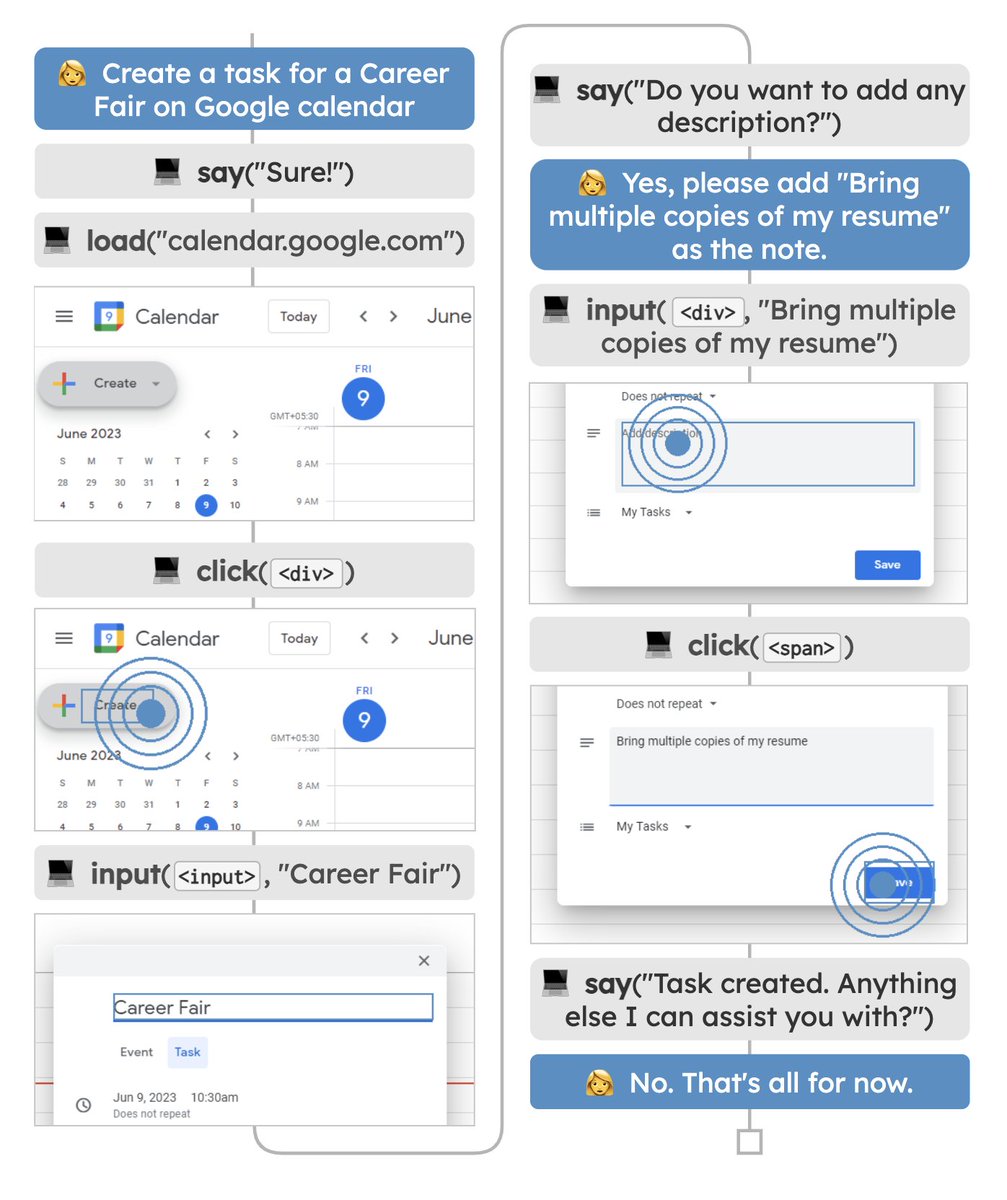
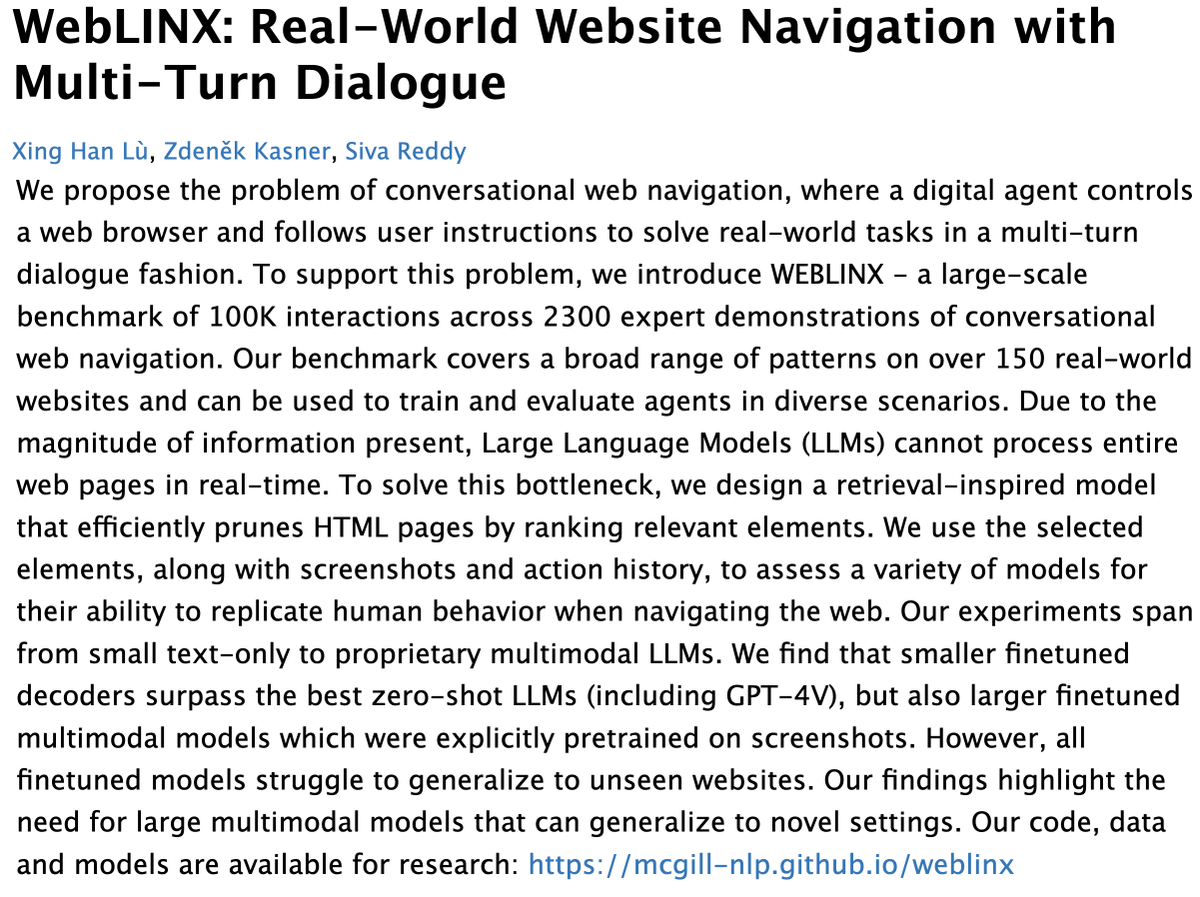
Introducing WebLINX 🐯, a large benchmark for AI agents navigating real websites with multi-turn dialogue. 100K interactions across 2300 demonstrations on 150 real-word websites. Includes HTML, screenshots and videos. Tests unseen sites, tasks, blind users
https://t.co/ULwqRz5y7l
Survey of LLMs
Reviews three popular families of LLMs (GPT, Llama, PaLM), their characteristics, contributions, and limitations.
Includes a summary of capabilities and techniques developed to build and augment LLM.
It also discusses popular datasets for LLM training, fine-tuning, and evaluation, and LLM evaluation metrics.
Concludes with open challenges and future research directions.
Introducing 𝗦𝘂𝗽𝗲𝗿 𝗝𝗦𝗢𝗡 𝗠𝗼𝗱𝗲, a framework for low latency structured output generation from LLMs.
Generate JSON up to 𝟮𝟬𝘅 𝗳𝗮𝘀𝘁𝗲𝗿 from OpenAI and open source models.
❌ No need to threaten the model, tip the AI, etc ❌
Built with @derhacobian 🔧
🧵👇
Big news.
The most powerful GPT competitor, Gemini Ultra, will be released on Wednesday. Google confirmed it.
Ultra beats GPT-4 in 7 out of 8 benchmarks:
HumanEval (Code)
Gemini Ultra: 74%
GPT-4: 67%
MMLU (General)
Gemini Ultra: 90%
GPT-4: 86.4%
GSM8K (Math)
Gemini Ultra: 94.4%
GPT-4: 92%
Big Bench (Reasoning)
Gemini Ultra: 83.6%
GPT-4: 83.1%
It's also the first model to outperform human experts on MMLU.