Learning from Jewish Diversity: Over the past few weeks, the fractures within Jewish, Israeli, Zionist, and pro‑Israel circles have been impossible to miss. Religious, political, ideological, organizational, and strategic divides have erupted into open accusations: some are “too extreme,” others “too soft on Israel’s critics,” “reckless,” “undiplomatic,” “not pro‑Israel enough,” “sabotaging the cause,” or even “endangering Jewish safety.” Whatever one thinks of these claims, the reality is clear: Jewish communities and Israeli society contain a wide spectrum of socio‑religious and political diversity.
Across that spectrum, there is space, sometimes narrow, sometimes wide, for people to express their unique identities, their Judaism, and their individual politics. The communal infrastructure is vast and enviable: JCCs, Federations, JCRCs, Hillel, Atid, AIPAC, Israel Policy Forum, J‑Street, JVP, the World Zionist Organization, ZOA, ICC, AJC, ADL, Birthright, and dozens more. Add to that the Reform, Conservative, and Orthodox movements, plus the full range of political organizations in both the U.S. and Israel. This is not a monolith; it is a sprawling ecosystem.
That is precisely why simplistic labels like “Zionist” obscure far more than they reveal. And it is why I often find myself wishing that Palestinian, Arab, and Muslim Americans had anything comparable. Instead, there are fewer than a handful of national organizations, political and student alike, that enforce near‑total conformity on the Israel and Palestine discourse, despite the fact that Palestinian, Arab, and Muslim Americans hold a wide range of views on Hamas, Gaza, Israel, peace, pragmatism, the U.S., and belonging.
One of my deepest frustrations with certain Jewish groups of a particular political orientation is the role they expect me to play as someone from Gaza. Consciously or not, some want me to perform the part of the Palestinian victim who reinforces their own narratives. They recoil when I speak about Palestinian failures, Hamas’s catastrophic impact on Gaza, or my efforts to build bridges with center‑right Jewish and Israeli audiences. To them, these points “distract” from the larger story of Israeli wrongdoing. And if my words are cited by conservative pro‑Israel voices, that becomes the ultimate offense: “tokenization,” even though anti‑Israel activists routinely cite these same groups when convenient.
The result has been predictable: invitations withdrawn, doors quietly closed, and participation discouraged. I failed to play the role they had scripted for me; a victim to be wielded in their internal communal battles. And for that, I was sidelined.
Q Manivannan was elected to the Scottish Parliament last week as a Green MSP.
They’ve backed a manifesto demanding Scottish taxpayers fund reparations to Palestinians for Scotland’s “colonisation and occupation” of Palestine.
Scotland never colonized or occupied Palestine.
Manivannan lives in Scotland on a student visa.
@RabbiMivasair With all due respect rabbi. They didn’t attack until after a partition plan was enacted and the state Israel claimed independence. The certainly could have attacked prior to then. Why didn’t they? The fact of the matter is they are quoted as no Jews or no Jewish land
Hamas Declares War: In a bizarre twist of events, Hamas has officially declared war on me today, calling me a “suspicious figure,” after its leader, Basem Naim, came out against me because a Board of Peace official had retweeted a post of mine, triggering a cascade of events by the terror group and its online armies. Naim said that I am a “suspicious person” who has maligned Hamas and that my condemnation of the terror group is “fascist, racist, and extremist” because, according to Naim, my depictions of Hamas are “inaccurate.”
He attacked the Board of Peace official for retweeting me, questioning how a “suspicious” person like me could be taken seriously. Hamas’s media office then issued statements on my page, while their outlets published articles inciting against me and accusing me of “marketing Zionist projects to eliminate the resistance and deport Gaza’s population,” all of which began trending on Gazan social media.
Hamas didn’t just go after me; they also viciously attacked the UAE and its leadership, claiming I am “wholly financed by the Emirates” and an “agent of media empires they control.” They even targeted the Realign For Palestine initiative, falsely alleging that the UAE Foreign Ministry funds me (they don’t). Hilariously, they added that I write for “Zionist platforms like Haaretz to malign the resistance” and call for peace and reconciliation – interestingly, I’ve only ever written for Haaretz twice in 2017 and 2024.
Unfortunately, attacks by Hamas’s leaders and government against me triggered an avalanche of online hate by the group’s members and terrorists, including those who were calling for there to be “operations like the 1972 Munich attack to deal with agents and those who seek to weaken the resistance in Western countries,” in reference to me.
All of this started because of a post that called out Hamas for not allowing the construction of new accommodations for displaced Gazans near the Rafah area beyond the “Yellow Line,” and because I said that, like many other conflicts, civilians must not be left along with combatants if there is ever to be hope for the removal of terrorists and the reconstruction of Gaza for its people.
Hamas knows exactly why my words hit a nerve. They know that moving civilians out of the red zone they control and creating a new reality beyond the “Yellow Line” with better housing, health, education, and security under an International Stabilization Force and a new Gaza police force is the only strategy that will weaken them. They fear any plan that removes their leverage, their ability to weaponize Gazans suffering, and their access to aid and resources.
So if Hamas and Basem Naim want a war, they have one. And I’m only getting started. Now that we know what triggers them, this is precisely the strategy the Arab world, the international community, the United States, the European Union, the Board of Peace, Israel, and the United Nations must pursue, maximally and without hesitation.
@SallyMayweather One was provoked the other was not. I’ll let you use what little brain you have. One has combatants in civilian locations to maximize death and destruction. The other was an isolated incident. Again remove brain from ass
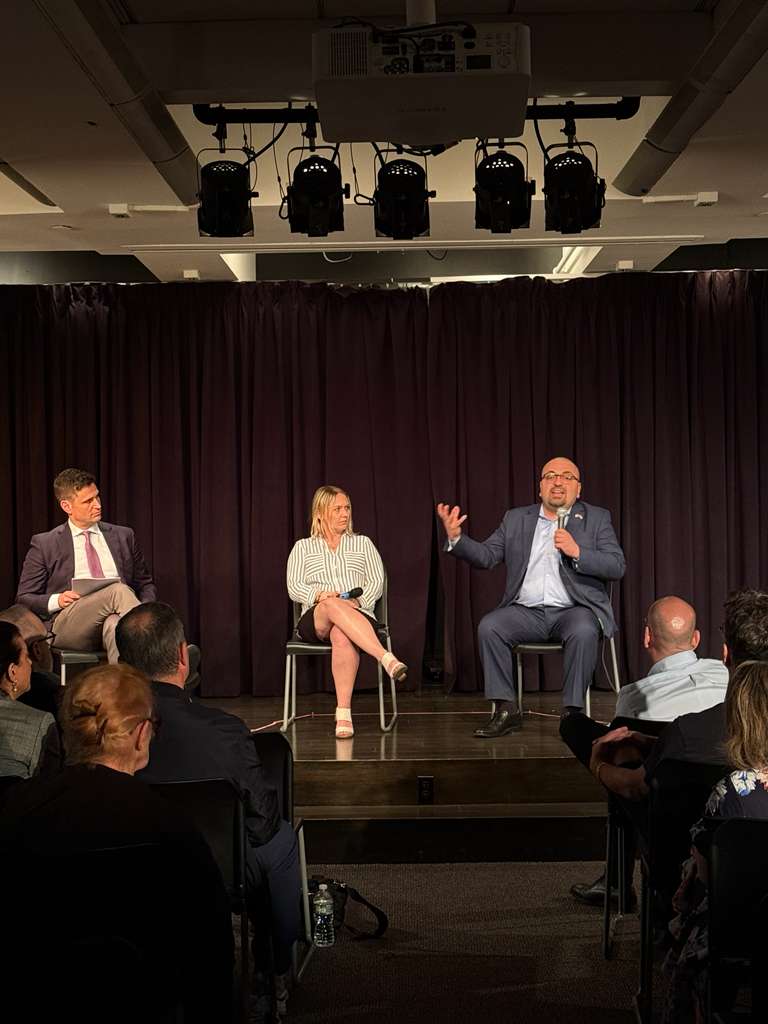
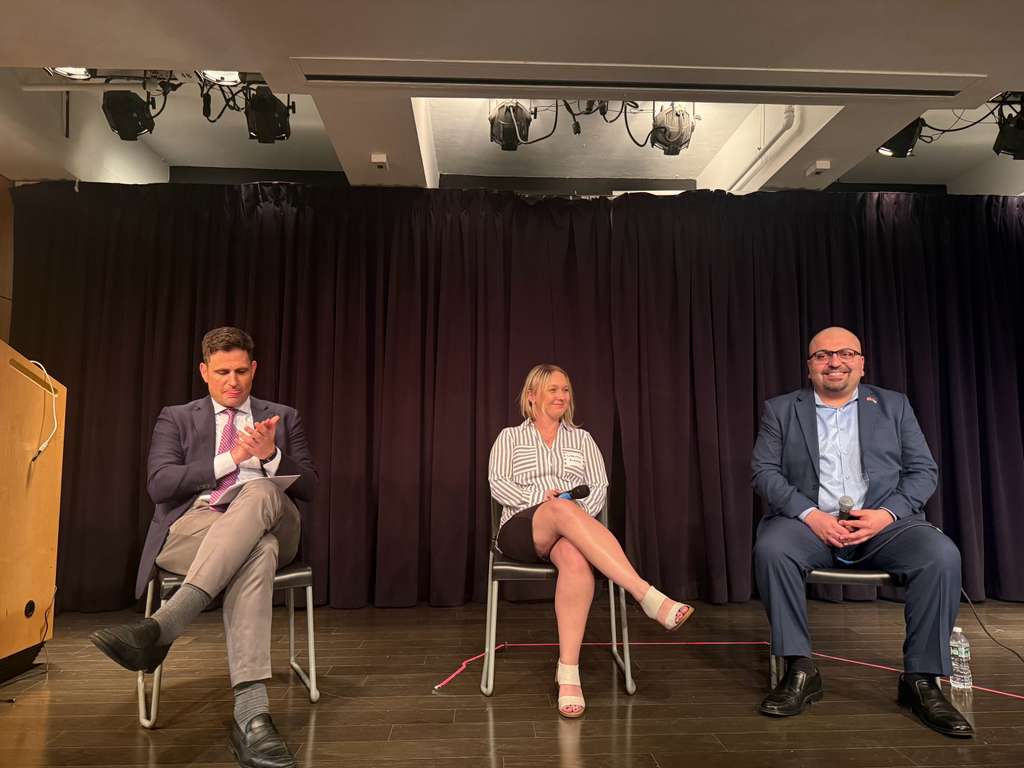
Courageous Palestinian and Israeli Conversations: Last week, I spoke at the Birch Wathen Lenox School through the ConnectED program, which helps independent schools approach complex issues like the Israel‑Palestine conflict with nuance and empathy. I often speak alongside an Israeli partner to model healthy dialogue, active listening, and the ability to sit with uncomfortable truths. This time, I joined Charlotte Korchak, whose Israeli-American background and deep knowledge of the conflict complemented my focus on radical pragmatism, self-reflection within our communities, and a future-oriented approach.
Since October 7, students, faculty, and parents have struggled with this topic. Instead of avoiding it, the school chose to foster courageous conversations, essential preparation for high school students who will soon enter charged university environments. Our goal was not to debate or “win,” but to present perspectives from within our communities and show how to engage difficult history without feeling personally diminished.
I shared a common Palestinian view: that the creation of a Jewish homeland unfolded at the expense of a population already living there, who had no say in the collapse of the Ottoman Empire, the British Mandate, or the Balfour Declaration. Many Palestinians feel they ultimately bore the cost of European antisemitism and the Holocaust, which accelerated Jewish immigration and contributed to the tensions that erupted in 1948.
Charlotte explained the Jewish people’s ancient connection to the land, predating modern Zionism, and emphasized that early Zionist visions did not call for the expulsion of local inhabitants. She described how repeated denials of Jewish heritage and sovereignty contributed to a need to assert Jewish presence, even as legal land purchases and various proposals for coexistence were historically and contemporarily made.
We then responded to each other – me highlighting my family’s violent displacement in 1948, and Charlotte noting multiple Israeli attempts at peace that could have led to Palestinian statehood but were instead met with rejection and violence. I affirmed the Jewish right to self‑determination while explaining why many Palestinians feel theirs has been sidelined. Charlotte emphasized that a two‑state future is still achievable if both peoples accept each other’s permanence. Across several topics, we demonstrated how difficult conversations can be productive when grounded in history, empathy, and a willingness to listen.
We urged students to focus on making a difference rather than making a point, and to reject sloganeering, hostility, and performative activism in favor of pragmatic, informed engagement. Always say yes to more dialogue that is constructive, courageous, and rooted in understanding, and ignore those who try to punish or delegitimize such conversations.