Also wild to me that investors want to own the companies building the space economy for the next 20 years but sell $RKLB because Neutron slipped a few months or $ASTS because scaling a satellite constellation takes time despite the tech already being proven and distribution partnerships in place.
Love the patience.
Here’s what it’s like to sit in the new Tesla Roadster, and what the on-screen controls look like.
The on-screen controls are like nothing else Tesla has designed. Very unique to this vehicle.
Barclays’ Dan Levy says $TSLA and $SPCX could announce a merger before the December 6 annual meeting deadline.
The logic is that Musk’s ambitions across AI, robotics, chips and satellite connectivity are increasingly converging making a merger make a ton of sense.
I’m 60 years old and retired from JPMorgan. My monthly income is $105,000.
Unwritten rule for the stock market:
1. If the price drops 10%, just hold.
2. If the price drops 20%, add 10%.
3. If the price drops 30%, add 20%.
4. If the price drops 40%, add 30%.
5. If the price drops 50%, add 50%.
6. If the price rises 10%, just hold.
7. If the price rises 20%, still hold.
8. If the price rises 30%, sell 10%.
9. If the price rises 40%, sell 20%.
10. If the price rises 50%, sell 30%.
11. If the price rises 60%, sell 40%.
12. If the price rises 100%, sell everything.
Don't forget to save it to look back on later…
If you are not following us with notifications turned on, you might miss our next alerts.
$NOK just introduced the first 16-port fiber card supporting speeds ~50G on every port powered by its own Quillion chip with ~4x lower upstream latency.
Operators can now upgrade speeds without replacing hardware keeping them on Nokia’s platform longer while its in-house silicon supports margins and broader AI optical networking push.
$OSS is one of the smallest companies in my 'Physical AI' basket and I’ve been adding because it builds rugged AI computing systems for defense platforms where traditional data center hardware cannot operate.
As drones, military vehicles and autonomous systems process more sensor data locally that's where OSS comes in by providing the high-performance compute needed for real time AI without relying on cloud.
What I also like is once OSS hardware gets designed into a military platform then replacing it becomes much harder creating a potentially sticky revenue opportunity as defense spending shifts toward autonomy across air, land and sea.
$SPCX $ASTS
Starlink is not a competitor to AST SpaceMobile.
Why do I think that? A few years ago, it was. Starlink partnered with MNOs, including T-Mobile. But the landscape has changed.
It has now become clear that Starlink wants to become an MNO itself.
AST does not compete with MNOs. It provides direct-to-device coverage through them. MNOs therefore won’t partner with Starlink anymore, because Starlink is becoming a direct competitor and a threat to their business.
AST’s business model was never to sell satellite internet directly to consumers. It was always to provide it through MNOs.
So what is the threat to $ASTS now?
> First, customers switching to Starlink and leaving their current MNO.
> Second, Starlink launching its own phone.
But as I’ve always said, this is not a winner-takes-all market. This is a huge market, with one of the biggest TAMs in the world and room for more than one player to succeed.
And as Scott Wisniewski said, commercial revenue will account for 50% of total revenue. Keep that in mind. Yet people are acting as if ASTS’s business model died overnight.
Overnight, AST SpaceMobile became far more valuable.
-RM
$NOK says “If we could build 2x faster, our customers could build 2x faster, they probably would” showing AI infrastructure is still supply constrained.
As power spreads compute across more campuses then demand for Nokia’s Infinera optics rises with it.
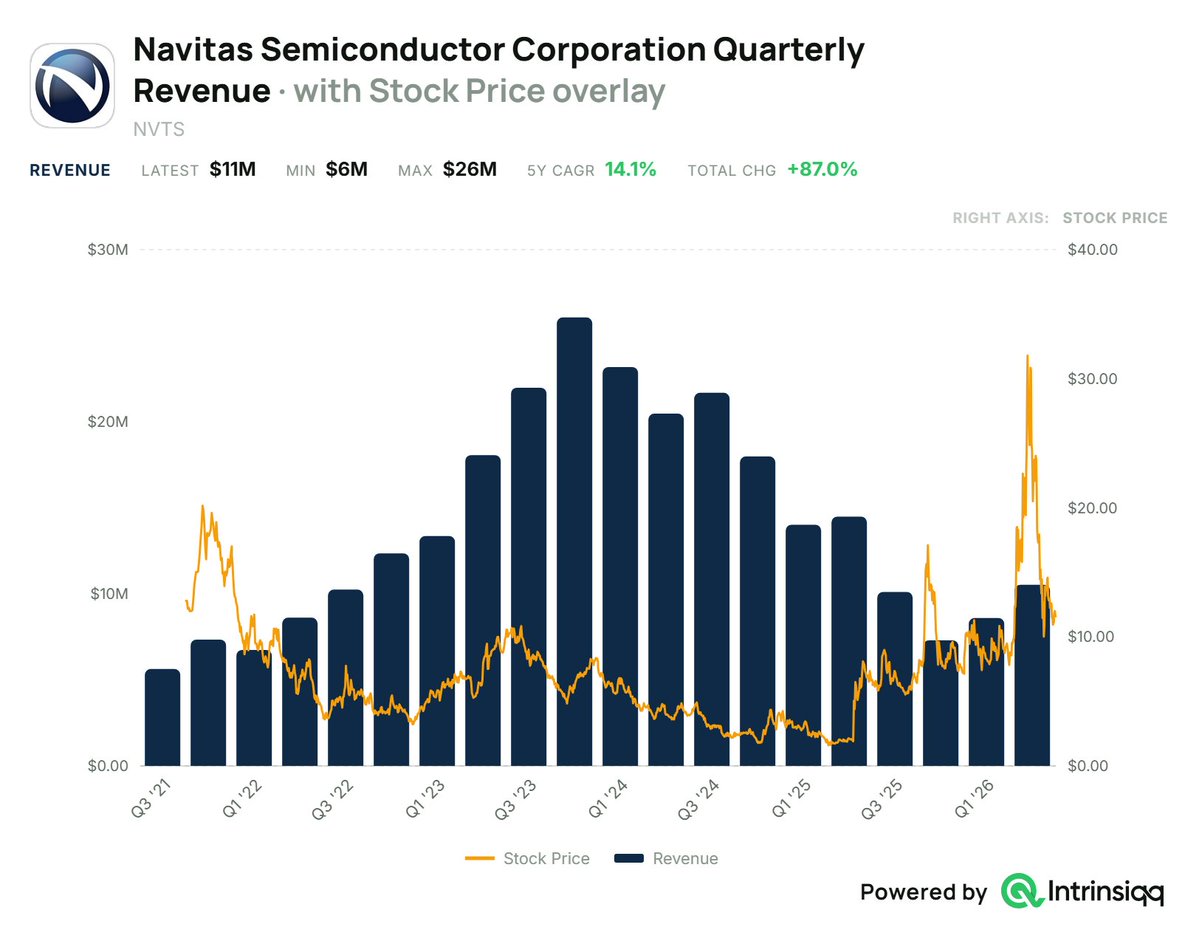
$NVTS just closed Claros adding integrated voltage regulators next to AI processor and more than doubling its 2030 AI power opportunity to $8B.
Navitas now spans nearly the full power path from 10 kV SiC near the grid to 800V rack conversion, GaN inside the rack and power at the chip itself which CEO Chris Allexandre calls a “defining step.”
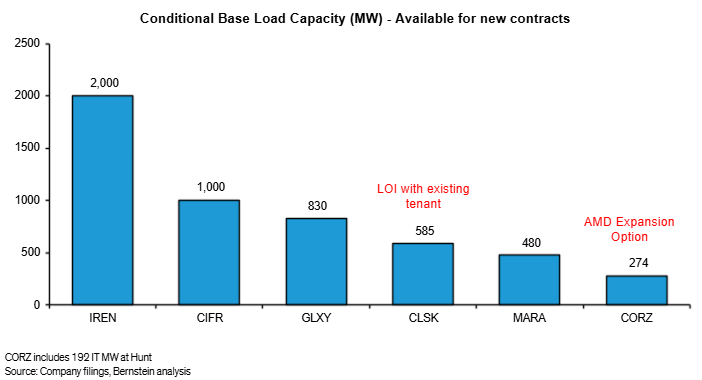
$IREN has by far the most uncontracted power in the group with 2,000 MW (~40% of the ~5.2 GW total) and about double $CIFR at 1,000 MW with $GLXY at 830 MW, $CLSK 585 MW, $MARA 480 MW and $CORZ 274 MW.
Approved power is becoming one of the scarcest assets in AI and same megawatt can generate ~5x more revenue as GPU cloud than traditional colocation.
That gives IREN a lot more upside if it can keep turning those 2 GW into higher value AI contracts.
Every $MU shareholder should have Dec. 9 circled as CHIPS Act related buyback restrictions expire just as quarterly FCF sits near ~$33B today and is estimated to surpass $40B by late 2027.
Micron has already said capital returns should increase with a long term goal of returning 100% of excess cash so even a fraction of that cash flow going toward buybacks could become a huge catalyst.
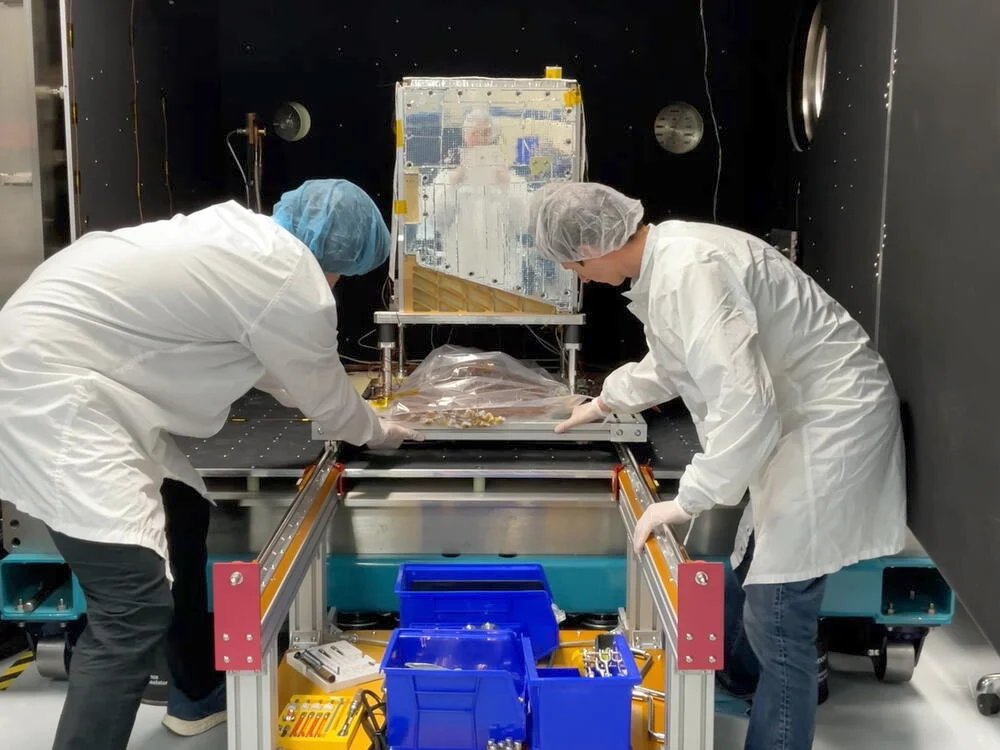
$GOOGL JUST PUT ITS AI CHIPS INTO ORBIT FOR THE FIRST TIME
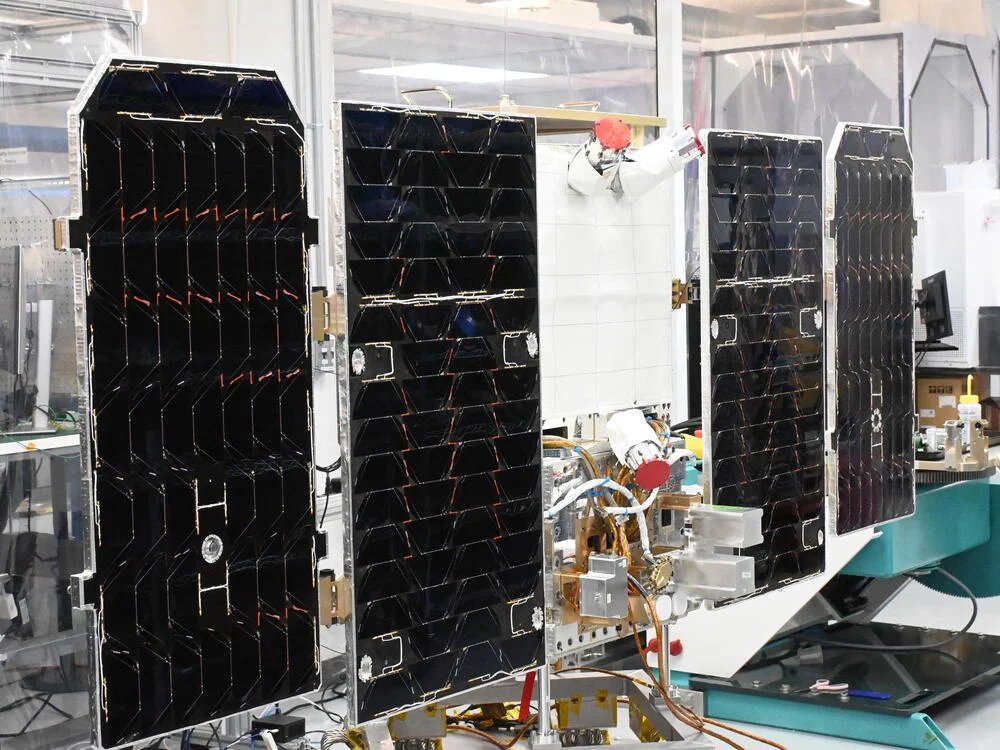
Google and Planet Labs $PL have successfully launched Project Suncatcher M1 aboard SpaceX’s Transporter-18 mission.
Planet says it has already made contact with the spacecraft and begun commissioning. This is the first-ever in-orbit test of Google’s Tensor Processing Units, or TPUs.
The refrigerator-sized prototype carries four Trillium TPUs, Google’s custom AI accelerators.
This is not yet an orbital data center. The goal is to see whether the same type of AI hardware Google uses on Earth can survive launch and reliably run machine-learning workloads in low Earth orbit.
There are three major engineering problems Google is testing:
RADIATION: cosmic radiation can corrupt calculations or damage electronics. Google previously tested Trillium TPUs with proton radiation and found they could withstand more total radiation than expected over a five-year mission.
COOLING: there is no air in space, so fans cannot cool the chips. Heat has to be moved through heat pipes into radiators and then emitted away from the spacecraft. The current prototype is expected to run AI workloads in roughly 15-minute bursts before allowing the system to cool.
NETWORKING: Google’s long-term plan is not one satellite, but clusters of satellites carrying dozens of TPUs each and connected through high-speed laser links.
Google estimates future AI workloads could require tens of terabits per second between satellites. Its ground prototype has already demonstrated 800 Gbps in each direction.
Why put AI compute in space at all?
In the right low-Earth orbit, solar panels can generate up to 8x more power than on Earth because satellites can receive near-continuous sunlight, reducing one of the biggest constraints facing AI data centers: electricity.
The economics:
Google estimates that if launch costs eventually fall below roughly $200 per kilogram by the mid-2030s, the cost of operating compute in space could begin approaching the energy cost of comparable terrestrial data centers.
I JUST INITIATED A BRAND NEW POSITION TODAY
$CBRS is the name I bought today because the more I look at where AI infrastructure is heading the more I think inference creates a huge opportunity for companies built around speed and efficiency as hundreds of millions of users and eventually millions of agents start hitting these models constantly.
What pulled me into Cerebras is how differently it attacks that opportunity since it has already secured wafer supply from $TSM and keeps model weights in 44 GB of on chip SRAM instead of leaning heavily on HBM which is huge when $MU says memory gets “much tighter” in 2027 and 2028.
Agents like $META Muse, OpenAI Dot and Grok Bot only make that advantage more important because one task can trigger dozens of model calls in a row so small latency gains compound quickly as workloads get longer and more autonomous.
12 STOCKS I WOULD NEVER SELL IN THE NEXT DECADE 🚀
Here are the 12 names 👇
1/12 Navitas $NVTS
Gallium nitride and silicon carbide power chips. The efficient switching tech everyone's building on.
$ORCL signed a $7B AI compute deal with Tencent covering ~10OK advanced chips across its Southeast Asia data centers.
Also really interest seeing Tencent paying ~30% upfront as it locks in compute early for model training and agents across WeChat and its enterprise products.