Here’s another reason why South Africa is going nowhere:
Sentech is threatening to cut off the SABC over a billion rand debt, potentially cutting off public broadcasting services to millions of South Africans.
This situation is another textbook example of the state’s stubborn adherence to an absurd economic ideology. It’s almost comical if it weren’t so destructive.
The ridiculousness of this situation lies in how the state has created various “state-owned entities” (SOEs) and arms-length corporations, such as SABC, SENTECH, and Eskom, and then forces them to operate as if they are independent, profit-seeking corporations in a market. This is a fundamental fiction.
The SABC is not a private media company. It is a public broadcaster with a constitutional mandate to inform the nation.
Similarly, SENTECH is not a private signal distributor. It is a state-owned signal distributor.
The fact that one SOE is threatening to cut off the signal to another SOE over a debt is a theatrical performance of a market transaction that is, in reality, an internal accounting problem.
The entire drama is a consequence of the state’s refusal to acknowledge that it is one entity ultimately responsible for funding its own public entities, using money it creates.
Basically, the public broadcaster, which is the main vehicle for information for millions, is held hostage to accounting fictions.
This is even worse than the Gauteng government and SANRAL charade I wrote about here https://t.co/UmYQDQK7TA
Like I said then, the real issue isn’t money, it’s ideology. Just like with Gauteng paying SANRAL’s e-toll debt, the “discipline” here is performative. It’s about enforcing cost recovery and “market realism” inside the state itself, even when it undermines essential services.
The most ludicrous part of this is that the “debt” is denominated in rands, while the sole shareholder of both the SABC and SENTECH is the South African public, represented by the government, and the creator of the rand is the South African Reserve Bank, which is also a public institution.
For SENTECH to cut the SABC’s signal over this “debt” would be like your right hand refusing to write because your left hand hasn’t paid for the paper. It’s a farce that only makes sense within the arbitrary rules the brain (National Treasury) has imposed on the body.
While the state engages in this internal accounting drama, the consequences are devastatingly real for the public, as millions of South Africans, especially the poor and elderly who rely on the SABC for news, weather, and emergency alerts, would be plunged into an information blackout.
But even more appallingly, the state would be actively facilitating the collapse of an institution meant to be a pillar of democracy, all to uphold the fiction of corporate separateness.
And here’s the thing: the rules that force SABC and SENTECH to roleplay as businesses are the same rules that force the state to borrow its own currency from bond markets instead of issuing it directly.
The result is that instead of simply funding public broadcasting as a public good, the government perpetually sets up its own institutions to fail, then borrows, with interest, from private investors to “rescue” them. The beneficiaries are bondholders, who earn risk-free profits from the state’s refusal to use its monetary sovereignty.
The entire focus of this circus is on the illusion of fiscal discipline (“SENTECH must balance its books!”) rather than the reality of public service. It is a pretence of discipline in the service of profit extraction and control, not development.
Just like the Gauteng–SANRAL charade, the SABC–SENTECH crisis reveals the real logic of South Africa’s economic policy: to preserve the flow of interest payments to financial institutions at all costs, even if it means undermining democracy itself.
The ideology of “discipline” is not about efficiency; it’s all about ensuring that banks and asset managers always get paid first, while the public is told there is “no money.”
This is not a market governance failure but a funding failure. The state has failed to adequately fund its own public institutions to fulfil their mandates.
What should happen is that Parliament, through the National Treasury, must provide the SABC with a direct appropriation (a grant) to settle its operational debts, including what it “owes” SENTECH. This is the same as funding the police or the health department.
By doing this, money will have been moved from one state account to another via the banking system. The state’s net financial asset position would be unchanged, and the crisis would be averted without enriching a single private bondholder.
Instead, what will likely happen is a last-minute “bailout” framed as a necessary evil, accompanied by stern warnings about the SABC’s “financial sustainability,” further entrenching the narrative of scarcity and the need for austerity, exactly the ideology that caused the problem in the first place.
This saga is just the state, in a room, arguing with itself over pieces of paper it can create at will, while threatening to shoot its own foot to prove a point. It is, as I said, weapons-grade stupidity.
In the end, this is not technical mismanagement. It’s a political choice to prioritise bondholders over citizens, accounting fictions over democratic obligations, and austerity over development.
Until South Africa breaks away from this ideology, it will remain trapped in a cycle of self-sabotage and funding scarcity in a land of monetary sovereignty.
“You can’t bomb the truth away”
My full speech at Wembley Arena tonight, in London, to 12,000 people at the Together for Palestine concert, paying tribute to murdered Palestinian journalists and their bravery, and calling out the silence and complicity of Western media.
The interviewer was clumsy and amateurish, and patently professionally inadequate. But far more important was the cogency of Dr Ramphele’s argument; it was truly good to hear her moral clarity and powerful voice again @MamphelaR
I can appreciate the DA's clean governance and commitment to the constitution & SA while still critiquing their dismal internal transformation and diversity, and other issues.
I can appreciate the ANC'S enormous maturity and leadership in this moment, and that they offer the best president by a country mile, while holding them to account for corruption and poor service delivery.
I can commend the EFF's commitment to become more politically mature, and other things they get right, while not excusing what they've gotten wrong: violence, corruption, etc.
The ability to hold competing and difficult truths together is the hallmark of maturity.
But Twitter rewards us to devolve into simplistic black and white, hero and villain thinking, and to attack anyone who tries to see the nuance.
It's a pitiful state of affairs. And one I refuse to buy into.
Tintswalo is unemployed
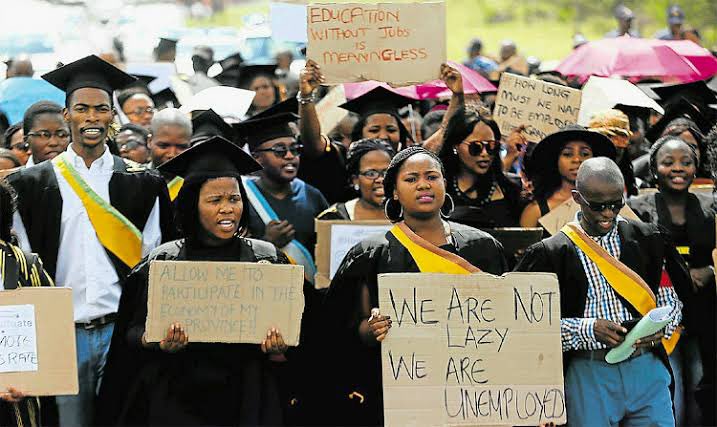
Tintswalo owes university fees and can’t graduate.
Tintswalo studies in the dark because of load-shedding.
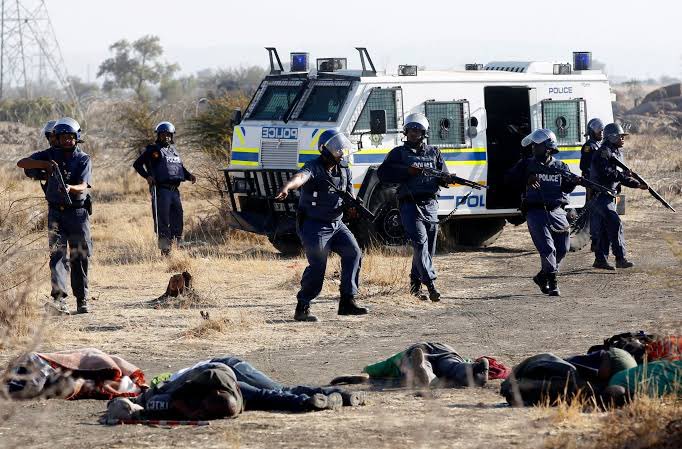
Cyril killed Tintswalo’s father in Marikana.
Tintswalo is depressed.
Tintswalo smokes drugs.
Tintswalo drowned in a school pit toilet.
#SONA24