The next edge in public affairs and political campaigns is not more outbound.
It is acting the moment people engage.
Most firms can generate response.
Very few can operationalize it in real time.
That's what @RedVoiceAI is built for.
Follow and share for more.
CENTCOM Commander Gen Brad Cooper:
“Today, I was proud to recognize American Soldiers and Sailors assigned to a Joint Counter-Unmanned Aerial System (C-UAS) unit in Bahrain for their exceptional performance in shooting down 14 Iranian one-way attack drones over the past several weeks. The incredible professionalism, skill, and dedication they displayed saved lives.”
Any money generated from this deal, the Intel stake, and any other holdings the U.S. government has in a private company should be put into a trust or fund that politicians cannot spend. Any money that comes into the trust should be evenly divided and mailed to every U.S. taxpayer.
Under President Trump’s leadership the United States is the undisputed winner in the AI race.
My gratitude to companies across industries who continue to work closely with the White House to implement the President’s EO: “Promoting Advanced AI Innovation and Security.” This includes excellent work around advanced model access and guardrail testing and security. The government and private sector have worked together in a way we have never seen before and this foundation of America First is unprecedented.
Our shared priority remains: get the best tech deployed as quickly and safely as possible.
As someone who worked on risk-based screening at the White House, I think America already has the model for frontier AI access.
@WhiteHouse@DavidSacks@mkratsios47 — verify people, enforce rules, punish abuse.
But let trusted Americans build.
We recently obtained the highest-resolution 3D images of the human brain ever taken from outside the skull. This is the first look.
Introducing Aleph, a research lab building brain interfaces for the telepathic future. (1/n)
AI can help us *do* useful things in medicine – great!
Below - one such thing, from our @nature paper:
- AI can flag people at high risk of dropping dead
- and help us decide who gets implanted defibrillators
But what can we *learn* from AI?
https://t.co/InNKVcSEtc
If the government is going to slow broad release of frontier AI models like Mythos and Sol, what is the transparent path for responsible Americans to get access?
One of the things I worked on at the @WhiteHouse was Secure Flight — part of the risk-based screening architecture that later helped make TSA PreCheck possible.
The principle was simple: don’t treat every person as the same risk.
Verify identity. Run appropriate checks. Monitor for disqualifying conduct. Create a faster, more efficient path for trusted people without weakening security.
We need the same concept for frontier AI.
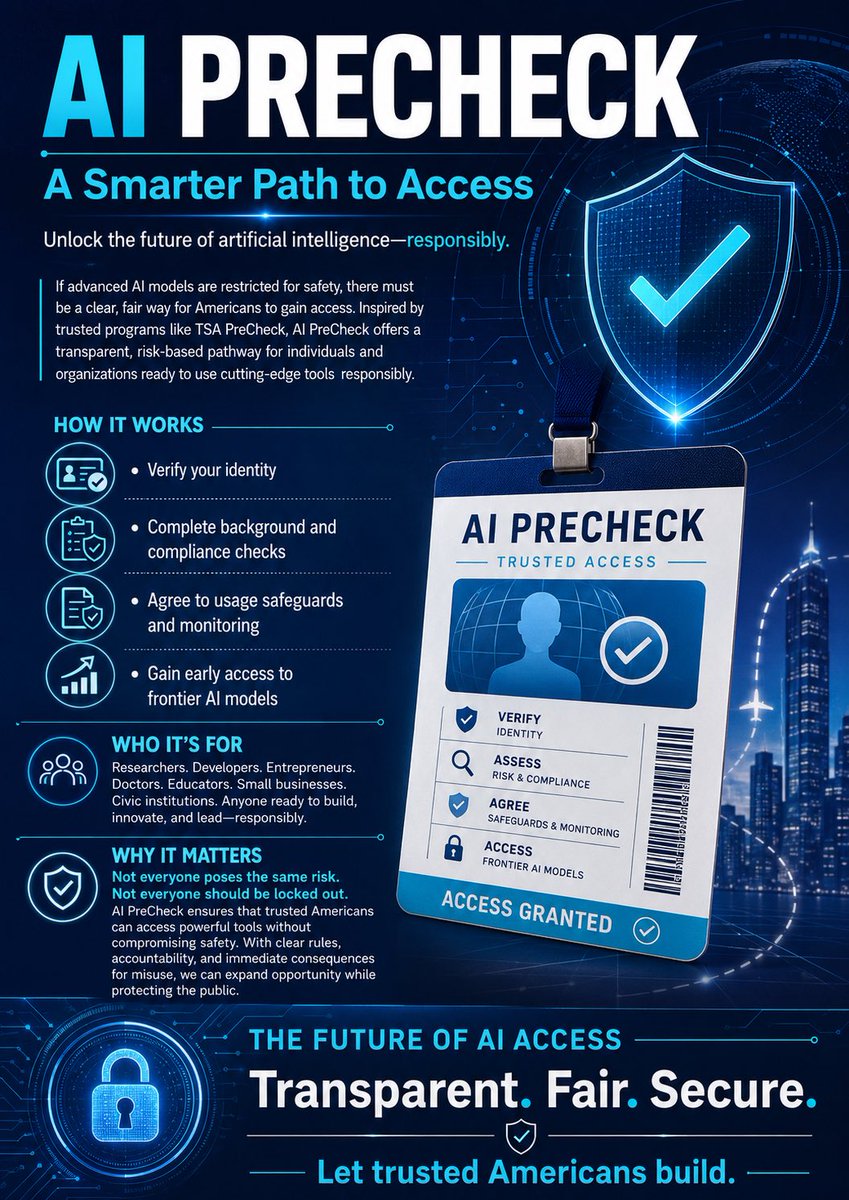
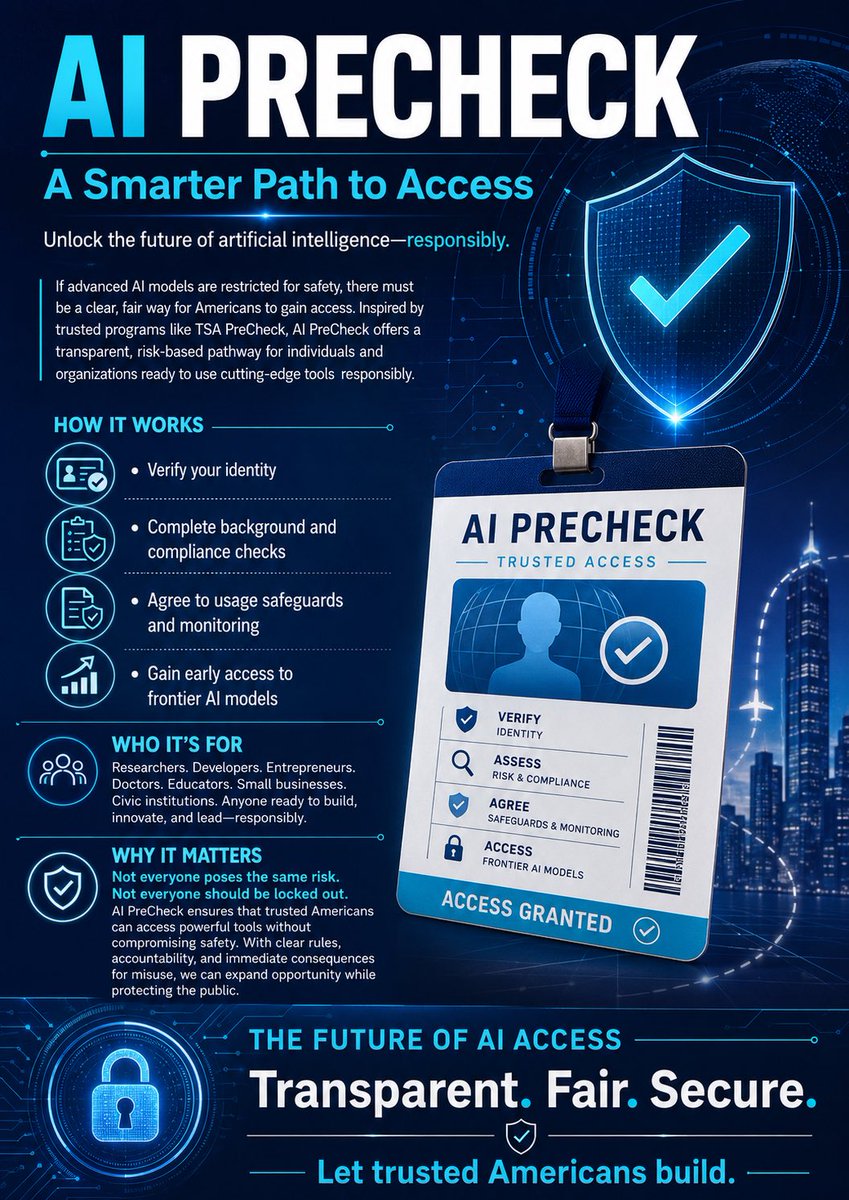
Call it AI PreCheck.
If an American already qualifies for a federal trusted-traveler program — or can satisfy an equivalent identity, background, and compliance process — that person should be eligible for early access to advanced AI models, subject to model-specific safeguards, logging, rate limits, use-case rules, and immediate revocation for abuse.
This would not mean unrestricted access for everyone.
It would mean a transparent, rules-based pathway for vetted citizens, researchers, developers, entrepreneurs, doctors, educators, small businesses, and civic institutions to use the best tools America builds.
The wrong answer is indefinite access for only a handful of insiders, giant companies, and politically connected institutions.
The right answer is risk-based access.
Verify people. Enforce rules. Punish abuse. But let trusted Americans build.
If America wants to lead in AI, these capabilities cannot sit behind closed doors forever. The government and model labs should create a clear early-access framework now — before every major model launch becomes another ad hoc negotiation.
@OpenAI@xai@grok@elonmusk@sama@AnthropicAI
Big companies cannot be the only ones
One of the things I worked on at the White House was Secure Flight — part of the risk-based screening architecture that later helped make TSA PreCheck possible.
The principle was simple: don’t treat every person as the same risk.
Verify identity. Run appropriate checks. Monitor for disqualifying conduct. Create a faster, more efficient path for trusted people without weakening security.
We need the same concept for frontier AI.
Call it AI PreCheck.
If an American already qualifies for a federal trusted-traveler program — or can satisfy an equivalent identity, background, and compliance process — that person should be eligible for early access to advanced AI models.
That access should come with real safeguards: model-specific rules, usage logging, rate limits, approved-use requirements, and immediate revocation for abuse.
This would not mean unrestricted access for everyone.
It would mean a fair, transparent pathway for vetted citizens, researchers, developers, entrepreneurs, doctors, educators, small businesses, civic institutions, and independent builders to use the best tools America creates.
The wrong answer is a future where only giant companies and politically connected institutions get access to the most powerful AI.
The right answer is risk-based access.
Verify people. Enforce rules. Punish abuse. But let trusted Americans build.
If America wants to lead in AI, frontier models cannot remain behind closed doors indefinitely. The government and model labs should create a clear early-access framework now — before every major model launch becomes another ad hoc negotiation.
Big companies cannot be the only ones with access to frontier AI models.
If the government slows broad release of the most advanced AI systems, then we need a transparent, rules-based pathway for responsible Americans to gain access.
Not just the largest corporations.
Not just a handful of insiders.
Not just institutions with the money, lawyers, lobbyists, and relationships to get to the front of the line.
One of the things I worked on at the White House was Secure Flight — part of the risk-based screening architecture that later helped make TSA PreCheck possible.
The principle was simple: don’t treat every person as the same risk.
Verify identity. Run appropriate checks. Monitor for disqualifying conduct. Create a faster, more efficient path for trusted people without weakening security.
We need the same concept for frontier AI.
Call it AI PreCheck.
If an American already qualifies for a federal trusted-traveler program — or can satisfy an equivalent identity, background, and compliance process — that person should be eligible for early access to advanced AI models.
That access should come with real safeguards: model-specific rules, usage logging, rate limits, approved-use requirements, and immediate revocation for abuse.
This would not mean unrestricted access for everyone.
It would mean a fair, transparent pathway for vetted citizens, researchers, developers, entrepreneurs, doctors, educators, small businesses, civic institutions, and independent builders to use the best tools America creates.
The wrong answer is a future where only giant companies and politically connected institutions get access to the most powerful AI.
The right answer is risk-based access.
Verify people. Enforce rules. Punish abuse. But let trusted Americans build.
If America wants to lead in AI, frontier models cannot remain behind closed doors indefinitely. The government and model labs should create a clear early-access framework now — before every major model launch becomes another ad hoc negotiation.
@sama If the government is going to slow broad release of frontier AI models, what is the transparent path for responsible Americans to get access?
One of the things I worked on at the White House was Secure Flight — part of the risk-based screening architecture that later helped make TSA PreCheck possible.
The principle was simple: don’t treat every person as the same risk.
Verify identity. Run appropriate checks. Monitor for disqualifying conduct. Create a faster, more efficient path for trusted people without weakening security.
We need the same concept for frontier AI.
Call it AI PreCheck.
If an American already qualifies for a federal trusted-traveler program — or can satisfy an equivalent identity, background, and compliance process — that person should be eligible for early access to advanced AI models, subject to model-specific safeguards, logging, rate limits, use-case rules, and immediate revocation for abuse.
This would not mean unrestricted access for everyone.
It would mean a transparent, rules-based pathway for vetted citizens, researchers, developers, entrepreneurs, doctors, educators, small businesses, and civic institutions to use the best tools America builds.
The wrong answer is indefinite access for only a handful of insiders, giant companies, and politically connected institutions.
The right answer is risk-based access.
Verify people. Enforce rules. Punish abuse. But let trusted Americans build.
If America wants to lead in AI, these capabilities cannot sit behind closed doors forever. The government and model labs should create a clear early-access framework now — before every major model launch becomes another ad hoc negotiation.
If the government is going to slow broad release of frontier AI models, what is the transparent path for responsible Americans to get access?
One of the things I worked on at the White House was Secure Flight — part of the risk-based screening architecture that later helped make TSA PreCheck possible.
The principle was simple: don’t treat every person as the same risk.
Verify identity. Run appropriate checks. Monitor for disqualifying conduct. Create a faster, more efficient path for trusted people without weakening security.
We need the same concept for frontier AI.
Call it AI PreCheck.
If an American already qualifies for a federal trusted-traveler program — or can satisfy an equivalent identity, background, and compliance process — that person should be eligible for early access to advanced AI models, subject to model-specific safeguards, logging, rate limits, use-case rules, and immediate revocation for abuse.
This would not mean unrestricted access for everyone.
It would mean a transparent, rules-based pathway for vetted citizens, researchers, developers, entrepreneurs, doctors, educators, small businesses, and civic institutions to use the best tools America builds.
The wrong answer is indefinite access for only a handful of insiders, giant companies, and politically connected institutions.
The right answer is risk-based access.
Verify people. Enforce rules. Punish abuse. But let trusted Americans build.
If America wants to lead in AI, these capabilities cannot sit behind closed doors forever. The government and model labs should create a clear early-access framework now — before every major model launch becomes another ad hoc negotiation.
If the government is going to slow broad release of frontier AI models, what is the transparent path for responsible Americans to get access?
One of the things I worked on at the White House was Secure Flight — part of the risk-based screening architecture that later helped make TSA PreCheck possible.
The principle was simple: don’t treat every person as the same risk.
Verify identity. Run appropriate checks. Monitor for disqualifying conduct. Create a faster, more efficient path for trusted people without weakening security.
We need the same concept for frontier AI.
Call it AI PreCheck.
If an American already qualifies for a federal trusted-traveler program — or can satisfy an equivalent identity, background, and compliance process — that person should be eligible for early access to advanced AI models, subject to model-specific safeguards, logging, rate limits, use-case rules, and immediate revocation for abuse.
This would not mean unrestricted access for everyone.
It would mean a transparent, rules-based pathway for vetted citizens, researchers, developers, entrepreneurs, doctors, educators, small businesses, and civic institutions to use the best tools America builds.
The wrong answer is indefinite access for only a handful of insiders, giant companies, and politically connected institutions.
The right answer is risk-based access.
Verify people. Enforce rules. Punish abuse. But let trusted Americans build.
If America wants to lead in AI, these capabilities cannot sit behind closed doors forever. The government and model labs should create a clear early-access framework now — before every major model launch becomes another ad hoc negotiation.
If the government is going to slow broad release of frontier AI models, what is the transparent path for responsible Americans to get access?
One of the things I worked on at the White House was Secure Flight — part of the risk-based screening architecture that later helped make TSA PreCheck possible.
The principle was simple: don’t treat every person as the same risk.
Verify identity. Run appropriate checks. Monitor for disqualifying conduct. Create a faster, more efficient path for trusted people without weakening security.
We need the same concept for frontier AI.
Call it AI PreCheck.
If an American already qualifies for a federal trusted-traveler program — or can satisfy an equivalent identity, background, and compliance process — that person should be eligible for early access to advanced AI models, subject to model-specific safeguards, logging, rate limits, use-case rules, and immediate revocation for abuse.
This would not mean unrestricted access for everyone.
It would mean a transparent, rules-based pathway for vetted citizens, researchers, developers, entrepreneurs, doctors, educators, small businesses, and civic institutions to use the best tools America builds.
The wrong answer is indefinite access for only a handful of insiders, giant companies, and politically connected institutions.
The right answer is risk-based access.
Verify people. Enforce rules. Punish abuse. But let trusted Americans build.
If America wants to lead in AI, these capabilities cannot sit behind closed doors forever. The government and model labs should create a clear early-access framework now — before every major model launch becomes another ad hoc negotiation.