My boss reviewed a piece of work I did and the feedback wasn’t great. I wasn’t happy about it and I brooded over it for a while.
Yesterday, I started working through the feedback. Today, I looked at the new version and smiled. I haven’t even shared it yet, but I’m proud of the improvement.
Feedback is not always pleasant, but when we receive it with the right mindset, it can sharpen us.
“Whoever heeds life-giving correction will be at home among the wise.” — Proverbs 15:31
Still learning. Still growing.
#GrowthMindset #Feedback #Leadership #ContinuousImprovement #PersonalGrowth
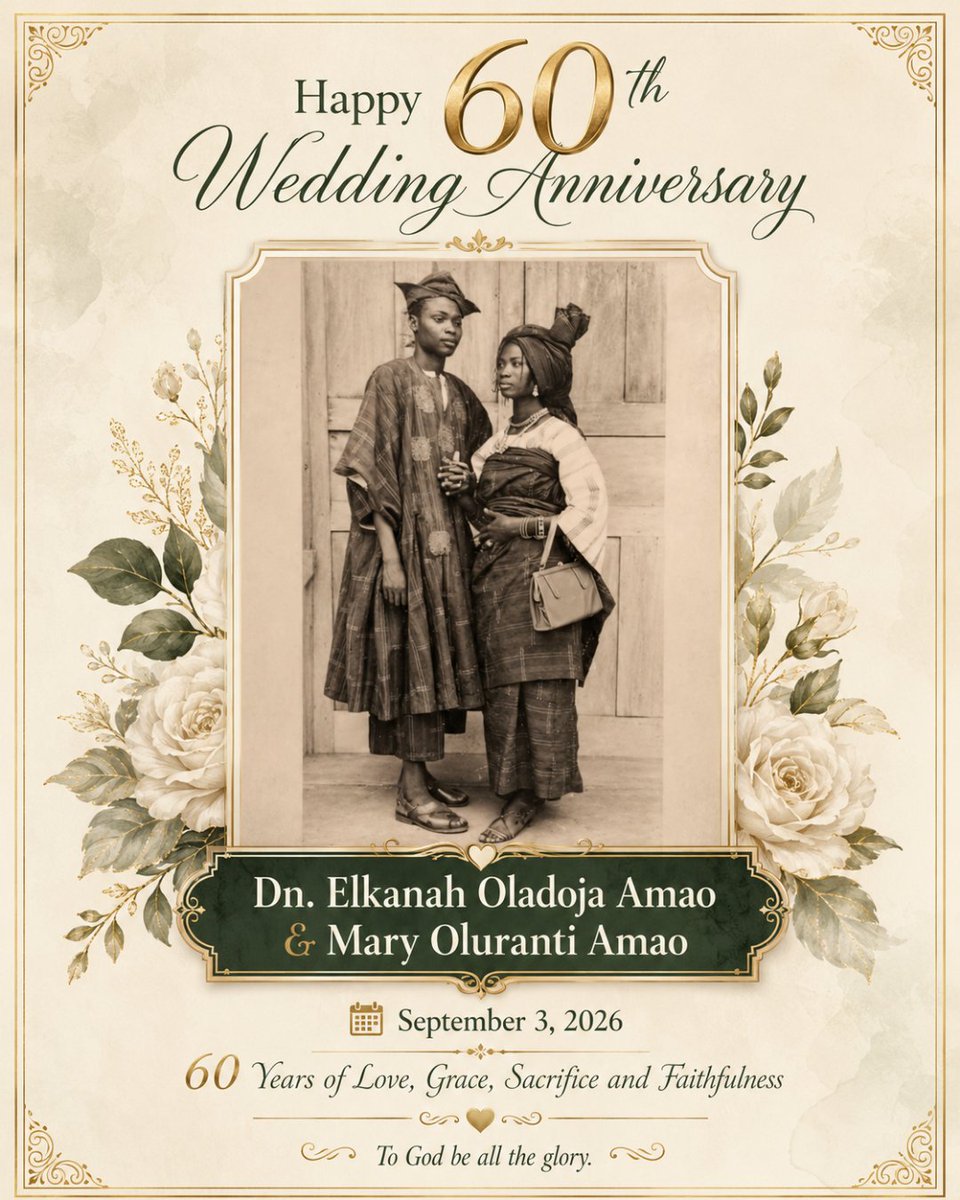
Today, September 3, 2026, marks a truly special milestone in our family, the 60th wedding anniversary of my parents, Dn. Elkanah Oladoja Amao and Mary Oluranti Amao.
Sixty years.
Sixty years of choosing each other through thick and thin. Through the good seasons and the difficult ones. Through moments of joy and seasons when life tested you in ways that could easily have made many people give up.
Sixty years of patience, understanding, friendship, sacrifice and commitment.
Sixty years of learning to live together, forgive each other, support each other and keep moving forward, even when the road was not easy.
And then there were the five boys you raised.
You made sacrifices, many of which we probably did not fully understand at the time, just to make sure we had what we needed and could grow into men capable of standing on our own.
When you had plenty, you shared.
And when you didn't have much, somehow, you still found something to give.
That is one of the greatest lessons I have learnt from both of you - to live and lead with a large heart.
There are so many stories I could tell. Stories of sacrifice. Stories of difficult decisions. Stories of generosity, discipline, faith and love. But perhaps those stories are for another day.
Today is simply a day to say thank You, God.
Thank You for grace.
Thank You for strength.
Thank You for sustaining this marriage for six incredible decades.
Thank You for being there in the moments they could see You and, in the moments, when they simply had to trust that You were there.
The God who was there at the beginning has remained faithful through it all, the Alpha and the Omega, the Beginning and the End.
To Him alone be all the glory, honour and praise.
And personally, I thank God every day for giving both of you to us.
As I always joke:
“My papa no be Dangote or Adeleke, but we dey okay o! 😂”
Because beyond money and possessions, you gave us something far more valuable, a foundation, a family, a name, values, prayers, love, and an example we can carry into our own homes.
Happy 60th Wedding Anniversary, Grandpa and Grandma.
Sixty beautiful years down.
And by God's grace… 60 more to go!
May God continue to preserve you, strengthen you and surround you with the love of the children, grandchildren and family you have spent a lifetime building.
“Even to your old age and gray hairs I am He, I am He who will sustain you. I have made you and I will carry you; I will sustain you and I will rescue you.”
Happy Diamond Wedding Anniversary, Dad & Mum.
We love you, we honour you, and we celebrate you today and always.
Volume 5 of my weekly Humanward Leadership series is about one word: Align.
Alignment is not about lowering standards or making excuses for poor performance.
It is about building enough trust that people are willing to meet the standard because they believe in the person holding them accountable.
In this volume, I share a personal leadership experience that taught me an important lesson: people notice when a leader is willing to stand up for them, and that trust can change how far they are willing to go for the team.
I also explore the difference between compliance and true alignment.
Your team may comply because you are the manager.
But will they give you their best because they trust you?
How are you creating alignment with the people you lead today?
#Leadership #HumanwardLeadership #LeadershipDevelopment #PeopleLeadership #Trust #EmployeeEngagement #Management #HumanLeadership
Link to the full article in the comment section.
Volume 4 of The Humanward Leadership Series looks at a challenge almost every leader will face at some point: how do you care about your people without compromising the standard?
Being human in leadership does not mean avoiding accountability. At the same time, driving performance should not mean ignoring the person behind the role.
In M - Match: Care Without Compromising the Standard, I share a personal experience and explore why leaders must learn to match empathy with accountability, support with expectations, and flexibility with responsibility.
Because sometimes leadership requires grace.
And sometimes it requires a difficult conversation.
The real skill is knowing which one the situation need.
Full Article - https://t.co/wTkKsDjguy
#HumanwardLeadership #Leadership #PeopleLeadership #LeadershipDevelopment #EmployeeExperience #WorkplaceCulture #Management #Empathy #Accountability
A lot of people are bringing culture and age into the conversation. They point to the age difference and argue that Tony Elumelu is old enough to be her father.
Fair enough. But if you have a gateman, driver or cook who is much older than you and you call him by his first name, then you are just as guilty as the young lady. The difference is that she was probably following the company culture she had been taught.
If you are a leader—religious or secular—and you allow men much older than you, some with grey hair, to call you “Daddy,” then you are equally guilty.
This mentality is one of the reasons our political leaders continue to behave like emperors. Interestingly, the same man once had an interview with a young Black woman outside Nigeria and did not blink when she addressed him as “Tony.”
If you cannot accept a first-name culture, then change your company culture. Do not try to copy the “Oyinbo” style when you cannot accept everything that comes with it.
Selah!
Tony Elumelu Mr Tony TOE UBA
Tony Elumelu, a Graduate Trainee and the Hypocrisy of Nigerian Social Media Critics
Today’s timeline has been filled with the video of a young UBA graduate trainee who addressed the Chairman of UBA, Tony Elumelu, by his first name and immediately got corrected.
Tony clearly didn’t like being called “Tony.” He told her she could call him Mr Elumelu, TOE or Chairman.
Fair enough. Everyone has a preference about how they want to be addressed.
What I find more interesting, however, is the reaction from many Nigerian social media critics.
Within minutes, people were bashing the young lady. Some called her disrespectful. Others questioned her upbringing. And, as expected, our favourite argument came out: “It is not our culture.”
Sometimes, I wonder why we are always in such a hurry to crucify people on social media without first asking if there might be more context.
Let me explain why I am reluctant to blame this young woman.
At the beginning of my banking career, I worked in a bank where addressing people by their first names was a big part of the culture. It wasn't something employees invented. It was encouraged.
In fact, some senior colleagues could take offence if you called them “Mr,” “Sir” or “Oga.”
From our three-month training school, it was hammered into us that everybody, regardless of rank, was addressed on a first-name basis.
Now imagine a young graduate coming straight from university into the professional world.
You put that person through months of training. You teach them about your values, your culture and how people relate within the organisation. Naturally, they will try to practise what they have been taught.
Our CEO at the time would never have frowned because a junior employee called him by his first name. In fact, that was what the culture encouraged. Even in emails, first names were normal.
And this is where I think the real conversation around the UBA video should be.
What exactly are UBA graduate trainees taught about addressing colleagues and senior leaders?
I genuinely don't know.
But that question matters.
If they are taught from training school that UBA operates a formal hierarchy where executives should be addressed by titles, then the young lady got it wrong and the correction was understandable.
But if they are taught that UBA is a modern, open organisation where employees generally operate on a first-name basis, then we should be asking a completely different question.
How was she supposed to know that the rule suddenly changes when she gets to the Chairman?
You cannot teach people one culture and expect them to magically recognise another culture when the most senior person walks into the room.
And this goes beyond UBA.
Many Nigerian organisations want the packaging of global corporate culture: open offices, flat structures, innovation, first-name relationships, employee empowerment and all the nice phrases that appear in corporate presentations.
But sometimes, underneath the packaging, we still want the traditional Nigerian hierarchy.
Nothing is necessarily wrong with either culture.
The problem is inconsistency.
If your organisation believes senior executives should be addressed formally, say it. Teach it. Make it part of the culture.
If everybody is supposedly on a first-name basis, then that culture shouldn't suddenly disappear because the Chairman entered the room.
Corporate culture cannot be one thing on the PowerPoint slides and another thing when the Chairman arrives.
There is also another lesson here for Nigerian social media.
We have become too comfortable judging people from 30-second videos.
Before attacking the young woman, perhaps we should first ask what she had been taught, what normally happens within the organisation and what context we might be missing.
Correction is fine.
Respect is important.
Culture is important.
But consistency is also important.
So next time a graduate trainee calls Mr Elumelu “Tony,” rather than making the young person the main issue, perhaps HR should also ask whether the organisation has been clear enough about what its culture actually expects.
If the reality doesn't match the packaging, maybe the packaging needs some work.
As for Mr Tony, Mr Elumelu, TOE or Chairman…
Take am easy next time, sir! 😂
#TonyElumelu #UBA #WorkplaceCulture #CorporateCulture #Leadership #ProfessionalEtiquette #GraduateTrainees #WorkplaceLeadership #NigerianWorkplace #SocialMediaNigeria #LeadershipCulture
U - Understand: Hearing Is Not Enough
In the last volume of The Human Shift, we looked at H - Hear: Hear the Person. We talked about the importance of listening, particularly active listening, and listening not only to what is said but also to what is not said.
But hearing is only the beginning.
You can hear someone without really understanding them.
And that takes us to the next letter in our HUMAN framework:
U - Understand. Understand the person.
My daughter sent me a text one day while I was at work:
“I am going to leave this job. This is getting out of hand!”
She was visibly angry, and all my attempts to calm her down proved abortive.
To be fair, I wouldn’t have minded her resigning so she could focus more on her schoolwork, but I also did not want her to resign out of frustration. I wanted her to think through the decision properly.
But she wasn't alone. Her co-worker had made the same decision.
These were two of the strongest members of their team. In fact, their boss had specifically selected them for an off-site project that required travel.
So, what happened?
They had been going through a particularly demanding period at work. There were days they worked overtime and late into the evening. On some days, they were so exhausted that dinner was almost an afterthought before going to bed.
One night, my daughter became sick.
The following morning, she still managed to get herself ready for work. Her colleague was also trying to make sure she was okay while they prepared for the day's assignment.
They arrived at the work location four minutes late.
Their boss was angry.
They were reprimanded very harshly for being late.
Now, anyone who knows me knows that I do not tolerate habitual lateness myself. I believe in discipline, accountability and doing what we have committed ourselves to do.
But leadership sometimes requires something more.
Before the reprimand, could there have been a question?
“You are normally on time. What happened this morning?”
That one question could have changed everything.
I later understood that the harsh manner of communication was not necessarily a one-time occurrence. This incident simply became the last straw for two employees who had continued to give a lot to the job.
A few days later, they both submitted their resignation letters.
Their boss tried to convince them to stay. There was even an offer of increased pay.
But it was too late.
Two excellent team members were lost.
This raises an important question for every leader:
Do we make enough effort to understand the people we lead?
Not just hear them.
Not just wait for them to finish talking so we can give our response.
But truly understand.
Stephen R. Covey captured this beautifully in The 7 Habits of Highly Effective People:
“Seek first to understand, then to be understood.”
There is a big difference between hearing someone and understanding them.
Hearing tells me that a team member was late.
Understanding makes me curious about why.
Hearing tells me that a normally dependable employee missed a deadline.
Understanding makes me ask, “What is going on?”
Hearing tells me that someone who used to be engaged has suddenly become quiet.
Understanding makes me resist the temptation to immediately conclude that the person has become lazy, difficult or uninterested.
Sometimes, as leaders, we are too quick to fill in the blanks ourselves.
And unfortunately, we often fill those blanks with assumptions.
Communication scholars have long recognized the importance of feedback in communication. Wilbur Schramm's communication model, for example, moved communication away from being seen simply as a message travelling in one direction. Feedback helps establish whether meaning has actually been shared and understood.
That is important in leadership.
When we give instructions to our team members, do we check that they understand what we mean?
And when they communicate with us, do we make enough effort to ensure we understand what they mean?
The responsibility goes both ways.
Sometimes a leader might say, “But they didn't tell me.”
That may be true.
But not everyone speaks immediately.
Not everyone knows how to explain what they are going through.
And not everyone will give you every detail the first time you ask.
Sometimes understanding requires another question.
And maybe another one.
Not interrogation. Curiosity.
Because in an organization, we are dealing with human beings, not machines.
Machines are designed to perform in predictable ways under certain conditions, and even machines don't always produce exactly the same output every time.
How much more human beings?
We come to work with different backgrounds, personalities, pressures, responsibilities and experiences.
People are fighting battles that may never appear on a Teams call, in an email or across the meeting table.
Life happens.
Emergencies happen.
Loss happens.
Family challenges happen.
Sometimes, some of our most dedicated team members will still show up while going through incredibly difficult periods of their lives.
I know this personally.
There have been times in my own career when I worked while going through some of the toughest periods of my life.
I missed the birth of my first daughter because, after spending the night at the hospital, I had to leave in the morning to attend to work.
I have worked through the loss of a family member with tears in my eyes.
Looking back today, I wonder how many people I interacted with during those periods had absolutely no idea what was happening behind the person they saw at work.
And that is the point.
What we see is not always the complete story.
Understanding our team members also goes beyond what may be happening in their personal lives.
Sometimes the problem is at work.
It may be workload.
It may be unclear expectations.
It may be a process that is no longer working.
It may be a management style.
It may be team dynamics.
It may even be something we, as leaders, are doing.
And this is where understanding can become uncomfortable.
Because sometimes when we genuinely seek to understand, the feedback may point back at us.
That is leadership too.
Understanding does not mean lowering standards.
It does not mean accepting every excuse or overlooking poor performance.
Accountability is still important.
Standards are still important.
Deadlines are still important.
But there is a difference between accountability and assumption.
A good leader can hold people accountable while still being curious about what happened.
We can ask questions before reaching conclusions.
We can understand before judging.
We can correct without humiliating.
And we can maintain high standards without forgetting the human being behind the performance.
Our strength is in our people.
The quality of the team around us will often determine how well we perform and how far we can go.
And when people know that their leader does not only hear them but genuinely makes an effort to understand them, something changes.
Trust grows.
People become more willing to speak.
Leaders get better information.
Problems are identified earlier.
And teams become stronger.
Sometimes the difference between losing an excellent employee and keeping one may not be more money.
It may simply be the feeling that:
“My leader understands.”
So, the next time a normally dependable person disappoints you, before concluding that they have become unserious, careless or disengaged, perhaps start with one question:
“What happened?”
And then...
Listen long enough to understand the answer.
That is the HUMAN Shift.
H - Hear the person.
U - Understand the person.
#TheHumanShift #HumanwardLeadership #Leadership #PeopleLeadership #HumanCenteredLeadership #UnderstandThePerson #WorkplaceCulture See less