I always thought that Sanskrit can be taught more "naturally" than it is.
The attached post also indicates that it can be done more parsimoniously than I thought.
https://t.co/q77tZUzRYd
Here is Ver 0.0.0.1 of applying some idiosyncratic ideas -- Gita with Sanskrit
Link :
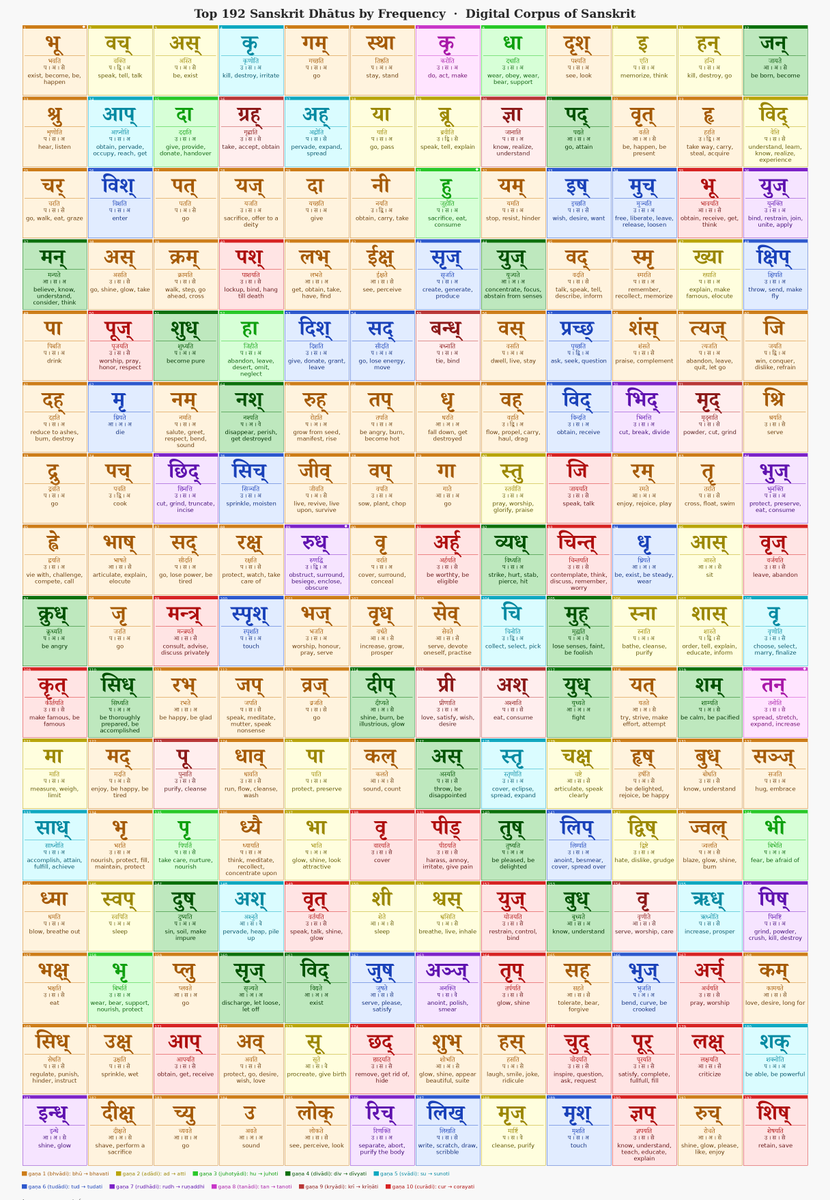
Sanskrit has >2000 verb roots (dhātus). But do you really need to learn them all?
I had Claude analyze 270 Sanskrit texts, and it found that with just the 192 most common dhātus, you can understand ~90% of verbs in literature.
Below are those 192 dhātus, ordered by frequency:
One of the most fun things you'll read this week:
A bunch of @iitbombay 20-somethings spent their college year building an actual semiconductor fab of sorts. They're now weeks from their first working transistor.
Technically it's a "hacker fab".
-basically a semiconductor fab you build in a college for not a lot of money (it's hard work though)
-it makes scrappy chips but who's asking state of art
-open source framework that started in the West.
-only some seven such fabs exist
-the IIT-B one is first outside West.
What @hackerfabindia have built:
-lithography machine = an old projector with the optics flipped, printing at 3–4 microns (a human hair is ~100)
-a 1,100°C furnace built by two first-years from cement, ceramic wool and 50m of resistance wire
-a sputter built in-house
-a vacuum chamber
Whole toolkit:
-Rs 15–20 lakh - roughly a campus racing team's annual budget
-First devices (a diode and a MOSCAP) came off their own tools on 12 June
-Full transistor due by end of summer
-2nd in the world to do it on the open HackerFab framework
Tagline:
Why should TSMC have all the fun? 😎 (good one @aryamman_bhatia & team)
@astrokaran's story 👇
https://t.co/EWcBnKDoPv
A French engineer who lives quietly in Paris has spent 30 years writing software that the entire internet now runs on without knowing his name.
He wrote the code that streams every YouTube video, every Netflix show, every TikTok clip. He wrote the code that runs the virtual servers underneath AWS, Google Cloud, and Microsoft Azure. He calculated more digits of pi than anyone in history. He has no Twitter. He has no marketing. He just keeps shipping.
His name is Fabrice Bellard.
Here is the story, because almost nobody outside the systems programming world knows what one man has built.
Fabrice was born in 1972 in Grenoble, France. He studied at École Polytechnique, the top French engineering school. He never went to Silicon Valley. He never built a startup empire. He just wrote code.
In 2000 he started a project called FFmpeg, an open-source multimedia framework for encoding, decoding, and streaming video. He was 28. The project did one thing nobody else had done well. It handled every video and audio format that existed, in one library, on every operating system. He led it himself for years.
Today FFmpeg is the invisible engine of the internet. YouTube uses it. Netflix uses it. VLC uses it. Chrome and Firefox use parts of it. Every Android phone, every iPhone, every smart TV, every video editing tool you have ever touched runs FFmpeg somewhere underneath. If you have watched a video on a screen in the last 20 years, Fabrice's code processed it.
He was not done.
In 2003 he started QEMU, a machine emulator and virtualizer. He wrote it solo until version 0.7.1 in 2005. QEMU lets you run any operating system on any other operating system. It became the foundation of modern virtualization. KVM, the Linux kernel hypervisor, runs on top of QEMU. Every major cloud provider, AWS, Google Cloud, Microsoft Azure, IBM Cloud, runs virtual machines on infrastructure built around it. The Quick Emulator is the most cited piece of cloud infrastructure code on Earth.
He kept going.
In 2001 he won the International Obfuscated C Code Contest with a small C compiler that grew into TCC, the Tiny C Compiler. TCC can compile and boot a Linux kernel from source in under 15 seconds. In 2004 he calculated the most digits of pi ever computed at the time, using a personal desktop computer and an algorithm he derived himself called Bellard's formula. In 2011 he wrote a complete PC emulator in pure JavaScript that runs Linux in your browser, a project called JSLinux that engineers still cannot believe is real.
In 2019 he released QuickJS, a small but complete JavaScript engine that fits where V8 cannot. In 2021 he released NNCP, a neural network based lossless data compressor that immediately took the lead on the Large Text Compression Benchmark.
Then he turned his attention to large language models. He built TextSynth Server, a web server with a REST API for running LLMs locally. He released ts_zip and ts_sms, compression utilities that use language models to compress text and short messages at ratios traditional algorithms cannot reach. He released TSAC, a very low bitrate audio compression system. In December 2025 he released Micro QuickJS, a new JavaScript engine for microcontrollers, separate from QuickJS, designed for environments with almost no memory.
Fabrice co-founded a telecom company called Amarisoft in 2012, where he serves as CTO. Amarisoft builds 4G and 5G base station software used by carriers and labs around the world. He has been running it for over a decade while continuing to ship personal projects from his own home page at bellard dot org
He has no Twitter. He has no Instagram. He gives almost no interviews. His personal website is a flat list of projects with no styling, no fonts, no marketing copy. Just titles and links.
A quiet French engineer who never moved to Silicon Valley wrote the code that quietly runs the internet.
He is still shipping.
Terence Tao: "We lived in a world with cognitive friction until very recently, where every task required us to use our brain.
So we didn't really think about it, we just thought this was the cost of doing something intellectual. But now we have AI and the other technologies that can bring these frictions down to zero."
Most research time is not spent having cinematic insights.
It is spent checking cases, chasing references, translating intuition into computation, testing a path, finding it false, and deciding whether the failure taught you anything.
AI changes the cost of that loop.
Terence Tao says that now he can try “crazier things,” and that makes so much difference. Because unconventional ideas are often not rejected by proof, but by inconvenience.
A mathematician may avoid a strange direction not because it is foolish, but because the bookkeeping, coding, or literature search needed to test it is too expensive for a hunch.
This is where cognitive friction becomes scientific friction.
Lowering it does not make taste, judgment, or proof disappear; it makes more weak signals cheap enough to inspect before they are abandoned.
AI is making hesitation less expensive, and that is often where discovery begins.
If you look at success rate in any area, you would realise failure is the norm and success is an exception.
If you've succeeded, be grateful. Be kind to those who have failed.
Our vision is limited; Bhagavan alone knows what leads us to our highest good. Thus, surrender at His feet becomes the noblest path.
A Must-Watch Subtitled Anugraha Vani Clip of Jagadguru Shankaracharya Sri Sri Vidhushekhara Bharati Mahaswamiji
*-*-*
The online book store - Sharada eGranthalaya: https://t.co/9pCszRRmcg
#Ramayana #SriRama #Bharat #SanatanaDharma #Shankaracharya #Sringeri #Peetham #Jagadguru #शंकराचार्य #Mahaswamiji #Vedas #Upanishads #Hindus #Hindu #DharmicValues #ProtectDharma #DharmaAwareness #Samskara #HinduValues #DharmicGuidance
.@WSAI_IITM is gearing up for its Annual Research Showcase this May — our flagship event that celebrates innovation, discovery, and impactful research.
The Indian conversation on AI has settled into a fatalistic mood.
We are told the country fell behind, that the frontier is now a closed shop between Silicon Valley and Hangzhou.
Sarvam AI's Vivek Raghavan, who built Aadhaar's biometric stack, disagrees. 🧵
Let me explain what just happened today because it deserves so much recognition.
GalaxEye is a Bengaluru startup founded in 2021 by IIT Madras engineers. Today they launched Mission Drishti on a SpaceX Falcon 9. It is India's largest privately built satellite at 190 kg. And it carries a technology that no commercial satellite has ever carried before.
Normal satellites take photos of the Earth using optical cameras. Like your phone camera, but from 500 km up. The problem is obvious. Clouds. Night. Fog. Smoke. If any of these are in the way, the photo is useless. India has monsoon cover for 4 months a year. That is 4 months where optical satellites are partially or fully blind over large parts of the country.
The alternative is SAR. Synthetic Aperture Radar. Instead of taking photos with light, it sends radar waves down and reads what bounces back. Radar goes through clouds, through darkness, through smoke. A SAR satellite can image a flooded village at 2 AM during a cyclone when no optical satellite can see anything.
The problem with SAR is that the images look nothing like photos. They look like grainy black-and-white radar maps. A military analyst or a trained geospatial engineer can read them. A farmer, a disaster response team, or a city planner cannot.
Until today, if you wanted both optical and SAR data for the same location, you needed two different satellites, passing over at different times, at different angles. Then someone had to manually align and fuse the two datasets. Expensive, slow, and the data never perfectly matched because the satellites saw the same spot minutes or hours apart.
GalaxEye put both sensors on one satellite. Optical and SAR, fused into what they call OptoSAR. Three times more information than a single sensor. Processed onboard by an NVIDIA AI chip at 1.8 metre resolution.
Now in practice, during the next cyclone hitting Odisha, one satellite pass gives you a clear image of which villages are flooded, which roads are cut, and which buildings are standing. Day or night. Cloud or clear. In near real-time.
For defence, it means you can monitor a border area 24/7 regardless of weather. For agriculture, it means tracking crop health across an entire monsoon season without a single cloud gap. For infrastructure, it means monitoring construction progress on highways and bridges without waiting for a clear day.
GalaxEye tested their SAR tech on ISRO's POEM orbital platform. The satellite was tested at ISRO facilities. IN-SPACe provided regulatory clearance. NSIL, ISRO's commercial arm, will distribute the imagery globally. And it launched on SpaceX because ISRO's PSLV doesn't have the right orbit slot for this mission.
Yes, four IIT Madras graduates built a world-first satellite in 4 years in Bengaluru.
Take a bow!
@anuragwho It's not chest thumping, there is real work happening in India (in my own team to advance frontier models, in startups like Sarvam, and academic institutes like IITM). What has held India back is low investment in research by Indian industry and a lack of ambition.
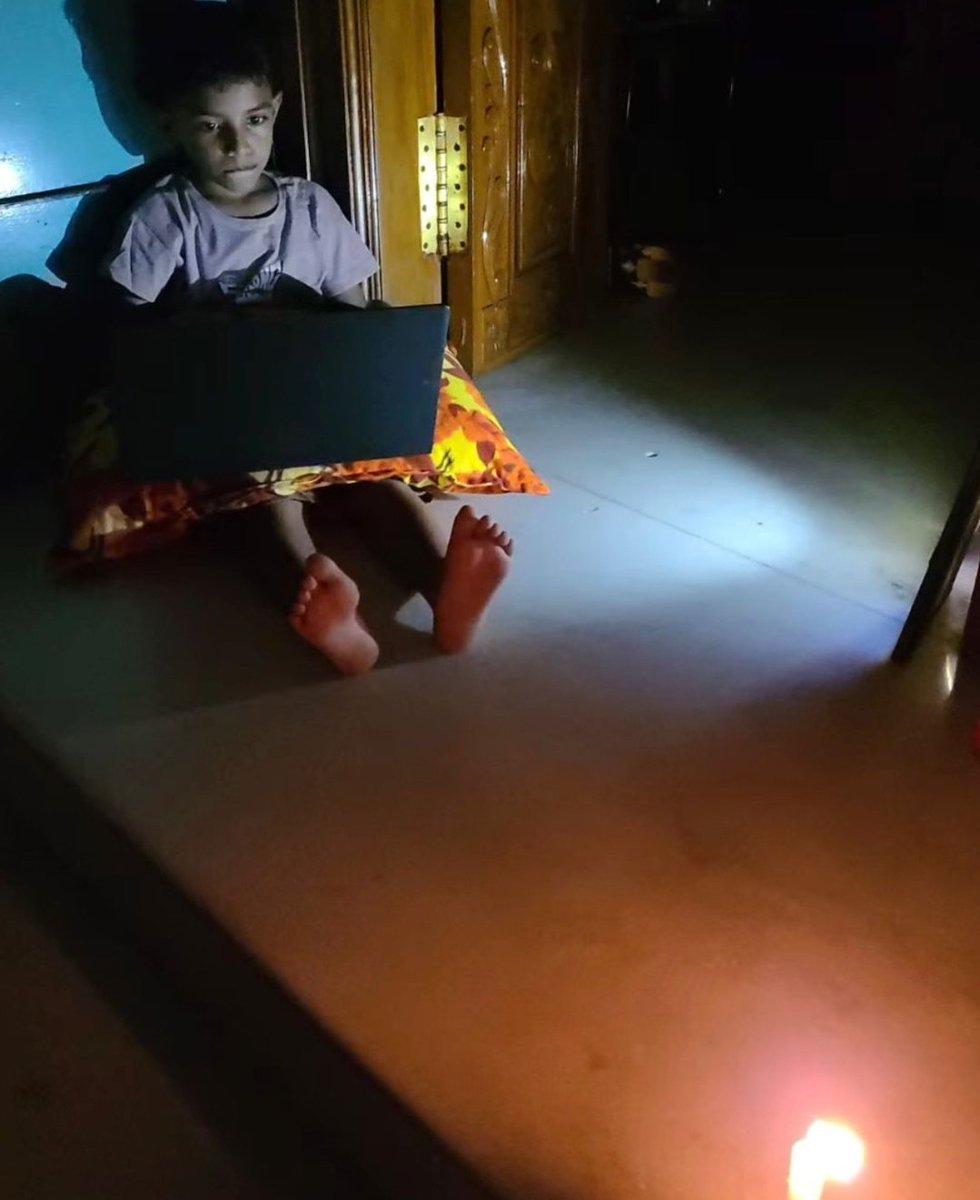
This is 8-year-old Tamizh Amudhan (born on 2nd of September 2017). He is sitting in his home in Sivakasi. The electricity was not there so he had to use a candle.
In the first round of Freestyle Friday, he was pitted against world no.7 Vincent Keymer (2759). Not only is Vincent an amazing player he is well known for his Freestyle Chess. It was absolutely stunning how Tamizh Amudhan outwitted him!
This youngster who trains at Hatsun Chess Academy near Sivakasi is already a CM and rated close to 2000 Elo. A huge congrats to the youngster and his grit! 😍
#chess #chessbaseindia #freestylechess
Next in who after the Ramanujan Series? He is the reason we can find a needle in the digital haystack of the world. Meet Dr. Rajeev Motwani (1962-2009), the Ghost who built the logic of the modern world. A boy from Jammu who went to IIT Kanpur & ended up teaching 2 kids at Stanford how to organize the internet. W/o him, there is no Google. W/o him, the web would be a chaotic library with no index.
He was the master of Randomized Algorithms, the man who proved that sometimes, a bit of chance is the fastest way to the truth. He won the Nobel of his field & mentored the titans of Silicon Valley, yet he remains an invisible legend in his homeland. He is the architect of the digital oracle, the man who taught the world how to search.
Born in 1962 in Jammu, Rajeev grew up in a household defined by the discipline of the Indian Army. As a child, he famously wanted to be a librarian because he loved books so much. He eventually realized that mathematics was the ultimate indexing system for the universe. He belonged to the legendary Class of 1983 at IIT Kanpur. This was a Silo of intense competition that refined his ability to solve problems with extreme speed & elegance.
He moved to the US & earned his PhD from UC Berkeley in 1988, diving into the deep waters of theoretical computer science. Before Motwani, most computer scientists tried to find perfect answers. Motwani realized that for massive amounts of data, perfection is too slow. He proved that by introducing a small, controlled amount of randomness into an algorithm, we could solve complex problems millions of times faster than traditional methods.
In 1995, he co-authored Randomized Algorithms. It is not just a textbook; it is the fundamental blueprint for modern computing. Every time a large system (like a global bank/a social network) processes data, it likely uses a Motwani-style randomized check.
In the mid-90s, at Stanford University, Motwani encountered 2 students: Larry Page & Sergey Brin. They had a rough idea for a search engine. Motwani provided the mathematical rigor. He helped them formulate PageRank, the algorithm that ranks web pages by their importance based on link structure.
He was not just a mentor; he was an early advisor & investor. He was the Ghost in the room when Google was born in a garage. Beyond Google, he was a foundational advisor to PayPal, Airbnb, & Twitter. He saw the Pattern of Success in startups before they even had a name.
In 2001, he won the highest honor in theoretical computer science (The Gödel Prize) for his work on the PCP Theorem (a massive breakthrough in how we verify proofs).
In 2009, at the age of 47, he passed away in a tragic accident at his home in California. Silicon Valley went into a state of deep mourning. Sergey Brin wrote a heartbreaking tribute titled "Rajeev Motwani, my friend & teacher." Yet, in India, his name did not make the front pages. He remains a Ghost in the country that produced him.
He is the Ghost of the Algorithm. Like Ramanujan, he saw the beauty in the approximated truth. He realized that the world is too big to be solved by simple, rigid lines, so he taught machines how to use probability to find the truth.
Key Work: https://t.co/INQyMOp9Bj
3 days. Nearly 14,000 words as I document our Trans Siberian trip. Along with Russian History, social mores etc.
This enforced divorce from the digital space.. brought about by a lack of network connectivity is brilliant. No information overload. No being bombarded constantly with useless information
I now understand why people would go to a remote hill station to write.
#TransSiberianTrip
@ArunKrishnan_ Whenever I stay away from digital media for a day, I recover a small portion of my brain, and my soul. Planning to take a lot of long breaks this year.
I've used em-dashes my whole life — they add rhythm and grace to writing. But now they're an AI tell.
Can we get a grandfather clause for those of us who were fluent in em-dashes before ChatGPT launched in November 2022?
Open letter to Indians in America.
--
Dear brothers and sisters from Bharat:
Like I did 37 years ago, you arrived in America with no money but with a good education and cultural heritage from Bharat. You achieved outstanding success. America was good to us. For that we must remain grateful - gratitude is our Bharatiya way.
Yet today, a significant number of Americans, may be not the majority but not too far from it either, believe that Indians "take away" American jobs and our success in America was unfairly earned.
You may think the next election will fix this, but your choice would be between people who hate our Bharatiya civilisation and people who hate civilisation itself. That is the "hard right" vs "woke left" battle. You are mere bystanders to that conflict.
Meanwhile there is one thing that is true now and will be true in the future: the respect Indians command world-wide will substantially depend on the fortunes of India herself. If India remains poor, the woke left will give us moral lectures with pity and the hard right, different moral lectures with scorn ("hellhole") and we must not confuse either with respect.
Respect in today's world, along with prosperity and security, comes from one source: a nation's technological prowess. India produces sufficient brain power to achieve that prowess but alas we exported so much of that talent, particularly to America. As we develop that prowess in India, our civilisational strength will assert itself.
As difficult as it is for many of you to contemplate this, please come back home. Bharat Mata needs your talent. Our vast youthful population needs the technology leadership you gained over the years to guide them towards prosperity. Let's do it with a missionary zeal.
Respectfully
Sridhar Vembu
Many would. They tell us we are a low trust society.
Tell that to the small shopowners who have a credit system for goods they sell.
Or who sell their wares on a vague promise of "kal de denge".
We don't celebrate ourselves enough.
We have been poor because we waste our talent on a truly massive scale.
Zoho is built by very ordinary Indians from very humble backgrounds. That kind of talent pool is there everywhere in India. We have to tap it to create tens of thousands of companies like this. At that point, we will be shockingly wealthy as a nation.