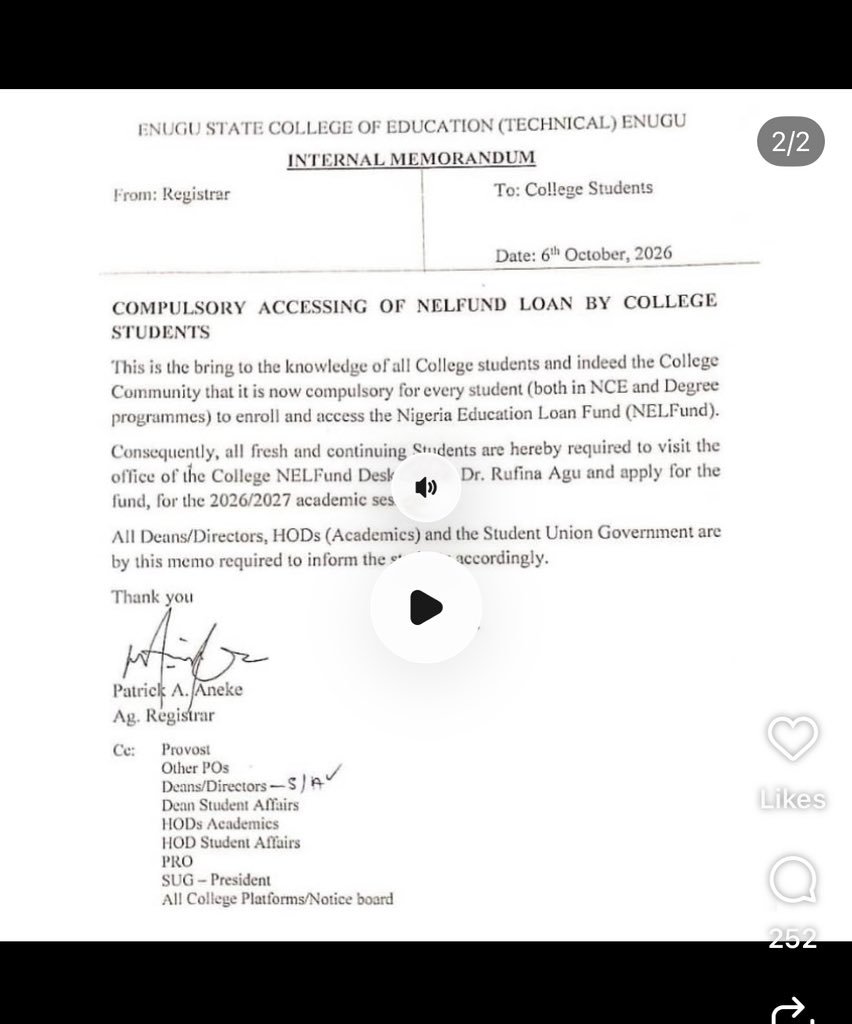
Imagine being a student, managing to pay your school fees yourself, and then being told that unless you take a loan you never asked for, you may not be allowed to write your examinations. 😂
That is the controversy surrounding the Enugu State College of Education (Technical), following reports that the institution has made NELFUND student loans compulsory, with examination bans and possible expulsion for students who refuse to comply.
But this raises a fundamental question: How can a loan designed to help students become another condition they must satisfy to remain in school?
To understand why this is troubling, we need to understand what NELFUND is supposed to do.
The Nigerian Education Loan Fund was established to help eligible students pay institutional charges and, where applicable, receive upkeep support. It is an intervention for students who need financial assistance, not a compulsory debt scheme for every student.
NELFUND's own application process requires students to apply for the loan and accept its terms and conditions. Its official website describes the scheme as providing loans to students who desire to access them.
In other words, the scheme is built around an application and a loan agreement. A student who can afford to pay their fees should not automatically be forced to borrow money simply because the school wants them to use the scheme.
So, what is the rationale behind forcing students to take the loan?
There are a few possible explanations, although the college's specific reasoning has not been established in the reports available.
First, the institution may want to channel tuition payments through NELFUND. The Fund pays approved institutional charges directly to schools, potentially improving payment administration and giving institutions a more structured way to collect fees.
Second, the school may be trying to increase participation in the scheme or simplify its fee collection process. But administrative convenience does not automatically justify forcing students to take on debt.
Third, there may be a misunderstanding of the scheme's purpose or a policy decision by the institution that needs to be explained and scrutinised.
None of these possibilities, however, establishes a legitimate reason to threaten students with examination bans or expulsion for refusing a loan.
And there is another important detail students must understand: interest-free does not mean free money. NELFUND loans come with repayment obligations. The Fund's published terms provide for repayment under specified conditions, including salary deductions when repayment becomes due. A student is therefore accepting a financial obligation, not receiving a scholarship.
Imagine a student whose parents have already paid the fees, or someone who has secured a scholarship. Why should that person be compelled to take a loan and assume a repayment obligation they do not need?
If the institution believes compulsory participation is legally justified, it should explain the specific legal provision that authorises it. Students should also be able to see the written directive and seek clarification from NELFUND and the relevant education authorities.
The bottom line: NELFUND exists to widen access to education by easing financial pressure on students. Turning access to examinations into leverage for forcing students to borrow would run contrary to the scheme's stated purpose.
A loan should be an option that helps a student stay in school, not a debt they must accept to be allowed to continue.
EBOLA HAS BEEN CONFIRMED IN ABUJA. HERE IS WHAT WE KNOW.
Nigeria has recorded a confirmed case of Ebola disease in the Federal Capital Territory. This time, it is not a social media rumour.
According to the Federal Government, the patient is a woman who recently travelled to Nigeria from Uganda. She was admitted to a private hospital in Abuja, where she received treatment before laboratory tests confirmed the infection.
She is now in isolation and receiving medical care.
How far has it spread?
As of the government's announcement on October 20, health authorities had identified 44 people who may have been exposed to the patient. Contact tracing is underway to locate and monitor them.
That does not mean all 44 people are infected. They are contacts being investigated because of possible exposure.
How does Ebola spread?
This is an important distinction. Ebola does not spread through the air in the same way as common respiratory infections. It spreads through direct contact with the blood or other body fluids of an infected person who is showing symptoms, or through contaminated objects.
Symptoms can include fever, severe weakness, headache, vomiting and diarrhoea. These symptoms can resemble other illnesses, so having a fever alone does not mean someone has Ebola.
What should Nigerians do?
Stay calm, wash your hands regularly and avoid contact with the body fluids of anyone suspected of having the infection. If you develop symptoms after possible exposure, avoid close contact with others and contact public health authorities for guidance before visiting a hospital.
Do not stigmatise people who have travelled from Uganda or other affected areas. Travel history alone does not mean someone is infected.
The fact that the case has been detected is serious, but it does not automatically mean Nigeria is facing a widespread outbreak. The next critical steps are tracing contacts, identifying any further cases and preventing transmission.
And please, don't turn this into a political argument or circulate unverified claims. Ebola requires a serious public health response, not panic or misinformation.
BREAKING: FG Confirms Ebola Case In FCT
The Federal Government has confirmed a case of Ebola virus in the Federal Capital Territory (FCT).
https://t.co/zHWRWp1j23
According to the Federal Government, the patient is a woman who recently travelled to Nigeria from Uganda. She was admitted to a private hospital in Abuja, where she received treatment before laboratory tests confirmed the infection.
She is now in isolation and receiving medical care.
How far has it spread?
As of the government's announcement on October 20, health authorities had identified 44 people who may have been exposed to the patient. Contact tracing is underway to locate and monitor them.
That does not mean all 44 people are infected. They are contacts being investigated because of possible exposure.
How does Ebola spread?
This is an important distinction. Ebola does not spread through the air in the same way as common respiratory infections. It spreads through direct contact with the blood or other body fluids of an infected person who is showing symptoms, or through contaminated objects.
Symptoms can include fever, severe weakness, headache, vomiting and diarrhoea. These symptoms can resemble other illnesses, so having a fever alone does not mean someone has Ebola.
What should Nigerians do?
Stay calm, wash your hands regularly and avoid contact with the body fluids of anyone suspected of having the infection. If you develop symptoms after possible exposure, avoid close contact with others and contact public health authorities for guidance before visiting a hospital.
Do not stigmatise people who have travelled from Uganda or other affected areas. Travel history alone does not mean someone is infected.
The fact that the case has been detected is serious, but it does not automatically mean Nigeria is facing a widespread outbreak. The next critical steps are tracing contacts, identifying any further cases and preventing transmission.
And please, don't turn this into a political argument or circulate unverified claims. Ebola requires a serious public health response, not panic or misinformation.
Three are accused of abducting the 20 prospective corps members on October 1, Nigeria’s Independence Day. The other two are accused of kidnapping four people in a separate incident on October 4.
The three defendants in the NYSC case are Usman Aliyu, also known as Chonge; Babangida Aliyu; and Mohammed Ali, alias Smallie Pepper.
According to the prosecution, the trio and other suspects allegedly demanded and collected ₦48 million, plus an undisclosed amount in US dollars, for the release of the corps members. They are also accused of possessing three AK-47 rifles, four magazines, a pistol and 81 rounds of ammunition.
The other defendants, Aminu Haliru and Tange Ibrahim, also known as Jijji, are accused of abducting four people around Owerri and Mgbidi and collecting ₦8 million in ransom.
Here is the part worth noting: the 20 prospective corps members were rescued alive on October 7 from a forest in Owerri West, after a joint operation involving security agencies. The five suspects were arrested later, between October 10 and 14, in Rivers and Abia states. Three other suspected members of the gang reportedly escaped with gunshot wounds and remain at large.
All five defendants have pleaded not guilty. They have been charged, not convicted, and the allegations must still be proved in court.
The cases have been adjourned for further proceedings.
Kidnapping for ransom is not just a headline or a demand for money. It means families scrambling to raise huge sums, victims spending days fearing for their lives, and people travelling to serve their country becoming targets on the road.
The next test is whether the prosecution can establish the suspects’ guilt and bring everyone involved to justice.
Tunde Perry visits K1 De Ultimate’s “Mayegun Royal Resort” in Ijebu and urges people to buy tickets for Olamide’s O2 Arena show.
K1 De Ultimate saw him, and the first thing he told him was that they should play dice. 😂
Imagine greeting the bride, turning around, and seeing what looks like the same person standing beside her husband. Then you look at the grooms and discover that the same situation applies to them.
But there is an even more fascinating angle to this story.
If both sets of twins are identical, their children could be genetic cousins who are as closely related as ordinary siblings.
Here is why: children of identical twin sisters and identical twin brothers inherit DNA from parents who are genetically almost identical to one another. So, although the children would legally and socially be cousins, their expected genetic relationship would be similar to that of full siblings.
That is a fascinating biological twist to an already unusual family arrangement.
And while the wedding is attracting attention, it is worth noting that this is not the first time such a union has happened in Nigeria. A similar wedding involving twin sisters and twin brothers took place in Uyo, Akwa Ibom State, in 2017.
One important caveat: I could not independently verify the identities of the couples in the latest viral post or confirm all the details about their states of origin.
Still, one thing is certain: when twins marry twins, family gatherings could become a serious test of everybody's ability to tell people apart. 😂