My "Efficient Go" book with @OReillyMedia has been released!🎉
I wrote some words about the book, content and generally my experience writing it (with photos!):
https://t.co/7s2s6yI2wQ
Good for a slow Saturday--maybe it will help you to decide to write your own book? 🤗
[NEW RELEASE] Efficient Go -- Author @bwplotka provides the tools and knowledge required to make your systems faster and less resource-hungry. https://t.co/osraCNkhxy #OReillyExperts
🥳 Excited to start revealing what we've been working on in the last few months. First, we decided to reinvent Kubernetes for agentic workloads with statefulness and fast resumption. Secondly, we are building an agentic orchestrator that will be Google's open agentic orchestrator and runtime. https://t.co/XCrdAVvDAe
The "whiteboard defense:" I should be able to pull you aside at any moment and ask you to explain any customer-facing system you've shipped. You should be able to clearly explain how it works and defend the decisions you made. This is my benchmark for responsible AI usage.
I don't expect line-level familiarity with the code. I don't care if you remember the exact function name or implementation detail. You may not even know it. I don't care.
But if I ask "why did you do X instead of Y?", "what happens if this actor behaves maliciously?", "what data structure did you use here and why?", or "where does this fail?" you should be able to answer confidently.
For PoCs, demos, experiments, whatever: I don't care. Generate 100% of it and understand none of it. Speed over quality every time in those specific scenarios.
But if you're shipping customer-facing work, you can't be shipping things you don't understand at a high level.
We caught up with @bwplotka at KubeCon EU. He's pumped about semantic conventions across OTel and Prometheus finally becoming practical, and AI changing how open source is built. #KubeCon#Prometheus#OpenTelemetry
https://t.co/dsRtra9yq2
🚨 ALERTS{alertname="NewBlogPost", alertstate="firing"} 1
I wrote about exciting and ambitious changes we are making in @PrometheusIO project:
https://t.co/F8mlOfGY75
Diving into the potential future of the "native" model for the composite metric types in Prometheus. 💪
@_josephwoodward@DuffieldJesse I was aware, but I was too lazy to construct and design them 🫠
I might copy your config, sounds useful to integrate with GitHub more.
Especially, I often pull somebody else PR locally for review, with this magic fetch pull/number/head:branch - good for custom cmd!
Side projects, blog, podcasting is hard with 2 small kids, but I eventually managed to find time for a blog! (PS: I had to switch to 5am routine 🙈)
Wrote some words about @DuffieldJesse#lazygit OSS tool and what we can learn from its UX. Enjoy! 🤗
https://t.co/Ywp6mCxetk
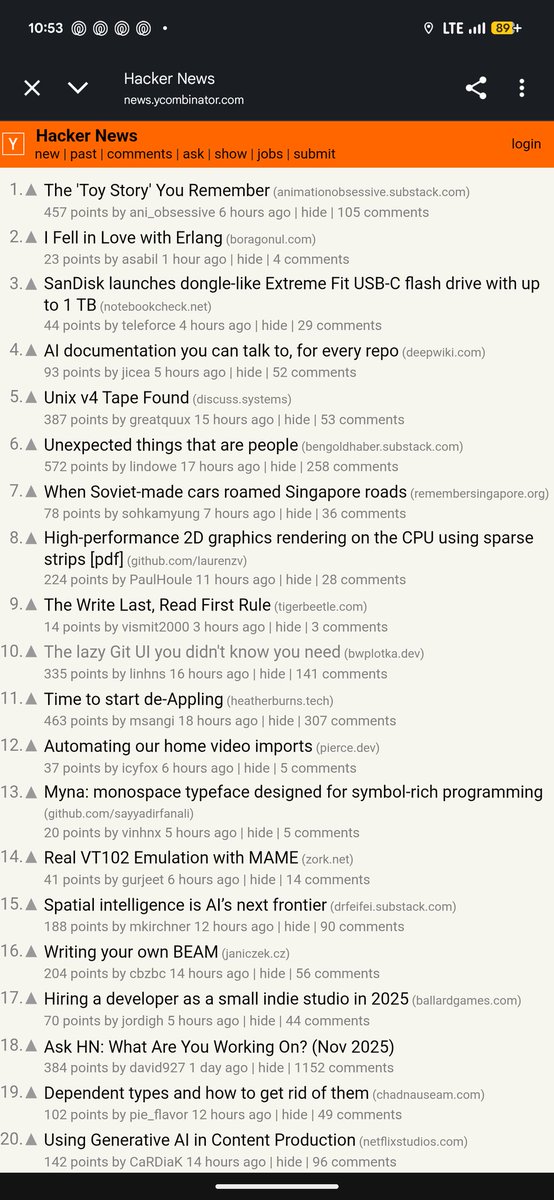
Woke up today to my blog post appearing on the top 10 of hacker news today!
Sounds like my site is up on down due to concurrent traffic... 🙃 switched to higher provider tier, but if it's down, here is a backup link: https://t.co/kJUiONLFjl
Side projects, blog, podcasting is hard with 2 small kids, but I eventually managed to find time for a blog! (PS: I had to switch to 5am routine 🙈)
Wrote some words about @DuffieldJesse#lazygit OSS tool and what we can learn from its UX. Enjoy! 🤗
https://t.co/Ywp6mCxetk
@AdamRackis Then propose & design the switch to Go. Analyse pros & cons, convince stakeholders and estimate the efficiency, maintenance and reliability gains (numbers!)
Might be worth it, plus tons of career impact (:
100% this.
We are in the cycle of "unifying things", which is like going back to monoliths for DBs, collection, SDKs etc.
Tempting but maybe utopia?
BUT no one blocks ppl from trying and learning on their mistakes (: We will see in 5y cycle to move back to dedicated solutions.
There are DevOps and SRE engineers who think that a unified database for metrics and logs is a good idea. This isn't a good idea from an operations perspective because of the following reasons:
- Lower availability. If something wrong happens with the stored logs, there are high chances that this will affect metrics stored in the same database, and vice versa.
- Noisy neighbour. You cannot allocate dedicated resources (storage space and storage IO, CPU, RAM, network bandwidth) individually for metrics and logs if they are stored in the same database. These resources are shared, so the increase in logs' workload may negatively affect metrics' workload and vice versa.
- Operational complexity and efficiency. You cannot have individual backup and recovery strategies per metrics and logs stored in the same database. Logs and metrics may require different retention policies. These policies are hard to implement efficiently and clearly when logs and metrics are stored in the same database.
- Query usability and performance. Efficient querying metrics and logs are completely different things - they need different query languages optimised for typical queries over metrics and logs. They also need different optimizations at the database level for achieving high querying performance and low resource usage.
So think twice before choosing an all-in-one observability solution for metrics, logs, traces and profiles, which stores all this data into a single database, and advertises this as a feature. It usually works great at demo time and at low load in staging environments, but it may not be so great under load in production because of the issues mentioned above.
FYI, @CloudNativeFdn KubeCon Europe (23-26th March) CFP closes in 3 days (12th October). What fun talks do you plan to propose? (:
https://t.co/2vditdxCkz
What'd you like to like to hear more about?
Maybe you'd like to co-speak? Happy to mentor/co-speak with passionate ppl!
Fun bugs happen, let's see if you can spot them (without looking on comments)! (:
Quiz#1: Why "make check" will never detect any formatting errors in the following snippet:
https://t.co/3vuW6aDTl0
@talonx > The more you write the better you get at it🚀
Sounds like are suggesting I'm not good at it 😀
Luckily today's genAI tools are great aren't they? 😉