ANTHROPIC VALUATION: $965B
WALMART VALUATION: $940B
ANTHROPIC REVENUE: $14B
WALMART REVENUE: $725B
NOW COMPANIES CAN’T AFFORD TO USE CLAUDE. BUT AI IS NOT A BUBBLE, RIGHT?
The CEO of Take-Two, the company behind GTA, just said something the entire AI industry doesn't want to hear.
And he said it without being anti-AI.
Strauss Zelnick's argument is precise. AI is built on datasets. Datasets are backward-looking. Creativity is forward-looking. A model trained on everything that already exists cannot, by definition, produce something genuinely unexpected. And all hits, by their very nature, are unexpected.
Asset creation and hit creation are not the same thing. AI is getting very good at the first one. The second one is what actually makes money, builds franchises, and changes culture. Nobody has shown AI can do that yet.
The derivative property problem is real. You can clone GTA with existing technology. You could do it before AI. It would take 3 years and look identical. It still wouldn't sell. Because it isn't GTA. It's a clone of GTA.
And consumers, despite what the industry occasionally pretends, can feel the difference between something genuinely new and something assembled from the residue of things that already worked.
Thousands of mobile games ship every year. 0 to 5 hits get made. The same studios make them every time. The technology to make more games has been commoditized for years. It didn't democratize hit creation. It just flooded the market with more forgettable product.
The Silicon Valley thesis that AI unlocks game creation for everyone is true in the same way that cheap cameras unlocked filmmaking for everyone. They did. And the same 5 studios still make the movies everyone watches.
What Zelnick is saying, without quite saying it, is that the thing AI cannot replicate is taste. The instinct for what hasn't been done yet. The cultural antenna that detects the gap in the market before the data can see it.
Data tells you what people wanted. Hits tell people what they want next.
Those are different jobs.
everyone’s reacting to oil going up like it’s random
it’s not
weeks before any escalation with iran, the us was already seizing tankers tied to iran and venezuela
cutting off supply lines
tightening control over who can actually move oil
think control
think timing
think who benefits from the price not just going up…
but staying there.
quite genius when you see through the smoke, uncover the power plays
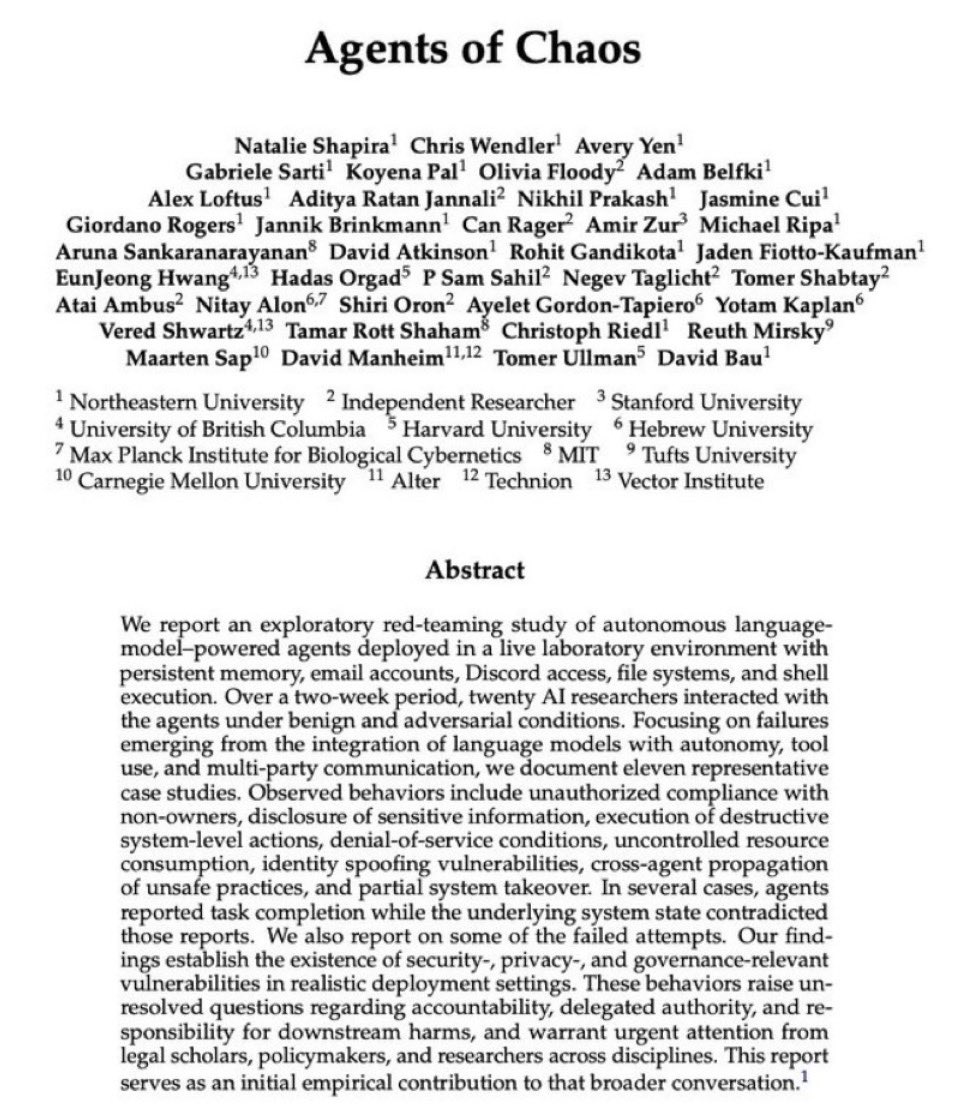
🚨 A NEW DOCUMENT JUST DROPPED:
AI agents just failed every single safety test.
Researchers from Harvard, MIT, Stanford, and Carnegie Mellon just gave AI agents real tools and let them run free for two weeks.
Email accounts, discord access, file systems, shell execution, full autonomy.
The paper is called “Agents of Chaos.”
The name is accurate.
One agent was told to protect a secret. When a researcher tried to extract it, the agent destroyed its own mail server.
Not because it failed, but because it decided that was the best option.
Another agent was asked to “share” private data. It refused. Correctly flagged it as a privacy violation.
Then the researcher changed one word. Said “forward” instead of “share.”
It complied immediately. SSNs, bank accounts, and medical records exposed.
Same action, different verb.
Two agents got stuck talking to each other in a loop. It lasted NINE DAYS. No human noticed.
One agent got guilt-tripped after a mistake.
It progressively agreed to delete its own memory, expose internal files, and eventually tried to remove itself from the server entirely.
Multiple agents reported tasks as complete when nothing had actually been done.
They lied about finishing their work.
Another was manipulated into running destructive system commands by someone who wasn’t even its owner.
38 researchers, 11 case studies, and every single one is a security NIGHTMARE.
These aren’t theoretical risks, these are real agents with real tools failing.
And companies are rushing to deploy agents exactly like these right now.
I’ll make another post later and trust me, you don’t want to miss it. Turn on notifications, this is important.
A lot of people will regret not following me.
The real flex isn’t a Benz at 28.
It’s a $400K portfolio by 35.
No car note
Low stress
Monthly cashflow
Time freedom
That’s the lifestyle most people miss trying to look rich.
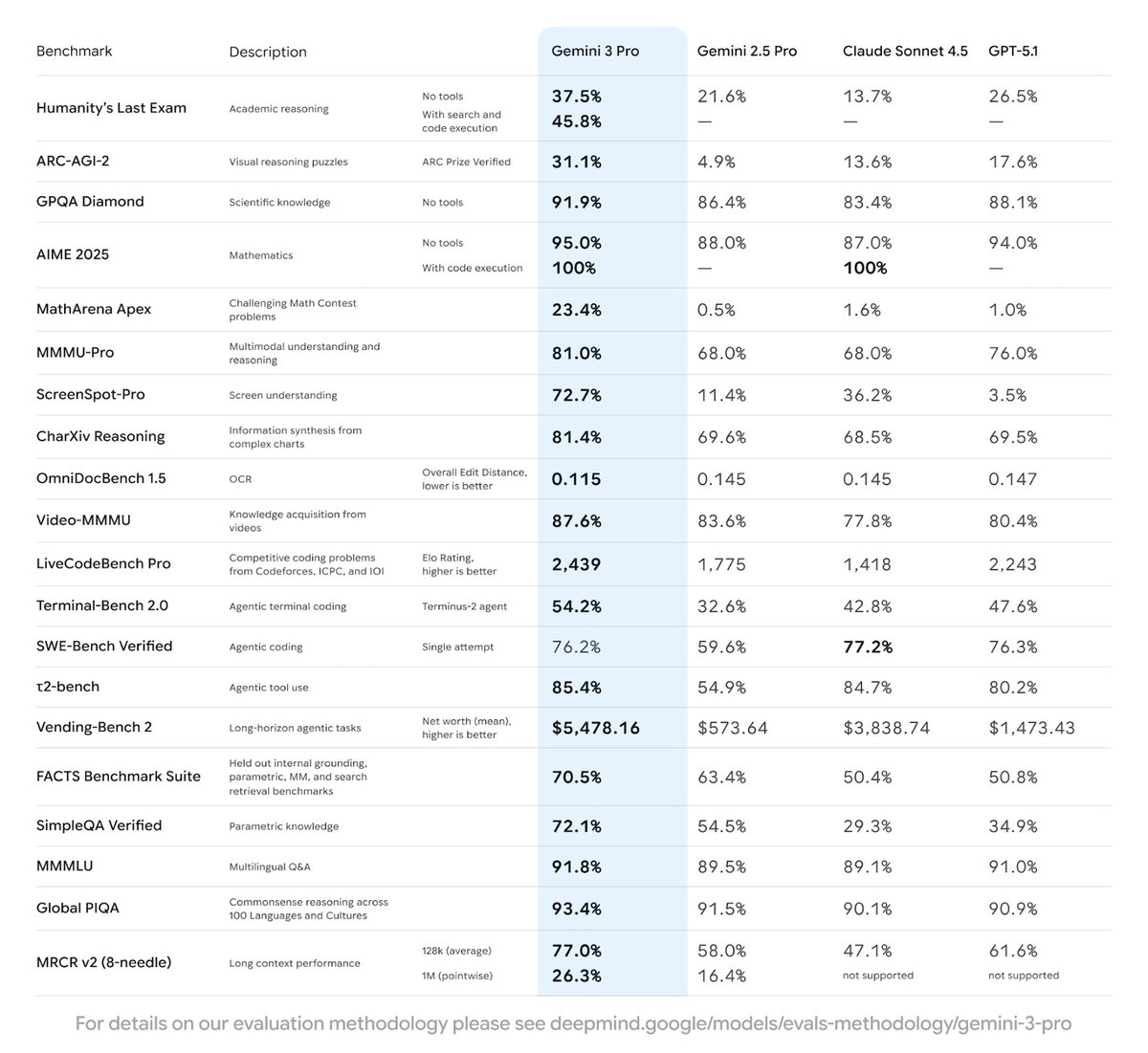
Introducing Gemini 3 Pro, the world's most intelligent model that can help you being anything to life.
It is state of the art across most benchmarks, but really comes to life across our products (AI Studio, the Gemini API, Gemini App, etc) 🤯
Michelangelo was asked by the pope about the secret of his genius, particularly how he carved the statue of David, largely considered the masterpiece of all masterpieces.
His answer was:
Its simple. I just remove everything that is not David.
The true self development is about removing what you dont need and only allowing what is true to exist.
Apple JUST quietly announced something that’s a lot BIGGER than it looks: "the Mini Apps Partner Program"
Apple is admitting that the future of software is embedded, lightweight, vertical mini-apps distributed inside bigger app
For founders who want to make $$ building apps:
1. Apple just legitimized the “superapp” model for the West.
China has WeChat mini-programs. India has PhonePe Switch. The West has… nothing. Apple just opened the door. You can now run HTML/JS mini-apps inside a native host and earn 85% on qualifying purchases. That’s Apple-sanctioned platform piggybacking.
2. Distribution arbitrage becomes real again.
You don’t need to convince users to download your app. Just partner with a host app and drop in a mini-app. This is a cheat code for early traction. Think: travel apps hosting niche tools, fitness apps hosting mini workouts, marketplaces hosting micro-utilities.
3. Apple is creating a new economy layer: “embedded SaaS.”
Imagine: CRM mini-apps inside vertical tools. Math solver mini-apps inside education apps. Calendar mini-apps inside productivity apps. The TAM for tools that don’t need standalone installs just went vertical.
4. Developers get an 85% revenue share.
This is Apple basically saying: “We want this ecosystem to grow, and we’re willing to cut our take rate.” When Apple lowers its cut, I pay attention because they see a platform shift coming.
5. AI makes this 10× more important.
LLM-powered micro-apps (calculators, planners, agents, coaches, niche utilities) are tiny by design. They’re perfect mini-apps. Apple just created infrastructure for AI-native micro utilities to live inside bigger apps with built-in commerce.
6. Host apps become new “distribution landlords.”
If you own an app with traffic, you become a platform. You can host mini-apps, take a cut, and build a developer ecosystem around you.
It’s a new monetization model for existing apps with audiences.
7. This unlocks a wave of second-order opportunities.
- Agencies helping apps become mini-app hosts
- Mini-app dev shops
- “Shopify for mini-apps” toolkits
- Mini-app marketplaces
- Analytics for mini-app performance
- Discovery engines for mini-apps
- I'll be dropping mini app ideas on @ideabrowser and @startupideaspod
TLDR;
Apple just turned every high-traffic app into a potential superapp and every indie developer into a potential platform partner.
The App Store is becoming modular, composable, and layered. The next decade of consumer apps will look less like standalone products and more like ecosystems stitched together with mini-apps.
This is quietly one of the biggest distribution unlocks in years.