the @monad_xyz ecosystem continues to gain mindshare as its community takes the shape of those that pushed today's industry leaders to success
thought it might be worth exploring some of the current players in the ecosystem:
• @KuruExchange a central-limit orderbook recently raised from @ElectricCapital
• @kintsu a liquid staking protocol that recently raised from @CastleIslandVC and others
• @aprMEV bringing an MEV optimized liquid staking protocol raising from @PanteraCapital
• @magmastaking is another LSD protocol developed by @hydrogen_labs
• @tayaswap is an AMM and dapp as a service platform for custom exchanges from @sublabs_
• @ensofi_xyz will offer cross-chain borrowing and lending connecting Monad to @solana and @sui
• @poply_xyz will be building a Monad-native NFT marketplace
• @kizzymobile is dropping a social media betting platform
being a fellow EVM chain, @TimeswapLabs, @ambient_finance, and many more applications also have plans to deploy here
to ensure proper infrastructure from day one, @backpack, @wormhole and @PythNetwork have committed to supporting monad for wallet, bridging, and oracle support...
anything we're missing?
today's reading rec ft. @VanessaGrellet_
klara and the sun by kazuo ishiguro
a *very* timely read touching on AI companions and the value of connection
NEW INTERVIEW ft. @matthewchaim.
chatted all things @songcamp_, our complicated relationship with algorithms, how to make tokenized music actually matter, and more.
link below.
though it still needs a lot of work, believe that online communities coordinating actions through daos (single purpose, grants, investments, non profit) will be a big unlock for "web3 social"
back with another reading rec -- this time ft. @ArtGeebz
secrets of sand hill road by @skupor
(just in case understanding VC fund lifecycles is the game-changer you didn’t know you needed)
if you’re anywhere close to crypto, cult has probably been used to describe some of the communities that've been floating around your network.
cults, particularly those using the internet as a point of origin, have been around for quite some time and range from extremes like qanon to the cult-like fan bases built by influencers. it's also important to note that the line between a passionate online community and a cult can sometimes be blurry. even so, micro cults and macro cults (political parties, sports, bitcoin, etc.) are everywhere.
before going further, a quick pitstop to see what’s floating around the (cult)ural zeitgeist:
• @gritcult recently shared a manifesto around starting a cult saying “all around you are cults, the world is already full of them. history is full of cults. you need to learn how to start them, you need to be able to recognize them. study cults” [https://t.co/UoZI9HG7LR].
• @michaelmiraflor noted how "everyone just belongs to small cults nowadays. different flavors for everyone, run club cults, chess club cults, longevity qualification of self cults, yoga therapy on rooftops cults, etc. irl micro cults are like a third order post-pandemic ripple effect" [https://t.co/QE634gq1uf].
we could go in a few directions here, but let’s zoom into crypto communities. overall, we’re seeing a shift from explicit utility offerings to more of a focus on distribution through cult-like organizations.
initially, many NFT projects tried to justify their value through claims of utility. voting rights, clothing lines, fractional ownership...etc. pretty early on, teams and community members realized this concept was kinda cooked. something about this felt empty. a facade of sorts where the customer thought they were an owner but just entered a virtuous loop of consumerism.
since, we’ve seen a shift to cult-like dynamics: moving away from tangible utility towards value derived from community engagement and loyalty - sometimes to the point of cult-like behavior.
this shift involves community as the product, a heavy meme culture creating a shared language, an "us vs. them" mentality, promises of vague future benefits that keeps holders in a state of anticipation, and more.
at the end of the day, these consumers (with a little orchestrated pressure) become the brand themselves. these organizations place a strong emphasis on promoting their internal culture and publicly showcasing their ideals – even past official team members. as a result, they dedicate more effort to fostering a sense of community among their members rather than developing practical applications for tech.
on one side of things, @miladymaker is a prime example. in fact, i think a snippet from their twitter bio gives some great context here: “a license to have fun online”.
the project taps into niche aesthetics and cultural references, and its community often views themselves as part of a distinct subculture within the broader crypto space. this sense is further amplified by some insane lore (you’ll have to do your own research on that one).
the milady ecosystem runs deep. you have the original milady maker nft collection, extensions of the milady brand like the remilia collective which includes various projects that expand on the milady aesthetic, the milady minecraft metaverse, milady raves, countless less official remixes, and even their (rightly) named token, $CULT.
even @pudgypenguins, who one might say initially monetized on utility, has gone a slightly different direction by announcing @abstractchain – aiming to be the dominant consumer crypto chain. in their words: “through a combination of culture & community building and dedicated builder & brand support, abstract will allow those building for billions to scale and flourish.”
as @bigvibesss recently tweeted, “it’s going to be a long 2025 for everyone who put blockchains ahead of culture”.
it’s become clear that everything hinges on distribution, and cult-like communities play a key role in that distribution strategy. this stretches far past just NFTs.
@muststopmurad recently said, “people want to belong. whether cult is the right word for it is up for debate.”
though certainly not as investor friendly or mainstream, cults have become the backbone of crypto culture, driving the majority of engagement and activity onchain. it might be time to rethink our definition and perception of what cults are and possibly even embrace them as integral components of an ecosystem.
side note, we chatted a bit about distribution and the role cults play here. outside of what we’re seeing right now in crypto, it felt right to share some other relevant insights:
• @alanadlevin notes how distribution is all that matters by sharing some examples of how founders got their products into the hands of users [https://t.co/PiVa8feiXz].
• @seyitaylor attempted to show that "all massive growth was as a result of distribution alpha" in this recent presentation titled you’re not thinking enough about distribution [https://t.co/dK2xUUZcwp].
Here are the [lightly edited] slides from my talk at Columbia Business School.
In this, I trace a history of business across media and commerce.
I attempt to show that all massive growth was as a result of distribution alpha. And the end of that alpha killed most of the businesses in that space.
There's a throwaway line about how DTC and Buzzfeed are in the same business. Please don't be mad.
Conclusions are simple:
✅ Distribution is the rate-limiting factor for most outsized returns.
✅All good things come to an end... Remember that when you're surfing a wave.
✅And remember to align your capital structure with the business you're building (or assessing).
Thanks @paulcanetti for the invite.
Link in the next tweet.
from @balon_art's bookshelf...
picasso's war: how modern art came to america by hugh eakin.
the unlikely connection between american collectors and a jaded spanish artist that ended up revolutionizing america's art scene.
NEW INTERVIEW ft. @matthewchaim.
chatted all things @songcamp_, our complicated relationship with algorithms, how to make tokenized music actually matter, and more.
link below.
market corrections always call for some adds to the bookshelf -- today’s reading recs from @shacheng:
• a brief history of intelligence by max bennett gets into the evolution of human cognition.
• a thousand brains by jeff hawkins explores how the brain’s architecture shapes our perception.
• the singularity is nearer by ray kurzweil shares an updated vision on the future of ai.
some member reading recs: @ChrisF_0x suggests ghosts of my life and capitalist realism -- both by mark fisher.
ghosts of my life is about how missed futures shape today’s culture while capitalist realism looks at how capitalism messes with our imagination.
*our intern braved BTC Nashville so you didn't have to*
here’s a recap of the mining developments, political cameos, and L2 advancements that defined the event:
one of the standout themes at BTC Nashville were the advancements in mining technology. the expo hall was filled with impressive displays of cutting-edge hardware designed to make Bitcoin mining more efficient and sustainable. it was especially interesting to see the number of new industries being spun out of crypto mining – companies showcased new filtration systems, high-tech ASICs, and even miner powered indoor space heaters. definitely a side of crypto we hear (less) about on the daily.
shell gas made a surprising appearance, showing how their coolant technology can help manage excess heat generation by mining rigs (just one of the major traditional companies in attendance).
L2s on Bitcoin were another hot topic at the conference, with rollups taking center stage. solutions like @build_on_bob and @citrea_xyz promised to enhance Bitcoin’s scalability and transaction speed, addressing some of the key challenges that have hindered its adoption as a mainstream payment system. the discussions around Layer 2s offered a glimpse into the future of Bitcoin as a more efficient and accessible platform while not sacrificing liquidity within the BTC ecosystem.
surprise: BTC Nashville wasn’t just about technology and finance. the culture and magic internet jpegs that have grown around Bitcoin were on full display. it was a reminder that Bitcoin was a community first and currency second: something that many (fresher) L1s struggle to replicate. and as @udiwertheimer said: “pro tip: easiest way to find your friends at @thebitcoinconf is to tell them ‘meet me at the @taprootwizards hat’”.
no conference would be complete without addressing the complex regulatory landscape of the crypto industry. BTC Nashville was no exception, with panels and discussions dedicated to exploring the evolving regulations and their impact on Bitcoin.
a recurring theme was the urgent need for a clear and supportive regulatory framework. many american politicians, including prominent figures like former president donald trump and independent presidential candidate robert f. kennedy jr., expressed their desire to make the nation pro-crypto. trump's bold promises included appointing a dedicated crypto advisory council and firing sec chairman gary gensler to foster a more innovation-friendly environment. kennedy emphasized the importance of decentralization and proposed significant measures to integrate Bitcoin into the national economy, such as daily government Bitcoin purchases and treating Bitcoin as a strategic treasury asset.
i would be remiss not to point out how large a role politics played at BTC Nashville. former president donald trump’s speech was clearly the most anticipated event. after having a near miss just a few weeks prior, the secret service was in full control of the venue for the entire third day of the conference. huge lines stretched outside the building and many were unable to attend his speech. even so, the attendees were not disappointed with his promises.
his bold statements about making Bitcoin an American priority and his promise to fire sec chairman gary gensler drew a huge applause from the crowd. trump emphasized the importance of financial freedom and the role of Bitcoin in promoting economic independence through decentralization. he advocated for a regulatory environment that would boost innovation and position the US as a superpower in the global Bitcoin sector.
trump’s speech also included a proposal for creating a new presidential advisory council dedicated to overseeing Bitcoin and cryptocurrency. he promised that this council would prepare transparent guiding principles within the first 100 days of his administration to ensure a clear and supportive regulatory framework. trump also voiced strong opposition to CBDCs, declaring that there was no space for them in his vision of the future. trump's rallying cry, “if crypto is going to define the future, it will be mined, minted, and made in america,” certainly resonated with the audience in the classic way.
similarly, presidential candidate robert f. kennedy jr. offered his nuanced perspective on Bitcoin, speaking passionately about the importance of decentralization and Bitcoin’s role in promoting “transactional freedom.” he criticized the canadian government’s actions during the trucker strike, where officials froze protestors’ bank accounts, underscoring the need for financial freedom akin to freedom of expression. kennedy promised that if elected, he would sign an executive order for the u.s. to buy 550 BTC daily to build a reserve of 4 million Bitcoin. he also unveiled plans to classify the country’s current 200,000 BTC holding as a strategic treasury asset and direct the IRS to treat Bitcoin as an eligible asset for a 1031 exchange into real property.
he stressed that policymakers need to create a regulatory framework to integrate Bitcoin as part of the national reserve, believing that strategic Bitcoin reserves would guarantee the future of the dollar as a global reserve currency.
cathie wood, CEO of @ARKInvest, also shared her insights on the intersection of politics and Bitcoin. wood highlighted macroeconomic trends and Bitcoin’s pivotal role in the global economy, especially in times of economic instability. she argued that Bitcoin acts as a hedge against inflation and emphasized its transformative potential.
the political discussions at BTC Nashville illustrated the double-edged sword that BTC has become, embodying both the potential for Bitcoin to revolutionize the financial system and the challenges posed by regulatory scrutiny. while there was optimism about the growing political support for Bitcoin, there was also an underlying concern about the possible implications of political influence on the crypto space.
edward snowden’s keynote on the dangers of political capture and blockchain misuse by large agencies was, in my opinion, the most fascinating speech by far and deserves a watch. snowden believes that at the end of the day, BTC is not owned by one political party and should not be. additionally, in his opinion, people are yet to recognize the inherent risks of a public, decentralized ledger. it’s only by recognizing these pitfalls, that the BTC community, which he himself is a strong advocate for, can prosper. his quote, “land of the fee, home of the slave,” served as a stark reminder of the delicate balance between embracing innovation and protecting individual freedoms, perfectly summing up his fear for a digital asset future manipulated and exploited by the few against the many.
leaving the conference, i couldn’t help but feel mixed emotions. on one hand, i was blown away by the sheer size of and influence of the BTC community. it’s clear that BTC is more than just a currency; it’s a movement that has steadily grown to the point where it can shift elections. on the other hand, the fact that political forces could shape the future of Bitcoin in ways that might not always align with the community’s core values kept popping up. cautious optimism.
last but not least: @megaeth, aka ethereum with 3 coffees and no lunch.
• @knowerofmarkets introduces why megaETH works: [https://t.co/e5r4qR0lAb]
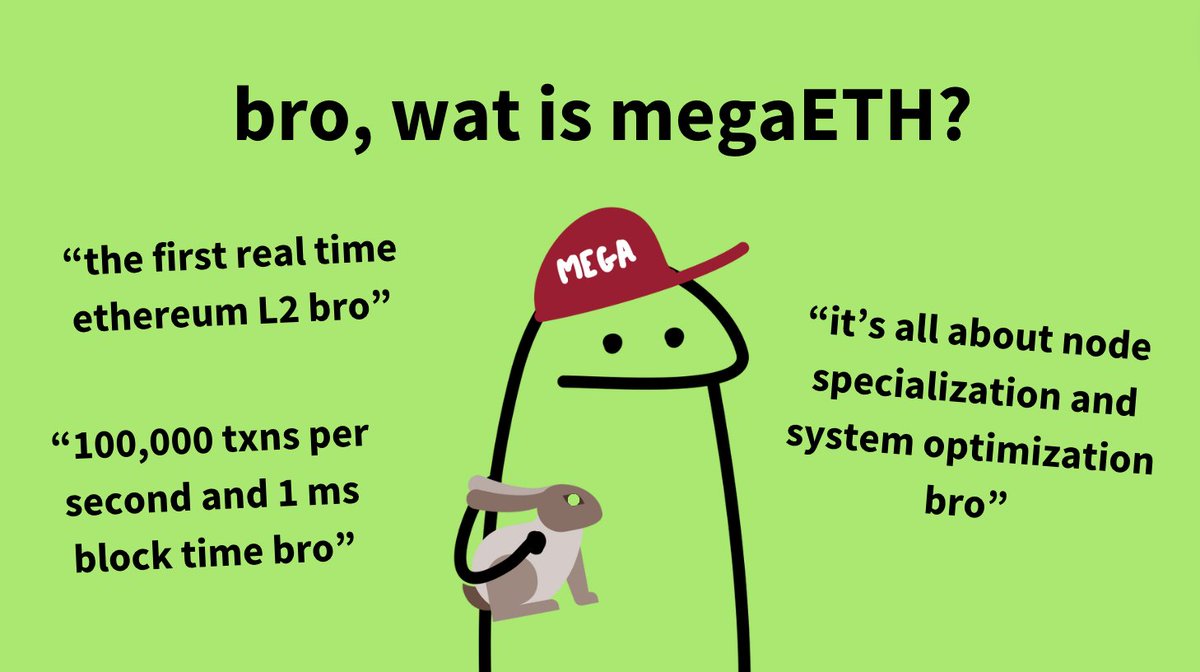
• @0xNairolf answers the quesition "bro, wat is megaeth?": [https://t.co/vETtodU6Rv]
• straight from the source, the @megaeth articulates why the world needs another chain: [https://t.co/wjEuEJEnr0]






![seyitaylor's tweet photo. Here are the [lightly edited] slides from my talk at Columbia Business School.
In this, I trace a history of business across media and commerce.
I attempt to show that all massive growth was as a result of distribution alpha. And the end of that alpha killed most of the businesses in that space.
There's a throwaway line about how DTC and Buzzfeed are in the same business. Please don't be mad.
Conclusions are simple:
✅ Distribution is the rate-limiting factor for most outsized returns.
✅All good things come to an end... Remember that when you're surfing a wave.
✅And remember to align your capital structure with the business you're building (or assessing).
Thanks @paulcanetti for the invite.
Link in the next tweet.](https://pbs.twimg.com/media/GT04Q8fWgAAYF-X.jpg)