For traders, the fee split matters more than the total. If parlays earn that much, the exchange has every reason to push combos, where the fee hides inside the price. Before buying a parlay, compare its price with the product of the single-leg prices.
Prediction-market exchanges charged ~$1.40B in trading fees in Q3.
Kalshi alone took $1.01B, or 72% of it. Its parlay fees by themselves out-earned Polymarket US.
Read the full State of Prediction Markets Q3 report. Link in comments 👇
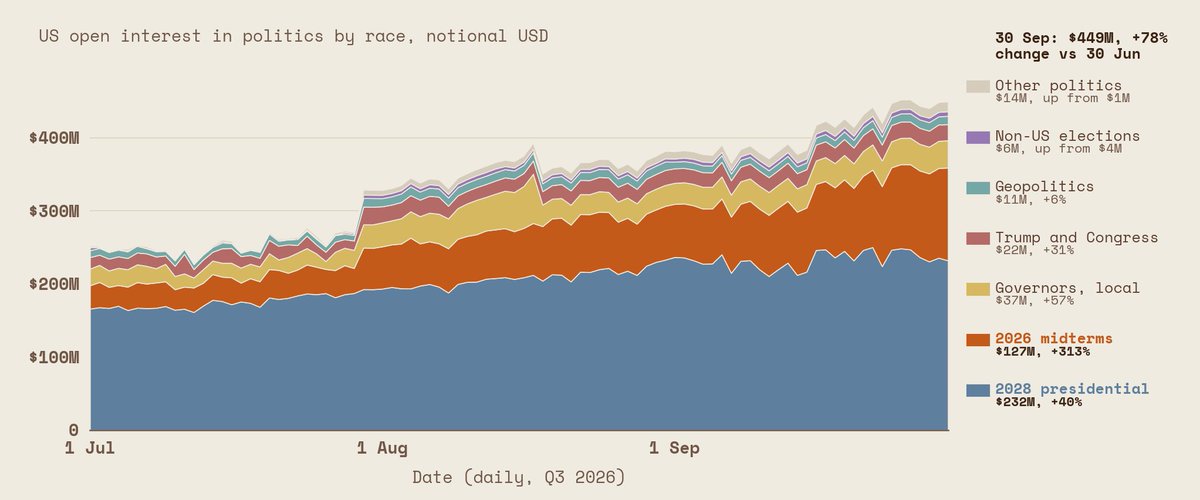
Political prediction markets get written off based on their volume.
Politics was 0.4% of all US PM trading in Q3, as per the @byPredicted Q3 report.
But open interest, the money people leave in a market, tells a different story.
Politics went from 17% to 23% of it in one quarter, adding $197M. Only parlays grew more.
These are long-dated markets, and they build slowly. Volume alone doesn't show it.
Proud that @americanspend data is behind some of the great insights in the newly published report on prediction markets from @byPredicted.
It's a fascinating look at an emerging industry using our model of the American economy.
I assume "most comprehensive PM report ever" was just hype, but no, this actually is the best *public* snapshot of what's happening in the space right now.
NEW: Our @bypredicted Q3 2026 State of Prediction Markets report is out.
With more data than ever.
More than half of Kalshi's card deposits now come from states where sports betting is illegal.
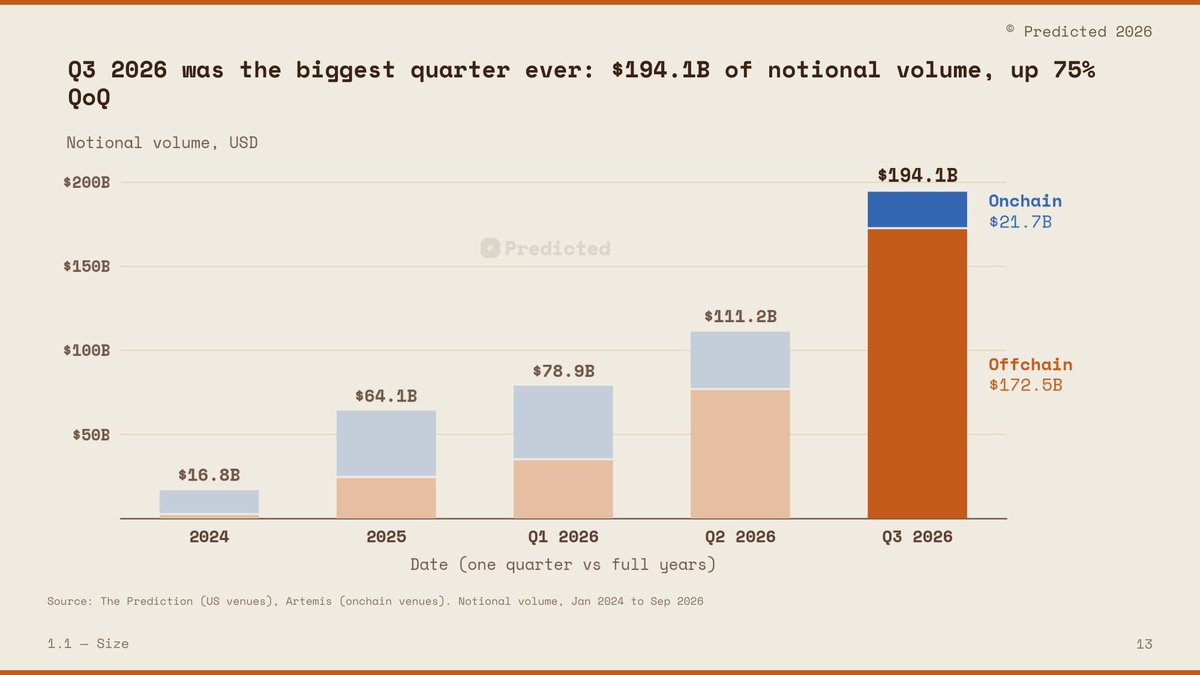
A $194.1B quarter, the biggest ever. 🧵
https://t.co/y5WRrqfigk
Think about ETFs for prediction markets!
CT is sleeping on partnerships like @Kalshi × @SPDJIndices.
H/t @byPredicted. More on the fast growth in Prediction markets, TradFi partnerships and overlooked trends in our revenue report: https://t.co/aZosspr3RX