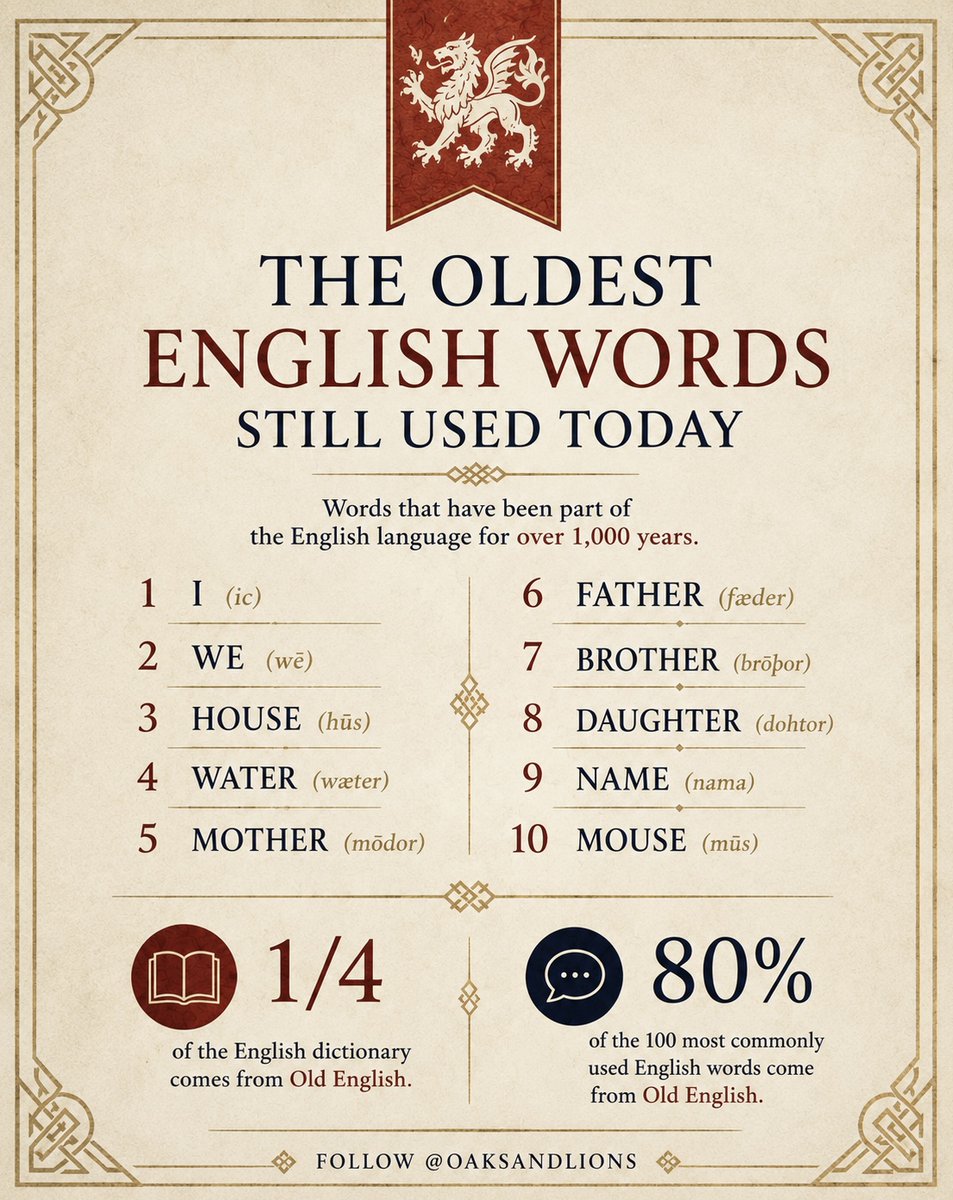
You have probably spoken Old English several times already today.
Although English has changed enormously over the last 1,500 years, many of our most common everyday words have survived since the days of the Anglo-Saxons.
Some of the oldest English words still in everyday use include:
• I (ic)
• We (wē)
• House (hūs)
• Water (wæter)
• Mother (mōdor)
• Father (fæder)
• Brother (brōþor)
• Name (nama)
• Night (niht)
• Mouse (mūs)
These words were already being spoken in England over 1,000 years ago, appearing in Old English texts dating from around AD 700–1000.
Here's the remarkable part:
Old English accounts for only around a quarter of the English dictionary, yet it provides around 80% of our most commonly used words.
The language has evolved, but the words we use most often have remained with us for more than a millennium.
Could you get through a conversation without using one of these Old English words?
Follow @oaksandlions for more interesting posts like this.
#English #EnglishHistory #AngloSaxon #OldEnglish
England's oldest surviving cookbook is over 600 years old.
Compiled around 1390 for King Richard II's royal kitchens, The Forme of Cury contains nearly 200 recipes ranging from roast meats and pies to spiced sauces and elaborate feasts.
Its name comes from the Middle English word cury, meaning cookery.
Among them were dishes flavoured with saffron, cinnamon, ginger and cloves, showing that medieval kitchens were far more sophisticated than many people imagine.
The manuscript still survives today, offering a direct link to the tastes of the fourteenth century.
Would you try a meal from medieval England?
Follow @oaksandlions for more on England’s history and heritage.
📷: Original Forme of Cury manuscript housed at the New York Public Library.
#England #EnglishHistory #EnglishHeritage #MedievalEngland
RAISED GARDEN BEDS
At a Senior Living Community
What an outstanding idea, whoever thought of this has a big heart and great compassion for those who suffer❣️