🚨New working paper tweet🚨
Many questions in economics involve the causal effects of treatments which are computed from multiple sources of variation, according to a known formula. Consider three examples. First, when estimating spillovers from a randomized intervention, one might count the number of an individual’s neighbors who were selected for the intervention. This spillover treatment combines variation in who was selected with variation in who neighbors whom. Second, in studies of transportation infrastructure effects, one might measure the growth of regional market access: a treatment computed from the location and timing of transportation upgrades and the spatial distribution of economic activity in a country. A third example is a treatment capturing individual eligibility for a public program, such as Medicaid, which is jointly determined by the eligibility policy in the individual’s state and her household’s demographics and income
This paper develops a new approach to estimating the effects of such composite variables when some, but not all, of their determinants are generated by a true or natural experiment. We ask, for example, how one can estimate market access effects by leveraging the timing of new railroad line construction as exogenous shocks, when the other determinants of market access (such as the pre-determined location of large markets and planned lines) are non-random
We first show that omitted variable bias (OVB) may confound conventional regression approaches in such settings. Bias arises from different observations receiving systematically different values of the treatment because of their individual non-random “exposure” to the exogenous shocks. For example, even when construction is delayed for a random set of lines, regions that are economically or geographically more central will tend to see a larger growth in market access because they are closer to a typical potential line. Regression estimation of market access effects then fails without an additional assumption on the exogeneity of economic geography: that more exposed (e.g., central) regions do not differ in their relevant unobservables, such as changes in local productivity or amenities. Intuitively, randomizing transportation upgrades does not randomize the market access growth generated by them
Our solution to the OVB challenge is based on the specification of counterfactual exogenous shocks that might as well have been realized. This approach views the observed shocks as one realization of some data-generating process—what we call the shock assignment process—which can be simulated to obtain counterfactuals. In a true experiment, the shock assignment process is given by the randomization protocol. In natural experiments, shock counterfactuals make explicit the contrasts which the researcher wishes to leverage, for instance by specifying permutations of the shocks that were as likely to have occurred. For example, if line construction delays are considered as-good-as-random, one might produce counterfactual network maps by randomly exchanging the lines which were completed earlier and later
Valid shock counterfactuals can be used to avoid OVB by a “recentering” procedure which involves measuring and appropriately adjusting for a single confounder: the expected treatment. To do so, a researcher draws counterfactual shocks from the assignment process and recomputes the instrument many times. Then, for each observation, the treatment is averaged across these many draws to obtain the expected treatment. Finally, the expected treatment is subtracted from the realized treatment to obtain the recentered treatment. We show that using this recentered treatment as an instrument for the realized treatment removes the bias from non-random shock exposure. Intuitively, observations only get high vs. low values of the recentered treatment because the observed shocks were drawn instead of the counterfactuals, which is assumed to happen by chance
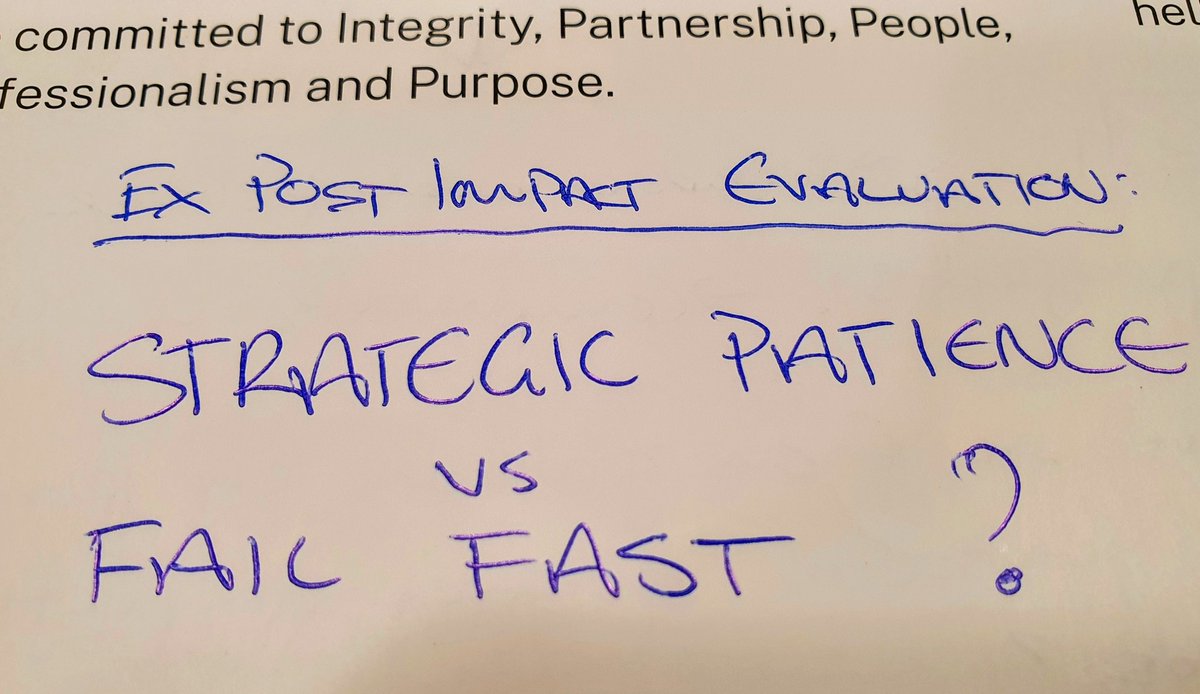
Is it time for new ex-post evaluation methods if our goals are long-term system change, and our key evaluation question is strategic patience (keep going) vs fail fast (stop investing)? #AAC2022
Panel with @CSIRO@ACIARAustralia@ANUCrawford@monicavanw @DrAlexPeralta
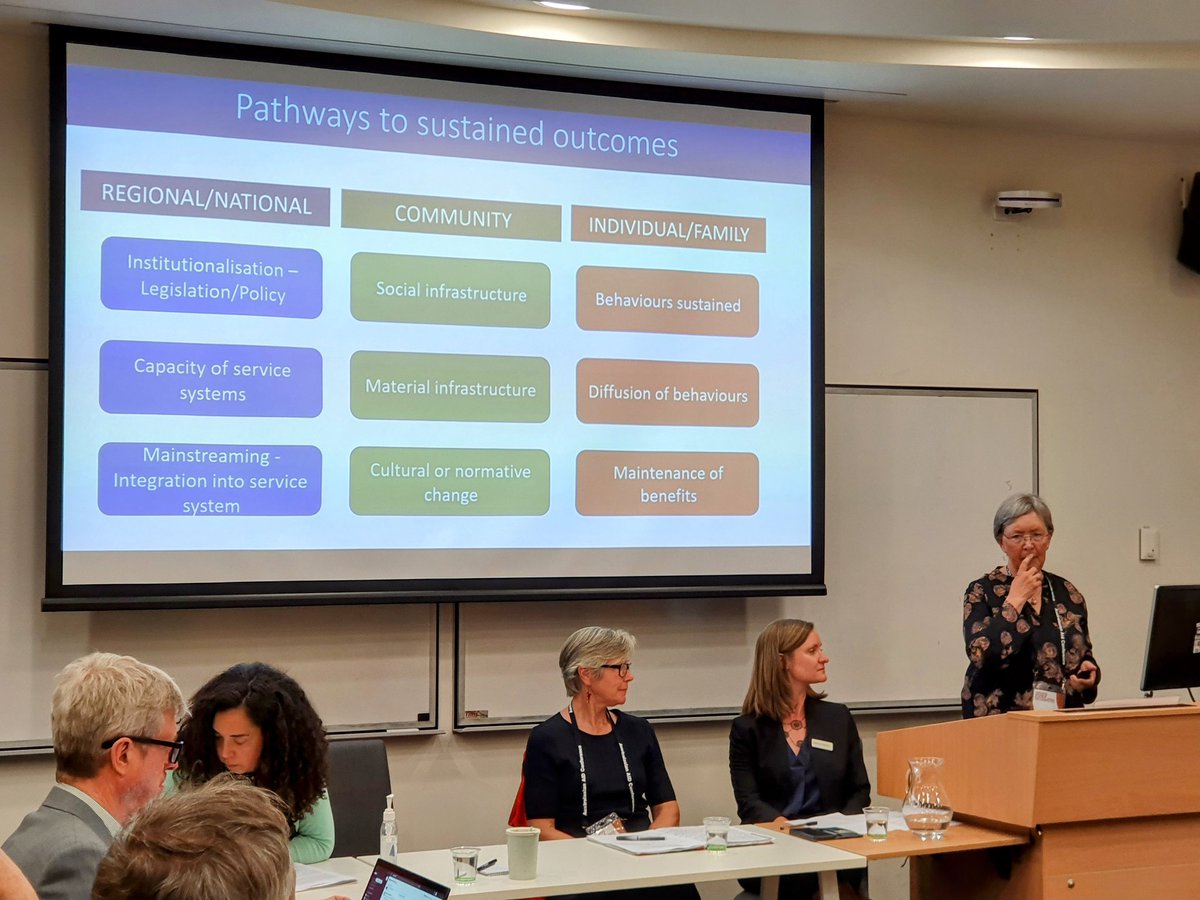
Gill Westhorp's nine mechanisms for sustained outcomes - "what works during an intervention is not the same as what works after an intervention". #aac2022
Panel with @CSIRO@ACIARAustralia@ANUCrawford@monicavanw @DrAlexPeralta
The Great #AAC2022 Debate: 'Geopolitical competiton is good for aid' in front of a packed audience.
Positive or negative, it's real. However, the ratio of aid (soft power) to military (hard power) spend has never been lower.🤷
@bridirice@stephendziedzic
@AdilNajam with a thought provoking speech at #AAC2022 - if we think climate change is as much of an urgent existential threat like covid, we can respond quickly with trilliona... so what's stopping us?
@phoenixvalue Important question.. need to also probe what are the triggers for increasing ones position (time? confirmed thesis? price movements?) and by how much..
@DividendGrowth @phoenixvalue A year to average in? Thats my challenge. How do you know when to increase your position? Its an oxymoron, but I find it easier to average down than average up. The curse of a value investor..
@BillBrewsterSCG @FoolAllTheTime Market over reacting to this. Two points: the market has assumed this new found technological will last forever; and its worthwhile noting a large part of Intel's revenue is not from microprocessors and is not impacted by Moore's Law race.
@abroninvestor How good are they at using the float? Historically they have had a substantial discount: 2019 (45%), 2018 (42%), 2017 (38%), 2016 (36%), 2015 (35%), 2014 (29%), 2013 (17%), 2012 (42%), 2011 (47%). Holding lots of bonds with low rates. Mean reversion seems pretty unlikely.
@SirBaby6 @BillBrewsterSCG @Post_Market Expecting decades more of compounding - most people haven't got past Use 19 of 1001, removing bug guts. https://t.co/zqtRqnur61
@InsidersABC@murpharoo Great in depth analysis by @murpharoo - wish all insiders panellists and discussions were like this. Clearly there are societal values at the heart of this debate which are often dumbed down to headlines.
@stig_brodersen@PrestonPysh@Greenbackd@harirama Great episode, the masterminds are a superb platform. I would have liked to have seen @harirama pitch Brookfield (Renewable) Energy Partners (NYSE:BEP) - same management issues, similar aggressive capital accumulation approach, but more "value" orientated than the property REIT.