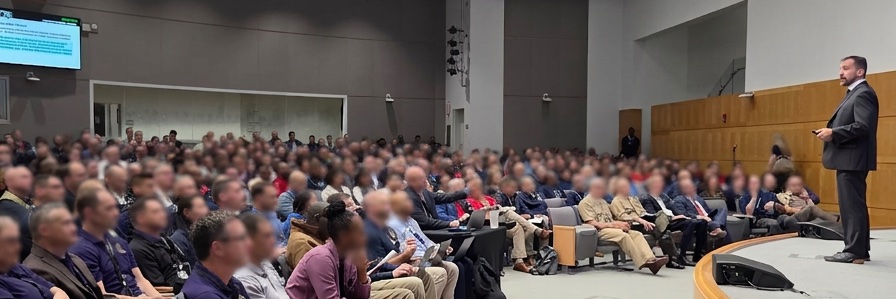
Hey folks- I will be doing this AI and future of conflict lecture at the Innovation Hub here in Colorado Springs with USSF and George Mason University. You can attend it live (if so, you get a special advanced copy of an upcoming AI monograph of mine) or you can dial in using the registration link below.
Pasting George Mason's instructions here:
Our next 𝗪𝗲𝗱𝗻𝗲𝘀𝗱𝗮𝘆 𝗪𝗶𝘀𝗱𝗼𝗺 𝗧𝗮𝗹𝗸𝘀 is right around the corner!
Join us as we welcome Dr. Ben Zweibelson, PhD, for a thought-provoking discussion on rethinking warfighting in an era of emerging technologies.
The event will be Wednesday, 𝗡𝗼𝘃𝗲𝗺𝗯𝗲𝗿 𝟭𝟴, from 𝟵:𝟬𝟬–𝟭𝟬:𝟬𝟬 𝗔𝗠 𝗠𝗧.
As artificial intelligence and emerging technologies continue to reshape the defense landscape, this conversation offers a great opportunity to challenge conventional thinking and explore what the future of warfare might look like.
Whether you're an industry professional, student, or simply interested in innovation and emerging technology, we encourage you to join us!
👉 There's still time to register: https://t.co/lqJzD4q88Z
We look forward to seeing you THIS Wednesday!
🚨 BREAKING: In a JAW-DROPPING first-time ever, Elon Musk's SpaceX just CAUGHT its Starship spacecraft with the tower's chopstick arms, and the team ERUPTS in celebration
"USA! USA!" chants BLASTING 🇺🇸
Starbase, TX has MADE HISTORY! Everyone is stunned!
Fully REUSABLE rockets are here
SpaceX had only caught the Super Heavy BOOSTER before, never the ship itself.
America is WINNING the space race and Elon's team is filled with PURE PATRIOTS
Tragic. Being older and perpetually in a state of "I want to train, but I need to go to work uninjured", I am extremely careful when I am applying a joint lock to my opponent (especially if they are lower belt and may not know what is about to happen). I even verbalize to the white belts "okay, this is going to go from nothing to something in about 2 seconds" and ensure they are tracking. Joint locks for me differ from chokes (not neck cranks) in that people know they are being choked. There is never a reason to say "I am so sorry" when you prioritize everyone's physical well-being over scoring some move for your own ego.
Bad War Stories is now at its lowest price on Amazon for a limited time- $8.30! If you need an additional stocking stuffer for a military person or history buff, consider checking this one out- https://t.co/UWYyfJLszz
How big is the black hole in M87?
In 2019, the Event Horizon Telescope measured its mass at 6.5 billion Suns (EHT Collaboration, ApJL 875, L6). Its event horizon works out to about 38 billion km across, roughly 1.5 light-days.
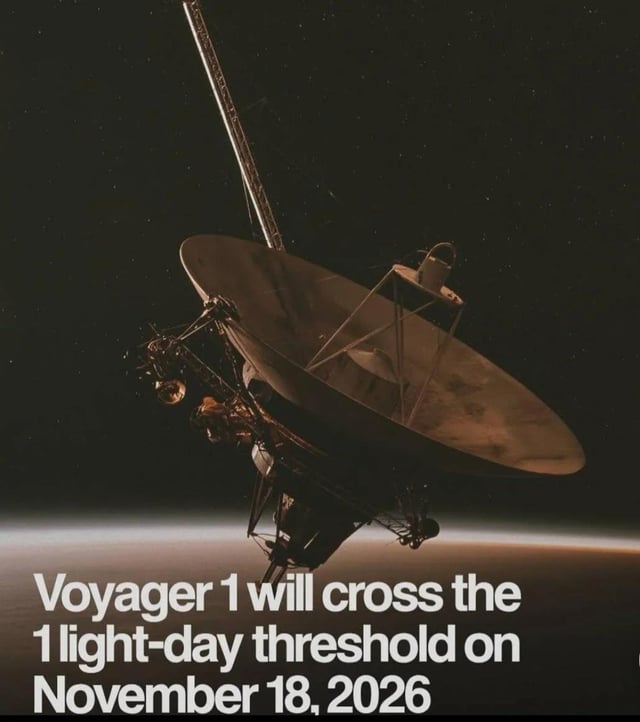
For scale: our whole planetary neighbourhood, Neptune and Pluto included, would sit comfortably inside it. Voyager 1 has been flying for 49 years and is only now approaching a distance of one light-day from Earth. It would still be crossing.
And it doesn't sit quietly. Its surroundings launch a jet visible for 5,000 light-years, first spotted in 1918 by Heber Curtis as "a curious straight ray". Its physical nature only began to become clear decades later.
Horizon size assumes no spin; rotation changes its size and geometry. Disk and jet shapes are illustrative.
The red dot right in the center of the frame is not just a speck of dust on the sensor. It’s one of the most distant galaxies we have ever seen.
Its light has been traveling to us for 13.3 billion years. We are seeing it as it was only 420 million years after the Big Bang — at a time when the universe was less than 3% of its current age. The first stars were just beginning to ignite, galaxies were only starting to assemble from gas, and space was still filled with a fog of neutral hydrogen.
This tiny red point sits almost at the very edge of what we can detect. Its red color comes from extreme redshift: the ultraviolet light of young stars has been stretched into the infrared and shifted into the red part of the spectrum. What looks like a barely visible dot is actually an entire early galaxy that existed when the first structures in the cosmos were only beginning to form.
Every object like this is a window into the era of cosmic dawn. It is precisely these “red dots” that force astronomers to rethink how quickly and efficiently the first galaxies appeared in the universe.
Nearly 49 years after its launch, Voyager 1 is about to achieve a historic first: the only human-made object ever to cross the one-light-day mark—roughly 16 billion miles from Earth—pushing humanity’s reach into the true depths of interstellar space.
Cover slide for my upcoming operational design, design theory, and strategic planning lecture to NDU for next week. I figured since there is an infamous video game coming out in NOV, I might as well capitalize on it for the lecture theme. This lecture follows a recent monograph I finished on this topic that is with a military publisher now.
I believe that in standing, my hips lower than opponent equals my advantage for take-down or throw. Once on ground, we enter into new dynamics where higher hips in a side or back take become risky... meaning a superior fighter will adjust hip to opponent hip as they transition through.
Humans in the loop, on the loop, behind the loop… or falling outside the loop due to AI manipulation of our reality; Epistemic collapse by design. This goes beyond “cognitive warfare” in alarming ways that are explained in this monograph section.
https://t.co/0ReIJTD4An
Quick announcement for some upcoming military design courses for DoW professionals:
Space-SOF-Cyber Innovation (SSCI)6-week course consisting of a 5-week asynchronous distance learning (DL) phase followed by a 5-day in-residence (IR) phase normally held in Colorado Springs.The five DL weeks are broken down into the following primers: 1) Irregular Warfare Primer, 2) SOF Primer, 3) Space Primer, 4) Cyber Primer, 5) Design PrimerSSCIC 27A:2 NOV - 4 DEC: Distance Learning (DL) Phase7-11 DEC: In-Residence (IR) Phase, Colorado Springs, CO----------------------------------------Space-Design amp; Innovation 101 (SDI)5-day in-residence (IR) design immersion course normally held in Colorado Springs.SDI101 27A:30 NOV - 4 DEC: In-Residence, Colorado Springs, CO----------------------------------------*** SSCI-SDI DESIGN IMMERSION PACKAGE ***Both SDI and SSCI are unique in their focus on and use of systemic design to address complex challenges facing warfighting institutions.SDI introduces participants to systemic design through an immersive design education experience. SSCI applies systemic design to explore the intersection of Space, Special Operations, and Cyber. Because systemic design is central to SSCI, the fifth and final week of SSCI’s distance learning phase serves as a Design https://t.co/QUghtINTzp increase accessibility and provide a deeper design immersion experience, SDI has been deliberately aligned with SSCI’s Design Primer week. This alignment allows participants to enroll in and simultaneously attend both courses together. Participants who attend SDI during this aligned week will receive an exemption from SSCI’s Design Primer.Dual-enrolled participants will complete the first four weeks of SSCI distance learning, then spend two consecutive weeks in residence in Colorado Springs. The first week will consist of SDI, followed immediately by the SSCI in-residence phase the second https://t.co/WFgMTs1lfW additional benefit is that dual-enrolled applicants will receive prioritized selection for SSCI.Attending SDI before the SSCI IR phase will significantly enhance the overall SSCI experience. In most cases, both courses will be held at the same location and in the same classroom. Its also worth noting that SDI may become a prerequisite for SSCI in the future.Note: SDI and SSCI are two separate courses. If interested in the Immersion Package, you will still need to apply separately for each.We hope you take advantage of the above opportunities and look forward to your participation.Please don’t hesitate to reach out to me with any questions.Attached is the SDI/SSCI Program Letter from the course director providing a deeper overview and explanation of the https://t.co/i7uU0RG5oY links to course descriptions and to apply for SDI and/or SSCI are provided at the NSSI portal: https://t.co/r9UaTmetZF
If the figure caught your eye, then you know the deal. We struggle with understanding systems thinking, design, complexity, and how to navigate organizations through chaos. Check out my latest SubStack and learn about this figure, where it comes from (originally 1990), and how I am adapting it to talk about NATO OPP, JPP, operational design, and strategic planning for an upcoming war college lecture in the next few weeks.
https://t.co/aIKWv3pxvM
Doing a George Mason "Wednesday Wisdom Talk" at the Innovation Hub here in Colorado Springs on November 18, 2026. I will present on "AI in Action: The Rise of the Machines" and include an upcoming AI paper on how this technology is disrupting how we understand war. The event is open to the public and details are available at the link below and the QR code. There is a registration requirement available at the link or QR site.
https://t.co/sO0c5mI7XU
This is interesting. Have always just hit a standing switch from that; never considered the kimura option. My concern is a talented opponent may quickly move to a takedown if one allows one's hips to remain clinched that close (standing switch helps with breaking their posture and separating our hips from their hips). But I will play with this tomorrow!