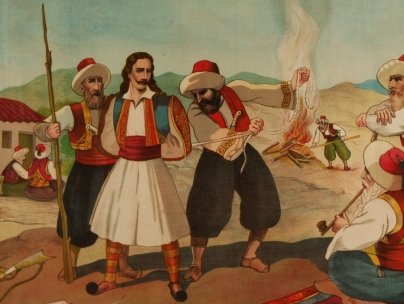
The Muslim Turks, in order to terrorize the Greeks, impaled and roasted alive Athanasios Diakos. But, they gave him a chance: “Will you become a Turk, Diakos? Will you change your faith? Will you pray in the mosque and abandon the church?”
He replied to them: “Go away, you and your faith, may you perish, you renegades! I was born a Greek, and as a Greek I shall die.”
According to eyewitness accounts from the time, two Turks lit a fire next to the stable and placed an iron grate and a large copper cauldron filled with oil over it. Then they lifted Diakos, still bound as he was, and made him sit on an old wooden stool. They raised his legs. The Turks began to mock him, asking him various questions. For every negative nod, they drove nails into his feet. Afterwards, they took the boiling oil and first poured it over his bare feet.
When they saw that he did not react, they tore his clothing and began pouring it on his back and chest. He groaned silently in pain, and the soldiers, under orders not to kill him, used needles to burst the blisters that had formed on his skin from the boiling oil. This continued for hours, until the next morning.
Exhausted as he was, they dragged him through the town to execute him. His execution was carried out in public view with the permission of Halil Bey, so that the Greeks would be warned about what would happen to anyone who dared to revolt. Testimonies state that even Diakos’s mother was present at his torture.
After tying him backwards onto a saddle with his legs spread apart, the executioner began pushing the sharp tip of a wooden stake into his groin area and then slowly drove it deeper, going all the way through his body until it emerged near his right ear. The executioner moved carefully, as he had orders not to kill him quickly; with every push of the stake, Diakos’s screams confirmed he was still alive.
Once the executioner had finished his work, the Turks tied the body tightly with the stake so that the skin would not tear, and they propped him up, almost upright, against a tree.
As he was dying, it is said that he uttered these sorrowful verses: “Look at the time Death has chosen to take me, now, when the branches are blossoming and the earth brings forth grass.”
Halil Bey gave the order to light a fire beneath him and to turn him slowly, so that he would be roasted alive like an animal.
After many hours of torture, the Greek chieftain passed away on April 24, 1821.
However, this had the opposite effect from what the Turks had expected.
When the Greeks learned of his story and his martyrdom, they were filled with even greater rage and strength to liberate themselves from the barbarous Muslims and Islam.
Athanasios Diakos is one of the most important heroes in the Greek history.
The Olympic Games should be held ONLY in Greece every 4 years. Participation only for countries that respect Greece, and only events that are related to athleticism. Enough with the circus & the clowns.
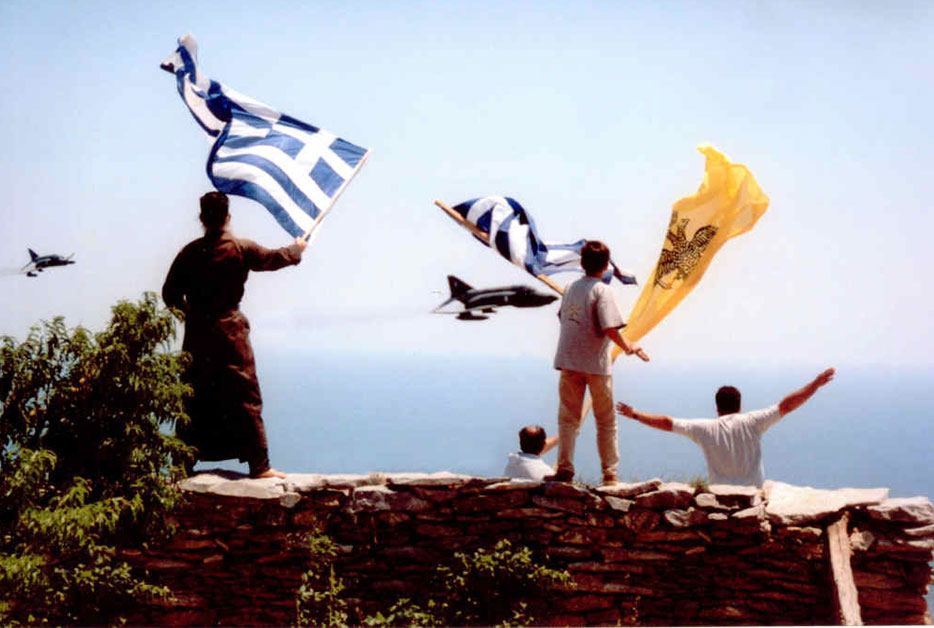
The Greek Orthodox Church has been chanting the Byzantine Greek hymn “Christos Anesti” (He is risen) continuously for 1600 years, in the same liturgy and language. The heart of the Empire still beats in Greece that patiently waiting for its revival.
“Turkey is a NATO country”
Turkey was in NATO when they invaded Cyprus in 1974 and they threat Greece (another NATO member) with war every single day. Of course you won’t talk about that. Everything is about Israel nowadays. You don’t even know where Turkey and Greece are in map
Palantir CTO @ssankar in 2024:
“For $10 billion, @elonmusk put 300 rockets in orbit.”
“For $11 billion the state of California has built 1600ft of elevated rail, with no rail.”
On March 30, 1822, when the massacre in Chios began, the Muslim Turks had clear orders. The Sultan had commanded that all Greek Christians be slaughtered, except for boys aged 3-12 and women from 12 to 40. These would be captured and destined for the slave markets.
Young girls were raped publicly in the streets, and newlyweds in front of their husbands, who were then slaughtered. Others were raped in front of their parents, after which the men's genitals were cut off. Women over 40 were set on fire and left to burn alive. Pregnant women had their bellies ripped open and their fetuses pulled out, while small children were thrown forcefully against rocks. The frenzy of the Muslims was unprecedented.
Many Turkish soldiers cut off the heads of Greek Christians and then licked their swords. With this act, they believed they would earn a place in paradise. Others were hanged from the island's trees for deterrence. Severed human limbs and corpses were scattered on the streets, while the sea had turned red from the blood. The smoke from the burning houses had covered all of Chios, while the flames made the night look like day.Several women from Chios preferred death over dishonor and slavery.
They committed suicide by jumping off cliffs. Some were killed while defending their children, siblings, and husbands. Even among those who were captured, some died on hunger strike.Destitute women and children from the island were crammed into ships and transported to the markets of Smyrna and Constantinople, where they were sold as slaves at humiliating prices.
By May 1, 1822, over 41.000 slave ownership documents, known as "teskerés", had been issued in Chios. According to the French-language newspaper of Smyrna, Spectateur Oriental, by May 10, duties had been paid at the Smyrna customs for 40,000 slaves. The priest Welsh from the English embassy in Constantinople recorded what he saw in those days at the city's slave market:
"The Turks treated the women from Chios with utmost contempt. They examined them, groped them like butchers do lambs, and bought them for 100 grosia to 3 pounds per head. About 500 women from Chios were sold in the fish market."
The tragic events of Chios shocked Europe and America. For many weeks, the European press reported daily information and descriptions about the fate of the inhabitants, the massacres, the plunder, and the sale of women and children in the slave markets.
Korais writes in a letter to Varvakis: "Imagine that you see Christ on the Cross, drenched in His blood, and calling out to you these paternal words: My son Varvakis, many thousands of captives baptized in my name are in danger at this hour of renouncing me and embracing the abominable religion of Mohammed. Behold the time, baptized in my name, beloved son, to save your baptized brothers from the Turkish defilement."
The horrific images of the crimes of the Muslims against the Greek Christians were never erased from the collective memory of Europeans. Great European artists were so shocked by the descriptions that they created important works inspired by Chios.
The famous painting by Delacroix is exhibited to this day in a prominent position at the Louvre. Victor Hugo's poem titled "The Greek Child" is a moving record. But the most famous sculpture of 19th-century America also stands out, named: the "Greek Slave." The sculptor Hiram Powers began carving it about twenty years after the tragic events. The statue depicts a young woman, nude, bound with chains. In one hand, she holds a small cross on a chain.
Powers himself describes the subject of his work as follows:
"The Slave has been abducted by the Turks from one of the Greek Islands during the Greek Revolution, the history of which is known to all. Her father and mother, and perhaps all her relatives, have been exterminated by her enemies, and she alone was kept alive, as a treasure that could not be thrown away. Now she is among barbarian strangers, under the pressure of the full recollection of the catastrophic events that led her to this state. She stands exposed to the gaze of people she abhors, and awaits her fate with intense anxiety, which is mitigated by her trust in the goodness of God. Gather all these sufferings together, and add to them the strength and resignation of a Christian, and there is no room left for shame."
(You can search for the sculpture to see it; I'm not uploading it because X might take down the post for sensitive content.)
As a Greek, I will use my weapon, the knowledge of my history, to warn as many as I can about the violent and barbaric invasion of Islam and the war we are experiencing today.
I will do whatever I can to warn you.
- Homer Pavlos
As soon as the Greek Revolution of 1821 broke out, the Muslim Turks, in their efforts to intimidate the rebels, butchered those they captured or threw them to the ground and slaughtered them like animals. In some cases, they exceeded the bounds of brutality.
In Patras, they captured a father and son, impaled them, lit a fire, and forced the other captives to roast them like lambs. Ali Pasha, in this regard, was more inventive: when he impaled Christians, he forced their relatives to turn the spit, threatening that if they refused, he would impale them as well.
Immediately after the hanging of Patriarch Gregory V in Constantinople, the Turks also hanged three metropolitans in various parts of the city. However, one of them, the very elderly Metropolitan of Nicomedia, breathed his last before reaching the place of execution.
After the hanging of the Patriarch, the Turks engaged daily in massacres of Christians who were trying to escape from the City. Then the Sultan sent a firman to the Patriarchate prohibiting the departure of Christians from Constantinople, making them collectively responsible in groups of five. This meant that if one from a group of five escaped, the remaining four would pay with their lives. Thus, the Greeks had to choose between the very likely massacre if they stayed, or the certain massacre if one of the five managed to escape.
The revolution in Macedonia was drowned in an ocean of blood. Five thousand Greeks were slaughtered in Naousa, the rest were sold in slave markets, and the entire city was turned to ashes. The Pasha of Thessaloniki, Abdul Abud, who had set as his goal the annihilation of the Greeks, burned 120 villages and exterminated their inhabitants.
Among the leaders of the Revolution, Zafeirakis was killed in Veroia, Gatsos and Karatasos escaped, while the fate of their wives was harsh; with horrific threats, Abdul Abud sought to force them to convert to Islam. They refused. The two wives were tortured to death in front of the governor's mansion. They were placed up to their necks in sacks filled with mice and cats, and the wife of Karatasos, before expiring, in a sack filled with snakes.
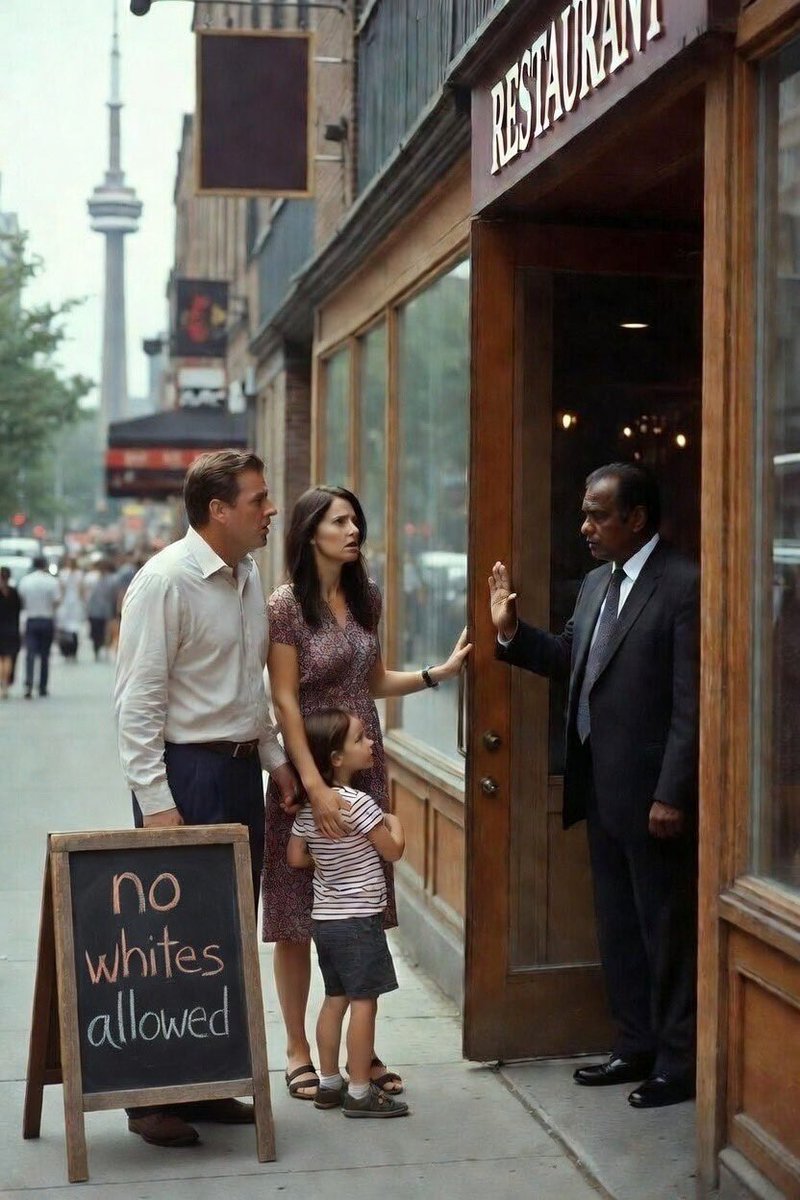
Canada's war on white people.
Top ten examples.
Are we becoming an apartheid state?
1. Race based hiring: Public jobs and universities enforce quotas favoring visible minorities and Indigenous (research chairs, exclusive clusters).
2. Quebec tribunal: Job excluding whites dismissed as non discriminatory and ideological.
3. CBC kids show: Casting any race except Caucasian.
4. Loans and grants: 250k plus for Black entrepreneurs and immigrants. No white equivalents.
5. Two tier justice: Migrants get lighter sentences to avoid deportation.
6. Scholarships: Many for Black Indigenous BIPOC only. No white versions.
7. CBC dating site exposure: Investigated and exposed users of WhiteDate (white only supremacist linked) while ethnic apps Black Jewish Muslim Arab ignored.
8. MAiD stats: About 100k killed by MAiD and 96 percent white recipients (above population share).
9. Selective enforcement: White Lives Matter sticker on Black councillor's ad in Hamilton 2022 sparked immediate hate crime police probe. Rare for similar group messaging.
10. Media exposure leading to firing: Rachel Gilmore exposed ex Olympic bobsledder Giulio Zardo in white nationalist fight club gym. He was fired from coaching job.
End race based perks or make them equal for everyone. Thoughts? 🇨🇦
Sources in comments.
19 year old Iranian wrestling champion Saleh Mohammadi was just publicly executed for protesting against the Islamic Regime.
So, to all liberal Westerners:
Watch and learn.
This is what it’s like to ACTUALLY live in a nation with no free speech.
A Muslim tries to interrupt a Greek Orthodox liturgy in Greece, like they do in the rest of Europe, but it's not working in Greece. If you don't respect us you are going to have a problem. Get out of my country, filthy barbarians.
On March 30, 1822, the Chios Massacre took place. The Muslim Turks slaughtered 42.000 women, men & children (Greek Christians). Additionally, 52.000 were sold as slaves in the markets of Smyrna & Constantinople.
A powerful scene in the Odyssey happens when Odysseus finally returns to Ithaca after twenty years of war and wandering.
You would expect the story to end with celebration, with the hero coming home, the family reunited, and order restored.
Homer does something far stranger.
Odysseus arrives disguised as a beggar, because Athena warns him that the palace has been taken over by more than a hundred suitors who have been living there for years, eating his food, drinking his wine, and pressuring his wife Penelope to marry one of them.
They believe Odysseus is dead and in their minds the kingdom is already theirs.
So the king of Ithaca walks through his own halls dressed in rags while the men stealing his house sit comfortably at his tables. They mock him, throw scraps at him, and one of them even strikes him, and Odysseus takes it. That is the remarkable part, because the same man who blinded the Cyclops and survived twenty years of disasters now stands quietly while strangers insult him in his own home. Homer tells us his heart burns inside his chest and that he wants to attack them immediately, yet he restrains himself and waits.
Instead of striking, Odysseus studies the room carefully. He counts the men, watches their habits, and quietly observes which servants remain loyal and which have betrayed him. The hero of the Odyssey does something most people cannot do, which is delay revenge until the moment is right.
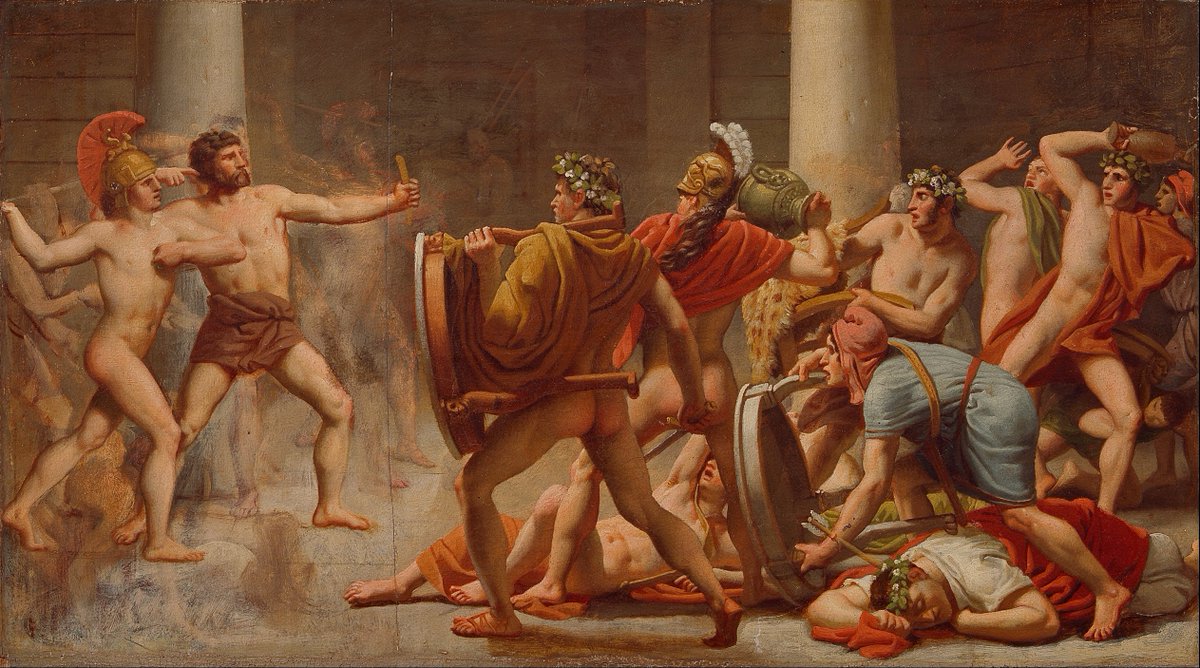
Eventually Penelope announces a contest and brings out Odysseus’ great bow, declaring that she will marry the man who can string it and shoot an arrow through twelve axe heads lined up in a row. One by one the suitors try and fail, because none of them can even bend the bow. Then the beggar asks for a turn. The suitors laugh at first, but the bow is eventually handed to him.
Odysseus takes it in his hands and strings it effortlessly. Homer says the sound of the bowstring tightening rings through the hall like the note of a swallow. Then he places an arrow on the string and sends it cleanly through all twelve axe heads.
In that moment the beggar disappears. Odysseus turns the bow toward the suitors and reveals who he is.
What follows is one of the most brutal scenes in Greek literature. The doors are sealed and the suitors realize too late that they are trapped inside the hall. Odysseus, his son Telemachus, and two loyal servants begin killing them one by one. There is no escape, no mercy, and no negotiation. The men who spent years consuming another man’s house die inside it.
It is a violent ending, but Homer wants you to understand something important. The real danger to Odysseus was never just the monsters and storms on the long journey home. It was the possibility that someone else might take his place while he was gone. When Odysseus finally returns, he reminds everyone in Ithaca of a simple truth: a man’s home is not truly his unless he is willing to fight for it.
Fearless Greek MEP exposes Turkish dictator:
"Erdogan is a dictator. His country is heavily involved in criminal activities and shows no respect for human rights, even deporting journalists."
Why is Europe still doing business with Erdogan?