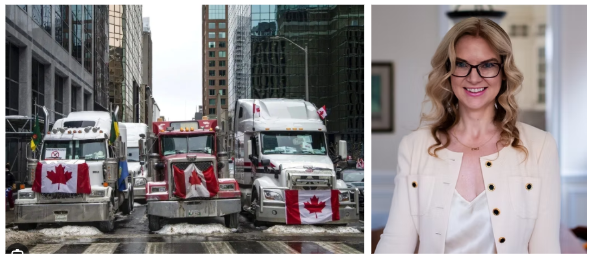
The Federal Court of Appeal has confirmed: the use of the Emergencies Act to crush the Freedom Convoy was unconstitutional. 🇨🇦
A massive congratulations to Christine Van Geyn and the Canadian Constitution Foundation (@CDNConstFound). You have rendered an immense service to the people of Canada by leading this legal fight! ⚖️
Our analysis of the original Federal Court ruling: https://t.co/qeTa1VlRfa
Historically, figures such as Richmond Shakespear and Alexander Mackenzie were expected to become self-reliant while still young, forging their own paths in a world with few social safety nets. Many other prominent historical figures — including William Wilberforce, William Pitt the Younger and Napoleon Bonaparte — assumed immense responsibility and achieved extraordinary things at remarkably young ages.
Necessity often pushed earlier generations toward lives marked by hardship, risk and adventure. Modern society, by contrast, with its expansive welfare state and culture of protection, increasingly fosters a prolonged adolescence in which many young adults remain dependent far longer, delaying maturity and avoiding uncertainty.
Read the full story: https://t.co/wS2RgJMEiU
Canada faces a nation-wide labour productivity crisis that has garnered much attention from financial institutions and governments. But a sneakier and under-reported “micro-productivity crisis” is also impeding Canadians’ personal, daily life. This crisis involves many small irritants that bit-by-bit sap our ability to get things done.
Technology was meant to free up time. But endless online obstacles and complications – including such things as two-step verification, CAPTCHA tests and other security measures – now slow down bill payments and other online transactions. Given these complications, paying bill might have been quicker in the bygone postal era.
Lengthy customer surveys and incessant online alerts have become time-wasting rituals. Online surveys often ask pointless questions and go on and on, wasting the time of customers who were generous enough with their time to agree to complete the survey in the first place.
Even streaming services are now wasting their viewers’ time. According to actor Matt Damon, Netflix now tells its screenwriters “It wouldn’t be terrible if you reiterated the plot three or four times in the dialogue” because people watching on their phones aren’t paying close attention. This means anyone who is paying attention is forced to sit through characters endlessly repeating the plot.
Many cities intentionally waste their residents’ time by engaging in "traffic calming" measures that make roads slower, narrower or more difficult to drive on. In 2024, Toronto renovated a portion of Bloor St. West as part of “Complete Streets” program. As a result, commuters now face a six-minute daily increase in travel times over this short stretch of road. In an entire working year, that adds up to more than a 24-hours of lost time.
Canada’s micro-productivity crisis is just as significant as the macro-version. The solution is for governments and businesses to start recognizing that their time is precious to taxpayers and customers. It shouldn’t be wasted.
An adventurous life: In 1898, Martha Purdy left her husband for the Klondike Gold Rush in Dawson City, Yukon, first crossing the treacherous Chilkoot Pass. Remarried as Martha Black, she became a successful business owner, renowned botanist and the second woman elected to Canada’s Parliament.
Read our latest story here: https://t.co/wS2RgJMEiU
Past generations, exemplified by figures such as British army officer Richmond Shakespear, explorer Alexander Mackenzie and botanist and business owner Martha Purdy, undertook extraordinary ventures driven by greater purposes: duty, exploration, curiosity, necessity. Unlike many in today’s risk-averse culture, these individuals faced danger and uncertainty young. They weren't exceptional outliers; in their era, assuming responsibility early was regarded as a normal part of adulthood.
Read the full story: https://t.co/wS2RgJMEiU
A B.C. court ruling in January 2026 on Metlakatla First Nation v. Prince Rupert Port Authority threatens the certainty of contract law in Canada, turning the threat of aboriginal title into the legal weapon.
The Metlakatla (pop. 1,102) hold a functional veto over resource development throughout their “traditional territory” that covers a vast swath of northern B.C. This allows them to extract cash payments, equity shares and guaranteed jobs from any resource project in the region.
The current dispute centres on REEF, a $1.3 billion propane export facility at Prince Rupert that has an exclusive contract with the port authority to export liquid petroleum gas (LPG). In 2023 MFN gave its consent to the REEF project in exchange for millions of dollars in financial benefits.
Trigon, a rival exporter partly owned by MFN, now wants the port authority to break its exclusive contract with REEF based on a constitutional “Duty to Consult”. In essence, the native group is arguing that its aboriginal title supersedes contract law. The B.C. Supreme Court has said the case can proceed to trial.
On February 4, 2026, MFN withdrew its previous consent for REEF and said it will refuse to participate in any future consultations. It intends to hold this $1.3 billion energy project hostage until it gets what it wants.
If aboriginal title can override a signed contract, no resource project will ever be safe in Canada. International investors will refuse to put their money into Canada if any signed contract can be dismantled by aboriginal title. As the author asks, if governments must abide by the “Honour of the Crown” shouldn’t native business partners by bound by a similar requirement to honour the deals they sign?
In 1793, Scottish-born explorer Alexander Mackenzie endured immense hardships to become the first European to reach the Pacific Ocean overland, painting his historic feat on a stone at Bella Coola, British Columbia. His legendary journey represents a spirit of purposeful risk and endurance that has all but disappeared in a modern society obsessed with enforcing a zero-tolerance safety culture.
Read our latest story here: https://t.co/wS2RgJMEiU
Artists once served universal truths like beauty and memory, but today, free-roaming imagination is cast as “cultural appropriation.” What matters now is the artist's ego and “lived experience” more than the art itself, fuelling not just a culture war, but a war on culture.
Political philosopher Richard Weaver diagnosed modern humanity’s disease decades ago: the individual is the sole measure of value. This destroys craftsmanship in work and form in art as the egotist “thinks not of subordinating self to end but of subordinating end to self.”
Arts institutions prioritize identity or “positionality” as credentials for legitimacy, making the work secondary. E.g., Vancouver's PuSh Festival cancelled Christopher Morris’s The Runner because the Canadian artist lacked “religious or cultural ties” to the region he portrayed.
But instead of protecting minorities, this invented doctrine of “cultural appropriation” limits creative imagination. Hal Niedzviecki, who urged writers to imagine across cultures, was pushed out. Art is damaged when the artist is barred from exploring reality in all its fullness.
Funding bodies like the Canada Council for the Arts embed DEI ideology into their operations. This teaches artists to conform to a specific vocabulary, prioritizing “equity” and “lived experience” over diversity of thought – plus often disdains accessible, popular craftsmanship.
Conservatives are losing this struggle. Progressives built airless institutions – while conservatives built complaint machines. If we truly desire a viable culture, conservatives need to get back in the game. Art and culture aren’t luxuries; civilization depends on them.
Read the full story:
https://t.co/7m5K8Ygv2D
Modern thrill-seeking, such as BASE jumping or big-wave surfing, often involves risk for its own sake, driven by self-gratification. This contrasts sharply with historical adventure, when men and women of the past undertook grave risks for higher aims, like duty, patriotism, religion or survival. What separated them wasn’t courage; it was purpose.
Read the full story: https://t.co/wS2RgJMEiU
In 1840, British army officer Richmond Shakespear travelled in disguise to the khanate of Khiva to convince a local khan to release 416 enslaved Russians and stave off a potential Russian invasion. He was knighted for a daring rescue rooted in courage and duty — a stark contrast to a world that now treats risk aversion as a moral good.
Read our latest story here: https://t.co/wS2RgJMEiU
Why were previous generations so much more adventurous? It sprang from a value system that regarded courage, daring and risk-taking as a social virtue. Society needs to shake off its smothering safety culture and rediscover that sense of adventure. It could build a better world.
In 1840, British army officer Lt. Richmond Shakespear undertook a dangerous 1,100 km journey through central Asia. He then bluffed the khan of Khiva into releasing 416 Russian slaves and personally led them to safety, thus preventing a Russian invasion. He was only 28 years old at the time, and was later knighted by Queen Victoria for his daring rescue.
Alexander Mackenzie entered the fur trade at the age of 15 and later became the first European to cross North America to the Pacific Ocean. Martha Black, the second women elected to Canada’s Parliament, was a participant in the Klondike gold rush and a renowned botanist. This willingness to explore the world was once commonplace throughout society. Today, young adults struggle to move out of their parents’ houses.
Modern society has created a “bubble-wrapped world” that regards risk avoidance as a social duty. An oppressive safety culture demands such things as trigger warnings, safe spaces and schoolyard snowball bans. All this denies children any exposure to risk and fosters perpetual childhood.
True adventure is still possible today. While there are fewer places left to discover, adventurousness should be considered a spirit rather than a destination. It is fueled by a curiosity about the world and an openness to experiencing new things. Wherever uncertainty lies, adventure follows.
Read the full story:
https://t.co/wS2RgJMEiU
The aggressive enforcement of risk avoidance has become a hallmark of our modern public life. From trigger warnings and safe spaces to mandatory helmet laws and bans on fireworks, safety culture has permeated everyday experiences, childhood especially. Children are increasingly denied experiences that might expose them to risk or misadventure. The result is a generation conditioned to embrace fragility and fear the unknown.
Read the full story: https://t.co/wS2RgJMEiU
The political man has falsely cast the modern state as the guardian of Western civilization when in reality it is a destructive leviathan. The apolitical man and woman, author David Solway concludes, remain the West’s last best hope.
Read the full story: https://t.co/ThJTDDma7m
The classical buildings still stand – but, as author David Solway notes,
the inner life of Western civilization has quietly left the building.
Read the full story: https://t.co/ThJTDDma7m
In its many intellectual and artistic dimensions reaching to the greatest expressions of high culture, play is an essential component and mark of a flourishing civilization.
Read the full story: https://t.co/ThJTDDma7m
Johan Huizinga, in Homo Ludens, argued that play is a foundational element of higher civilization, underlying art, law, science and even politics itself. This instinct for play — an essentially apolitical capacity — precedes both culture and the emergence of civilization.
Read the full story: https://t.co/kvtcnejAQr
In Democracy in America, early 19th century French political philosopher Alexis de Tocqueville famously predicted a devolution from self-reliance and broad liberty to comprehensive state control through “a net-work of small complicated rules, minute and uniform through which the most original minds” – i.e., apolitical men – “cannot penetrate.” At bottom, County Election, by George Caleb Bingham, 1852.
Read the full story: https://t.co/kvtcnejAQr
Political states, whether despotic or democratic, establish systems of legal, economic and administrative control over society. Though they differ in form, both tend toward the steady expansion of political management into ever-wider areas of human life. Russian philosopher Nicolai Berdyaev warned that when the state pursues collective perfection whether through ideology, equality or security — it often does so at the expense of individual freedom. In its attempt to organize society into a fully manageable order, the state risks reducing human beings to political units, diminishing creativity and the deeper dimensions of human flourishing.
Read the full story: https://t.co/kvtcnejAQr