🎉 Congratulations 🎉 to @cenmag 's Mitch Jacoby !
He's the 2023 awardee of the @AmerChemSociety James T. Grady-James H. Stack Award for Interpreting Chemistry for the Public
Jacoby is an @NUChemistry grad and @chicago based journalist
1/n
https://t.co/XqPUM1M1CS
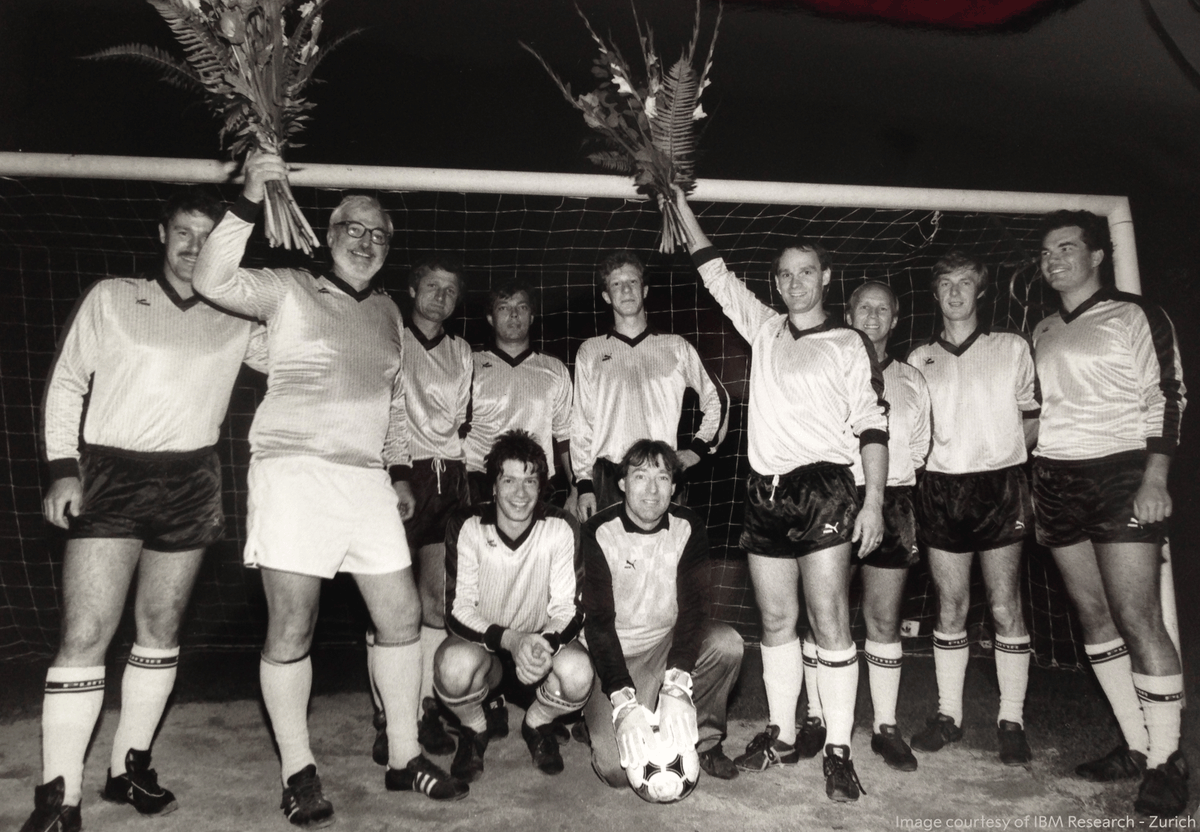
On October 15, 1986, the football teams of IBM Zurich Laboratory and Dow Chemical were due to play a game against each other. But it was almost derailed by a sudden announcement made just a few hours before kick-off.
The sudden announcement was that two of the IBM players – Gerd Binnig (right, holding flowers) and Heinrich Rohrer (left, holding flowers) had been awarded the Nobel Prize in Physics.
The two laureates were rushed off to a press conference, but they insisted the conference end on time because their football team needed them. Although IBM lost the match 2-4 they still had a reason to celebrate.
Loggerhead sea turtles 🐢 don’t just migrate willy-nilly. As it turns out, they follow a narrow band of ideal chlorophyll and heat levels—which stretches across the Pacific and moves north and south with the seasons!
In honor of #WorldSeaTurtleDay, see how data collected from tagged turtles and @NOAA’s #satellites reveals this migration pattern!
Reprezentacja Haiti na oficjalnych koszulkach w których zagra na Mistrzostwach Świata umieściła POLSKĄ FLAGĘ!
To nie błąd projektanta ani przypadek – to wyjątkowy gest pełen szacunku, który porusza serce każdego Polaka. W 1802 roku Napoleon wysłał kilka tysięcy żołnierzy z Polskich Legionów na San Domingo (obecne Haiti), żeby zdławić tamtejsze powstanie niewolników. Polacy jednak wybrali inną drogę. Zamiast walczyć przeciwko walczącym o wolność, wielu z nich przeszło na stronę powstańców i stanęło do walki ramię w ramię z Haitańczykami przeciwko wojskom francuskim. Po zwycięstwie rewolucji i ogłoszeniu niepodległości w 1804 roku, pierwszy przywódca Haiti – Jean-Jacques Dessalines – oddał Polakom wielki hołd. Przyznał im pełne obywatelstwo, a w konstytucji nazwał ich „Białymi Murzynami Europy”. Były to słowa najwyższego uznania i braterstwa w tamtych czasach. Część polskich żołnierzy (ok. 400–500) została na wyspie na stałe, głównie w regionie Cazale, gdzie ich potomkowie mieszkają do dzisiaj. Dziś, ponad dwieście lat później, pamięć o polskiej odwadze i solidarności wciąż żyje na Haiti. Kiedy ich piłkarze wychodzą na murawę, niosą na piersi symbol naszej wspólnej historii – historii walki o wolność, która nie zna granic ani koloru skóry.
Same concept operates here in #Chicago. We make ice at night when baseload electricity needs a use, then supply cold water to downtown buildings in the Loop.
https://t.co/6OlZujcDDD
The French hate air conditioning.
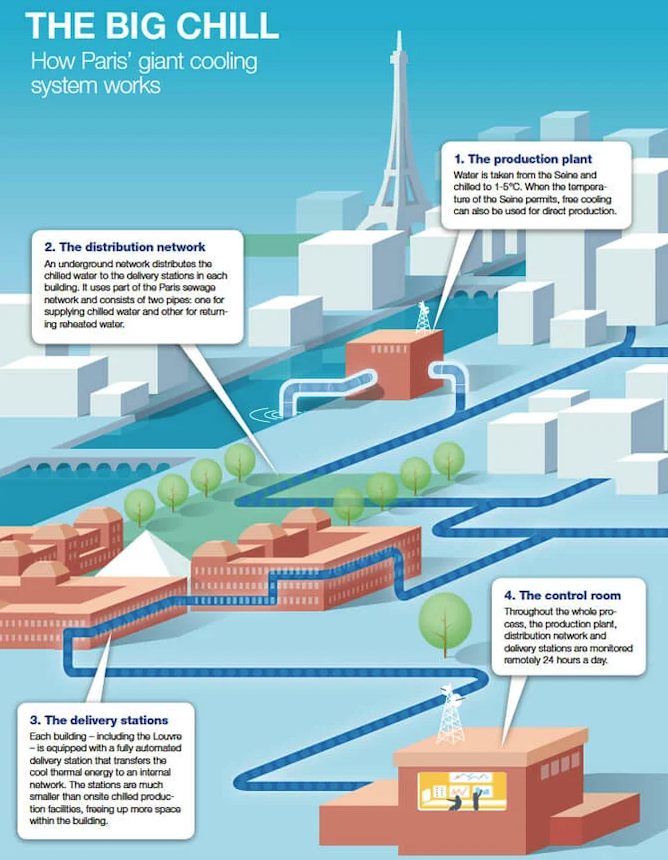
So Paris built a 120-kilometre machine under its streets for producing cold.
It’s called Fraîcheur de Paris, and it does for summer heat what district heating did for winter: centralise the problem.
Instead of every museum, office, hotel, hospital and shop bolting its own cooling plant onto the building, Paris moves cold through pipes.
The network sends water chilled to 2 to 4°C through buried supply lines. The water enters a connected building, absorbs heat through an exchange station, then returns at 12 to 14°C to be cooled again.
It essentially functions with two pipes. One carries the cold out, the other carries heat back.
The production plants cool the circuit from 12°C to 4°C. Some sites use the Seine as a heat sink. In colder periods, the system can use the river’s own temperature for free cooling, which means the machines work less and the electricity demand drops. The Seine water doesn’t become the building water. It stays separate, passing temperature across heat exchangers.
The scale is pretty strange when you see it written down though.
It's got 15 production sites, 4 storage sites, 120 km of underground network with 924 subscribers. This has resulted in 7 million square metres cooled, and 493 GWh of cooling sold.
A cold utility running beneath one of the densest cities in Europe.
The Forum des Halles has been cooled this way since 1979. The Louvre since 1986. Galeries Lafayette, Opéra Garnier, Hôtel de Ville, Station F, La Samaritaine and the National Assembly all sit on the same idea. Tourists stand in the Louvre looking at paintings while a municipal cold loop does part of the dull work below ground.
The boring part is the breakthrough.
Cold can be stored at night in chilled water or ice, then used during daytime peaks. The network is monitored from a control room with more than 125,000 control points. A delivery station inside a building takes 5 to 7 times less space than a standalone cooling installation and avoids the roof and façade clutter that turns cities into compressor farms.
That matters because conventional air conditioning solves heat by moving it somewhere nearby. In a dense city, thousands of private machines mean thousands of outdoor units rejecting heat into streets, courtyards and roofs, plus refrigerants, noise, vibration and maintenance spread across every building.
Paris’s public cooling network has a stated coefficient of performance of 4, against 3 for a wet standalone system and 2 for a dry standalone system. Against an equivalent set of autonomous installations, Fraîcheur de Paris says the network gives 100% higher energy efficiency, 35% less electricity use, 90% fewer refrigerant-fluid emissions and 50% lower CO2 emissions.
The climate backdrop is the real reason this exists.
Paris ran a full crisis exercise called “Paris at 50°C” in 2023. Météo-France’s 2050 reference trajectory for France points to heatwave days becoming five times more frequent, hot nights rising sharply in urban centres, and some local extremes around 48°C becoming possible.
The city signed a 20-year concession in 2022 with Fraîcheur de Paris, owned 85% by ENGIE and 15% by RATP. The contract is worth a projected €2.4 billion. The plan is to extend the network by 158 km by 2042, add 20 production plants and 10 storage sites, and reach more than 3,000 subscribers, including hospitals, nurseries, schools and care homes.
This is basically the infrastructure version of admitting that summer is becoming a public systems problem...
Really interesting paper in PNAS
In life there is usually an increasing cost associated with restaurant quality, so I'm usually running a 2-factor optimization. Solution to the how many restaurants to try concept is intriguing though.
A beautiful example of an "optimal stopping problem" – Feynman's restaurant problem – with a great backstory behind it. This is a fun, well written article, and a fun math problem too.
https://t.co/0Nng9KLDHa
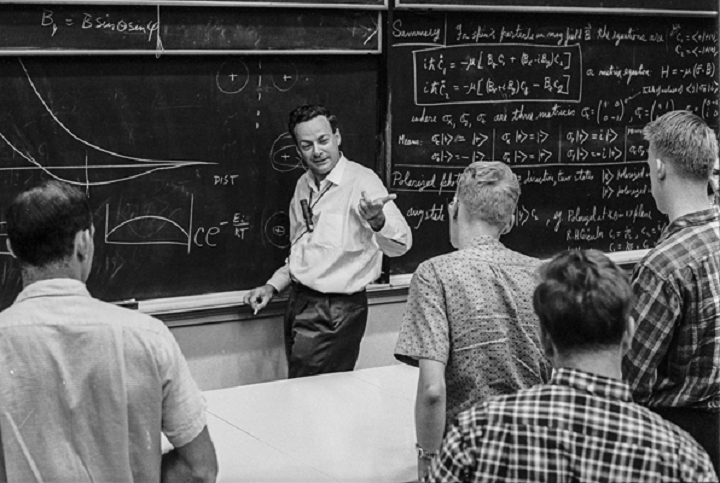
In 1964 a soon-to-be Nobel laureate walked into a Cornell auditorium and spent seven evenings explaining the nature of physical law to a general audience. Bill Gates paid the BBC out of his own pocket to keep those recordings on the internet forever.
His name was Richard Feynman, and the lectures are called The Character of Physical Law.
He was 46 years old when he gave them. He would win the Nobel Prize in physics the following year for his work on quantum electrodynamics. The BBC filmed every session. The tapes then went into distribution at universities through the 1970s, disappeared in the 1980s, and stayed lost until Gates licensed them for a Microsoft research project in 2009 specifically so they would never go offline again.
Here is the framework buried inside those lectures that changed how I think about knowledge itself.
In the final lecture of the series, titled Seeking New Laws, Feynman stops the philosophy and tells the room exactly how scientific discovery actually works. Not in metaphors. In three sentences.
He says in general we look for a new law by the following process. First we guess it. Then we compute the consequences of the guess to see what would be implied if the law we guessed is right. Then we compare the result of the computation directly to nature, to experiment, to observation, to see if it works.
And then he delivers the line that has outlived him by forty years.
If it disagrees with experiment, it is wrong. In that simple statement is the key to science. It does not matter how beautiful your guess is. It does not matter how smart you are, who made the guess, or what his name is. If it disagrees with experiment, it is wrong. That is all there is to it.
Read that again slowly.
He is not describing physics. He is describing the only intellectually honest way to hold any belief about the world. The method is indifferent to credentials, indifferent to elegance, indifferent to how much you want the idea to be true. Reality is the only referee, and reality never explains its rulings.
The second thread running through the whole series is the one Feynman kept circling back to across all seven nights.
He argued that the deepest beauty of a physical law is not in what it depends on but in what it refuses to depend on. Newton's law of gravitation works the same way on a falling apple, a moon in orbit, and a galaxy at the edge of the observable universe. That is not a detail. That is the entire point. A law that only works in one place is not a law. It is a coincidence. The test of a real generalization is whether it survives contact with situations its inventor never imagined.
The part that hits hardest comes in the opening lecture on gravitation.
Feynman is walking the audience through how Newton assembled the theory, and he pauses to say something most scientists never say out loud.
The importance of a physical law, he tells the room, is not how clever we were to find it. It is how clever nature was to pay attention to it. The universe did not have to be lawful. It did not have to reward pattern recognition with deeper pattern. The fact that it does is what makes science possible at all, and it is a standing miracle no one has ever explained.
Feynman ends the final lecture with a warning almost everyone misses.
He says the principles we now have may still be wrong in places we have not noticed. He suspects, out loud, that space being continuous is one of them. He offers no replacement. He just marks the edge where his own confidence runs out and tells the audience that honest uncertainty is the correct default for anyone actually trying to find the truth, instead of defend a position.
Sixty years later the full series still streams for free. Seven hour-long lectures. The best of Feynman at the peak of his powers, filmed before he was famous to the general public, speaking to a crowd that was never supposed to understand physics at this level.
Bill Gates kept them online because he understood what most people still miss.
A three-sentence method for testing any belief against reality is worth more than most of what graduate school teaches in three years.
Those wheels you’re looking at are 0.75 millimeters thick. That’s half the thickness of a US dime. Each one was carved from a single block of aluminum, and NASA sent six of them to Mars knowing they’d eventually shred.
Curiosity was built for a 2-year mission. It landed in August 2012, and by December that year NASA had already extended the mission indefinitely. Thirteen years and 35.5 kilometers later, the rover is still going, but the wheels started cracking just 14 months in. The damage came faster than anyone at JPL predicted. Sharp embedded rocks were punching straight through the skin between the treads.
So NASA assembled a Wheel Wear Tiger Team (a crisis problem-solving tradition that goes back to Apollo 13) and got to work. In 2017, they uploaded a traction control algorithm from Earth that adjusts each wheel’s speed in real time based on the terrain, reducing force on the front wheels by 20%. They rerouted the rover to softer ground and started driving backward when possible, because pulling wheels over rocks produces less force than pushing them into rocks.
The wildest part: if enough treads snap off, Curiosity is designed to find a sharp rock on Mars and use it to deliberately rip out the damaged inner section of its own wheel. JPL tested this on a replica rover and found Curiosity can keep driving on just the outer third. They predict this won’t be needed until around 2034.
Every 1,000 meters, the rover pulls over and uses the camera on its robotic arm to photograph its own wheels so engineers on Earth can count every crack. Each wheel also has tiny holes that spell “JPL” in Morse code, which Curiosity uses to measure distance by photographing its own tracks in the dirt.
These photos directly changed the next rover. When NASA built Perseverance, engineers 3D-printed about 70 different tread designs before landing on 48 curved treads instead of Curiosity’s 24, with thicker skin. They tested the new wheels over 60 kilometers and got zero damage by Curiosity’s original failure definition. “A boring graph with no data on it,” as one JPL engineer put it.
A $2.5 billion machine doing self-surgery with rocks on another planet because the mission outlasted its design by 6x.
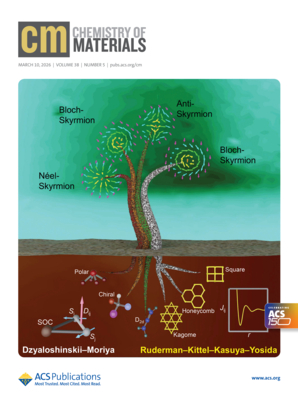
The latest issue of @ChemMater is now live!
Check out the #FrontCover Article by Thao T. Tran et al. @ClemsonUniv 👉 https://t.co/SxyIw09CVh
Explore the issue 👉 https://t.co/vM02TSUldm
🚨 USC study confirms the rotation of Earth’s inner core has slowed
The ground beneath your feet is rotating slower than it was in 2009 and almost nobody is talking about what that actually means.
Earth’s inner core, a solid iron and nickel sphere roughly 2,440 kilometers in radius, has been decelerating. The USC study published in Nature Geoscience confirms it crossed a critical threshold, now rotating slower than the planet’s surface for the first time in observed scientific history. This is not a minor calibration update. This is a fundamental shift in the mechanical behavior of a structure that has been spinning at its own independent rate for approximately 4.5 billion years.
To understand the weight of that number, consider what the inner core actually is. It sits 5,150 kilometers below the surface. The pressure at that depth reaches 3.5 million atmospheres. Temperatures hover around 5,400 degrees Celsius, roughly the same surface temperature as the Sun. Under any normal physical expectation, iron at that temperature should be liquid. The crushing pressure is so extreme that it forces the iron atoms into a solid crystalline lattice anyway, creating a structure that behaves like a metal while sitting inside conditions that would vaporize any known material on the surface.
That ball of impossible solid iron is what just changed speed.
The inner core does not spin independently by accident. It is magnetically coupled to the liquid outer core surrounding it, a 2,300 kilometer deep ocean of molten iron and nickel that generates Earth’s magnetic field through convection currents. Those currents drag the inner core forward magnetically while the gravitational pull of the rocky mantle above acts as a brake. For roughly 50 years the magnetic drag was winning.
The inner core was outrunning the surface by a fraction of a degree per year. Between 2009 and 2011, seismic data began showing the rotation differential flattening. Now it has reversed.
The seismic evidence comes from something elegant and unsettling. When large earthquakes strike, they send compressional waves called P waves straight through the planet, entering one side and exiting the other. Because the inner core is crystalline and anisotropic, meaning its atomic structure has directional preferences, those waves travel at slightly different speeds depending on the angle they cut through the core. Scientists have been using repeated earthquakes striking the same fault lines, recorded at the same seismic stations, for decades. The travel time differences in those repeated wave paths work as a clock. When the inner core rotates, the angle the waves cut through the crystal structure changes by fractions of a degree, and the travel time shifts by fractions of a second. That fraction of a second is enough to track rotational velocity across 50 years of recorded earthquakes.
What the accumulated data shows is a clear oscillation. The inner core appears to run through rotational cycles of approximately 60 to 70 years, accelerating relative to the surface for a few decades, then decelerating, then accelerating again.
The 1970s transition. The 2009 transition. Now this one. Each transition point correlates with measurable surface anomalies in the length of day measurements, which are tracked to an accuracy of 0.0001 seconds using atomic clocks and very long baseline interferometry.
The length of a day is currently changing. Not by seconds. By roughly 1.5 milliseconds per century in the long term trend, with shorter fluctuations layered on top tied directly to core dynamics. That sounds irrelevant until you trace the engineering dependencies. GPS satellites are calibrated against atomic time standards that must account for rotational irregularities. A drift of even 0.1 milliseconds unaccounted for over 24 hours produces a positional error of 4.6 meters on the ground. Global navigation infrastructure performs hundreds of thousands of precision corrections annually specifically because Earth refuses to spin at a perfectly constant rate.
Beyond navigation, the rotational coupling between the inner core, outer core, and mantle directly influences the behavior of the geodynamo, the process generating Earth’s magnetic field. Field strength, field geometry, and the location of magnetic poles are all downstream effects of how efficiently the liquid outer core convects. The current period of inner core deceleration coincides with an already documented weakening of the South Atlantic Anomaly, a region stretching from Chile to Zimbabwe where the magnetic field is measurably weaker than the global average and has been losing approximately 5 percent of its strength per decade since the 1840s.
Correlations at planetary scale across geological time are not clean linear causes. But they are not coincidences either.
The inner core has reversed its relative rotation at least twice in recorded seismic history. The geological record suggests these oscillations have been occurring since the core first solidified somewhere between 500 million and 1.5 billion years ago. Each cycle redistributes angular momentum through a planet sized mechanical system in ways that eventually reach the surface.
The planet you are standing on is not a fixed stage. It is a nested set of spinning, coupled, fluid and solid layers that have been in continuous mechanical negotiation for billions of years. What lives on the outermost layer of that system has always just assumed the ground was still.
The data says otherwise.
Evergreen Climate Innovations' Spring Investment Cycle is open through Monday, March 2nd!
If you, or a company you know is interested, apply here! https://t.co/R1zjRUEqUG
This Collection highlights published work that was funded by the Petroleum Research Fund. The PRF was established in 1944 and invests approximately $19 million per year in seed funding for fundamental research involving petroleum-derived compounds. https://t.co/bk5HA829u2
Metra will operate on a reduced schedule for all lines Friday, January 23 due to severe cold weather forecasted in the Chicagoland area. Riders are advised that travel times may be increased due to speed restrictions. Visit https://t.co/MqJdhPBi8o for schedule info.
The math on this image is insane.
New Horizons transmitted at 2,000 bits per second from 3 billion miles away. Slower than a 1990s dial-up modem. It took 16 months to download all the flyby data.
The spacecraft had to hit a target box 100km wide, arriving within 150 seconds of schedule, after 9 years of flight. Miss it and the preloaded observation commands point at empty space.
Ten days before arrival, the spacecraft crashed and went into safe mode. Engineers had 72 hours to restore everything.
The probe is now 5 billion miles out, still whispering data back to Earth. We got 50 gigabits of Pluto photos using technology slower than your phone’s bluetooth.
The math on this image is insane.
New Horizons transmitted at 2,000 bits per second from 3 billion miles away. Slower than a 1990s dial-up modem. It took 16 months to download all the flyby data.
The spacecraft had to hit a target box 100km wide, arriving within 150 seconds of schedule, after 9 years of flight. Miss it and the preloaded observation commands point at empty space.
Ten days before arrival, the spacecraft crashed and went into safe mode. Engineers had 72 hours to restore everything.
The probe is now 5 billion miles out, still whispering data back to Earth. We got 50 gigabits of Pluto photos using technology slower than your phone’s bluetooth.
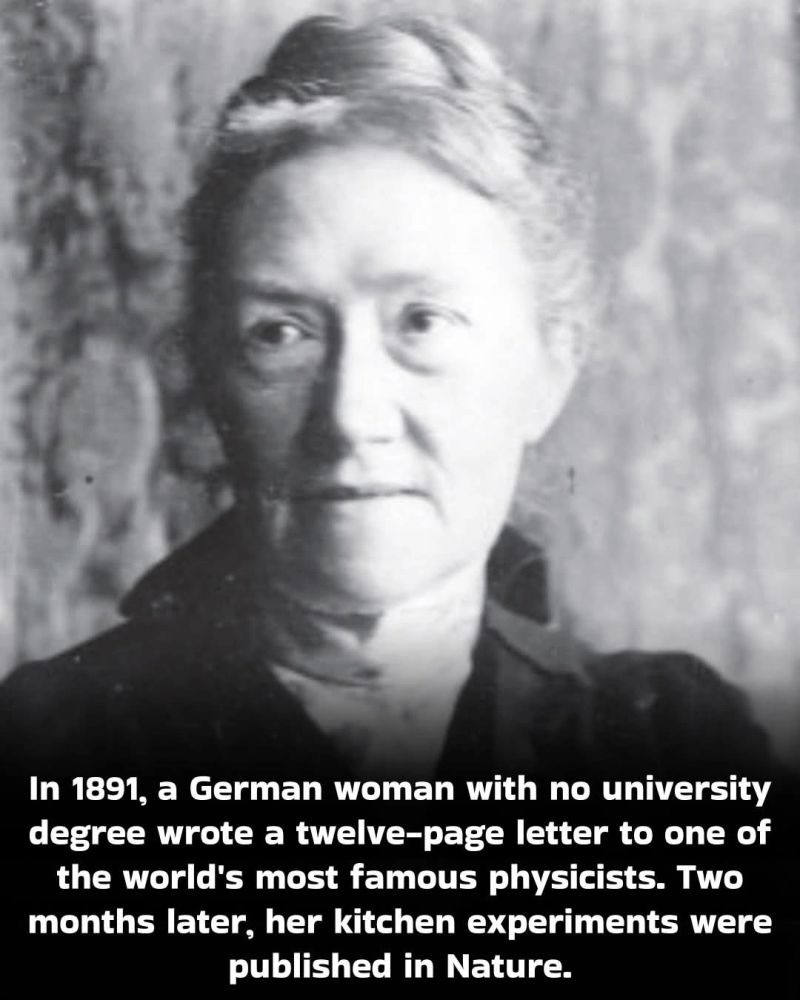
Agnes Pockels was nineteen years old when she noticed something strange in the dishwater.
It was 1881. She was standing at the sink in her family's home in Brunswick, Germany, watching the way grease moved across the surface of the water. The way soap changed everything. The way the surface itself seemed to have properties she couldn't explain.
Most people would have finished the dishes forgetting it.
Agnes Pockels wrote it down.
She would have liked to study physics at university. But in Germany in 1881, women were not permitted to attend university.
She devoured the physics books of her brother, teaching herself the mathematics and theory that formal education had denied her.
She needed a way to measure what she was observing. So she built one.
In 1882, she developed what she called a Schieberinne—a sliding trough.
With this homemade apparatus, Agnes Pockels began a decade of solitary research.
She had found the moment when a single layer of molecules, one molecule thick, formed across the surface.
She calculated that a single molecule occupied about twenty square angstroms of surface area. This threshold would later be named the "Pockels Point" in her honor.
Ten years. No laboratory. No colleagues. No mentors. No funding. Just a woman at kitchen sink, making measurements of stunning precision. And no way to publish any of it. She was isolated.
Then, in 1890, she read an article in a German science journal. The English physicist Lord Rayleigh—one of the most celebrated scientists in the world—had been studying the properties of water surfaces. He was asking questions remarkably similar to her own.
She wrote to him.
On January 10, 1891, she sent Lord Rayleigh a twelve-page letter in German, outlining a decade of research. She described her apparatus, her methods, her findings. She was modest almost to a fault:
"My Lord, will you kindly excuse my venturing to trouble you with a German letter on a scientific subject? ... For various reasons I am not in a position to publish them in scientific periodicals, and I therefore adopt this means of communicating to you the most important of them."
Rayleigh read the letter. He recognized immediately what he was holding.
On March 2, 1891, he forwarded it to the editor of Nature, the most prestigious scientific journal in the English-speaking world, with a covering letter:
"I shall be obliged if you can find space for the accompanying translation of an interesting letter which I have received from a German lady, who with very homely appliances has arrived at valuable results respecting the behaviour of contaminated water surfaces.."
Ten days later, Agnes Pockels's research was published in Nature under the title "Surface Tension."
She was twenty-nine years old. She had never set foot in a university. And her kitchen experiments had just entered the scientific record.
Agnes stunning story, a soul-stirring story can be found here
UPN Inbound and outbound train movement has been restored near Clybourn due to a vehicle striking a bridge. Extensive delays are anticipated. Updated 6:59 a.m.
UPN inbound and outbound trains are halted near Clybourn due to a vehicle striking a bridge. Please visit Metra https://t.co/FdgMvdQExT for the location of your train.