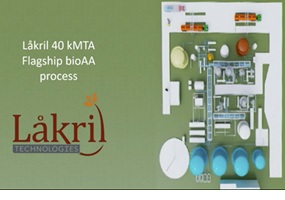
.@LakrilTech, one of C&EN's #10StartupsToWatch, tackles the challenge of biobased acrylic acid. The start-up may have a catalyst that finally makes the process work. https://t.co/glRWq92iIT
AIChE MRC 2026
Join our CTO Chris Nicholas at the 18th AIChE Midwest Regional Conference, which will take place April 14, 2026 at the Illinois Institute of Technology (IIT). He’s giving the industrial keynote lecture in the afternoon at 12:45PM!
https://t.co/QZTfIZOs9G
We are incredibly proud of the team's unwavering dedication and groundbreaking progress over the past four years. Thrilled to achieve a major milestone: successful startup of our first continuous pilot plant for bio-based acrylic acid production!
https://t.co/Kc5UkeTv2K
This paper from Harvard and MIT quietly answers the most important AI question nobody benchmarks properly:
Can LLMs actually discover science, or are they just good at talking about it?
The paper is called “Evaluating Large Language Models in Scientific Discovery”, and instead of asking models trivia questions, it tests something much harder:
Can models form hypotheses, design experiments, interpret results, and update beliefs like real scientists?
Here’s what the authors did differently 👇
• They evaluate LLMs across the full discovery loop hypothesis → experiment → observation → revision
• Tasks span biology, chemistry, and physics, not toy puzzles
• Models must work with incomplete data, noisy results, and false leads
• Success is measured by scientific progress, not fluency or confidence
What they found is sobering.
LLMs are decent at suggesting hypotheses, but brittle at everything that follows.
✓ They overfit to surface patterns
✓ They struggle to abandon bad hypotheses even when evidence contradicts them
✓ They confuse correlation for causation
✓ They hallucinate explanations when experiments fail
✓ They optimize for plausibility, not truth
Most striking result:
`High benchmark scores do not correlate with scientific discovery ability.`
Some top models that dominate standard reasoning tests completely fail when forced to run iterative experiments and update theories.
Why this matters:
Real science is not one-shot reasoning.
It’s feedback, failure, revision, and restraint.
LLMs today:
• Talk like scientists
• Write like scientists
• But don’t think like scientists yet
The paper’s core takeaway:
Scientific intelligence is not language intelligence.
It requires memory, hypothesis tracking, causal reasoning, and the ability to say “I was wrong.”
Until models can reliably do that, claims about “AI scientists” are mostly premature.
This paper doesn’t hype AI. It defines the gap we still need to close.
And that’s exactly why it’s important.
Chris Nicholas and Collette Nicholas are headed to the 29th Annual NECZA meeting. Chris will be kicking things off Friday with the keynote lecture!
Both are in town and happy to connect.
https://t.co/6ejtpW5idW
.@LakrilTech, one of C&EN's #10StartupsToWatch, tackles the challenge of biobased acrylic acid. The start-up may have a catalyst that finally makes the process work. https://t.co/glRWq92iIT
We are incredibly proud of the team's unwavering dedication and breakthroughs over the past four years. Thrilled to be named one of Chemical & Engineering News (C&EN)'s Top 10 Start-Ups to Watch!
Click through to read the article!
https://t.co/OUbCyOhCDv
Låkril Technologies names Justin Brown as CEO to accelerate commercialization of a bio-based acrylic acid
Click through to read the full press release:
https://t.co/OV1yR8ELhg
@MattyKirsh This is exactly the big picture business model we believe in. Opportunities begin and end with economics with material properties in between.
Folks, 2 weeks of free access remain to our Tutorial Review on the utilization of XRD for catalyst characterization. Read now!
And, as always, reach out with questions, comments, or samples to be analyzed.
@CatalysisChris
https://t.co/JygMJBL2BR
Check out our new publication available ASAP in Analytical Chemistry ⬇️⬇️
We developed a method to analyze permanent gases and organic acids from a single injection
https://t.co/sfLZ7fJMS1
We're extremely excited to have been selected as finalists for the Radicle Growth Corn Value Chain Challenge!
Our innovation leverages renewable corn resources to reduce carbon emissions during acrylics production.
https://t.co/jfQqBzGmRo
Come find us at the 16th MRC!
Stop by our poster on Tuesday afternoon 3/5 and listen to @CatalysisChris present “Process Design, Scaling, and Integration ... for Dehydration of Lactic Acid to Acrylic Acid” Wednesday 3/6 - Track 2 at 2:50pm.
https://t.co/YSeCXUApwU
Looking forward to showing off progress on the separations portion of our technology at the Separations @GordonConf in Galveston the 21st - 26th.
@CatalysisChris will give a poster.
Support for this work primarily from @MI_Corn and @mncorn