Canadian centrist. Allergic to partisan bullshit. Facts before narratives, evidence before outrage. I’ll criticize my own side too. Common sense still matters.
You know, Tim, I tried to keep this factual, civil and reasonably polite. But as this thread has grown, it’s become increasingly obvious that you’re firmly in the elbows-up crowd with the Carney-Liberal blinders strapped on tight.
“Trump is a liar, criminal and pedophile” is not a counterargument to anything I’ve said. Neither is calling anyone MAGA, a separatist or a conspiracy theorist. Those are labels you use instead of addressing the the substance of an argument.
Based on your repeated responses, name-calling appears to be the pinnacle of the argument you’re capable of offering, and I’ve wasted enough time on it.
Blocked.
I believe this is called cutting off your nose to spite your face. A recurring theme among the “elbows up” crowd.
Tough talk about withholding electricity sounds great until you remember how deeply integrated our energy systems are. Ontario and Quebec depend on Canadian oil that travels through a pipeline running across the United States before returning to Canada.
Mutual dependence is leverage for both countries. Turning it into a weapon invites retaliation that Canadians will also pay for.
When two countries get into a pissing contest, politicians get the applause. Ordinary people get the bill.
This is the more important question.
If the government’s strategy really is to “outlast Trump” and accept a prolonged deterioration in Canada-U.S. trade relations, then “Canada will survive” is hardly the standard we should be celebrating.
The question is: What will that strategy cost Canadians, who bears that cost, for how long, and is it actually better than the available alternatives?
“Survivable” and “successful” are two very different things.
Tim, I see no point continuing this discussion. You’ve repeatedly replaced evidence and reasoning with labels: Trump supporter, Maple-MAGA, separatist, and now conspiracy theorist.
The government works for Canadians. Questioning it is not disloyalty; it is citizenship. When government officials make carefully worded statements that omit material facts, I look for the rest of the story. When details about failed trade negotiations emerge piecemeal rather than transparently, I become more skeptical, not less.
You keep asking why I won’t simply take Carney and his cabinet “at face value.” That question says more than you realize. I don’t take any government at face value. I judge governments by evidence, decisions and results, not résumés, party affiliation or declarations from their own cabinet.
Carney is capable of being wrong. He is capable of misleading people. He is capable of lying. So is Trump. So is every politician. Rejecting Trump does not require me to suspend critical thinking when evaluating Carney.
And questioning my patriotism because I question my government gets this completely backwards. Patriotism is loyalty to your country, not unquestioning loyalty to whichever politician happens to govern it.
You want me to choose whose “word” I believe. I want to know what actually happened. That difference appears to make a productive discussion between us impossible.
This will be my last response. I’m interested in examining evidence, not defending political teams.
Tim, this is precisely the tribal thinking I reject. I don’t have to “believe Trump” simply because I question something Carney said.
Trump’s convictions don’t make Carney incapable of being wrong or dishonest, and Carney’s cabinet agreeing with Carney is not independent verification.
I evaluate claims based on evidence, regardless of who makes them. If Trump lies, call it a lie. If Carney lies, call it a lie. If either tells the truth, acknowledge that too.
Asking whether I’m MAGA, Maple-MAGA or a separatist because I won’t automatically accept my government’s version is a pretty good demonstration of the problem: you’re asking me to pick a team. I’m asking you to examine the evidence.
Tim, none of that addresses what I wrote. Trump’s character, criminal convictions and record have absolutely nothing to do with whether Carney’s specific claims were accurate or internally consistent.
I’m not defending Trump. I’m asking that Carney’s statements be judged on their own merits.
“But Trump is terrible” isn’t a fact-check. It’s a change of subject.
If Carney is right, demonstrate it. If he’s wrong, acknowledge it. This tribal insistence that criticism of one side automatically constitutes support for the other is precisely why political discussion has become so intellectually useless.
The Globe really needs to learn the difference between an interesting data point and a conclusion.
Faster year-over-year sales growth at Walmart and Costco does not mean Canadians are “outspending Americans,” nor does it establish that Canadian consumers are financially healthier.
Nominal sales can rise because of volume, prices, or both. If we’re comparing consumer health, show real per-capita spending, disposable income, debt servicing, savings, delinquencies, employment and purchasing power.
The article even acknowledges StatsCan’s advance estimate has July retail sales falling 0.8%.
The Canadian consumer may indeed be proving more resilient than expected. That’s worth reporting.
“What trade war? Canadians are healthier than Americans” is a narrative looking for a dataset.
I’m not sure what you think I’m supposed to fact-check. Carney pointed out that these are unelected U.S. officials and then said they’re lying. He also suggested they shouldn’t be commenting on Canadian politics, while simultaneously commenting on appointed positions within the U.S. government.
I’ve followed the trade negotiations very closely. Until we see official records or some other verifiable evidence of what actually happened behind closed doors, we’re still dealing with competing accounts from both sides.
As for “respecting other opinions,” that’s precisely the point. You’ve already decided Carney is being completely forthright and the Americans are lying. That’s not simply a difference of opinion. Accepting one politician’s version of events as fact without evidence is blind faith, regardless of which politician you support.
I prefer evidence before conclusions. Apparently that makes me uncanadian in today's world.
Translation: Ontario taxpayers are spending $30 billion to protect Ontario workers from the effects of tariffs.
Maybe some of that support is justified. But can we stop pretending government money materializes from another dimension?
Bailouts and relief programs can soften the damage. They don’t create a “more resilient and self-reliant economy” by themselves.
Eventually the plan has to be something more sophisticated than taxpayers paying taxpayers to survive.
Trump’s rhetoric is absurd, but this isn’t much better.
“Canada has emerged”? Emerged from what? We still have a productivity crisis, weak investment, serious affordability problems and an economy deeply dependent on U.S. trade. Most of the grand “national projects” are still announcements and proposals.
Diversifying away from the U.S. is smart. Pretending we’ve already transformed the country because Canadians started checking the label on their ketchup is political fan fiction.
You don’t counter MAGA propaganda with Maple-MAGA propaganda. Facts still matter.
Already given? Then this should be easy.
Please point us to the government’s complete explanation of what was on the table, what Canada offered, what the U.S. offered, exactly which provisions killed the deal, and when the strategy shifted from negotiating a deal to providing taxpayer support “designed to last longer than the current U.S. administration.”
We’ve learned pieces of that story over time, often from people other than Carney. That’s not the same thing as the government giving Canadians a full accounting.
Change the tune? I’d settle for hearing the whole song first.
There are really three separate claims here, and they shouldn’t be treated as though proving one automatically proves the others.
The Canada Research Chairs program explicitly incorporates demographic objectives into hiring. That’s not really debatable. The program’s own rules establish equity targets and consequences for institutions that fail to meet them.
Those incentives can create a tradeoff between representation and merit. That’s a legitimate concern. Once demographic outcomes become an institutional objective, the competition is no longer based solely on identifying the strongest researcher. Whether that tradeoff actually occurs, and how often, is the important question.
EDI has therefore reduced Canadian research excellence by 12% and wastes $36 million annually. That’s where this article gets ahead of its evidence. Differences in h-index between demographic groups are interesting and deserve investigation, but they don’t by themselves prove that less-qualified candidates displaced better-qualified ones because of EDI. Converting those differences into a precise dollar figure for “waste” requires even more assumptions.
The strongest argument against demographic hiring doesn’t require overstating the evidence: public research funding should select the best researchers and research, regardless of race or sex. Remove discriminatory barriers to competition, absolutely. But don’t predetermine what the demographic outcome of a merit competition is supposed to look like.
Ironically, overselling the evidence here makes a legitimate criticism of the CRC’s EDI system easier to dismiss.
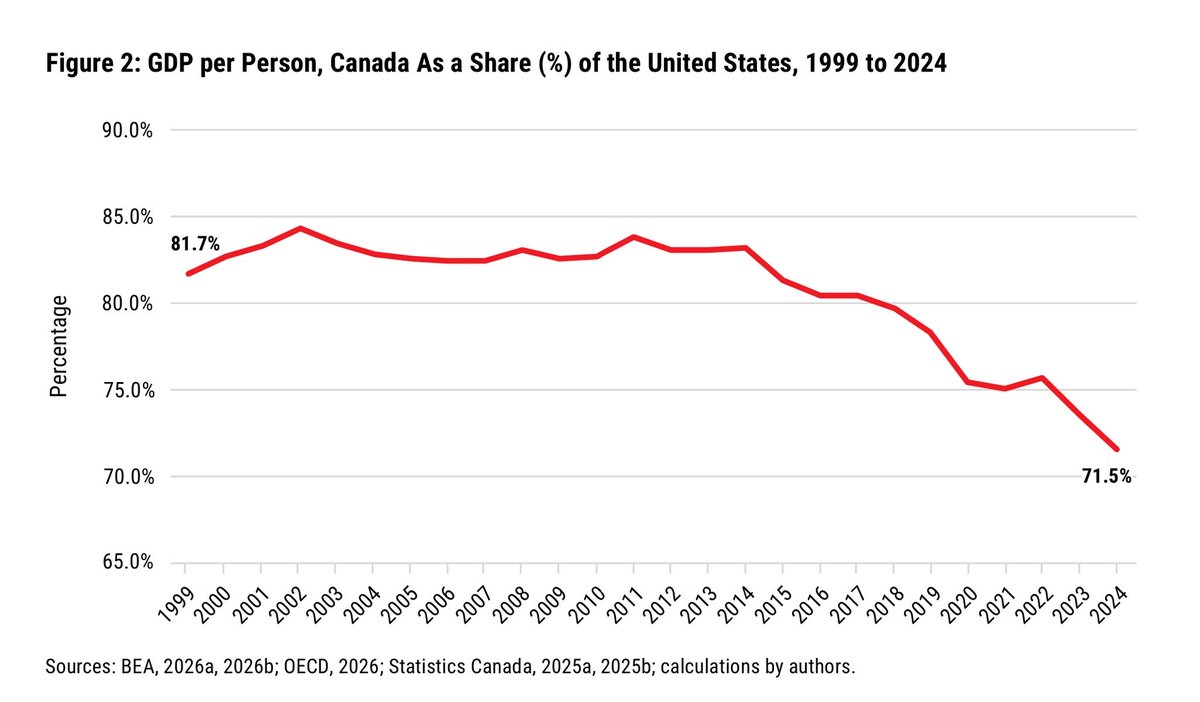
I stumbled across this graph. It shows a number that actually indicates how an economy is doing. Although the graph stops in 2024 the OECD’s 2026 assessment isn’t exactly showering us with participation trophies either. It says Canada’s GDP per capita remains below top-performing economies and identifies sluggish productivity, weak investment and relatively low capital stock per worker as important problems.
Can someone explain to me why the elbows-up crowd gets their info from memes while ignoring context and real facts?
The 3.3% number is actually correct. StatsCan reports Q2 real GDP grew 0.8%, which annualizes to 3.3%. Canada had a genuinely strong quarter.
But you’re using one quarter to dismiss concerns about Canada’s broader economic performance. That’s no more intellectually honest than using one bad quarter to declare the economy a disaster.
If you want to know how Canada is actually doing, look at multi-year real GDP per capita, productivity and real income trends, not one annualized quarterly figure.
The statistic is factual. The conclusion you’re drawing from it isn’t.
“A rapid, just phase-out of fossil fuels.”
Rapid? Based on what reality?
Fossil fuels still underpin transportation, aviation, shipping, agriculture, heavy industry, heating and much of the world’s energy supply. You don’t rapidly phase that out by issuing declarations from a UN podium. You do it by first building reliable, affordable, scalable alternatives.
And naturally CTV pairs the story with a wall of flames, because apparently reporting that the 1.5°C target is likely to be missed wasn’t sufficiently terrifying on its own.
The timing is interesting too. Maybe it’s coincidence, maybe it isn’t. But Canadian media suddenly returning to maximum-volume climate alarmism deserves some scrutiny.
Pretending the global energy system can be rapidly dismantled without enormous economic and human consequences isn’t a solution. It’s fantasy dressed up as policy.
Calling someone ignorant and then explaining away a GDP-per-capita comparison with “population differences” is quite the opening move.
The oil-price collapse absolutely hurt Canada, and nobody serious would attribute the entire Canada-U.S. divergence to one government. But it doesn’t explain a productivity and per-capita growth gap that persisted and widened long after oil prices recovered.
Tax and regulatory policy, weak business investment, declining capital per worker and poor productivity growth are all legitimate parts of that discussion.
Barlow’s conclusion is partisan. Your rebuttal isn’t a rebuttal. It’s two variables followed by “etc.” and a declaration of victory.
“He’s experienced and educated” isn’t evidence that he’s “nailing it.” It’s a résumé.
Growing the economy? Show the per-capita numbers. Creating jobs? Show them relative to population and labour-force growth. Rebuilding the military? Announcing spending plans isn’t rebuilding anything until the capability actually exists. Protecting sovereignty? From what, exactly?
And claiming Carney’s popularity “ain’t because of Trump” is particularly hilarious. Trump and the Canada-U.S. crisis dominated the election, and Carney was explicitly sold as the experienced economic heavyweight best equipped to deal with him.
You’ve basically listed campaign slogans, declared them accomplished facts, and called it analysis. The pom-poms were implied.