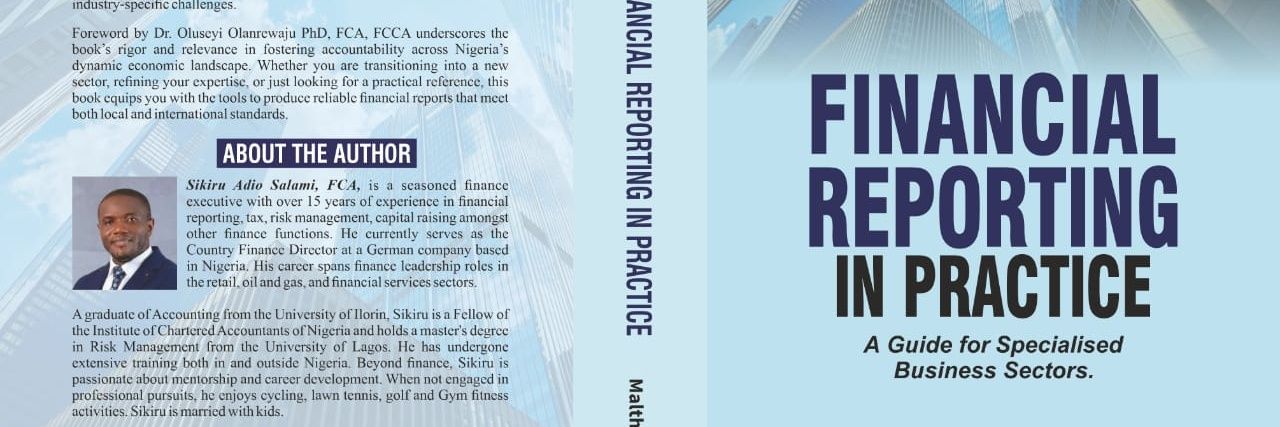
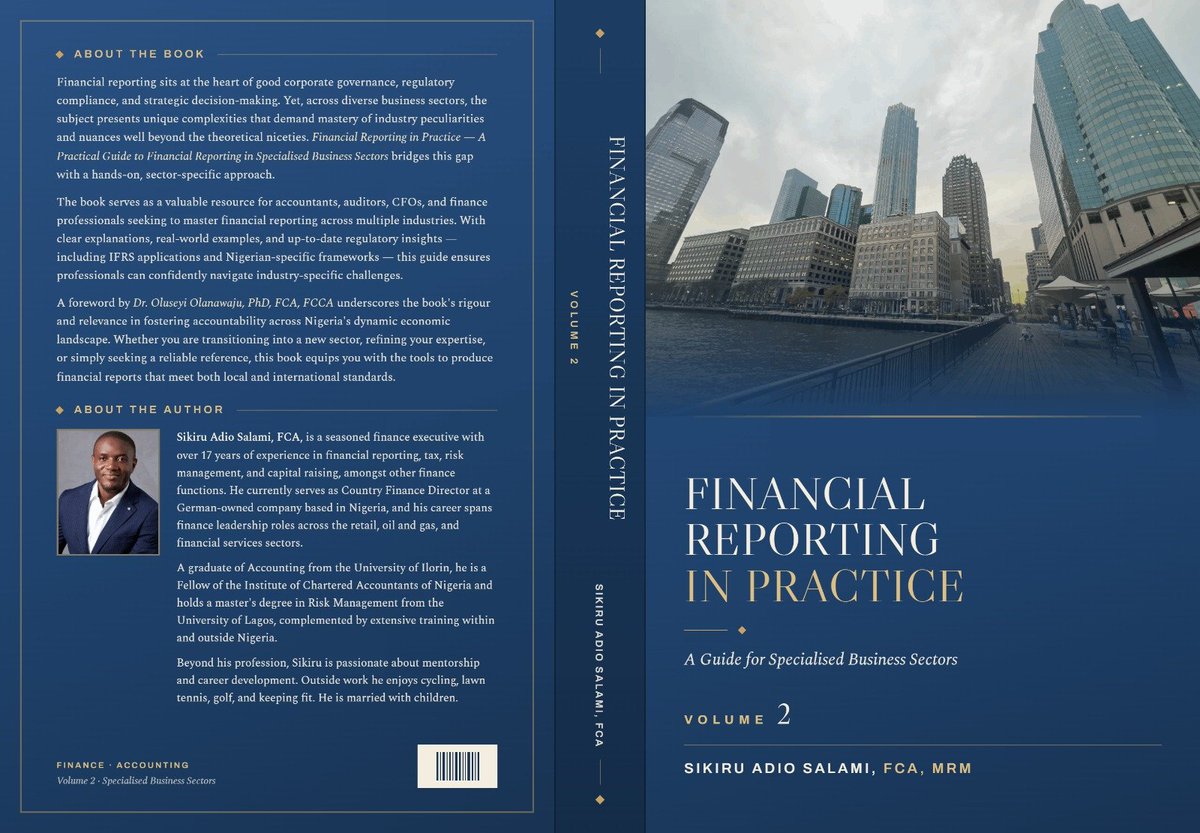
Financial Reporting in Practice: A Guide for Specialized Business Sectors.
Now finalizing work on the Volume 2 of this book, and the plan is to release it one chapter at a time. The book deals with specific industry topics and technical financial reporting issues and nuances in 12 business sectors, including banking, pension, healthcare, VC/PE, power etc.
Chapter 1: Finance Organization and Internal Reporting.
You can get chapter 1 here:
Selar: https://t.co/p3x2yGEnz5
Medium: https://t.co/LjWky54Dpw…
For volume 1 which deals with 11 business sectors, including manufacturing, oil and gas, telecoms, aviation, mining etc, you can get it here:
https://t.co/aQnBiXXf0X
Financial Reporting in Practice: A Guide for Specialized Business Sectors.
Now finalizing work on the Volume 2 of this book, and the plan is to release it one chapter at a time. The book deals with technical financial reporting issues and nuances in 12 business sectors, including banking, pension, healthcare, VC/PE etc.
Chapter 1: Finance Organization and Internal Reporting.
You can get chapter 1 here:
Selar: https://t.co/h7XJywXhyS
Medium: https://t.co/W1e25nVLCu
For volume 1 which deals with 11 business sectors, including manufacturing, oil and gas, telecoms, aviation, mining etc, you can get it here:
https://t.co/aiFVd7CXXR
I have a working theory. If you graduate with a First Class, you're most likely to make it in life, ultimately, cateris peribus. Hard work in school is easily replicable at work. Again, other things being equal.
@NaijaFlyingDr Indeed! Too many problems to solve. Too few people willing and crazy enough to get their hands dirty and do the impossible. For instance, I'm currently working on three things debatably no one in Nigeria has ever done before. But am I ready for the drama? No.
I have no dog in the fight, but this subtle threat of repeating the South Bronx fires -- in protest of the rent freeze -- is scary. Bill isn't the first the person to make this arson threat btw.
Imagine your family worked for a generation to save enough money to buy a brownstone occupied with rent stabilized tenants on the Upper West Side. The family financed the purchase with a mortgage from a bank based on the premise that rents and cash flow would at least keep pace with inflation so you could pay interest and principal on the mortgage and hopefully have some cash flow left as a return on your investment.
While you had rent stabilized tenants, you were led to believe that the NYC Rent Guidelines Board would be required to adjudicate rental increases each year by taking a measure of the inflation of costs to own and operate a building and setting rental increases appropriately.
You believed the RGB would do its job as the board is comprised of two representatives each for landlords and tenants and five independent representatives that represent the general public.
Now, a new mayor @NYCMayor Mamdani is elected on the promise of freezing rents. There are about two million rent stabilized renters that benefit if rents are frozen so by promising frozen rents the new candidate for mayor buys votes and wins the election.
The new mayor achieves his objective by stacking the RGB with directors who do not follow their obligations and simply vote for a rent freeze as a preordained conclusion as evidenced by the statements of an RGB director who resigned in protest for this very reason.
Meanwhile, inflation in NYC is rampant in utilities, real estate taxes, insurance, repairs and maintenance, etc. and now your rents are frozen. Real estate is a high operating leverage business which means that frozen rents and inflating expenses will cause property cash flows to plummet and your after debt service cash flow to go negative.
I expect therefore there will be hundreds if not thousands of small NYC property owners who are now or will shortly be underwater on their mortgages, and without any cash flow to maintain their assets.
If you remember the images of the South Bronx burning in the mid 1970s, you can viscerally understand what is happening to small NYC real estate owners.
While the rent freeze appears to be short-term good news (long term it will lead to poorly maintained apartments) for 2 million NYC renters, it is bad news for the 2 million or more renters in the 1 million market rate apartments in the City because a landlord-hostile market is not likely to add meaningfully more supply and market rents will likely continue to escalate at a high rate.
All of this seems quite unfair and wrong unless I missing something?
Why am I wrong?
For disclosure: I do not own any NYC rental apartments.
"A change imposed is a change opposed." - Spencer Johnson.
True business growth does not come from managing daily problems in a loop; it comes from leading the organization toward a clearly defined future, letting go of old behaviour before it becomes a liability, and viewing market disruption as an adventure to be capitalized upon.
@Ssaasquatch Scale is the problem. Nigerians don't eat out like that. Poverty won't let us. Culture too. It makes forecasting for foot traffic difficult.
What a discovery! I don't like voice note but seems I now have a use case for it: To record my ideas as they pop into my head. I then transcribe and document them on a digital note pad later.
I get your point. But I think, in Africa, governance is dessigned to be hard. Take public procurement for instance. You're a DG in an agency. You can directly get a car for 50m in the open market. But by law, you must go through tender above certain threshold. Now this is where it gets interesting. All the tendering contractors may, for some reasons, quote above 200m for the same vehicle. By law, you can only buy from any of those contractors that won the tender.
If you try to help govt save cost and unilaterally go buy the vehicle in the open, you may go to jail. Again, governance in Africa is designed to be hard.
War is such a terrible thing. Aside the ego boosting for the victor, it benefits no one ultimately. Not the victor; nor the vanquished. Value destruction for nothing.
Playing to win and playing not to lose are two different expectations. Both are driven by different mindsets and energy. One is proactive; the other is defensive with subpar outcome most times.