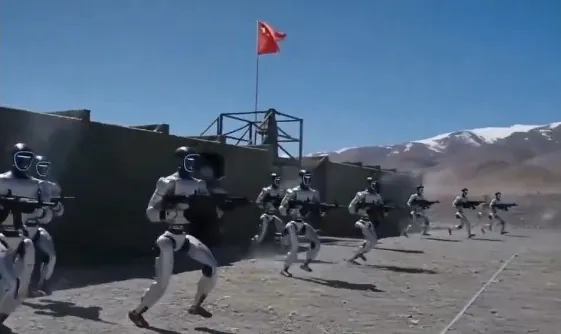
THE HUMANOID ROBOTIC ARMS RACE HAS BEGUN: China's Military Humanoids, the Next War will be Fought by Robots, & the Explosive Demand for Critical Metals That Follows! https://t.co/WOOp3Pn5QB
After reflection, this new narrative by Palantir is probably much more consequential than people may assume.
Palantir is basically being the canary in the coal mine announcing the death of two major assumptions propping up the US economy right now:
1) that AI labs will be able to extract significant economic rent - as opposed to AI models being mere commodities
2) that other countries can accept structural dependency on US technology and services without pushing back on sovereignty concerns
Why are Palantir specifically starting to be vocal about this?
First off, major middle-powers, even US “allies”, are one by one showing them the door. In June, France announced that the DGSI - its domestic intelligence agency, which had relied on Palantir since the 2015 Paris attacks - would replace it with French firm ChapsVision, with Prime Minister Lecornu explaining (https://t.co/SLhEGprBZC) that France “cannot accept new strategic dependencies in the digital sphere” and shouldn't depend on the goodwill of companies “capable of turning off the tap.”
Germany moved even earlier: its domestic intelligence service, the BfV, also selected ChapsVision over Palantir (https://t.co/pDZVj4SYUY), and the German military has said it will no longer use Palantir at all. Then, just this week, Spain instructed state-controlled companies - including strategic firms like Telefónica, Indra and Navantia - to avoid signing any new contracts with Palantir (https://t.co/0ik4UAFrT7).
Even in the UK, Washington's most loyal vassal, the NHS's £330 million data contract with Palantir is under review following parliamentary pressure (https://t.co/uJl6g4BMsW), and London Mayor Sadiq Khan blocked a proposed £50 million Palantir contract with the Metropolitan Police.
Palantir making a lot of noise around them caring about sovereignty makes a lot of sense: it's damage control since they keep being told they're a sovereignty risk.
I doubt it will work - because it's true: they are a sovereignty risk - but the fact that they feel the need to be vocal around this tells you where the wind is blowing: they're not shaping the narrative, they're reacting to one they're losing.
What they're saying against closed-source AI (basically a broadside attack on OpenAI and Anthropic), is again highly self-serving. Palantir's sudden love of open-weight AI models conveniently coincides with them launching 2 days before a partnership with Nvidia to sell exactly that: open models models (NVIDIA's Nemotron) in sovereign environments.
So it's essentially a product launch.
It doesn't make what they're saying wrong: it is factual that the value proposition of closed-source AI labs looks increasingly unsustainable. I mean: you're paying 10X the price of Chinese open-source AI models for something that's not really better (or just marginally) and on top of that you have zero control over your data, or the models themselves.
When Palantir says that "the architecture that maximally preserves sovereignty is one that enables institutions to own their tribal knowledge, and to compound it as alpha," they're right. I'd add that this also means you shouldn't trust Palantir either with that "tribal knowledge"... they obviously left this part out 😉
When you take a step back, these two things have major implications on many other US companies.
SpaceX - which just went public at the largest IPO valuation in history - is one clear example as I describe in my latest article on the new space race with China (https://t.co/JK3ELAyEVO).
If countries like France concluded with Palantir that they couldn't depend on a company “capable of turning off the tap” when it’s merely analyzing their data, what should they conclude about a company that aims to literally control their entire connectivity - at one man's whim, from space?
What percentage of SpaceX's crazy market cap is based on the assumption that foreign governments will not do to Starlink what they're currently doing to Palantir?
And SpaceX - or Palantir - aren't alone: a significant proportion of the top US tech giants, who rose in a world where no one questioned American technological hegemony, now face an environment that's much less conducive to the kind of lock-in their business models - and valuations - depend on.
When you pair this with the fact that it increasingly looks like the US made a wrong bet with closed-source AI - an extremely expensive wrong bet - the picture that emerges is of a country that bet its economic future on two things - proprietary AI and captive allies - and is losing both at the same time.
And to compound the problem, it doesn't help that the official narrative of the US government - via the voice of Jacob Helberg, the Under-Secretary of State (https://t.co/Z1rotPl9Ee) - is to be vocally opposed to "AI Sovereignty": essentially telling everyone "you know what, your worst fears are real, our tech companies are really out to undermine your sovereignty."
Read Helberg's post (the one I linked) and put yourself in the shoes of - say - a European or Asian leader and ask yourself how you'd react to being told that building your own AI capabilities is "marching in perfect formation into the past," that your pursuit of sovereignty is really just "synchronized mediocrity," and that your only path to the future runs through American technology.
If it was me in a position of power, I'd read this as a massive wakeup call: when another country's official position is that your sovereignty is a problem, history says you're about to need it.
So yes, it looks like - unexpectedly - Palantir, of all companies, is being quite the canary in the big tech mine. Yes they obviously do this for self-serving and cynical purpose, and yes they're of course also very much part of the problem and not the solution. But it doesn't make them wrong: sometimes it takes a vulture to tell you something is dying.
1/10
Justice Thomas’ dissent is hands down one of the MOST intellectually dishonest legal opinions I have EVER seen.
It should be clear to every American he is a compromised political actor - not a respectable member of this bench.
- Giorgia Meloni
Prime Minister of Italy:;
"It doesn't seem particularly effective to tell Ukraine that it must withdraw from Ukraine.
That sounds more like a propaganda initiative than a genuine peace proposal. There can be no true peace if it means Ukraine's surrender.
The choice before us is simple: either we defend international law and the sovereignty of nations, or we accept that the strongest can impose their will by force.
We have chosen to stand on the side of freedom.
Italy will continue to stand with Ukraine."
Just, wow, she is great😉
#BREAKING:🔥Rampell: “…but the bigger problem is that this is Trump’s modus operandi. He uses emergencies all the time as an EXCUSE for every imaginable violation of laws and norms. He wanted to deport people with no due process so he declared an immigration emergency. He wanted to tariff everything you buy and give handouts to big oil and coal, so he declared an economic emergency. He wanted to invade Venezuela so he declared a drug emergency. Knocking down the East Wing, handing out no bid contracts to cronies, putting soldiers on the streets of U.S. cities. Any time Trump wants something done that requires a vote of Congress or scrutiny from regulators, he just declares another emergency. So, as elections grow closer and voters grow even more frustrated with a president who obsesses over the trappings of his office, as they get squeezed by his policies, what emergency powers might he claim next?”😳
Mike Johnson: "If we were to lose the midterms, heaven forbid, these Democrats…will turn every committee of Congress into an investigative body and they will go after the president's family, the cabinet, his donors, and friends. Half of you in this room will be targeted. I run the protection program. I'll take care of you."
Clem Chambers, founder, CEO and financial author, rejoins the Metals and Miners pod on 6/5 and shares that he doesn't believe the Fed will raise rates into the higher inflation print because you can't punish your economy because the intrinsic price of stuff has gone up, why he's expecting something really bad to happen, why he expects the Fed to pull the lever and the markets will go up again, why he believes we are in a bubble now and that's probably got two years left in it, why he thinks the Strait of Hormuz can stay closed... and the world can adapt, why commodities may soon become luxuries, how we are in a new epoch, why gold is for war, why SpaceX is kind of like a foreshadowing of crazy valuations coming, and much more! @ClemChambers
Watch here --> https://t.co/OZeRAbinRi
Here's my latest interview with Erik Smolinski @_OutlierTrading recorded 6/4/26.Good discussion about the markets but also my track record and my methodology. As always, Erik asks lots of good questions. https://t.co/LtUAvLQ4ZE
🇺🇸🤡 The Retreat of the weakest Superpower in history.
Putin did not defeat the United States militarily. He did not need to. He simply looked Trump in the eye, and Trump tucked his tail and trotted home.
On June 3rd, U.S. European Command confirmed it. A third of America’s fighter jets assigned to NATO, gone. Half its strategic bombers, gone. Submarine commitments, eliminated entirely. The Financial Times reported the cuts were more sweeping than anyone had expected.
European capitals are not panicking. They are seething. The reaction across the continent is not fear, it is contempt. Cold, quiet, lasting contempt for a man they have watched perform weakness for years and are now watching formalise it in writing. Europeans despise weakness. They have a long memory for it. And they will not forget this.
Trump is described across Europe, by serious people in serious rooms, as the most cowardly president America has ever produced. Not dangerous. Not unpredictable. Cowardly. A man who mistakes grovelling for diplomacy and calls it a deal. In Warsaw, Tallinn, Paris and Berlin the verdict is the same: America turned out to be considerably smaller than advertised. The paper tiger accusation Washington spent decades throwing at its rivals has come home. It fits perfectly.
Russia and China are not hiding their amusement. Putin did not fire a shot. He just needed Trump to perceive strength and respond the way Trump always responds to strength: with immediate, grateful submission.
American generals and admirals are furious and humiliated. Officers who spent careers building the structures that kept the peace are watching it get packed into boxes by a man who flinches when Putin clears his throat. The word used in private, repeatedly, is embarrassing.
Every soldier, sailor and general in the United States Armed Forces knows exactly what has happened here. They just cannot say it out loud. Because the man who gave the order is still in the building.
Stay connected,
Follow Gandalv @Microinteracti1
Follow the money on this one. It is rotten to the core.
The Pentagon just lent $620,000,000 to a tiny North Carolina startup called Vulcan Elements. The company is two years old.
It had fewer than 50 employees.
And three months before the deal was announced, Donald Trump Jr.’s venture firm quietly took a stake in it.
Here is the part the administration tried to bury.
Of the dozens of companies the Pentagon was weighing, Vulcan was the only deal initiated by a top White House aide. That aide was Peter Navarro, a close friend of Trump Jr. The order came down to move fast.
One official put it plainly: The call came from the White House. We have to get this done.
Staff worked late nights to push it through in weeks. Deals like this normally take many months of vetting. And when it closed, Vulcan’s valuation jumped from about 200 million dollars to roughly 2 billion.
A windfall for the investors, including the president’s son.
This is public money. Your money.
Routed through the Pentagon to enrich the president’s family and their friends. The Bush administration’s own chief ethics lawyer called it corruption we pay for.
And there is more coming.
A drone parts company Trump Jr. holds a stake in is also under Pentagon review.
This is not a one-off. It is a pattern. The president’s family is treating the federal Treasury like a private bank, and the bill lands on every taxpayer.
https://t.co/4kB1cZNmlE
Financial repression; the deliberate engineering of inflation rates above nominal interest rates to erode the real value of government debt; is the most politically painless method of debt reduction available to a sovereign government. It does not require tax increases. It does not require spending cuts. It does not require a formal default. It simply requires that the purchasing power of the currency be quietly, steadily, relentlessly diminished over time. The math is straightforward. With ~$40 trillion in federal debt and a structural annual deficit running above $2 trillion, the U.S. government will find it mathematically challenging to grow its way out of its debt burden at current interest rates. It cannot cut its way out without triggering a political crisis. They tried and failed with DOGE. The only remaining option is to inflate the real value of that debt downward; to pay back creditors in dollars that are worth less than the dollars that were borrowed.
With Friday's strike, over 200 people killed by U.S. military in alleged drug boat strikes.
The overwhelming consensus of law of war experts, myself included, assess these to be murder because no armed conflict (and a war crime if it were an armed conflict).
Two hundred killed in a systematic policy also raises serious question: crime against humanity.
https://t.co/p6QhXH7vfD
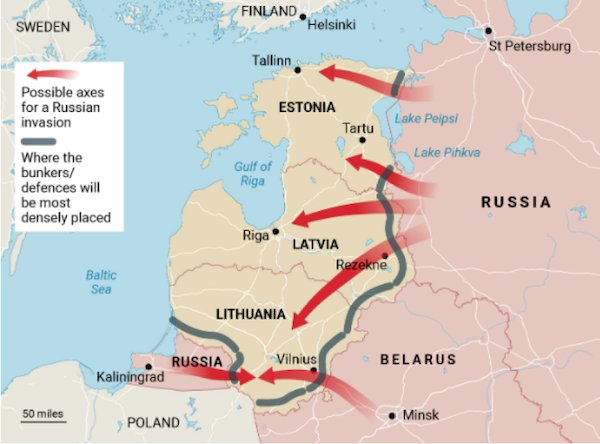
Russia is launching a new phase of pressure on the Baltic states.
Moscow has announced its intention to appeal to the International Court of Justice over the "suppression of the rights of Russian speakers" in Latvia, Lithuania, and Estonia.
In reality, this is another element of a systematic effort to build a legitimacy framework for possible intervention.
Moscow’s rhetoric is standard and familiar: "language bans," "Russophobia," and "persecution of dissent." The foreign ministry pretends that negotiations "have yielded no results" and that complaints submitted to the UN and OSCE have been ignored - therefore, the Kremlin is allegedly forced to go to court. This logic of "exhausting all available means" is not a legal strategy but preparation of a narrative: every refusal of jurisdiction will be presented as proof of "Western bias" and justification for extrajudicial actions.
The scheme is not new. Before the 2008 war in Georgia, Russia spent years talking about the "genocide of Ossetians," distributing passports to residents of Abkhazia and South Ossetia, and then used the claim of "protecting Russian citizens" as a formal justification for invasion. Immediately after that war, in 2009, Medvedev signed amendments to the Law on Defense that explicitly allowed the use of the military abroad to protect Russian citizens. The Kremlin moved the concept of "protecting compatriots" from propaganda into formal law. The same pattern repeated itself in Ukraine in 2014 and was expanded in 2022 - each time using the same set of narratives: "protecting Russians," "neo-Nazism," and "genocide."
Now this framework is being transferred to the Baltics while simultaneously receiving new legislative reinforcement. On May 13, 2026, the State Duma adopted, by 381 votes in favor, and on May 25 - the very same day the foreign ministry announced its intention to appeal to the ICJ - Putin signed a law allowing the use of the military abroad to protect Russian citizens from persecution by courts whose jurisdiction Moscow does not recognize.
What an astonishing coincidence: two steps taken on the same day - a legal claim and expanded legal authorization for the use of force, formalized simultaneously.
The Baltic situation has one fundamental difference from Georgia and Ukraine: passportization failed here. Accession to the EU and NATO in 2004 closed that window, so Moscow now appeals not to "Russian citizens" but to the legally much weaker category of "compatriots" and "Russian speakers."
The role of symbolic "proof of persecution" is played by the Gaponenko case - a man sentenced in Riga to ten years in prison after speaking at a Moscow conference about the "ethnocide of Russians," while Latvian courts classified his actions as incitement of hatred and assistance to a foreign state. The weakness of the legal basis does not stop Russia - it simply shifts the focus from legal results to propaganda effect.
NATO membership remains the main deterrent for Moscow. Therefore, the real goal of the campaign is to create a "gray zone" in the perception of the conflict and build an international record of an "unresolved issue concerning the rights of Russians." This objective becomes especially significant against the backdrop of April statements by the Trump administration regarding a possible U.S. withdrawal from NATO - uncertainty of this kind creates precisely the conditions under which the Kremlin’s human rights narrative becomes operationally useful.
The current campaign against the Baltic states is not a diplomatic episode. It is a methodical construction of an infrastructure within which any future escalation can be presented not as aggression, but as "forced protection."
This is exactly how Russia acted before.
🚨Breaking news:
Leaked docs from a Kremlin-controlled propaganda machine reveal a campaign backing far-right parties in EU elections and spreading disinformation to undermine Ukraine.
Read further:
https://t.co/rzmW5kfDJT
Let’s dive into the #FactoryofFakes🕵️♂️🧵
1/15
@SpeakerJohnson "Under President Trump’s leadership, our nation is ... more respected on the global stage ... than ever before."
This really made my day 🤣 Trump Derangment Syndrome just got a whole new meaning. What a relentless 🤡 show