Introducing trained AI employees that work towards your goals 24/7. You define the tools, roles, rules and goals. Hawkclaw handles the rest. It learns from feedback and gets better every other da, hour, minute and second.
6/ Good remote work practices have already solved part of this.
GitLab’s remote operating model emphasizes asynchronous communication, written documentation, public context and clear transfer of ownership.
Those are the conditions under which AI can coordinate work reliably.
1/ AI adoption inside companies is still treated too much like software deployment.
Give people access.
Connect a few systems.
Expect productivity to appear.
That is not how organizations work. Work moves through roles, handoffs, approvals, context and communication.
5/ AI should be onboarded more like a remote employee than a plug in.
It needs a role, a reporting line, a defined scope, approved tools, written rules, expected outputs and a clear boundary between routine execution and human judgment.
Super excited to be organizing Africas first @clawcon in Nairobi in June! Lets bring together a community of builders in Kenya! @openclaw@steipete https://t.co/oaitdKAa2o
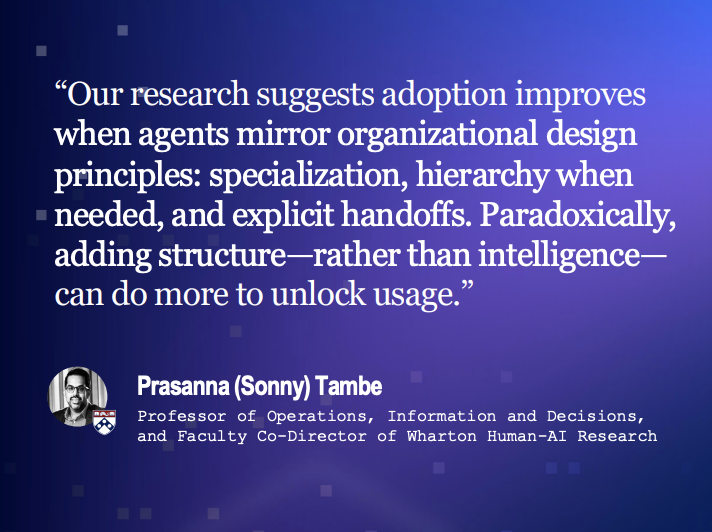
AI productivity unlock is not the all-purpose agent. It is the role-based agent: narrow enough to be reliable, structured enough to follow the org’s rules, and smart enough to reason within a specific job architecture.
A lot from Whartons Blueprint for AI Agent adoption speaks to our thesis. We believe agents mirroring organizational design principles is key to unlocking AI agent productivity in the corporate setting.
A lot from Whartons Blueprint for AI Agent adoption speaks to our thesis. We believe agents mirroring organizational design principles is key to unlocking AI agent productivity in the corporate setting.
The mistake is treating AI as a feature inside existing systems. Work inside SMEs is not defined by tools, it is defined by roles. If AI does not own a workflow end to end, it does not solve the coordination problem.
Most companies are integrating AI into tools, that improves fragments of the work. The real shift is treating AI as an employee that owns a role. A system helps you do tasks faster. An employee takes responsibility for an outcome. SMEs need the latter.
The assumption that AI replaces white collar work misses how SMEs actually operate. These businesses are already running below required staffing levels. AI fills coordination and execution gaps that were never hired in the first place and improves overall output.
Reinventing remote workers as AI employees is a game changer, SMEs are overworked and underfunded - these are the resources people need - not jobs taken.
We are in the design stage right now with a couple of SMEs. We follow the job description of the remote worker, the SMEs then have a dashboard where they can see the AI employee work, set organizational hierachies eg coordinate with Jack in logistics for xyz (same as you would onboard a junior), and give the AI feedback on its work.