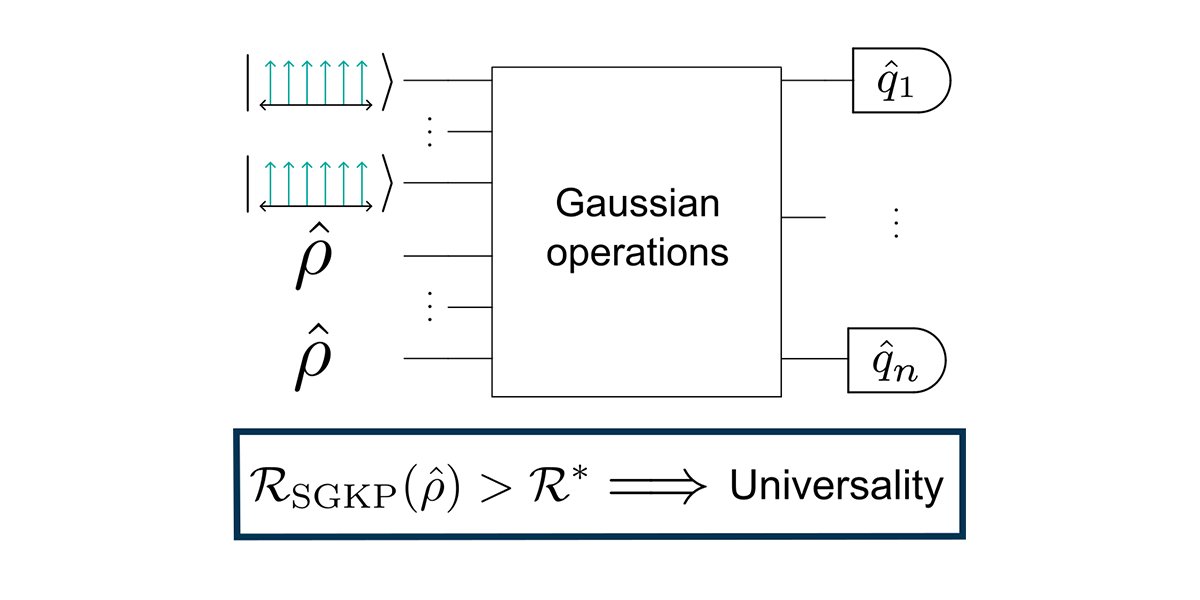
A sufficient condition for universal quantum computation with continuous-variable systems is derived through a novel generalized mapping between bosonic and qubit states. @caemron@chalmersuniv@wacqt_sweden
https://t.co/2kZDzbAMyf
Freshly published in Quantum: Efficient simulation of Gottesman-Kitaev-Preskill states with Gaussian circuits by Cameron Calcluth, Alessandro Ferraro, and Giulia Ferrini https://t.co/9AONbImDFD
@BenJamesBrown @msKesselring @felix_thomsen@jenseisert @BartlettQuantum Very interesting! We also recently put out a paper where we demonstrate that the vacuum is a resource for quantum advantage (in the context of GKP-Gaussian circuits), i.e. "nothing" provides exponential advantage over classical computers! https://t.co/e449FrpWXn
Adding access to the vacuum (a very simple and usually considered simulatable) or realistic GKP states unlocks the full power of the quantum computer and can run all quantum algorithms (including e.g. Shor's algorithm)
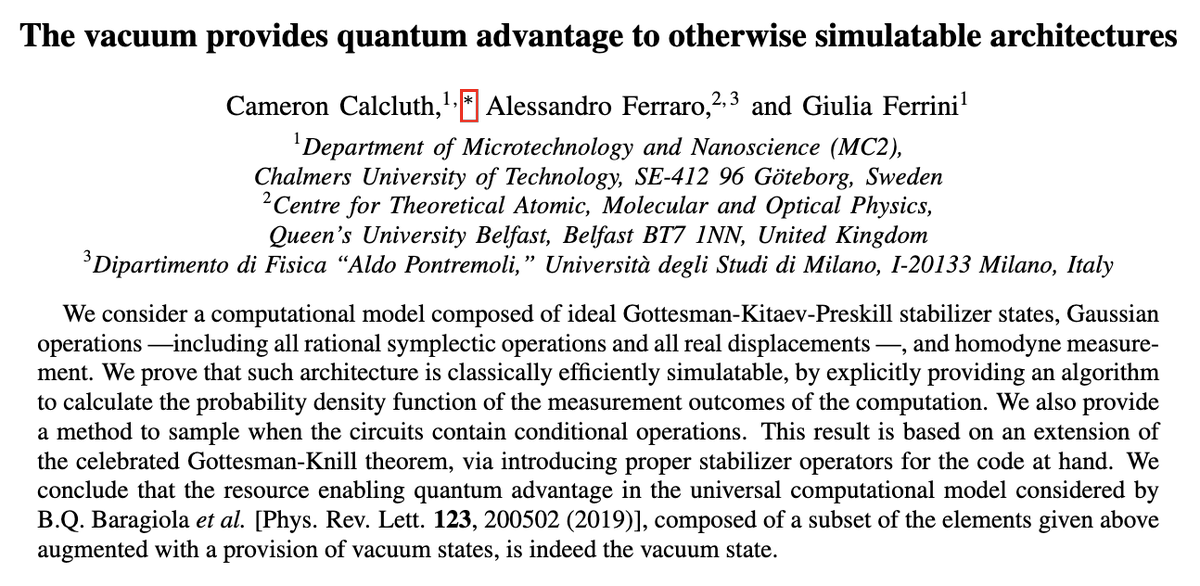
Our new paper contains two main results. 1) We demonstrate that these circuits are simulatable on a regular computer (these include Clifford circuits, i.e. simulatable qubit circuits, and beyond)
https://t.co/AHrWCgotO6
The circuits shown in the first picture are efficiently classically simulatable, meaning a classical computer will be able to do everything these circuits can do in a reasonable (polynomial) time. We demonstrated this using a twist of the stabilizer formalism
Today our new paper is on the arXiv! We show that the **vacuum** unlocks quantum advantage (i.e. promotes otherwise classically simulatable circuits to those capable of universal quantum computation) for GKP circuits. https://t.co/AHrWCgotO6
Today our new paper is on the arXiv! We show that the **vacuum** unlocks quantum advantage (i.e. promotes otherwise classically simulatable circuits to those capable of universal quantum computation) for GKP circuits. https://t.co/AHrWCgotO6
New preprint from WACQT researchers showing that large classes of Gaussian circuits with input GKP states can be computed with regular classical computers. https://t.co/CcXRsOlNDi
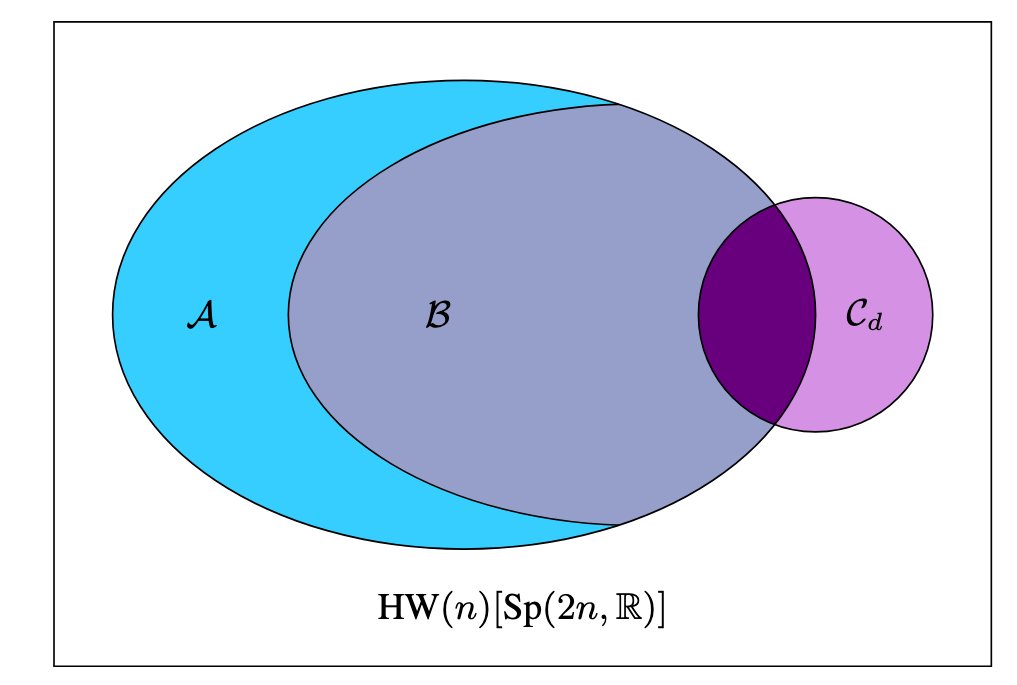
We show that a quantum computer performing circuits of the types A,B will not be faster than a regular computer. This could help to identify which problems continuous-variable quantum computers should be used to solve, and offers a method for benchmarking in their development
New paper out (my first 1st author!)
We prove that two large sets (A,B in figure) of continuous-variable quantum circuits with input 0-GKP states are efficiently simulatable (solvable with regular computers). Co-authors: Giulia Ferrini, Alessandro Ferraro
https://t.co/CaeJwv5FBq
The wavefunction of a Gaussian-transformed GKP state can be calculated analytically (using results from number theory!) as long as it is transformed according to certain constraints.