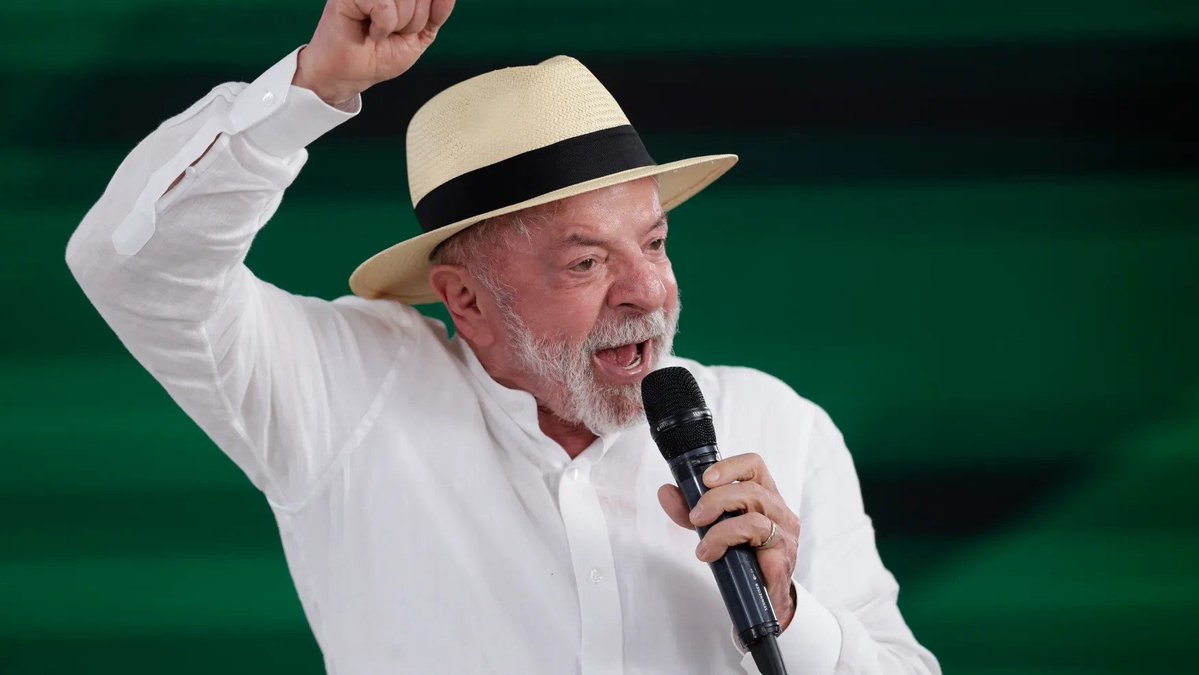
President Luiz Inácio Lula da Silva came from behind to win Brazil’s runoff election, halting a right-wing wave sweeping Latin America and defying predictions that the 80-year-old political veteran had finally reached the end of his extraordinary career. https://t.co/JXcHOl5s84
BREAKING: Brazil's President Lula has won reelection, defeating Flávio Bolsonaro runoff and securing an unprecedented fourth term.
He came back after trailing Bolsonaro 47.03% to 45.16% in the first round.
BREAKING: Brazil’s election authority has declared President Lula the mathematically certain winner of the presidential runoff, giving him a fourth term.
With 97.69% of polling sections counted, Lula (PT) has 51.74% and Flávio Bolsonaro (PL) has 48.26%.
That puts Lula ahead by about 4.2 million votes.
⭕️ President Luiz Inácio Lula da Silva has overtaken Flávio Bolsonaro in Brazil's runoff count. With 59.77% of polling stations reporting, Lula has 50.52% of valid votes to Bolsonaro's 49.48%, a lead of about 766,000 votes, according to Brazil's Superior Electoral Court (TSE). Stations vary in size, so that share is not the same as the share of votes counted.
Before the thievery British guys came, Ọwọ was 100% Benin, having its own Benin leadership, governed through Uselu, while Ondo (Ore Udo - the area of Udo), as Benin territory, was governed through Udo in Benin. Udo oversaw much areas like Oke Ada (Okada in Benin today), Siluko, Ofosu, Ohosu, etc. Uselu held the leaderships of Ọwọ, Ẹdo-Ekiti (Ado-Ekiti today), and Akurẹ areas.
All these people are Benin people, no matter what twists have happened over the last 129 years+.
During my last visit to both Ondo and Ọwọ (being in present Ondo State), I met with a few elders that revealed historical realities far beyond what I had known.
Even though I had shortly lived at Oke Ogun in Ọwọ at a young age, I revisited to learn more than what social media and history books could tell.
Difficult, for the next millennium to come, especially with the level of Ẹdo engagements in recent years, to tear up the Ọwo and Ondo origins, links, and traditional affiliations to Benin.
I strongly suggest that those who would argue my position online to, at least, visit Ọwọ, Akurẹ, Ilajẹ, Ẹdo-Ekiti (Ado Ekiti), and Ondo traditional homes.
So, when you see these people dress like or admire the need to dress like Benin, it’s because they bear the blood rights to look and be Benin. There’s a deeper connection than social media.🦇🦇🦇