6/ These are just a few of my favorite highlights. To access the full PDF presentation, check out the link below:
https://t.co/RqVzEMI6X9……
I trust you'll enjoy the content as much as we did building it.
Happy to share the launch of the 2024 edition of #ChartingDisruption, the annual flagship research report from Global X ETFs that explores the trends, technologies and bold ideas transforming our world.
https://t.co/47ztDaNFYP……
5/ Lastly, our exploration includes a in depth look into developer activity and novel use cases of the technology. Emphasizing the pivotal role developers play in the industry's success, we observe a continuous commitment to building the applications of the future.
In 2018 we blamed the lack of infrastructure as the main roadblock to onboarding mainstream users to crypto.
Since then, the industry has made considerable progress on that front. So why haven’t we seen more adoption?
I think the cardinal sin of crypto has been that most interest has been tied to speculation: the financialization of “X”
Speculation is not bad, per se, but it does influence the user’s mentality to have a different set of expectations relative to Web2. A subset of users equate the value of Web3 services to the price of the token - which is inherently volatile in this early stage. That wasn’t the case in Web2.
Users always have a motive but they didn’t create an email account, social media profile, and used other internet services with that financial expectation in mind. Some realized along the way they could monetize (see influencers) but the vast majority of users don’t have this as top of mind.
The monetization model of Web3 is different than Web2 where most services are free to use and subsidized by owners who monetize by selling ads.
Most Web3 services are incentivizing users thru airdrops or some other reward mechanism. This may seem artificial growth but it’s an essential component for decentralization. Web3 protocols give users part ownership in the protocol through work tokens. The effectiveness of many these programs (ie retention of users) is questionable but it’s a structural issue. Philosophically, shared ownership is the main distinction between Web3 and Web2 where contributors (not just owners) are equitably compensated for their contributions.
Ultimately, crypto platforms and services are a departure from Web2 monetization models. The user is also an owner but that introduces a new mental overhead leaving a subset of users too fixated on price.
That’s not to say this will impede Web3 from reaching mainstream. In spite of all the experimentation and perhaps lack of mainstream adoption, my hypothesis still is that Web3 platforms stand to create greater utility/consumer preference to convince users to switch to this new model.
But you could argue this new model introduces noise and leaves some users disappointed given the volatility in price of tokens, which leads to churn.
I’m optimistic the underlying value proposition of crypto will resonate with consumers and builders. Given the choice of using a Web2 vs a Web3 platform, creators should prefer the one where they are compensated more equitably. Better content attracts more users, and the growth flywheel is set in motion.
Games are another promising area but much less developed today. Web3 games that are at feature parity with Web2 games like WoW and COD will take a lot of time to build. Is it possible? Yes, and my bet is that talented builders will continue to enter the space. Smart people prefer to build in open source communities vs closed ones. That’s another fundamental thesis of why Web3 will thrive.
So what’s the point of this rant? I’ve been thinking of the catalysts that take us mainstream - the “email moment” of crypto. Maybe I’m naive and it’s already here: stablecoins. But adoption - at least in terms of # of users - is not where I think it should be to classify it as mainstream.
Infrastructure is not to blame this time. So what is it? Clunky front ends? Regulatory uncertainty? Too much financialization?
I think easier onboarding (on-ramps) and key/wallet UI/UX (account abstraction) may take us to the promise land where users start using crypto applications without realizing it or having to change and learn new behavior (Web2 flow with Web3 on the backend).
Maybe we’re still too early and more infrastructure is needed. We won’t know if that’s the case until a spike in demand tests the capability of these protocols.
In short, it’s tough to pinpoint why we haven’t reached mainstream and when we’ll get there. We’re not there yet but I think we’re not far. It’s always darkest before dawn 🌅
1/👋Introducing The Value Prop - an open database showcasing amazing use cases for blockchain technology. In less than 2 months & w the community’s help, we crowdsourced 300+ blockchain-based apps making a positive impact in the 🌎. Dive in at https://t.co/7Zx0ukhAbe & read 👇
New technologies like Blockchain or AI are best when used as enabling technologies.
It’s amazing tech, but it doesn’t need to show off - in fact, in the best examples you don’t even know it’s there. It’s under the covers. It simply makes something easier, or faster, or more powerful. Like a great magician, a great technology doesn’t need to reveal how it did it.
Good systems are those that have a strong rule of law and, importantly, have a process to modify and create new laws to best serve the needs of its citizens. These systems were built on the premise of decentralization - the balance power is crucial for the system to adapt in a manner that represents the interests of the majority. As much as investing makes you skeptical and leads you to question everything, I still believe those same foundational principles exist today in many developed systems across the world and have faith in the proper interpretation of the law to promote progress and wellbeing.
¿Interesado en aprender más sobre Bitcoin? El analista de investigación Christian Hazim explora los conceptos básicos de Bitcoin, incluidos sus componentes clave, aplicaciones y lo que está por venir.
AI-generated misinformation + accelerated news cycles + embedded finance—where fintech and social media platforms are intertwined—represent a compounding risk for financial markets and Internet life at large. Today, we saw another potent example with the fake image of the Pentagon explosion of how false information can ricochet across digital platforms and markets when no technological guardrails are in place. The speed and quality of AI-generated content are rapidly increasing, yet the technology to verify the authenticity of AI-generated content is falling behind.
Between text, images, video, and audio, it’s already becoming near-impossible to identify AI-generated content with human senses alone. The combination of Web3 technologies like blockchains and oracles could help both publishers and consumers verify that media is authentic and unaltered before it’s propagated. Blockchain-based hashes, tokens, and timestamps, in tandem with oracle networks validating real-world information, could be used to embed a unique digital signature in a file’s contents—a cryptographic watermark—to verify the origin and modification history of various forms of media.
In our time of AI proliferation and hyperconnectivity, demand for cryptographic truth is only growing. Web3 developers have an opportunity to build at the intersection of numerous sectors and create the guardrails for this new and fast-emerging era of adversarial AI.
If you’re ready to build, there’s still time to jump into the #Chainlink Spring 2023 Hackathon, where developers worldwide are competing to win prizes in Artificial Intelligence, DeFi, and more: https://t.co/aELgxWFAdG
For an overview of how blockchain technology and oracles can provide guardrails for AI systems, check out: https://t.co/tmkvHYer7x
Oh so you think crypto hasn’t found product market fit because you dislike digital art, finance, or meme coins? How’s that any different than all the “crappy” consumer goods you also don’t like but someone, somewhere does and buys online? Does that make Amazon or PayPal a crappy product without PMF? Wrong.
Like legacy e-commerce, crypto is expanding consumer preference. Anywhere, anytime, all the time. Key enhancement is crypto created digital property rights. Creators understand and value it. That’s the point. If you don’t find something you like on-chain today, don’t worry, you’ll come back later. Many didn’t buy books when Amazon started but eventually they bought something. Seen this movie before🍿
This week, DC will see a new TV campaign that explains how crypto moves America forward and why it’s the most important technology we have to create more economic freedom.
It’s time to update the system.
Crypto can help.
Learn more at https://t.co/6Hf1DAqeIV
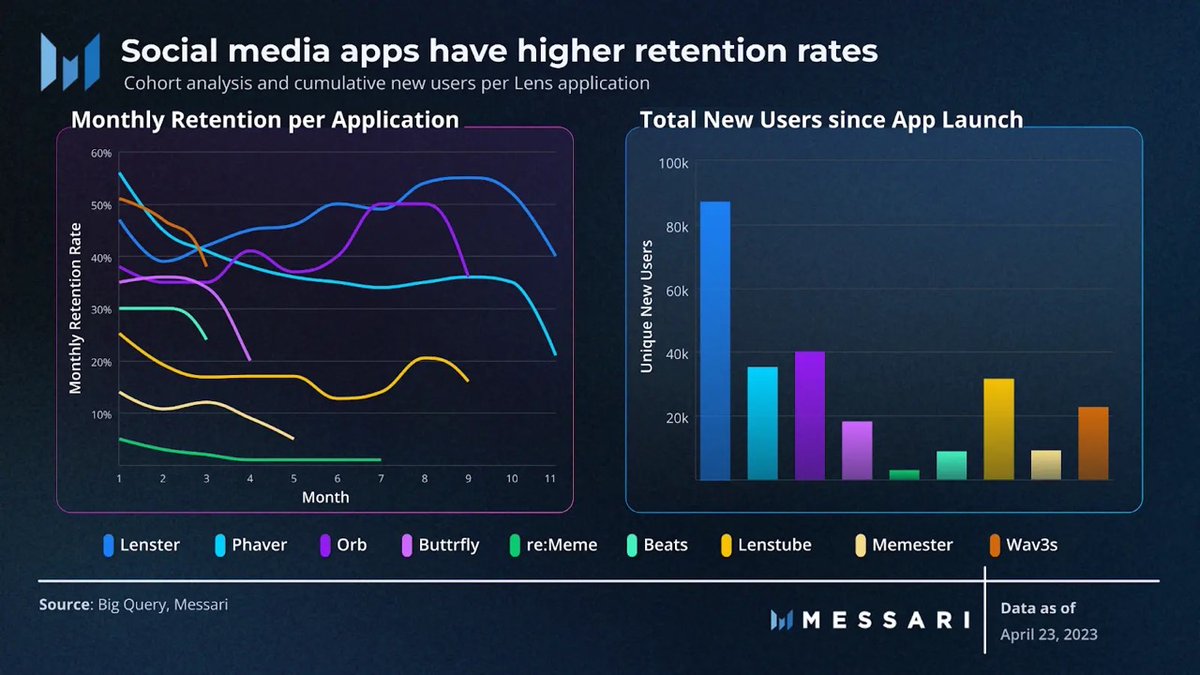
.@lensterxyz, @phaverapp, and @orbapp_, among other social media applications, boast remarkably high retention rates.
This success can partly be attributed to the users' familiarity with the UX and the lower barrier to entry for content creation.