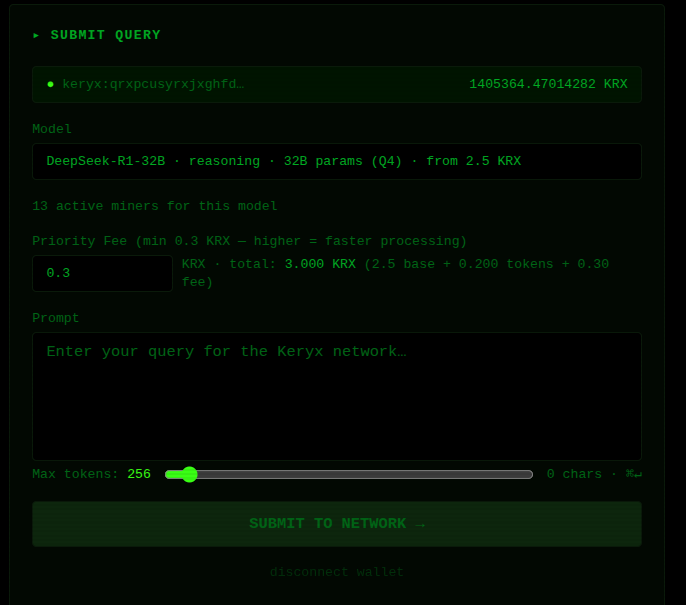
We’re back! 🚀 And we brought options.
You can now run the setup with 5 different AI models perfectly scaled to your GPU. Whether you are running a humble 4GB VRAM rig or pushing a 32GB RTX 5090, we’ve got you covered.
Check the table and fire up your GPUs! 👇
@Keryx_Labs Woah, it seems $KRX inherited not only the core technology of $KAS, but also its spirit, building relentlessly and delivering week after week 👀
A logic gate doesn’t care what’s energizing it.
Pressure. Fluid. Current. Sompi.
The gate was always the same object.
What’s new with Kaspa; a medium hard enough to hold the schematic permanently, fast enough to agree on every switch the moment it happens.
Millions of gates. Wired into circuits. Doing precisely what they were built to do.
This analogy perfectly explained by @Themooseisloos5 👇🏻
$KAS #Kaspa #Toccata
Show me another #crypto PoW project without VC backing that has the same level of expertise, technological advancement, and relentless execution as $KASPA. Can you name one?
You need wallet extension and API support so you can plug-in keryx like any other inference provider with capability to switch models using just one key. This will bring much more attention to the project. Imagine if you can run agent powered by $keryx
Proof-of-Model (PoM)
Keryx was built for a single purpose: decentralized, uncensored AI inference. This means the network's value relies entirely on miners actually hosting the AI models. Until now, this was based on a "cooperative" model—relying on good faith. But good faith isn't security. Any pool or modified miner could simply strip the models away, collect rewards, and contribute absolutely nothing to the network's core mission.
PoM fixes this natively at the protocol level.
How it works: With PoM, the model is the proof-of-work. Mining becomes a memory-hard process that reads thousands of random chunks directly from the model weights stored in your GPU's VRAM. No weights in VRAM = no valid proof = no valid block. It is completely deterministic.
What it brings to the table:
- Pool-proof & Fork-proof: You cannot fake model possession or route around the system. Hold the model, or you don't mine.
- ASIC-resistant by design: The work is strictly bound to memory (weights) rather than raw compute power.
- Bigger model = bigger reward: Block rewards scale dynamically based on the model tier you prove you are hosting. This incentivizes miners to run heavier, more capable models instead of the lightest ones.
Honest scope:
PoM guarantees possession—proving that a miner genuinely holds a specific open model in VRAM. It does not yet verify that every inference output is correct; that is a separate layer currently under development. We'd rather ship a rock-solid guarantee today than overpromise.
The result: a network where mining and AI capability become one and the same. The hashrate is the model.
Quand on analyse les données on-chain de $kaspa on évolue vers un scénario de pump énorme.
Les flux:
- 0 baleine vers les exchanges
- 0 dépôt massif
- réserve des exchanges stables
- mineurs qui ne vendent pas.
Clairement un pattern classique de compression avant expansion.
Les clusters alignés:
- mineurs en hold massif
- accumulation des fonds privés
- accumulation agressives des smart money
- flux des exchanges faibles.
Quand tout les clusters sont en accumulation c’est un setup de 200% à 600% sur 6 à 12 mois.
Concernant les indicateurs techniques montrent un retournement progressif:
- rsi neutre
- macd croisement haussier
- adx faible début de tendance
- Ichimoku montre une tenkan > Kijun en retournement a court terme haussier, la chikou span se rapproche du prix ( pré-cassure) et la Senkou Span A commence à se retourner.
En conclusion le momentum approche on verra l’ampleur de la cassure et si on est partit pour un pump a la solana 🧐
@humain974 Makes perfect sense, thanks for the detailed explanation. Looks like I need to learn more about BlockDAG and how it affects scalability and tx costs
Isn't sub-cent transaction cost only true at today's price? If $Kaspa is expected to go above $1, wouldn't transaction fees also increase significantly? Or am I missing something in the math?
The Architectural Edge: Why Kaspa Outpaces Ethereum for DEX Infrastructure
Building a Decentralized Exchange (DEX) on a traditional single-chain blockchain like Ethereum is like trying to run a high-frequency trading firm on a narrow, one-lane highway. While Ethereum pioneered automated market makers (AMMs), its sequential design forces every transaction to wait in a single queue.
Kaspa’s BlockDAG architecture—complemented by the Toccata hard fork—rebuilds the Layer 1 foundation to handle the intensive demands of decentralized trading natively. Kaspa offers several architectural advantages that make it a superior backbone for a modern DEX compared to Ethereum.
Parallel Processing vs. Sequential Bottlenecks
Ethereum processes transactions sequentially. One block is added at a time, roughly every 12 seconds. When thousands of traders rush to swap assets during market volatility, the network bottlenecks, causing a massive surge in gas fees.
Kaspa replaces the single blockchain with a Directed Acyclic Graph (**BlockDAG**). Using the GHOSTDAG protocol, the network processes multiple blocks **in parallel** simultaneously (~10 blocks per second on mainnet). For a DEX, this means transactions don’t get jammed in a single queue; trades are woven together concurrently without degrading network performance.
Structural Defense Against Predatory MEV
Because Ethereum relies on a public mempool where a single block producer dictates the exact sequential order of transactions every 12 seconds, **Maximal Extractable Value (MEV)** bots thrive. They spot a pending trade and "sandwich" the user—buying right before them and selling right after—forcing the trader to execute at a worse price.
Kaspa's Advantage: Real-time decentralization dismantles the mechanics of MEV bots. With Kaspa producing blocks at a rapid-fire pace, there is no single consensus leader holding a monopoly over transaction ordering for long intervals. Rapid parallel block creation and real-time sequencing make it virtually impossible for bots to accurately predict the state and insert predatory sandwich attacks. Traders get the exact execution price they expect.
Sub-Second Latency (CEX Speed, DEX Security)
Waiting 12 seconds for a block—and minutes for true finality—is a lifetime in live trading. While Layer 2 rollups speed up execution, they fragment liquidity, introduce bridge vulnerabilities, and complicate the user experience.
Driven by the Rusty Kaspa engine, the network features sub-second block times. After just 10 seconds, a trade has accumulated roughly 10 layers of confirmation deep within the DAG structure. A DEX on Kaspa delivers the instant, responsive user experience of a Centralized Exchange (CEX) while settling entirely on an ultra-secure, decentralized Layer 1.
.
Predictable, Sub-Cent Transaction Fees
High traffic turns Ethereum into a playground for whales, where a simple token swap can easily cost $20 to $100+ in gas fees.
Because Kaspa scales horizontally at the base layer rather than relying on vertical scaling, the throughput handles massive volume natively. Transaction fees remain consistently sub-cent (<$0.01), making micro-swaps and algorithmic high-frequency trading economically viable for retail users.
A historic surge for our network: from an average of 206 GH/s to a current peak of 1.10 TH/s!
The speed of this growth demonstrates the increasing appeal and robustness of our ecosystem 📈🔥💪
#MiningAnalysis#NetworkSecurity#HashratePeak#ProofOfWork
Kassword is not just getting updated.
It's getting armored.
Argon2id.
XChaCha20-Poly1305.
ML-KEM-768.
ML-DSA-44.
BLAKE2b Merkle media.
Cold-device armed vaults.
Your browser seals the vault first.
The Kaspa DAG only sees ciphertext.
No server. No account. No reset. No trust. Just Math.
https://t.co/VPP0NV7Y6h
$KAS #Kaspa #Toccata #PostQuantum #Privacy #PoW
$KAS has no marketing budget.
Growth is organic — developers, researchers, and genuine believers spreading the word one conversation at a time.
That's a harder path but it builds a more durable community than paid campaigns ever could.
#KASPA#KAS#BlockDAG
@mendes_xbt@JeffFernandes28@Fellipe71017122 Nesse caso, tudo está apenas começando na Kaspa. Dá uma olhada no que a $IGRA está construindo, é bem interessante. Existe uma boa chance de vermos oportunidades semelhantes às da Solana surgindo no ecossistema Kaspa em breve.
@mendes_xbt@JeffFernandes28@Fellipe71017122 Concordo que o Kasplex foi uma bagunça. Mas a Kaspa em si é uma rede revolucionária, e a Igra já está se mostrando uma solução muito mais forte.