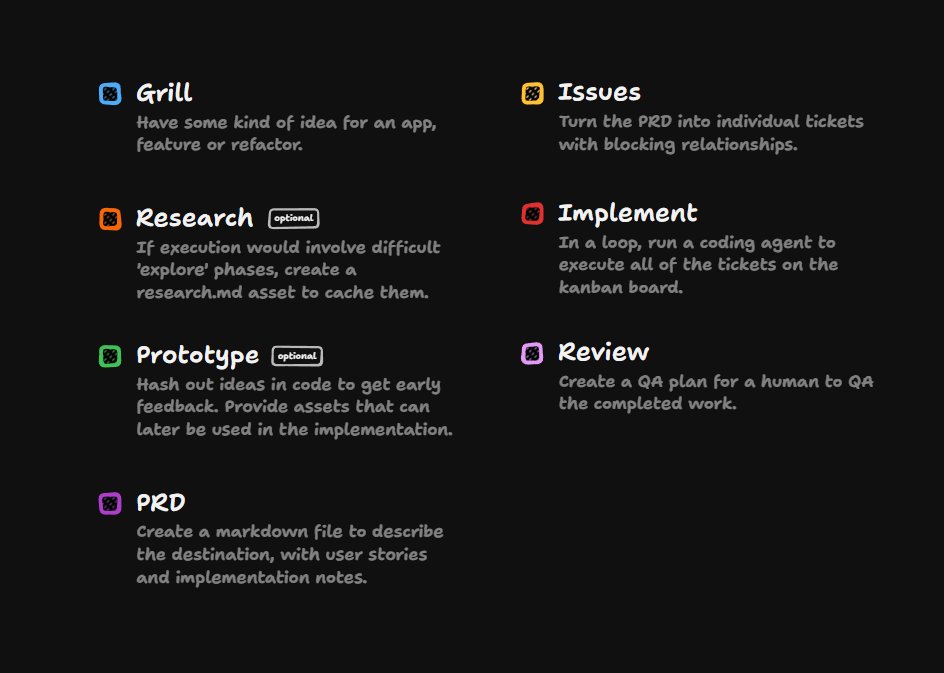
Here are my 7 phases of AI-powered development.
I've been thinking that the pre-PRD phase needs more structure. You need to figure out the shape of the design tree first, before then walking down it with higher-fidelity prototypes.
In other words, /grill-with-docs needs to change again IMO
In light of what happened, I'm doubling down on skills like /improve.
A frontier model got pulled. If it happened once, it's gonna happen again. Fable today. 4.9 tomorrow or maybe gpt 6 one day.
So, treat intelligence as borrowed. Drain intelligence when it's available. Build a catalog of plans today. Then implement later with a cheaper, open source, or a model you control.
Build the backlog now.
https://t.co/rqHw0fPv4G
A dev got so frustrated watching his AI agent write 500 lines for a 5-line problem that he built a fix.
He called it Ponytail. Named after the guy every team has - long ponytail, oval glasses, been there longer than the version control. You show him fifty lines; he looks at them, says nothing, and replaces them with one.
Now your agent does the same. Before writing anything, it looks for a reason not to.
80-94% less code. 47-77% cheaper. 3-6x faster.
The best code is the code you never wrote.
GitHub Repo: https://t.co/WnFp9YNY53
Introducing Extend UI — open-source components for document agents
- 14 components & examples for PDF, DOCX, and XLSX viewers, plus bounding box citations, file upload, e-signature, and more
- fully customizable
- MIT licensed
when we started, we tried every file viewer and document component library we could find
unfortunately, none of them had all the functionality (and polish) that we wanted, so we ended up building our own for @ExtendHQ
it was only ever meant to be internal, but enough customers kept asking for it that we decided to give it back to the community
it's useful for building agents, user-facing document flows, or internal tools
we use and maintain it for Extend ourselves, so it'll keep getting better over time (and it's battle tested on millions of pages running through our system every day)
it also works with design system agents like @magicpatterns for faster exploration and prototyping
available today on the @shadcn component registry! some examples in 🧵
Rspack + tsgo cut overall build time by 60% in our benchmark 🚀
Type checking during builds is often one of the biggest build-time costs.
tsgo integration is now available out of the box in:
- Rspack plugin
- Rsbuild plugin
- Rslib
We let agents autonomously access production systems (Deno Deploy). None of the existing security tools in this space worked for us - our systems do things like tunneling postgres through k8s.
Open sourced the firewall we built for this (written in Go of all things!)
All types of databases, Redis, Postgres, Clickhouse, Mysql etc. now display important stats and metrics aswell as most run queries in the Maple service map
Aging is arguably the root cause of most major diseases (loss of function in our cells). Four years ago, we made a bet that aging was treatable, and NewLimit was born.
NewLimit now has a prototype drug that reverses the age of some human cells (restores function they had when they were younger), and a clinical trial scheduled for next year (with more drug candidates in the pipeline).
Grateful to Founders Fund, Thrive, Greenoaks, and the rest of the investors for this latest round. @jacobkimmel and the team are just getting started.
My spiciest take: 🌶️
You only need prod.
Other environments are optional, and may cause more problems than they solve.
Imagine prod was our team’s only environment.
We’d:
- write lots of tests
- stop batching work in lower environments
- stop rushing to hit arbitrary release cutoff dates
- stop spending hours every week maintaining and coordinating work in lower environments
- auto-deploy upon merge
- release small changes multiple times a day
- monitor prod via automated checks that notify us of issues
- use feature flags and phased releases to safely test in prod before making a feature visible to everyone
These are mature dev team practices. Having only prod *forces* them.
So, your team might be better off with only prod than with a bunch of non-prod environments.
One of the superpowers of @EffectTS_ is the legibility of the code. Because you're encoding so much semantic meaning (concurrency, errors, dependencies), it's much easier to jump in and review if the clankers left something out.
underrated usecase for stacked PRs:
first PR is only tests, that should fail your CI, if it didn't fail, you didn't write a good test
second PR is the actual fix
📚 Surprisingly, I haven't written about how my two favourite TanStack libraries - Router and Query - work together.
🔁 loaders start fetches early
🔮 query owns the cache
🌀 suspense integrates naturally
🏝️ TanStack Start makes SSR & streaming easy
https://t.co/hFqo9YqAlV
🚨Must Have🚨
- disable auto-updates for extensions in VS Code/Cursor + other forks (MacOS: Cmd + Shift + P -> "Disable Auto Updating Extensions")
- use static analysis (https://t.co/0re0oLjgCO) for GHA to catch security issues
- use https://t.co/64cwF4XjxI to update GHA to latest versions with SHA pinning
- add Socket Free Firewall (https://t.co/qldhK1yhDt) or safe-chain (https://t.co/IFB7976pwr) when installing npm packages