Peliculón... ¿Qué fue de esos tiempos en los que había películas así todos los años sin necesidad de ser obras maestras que cambiaran la historia del cine?
Czesława Kwoka (1928–1943) was a 14-year-old Polish Catholic girl who became a widely recognized victim of Nazi German atrocities during WWII. Her registration photographs taken at the Auschwitz concentration camp are among the most famous and haunting visual records of the Holocaust...
In the photo, you can see a small cut on her lip and a haunting fear in her eyes. Just moments before this picture was taken, a guard had whipped her across the face with a stick. Czesława did not understand why she was being hit. She did not understand why she was in a place called Auschwitz. She was just a child, and she was terrified.
Czesława was born in a small Polish village called Wólka Złojecka. She was a Catholic girl who lived a simple life until the horror of the Holocaust reached her home. In late 1942, she and her mother were deported to the Auschwitz concentration camp. Her mother died just a month after they arrived. Czesława was left all alone in a world of striped uniforms and barbed wire.
The man behind the camera was Wilhelm Brasse. He was not a Nazi soldier. He was a fellow prisoner, a professional photographer from Poland who had been arrested because he refused to swear allegiance to Hitler.
The Nazis forced him to take identification photos of every person who entered the camp. He took over 40,000 of these "mugshots," capturing the faces of men, women, and children who were marked for death.
Brasse never forgot the day Czesława walked into his studio. He remembered her beauty and her absolute innocence. He watched as a female guard, a Kapo, lost her temper and struck the girl. Brasse recalled the moment vividly in a later documentary.
He said: "She was so young and so terrified. The girl didn't understand why she was there and what they were saying to her. Then a female Kapo took a stick and hit her in the face."
He watched the young girl cry. He saw her use her hand to wipe the blood and tears from her face before he had to click the shutter. Brasse wanted to help her, but he knew that any movement or word of protest would mean his own death.
"To tell the truth, I felt as though I had been hit myself, but I couldn't intervene," he admitted. "It would have been fatal. You couldn't say absolutely anything."
Czesława was murdered on March 12, 1943. She was one of 230,000 children and adolescents who were sent to Auschwitz. Most of them did not survive.
When the war was ending and the Soviet army was approaching, the Nazis ordered Brasse to burn all the photographs. They wanted to destroy the evidence of their crimes.
However, Brasse chose to risk his life one last time. He and another prisoner managed to hide thousands of negatives in the barracks. Because of his bravery,
Czesława’s face was not erased from history. Her eyes still stare at us today, demanding that we acknowledge what happened to her.
After the war, Wilhelm Brasse returned to his hometown. He tried to go back to his old life, but he found that he could no longer take pictures. The faces of the victims were burned into his mind.
"Despite having a Kodak camera, I couldn't bring myself to photograph again; I had a repulsion to it," he explained. He spent the rest of his life working in a deli, carrying the weight of those 40,000 faces until he died in 2012.
When we look at Czesława, we are not looking at a statistic; we are looking at a human being who deserved a future. History is made of individual lives, and it is our duty to protect the humanity of every person, especially when the world around us turns to darkness.
#archaeohistories
Claudine Auger (1941-2019) was a French actress best known for her role as a Bond girl, Dominique "Domino" Derval, in the James Bond film Thunderball alongside Sean Connery. She earned the title of Miss France Monde 1958 and went on to finish as the first runner-up in the 1958 Miss World contest...
Auger was born in Paris in 1941 and was just 23 when she landed the role of Domino, the female lead in the fourth James Bond film. She was one of the first French actresses to star as a Bond girl. Producers kept her performance but felt her French accent was too strong, so another actress Nikki van der Zyl dubbed all of her lines. An accomplished swimmer, she performed her own underwater stunts and helped design some of her character's iconic swimsuits.
Thunderball was a massive hit. Released in December 1965, it became one of the most successful Bond films ever and, adjusted for inflation, is still among the highest-grossing in the franchise. Its underwater battle scenes were so groundbreaking that the film won an Academy Award for Best Visual Effects.
The role made Auger famous in Europe, and she appeared in over 80 European films and television shows, including Triple Cross (1966) and The Memoirs of Sherlock Holmes (1994).
She passed away in 2019 at age 78. Connery passed away the following year at age 90. She passed away in Paris on December 18, 2019, at the age of 78 following a long illness.
Thunderball was remade in 1983 as Never Say Never Again, after a long legal battle over the story’s rights, and Sean Connery returned to play Bond one last time.
#archaeohistories
In 1961, while in Europe for medical treatment, Elizabeth Taylor was introduced to an infant girl by the German actress Maria Schell.
The baby was nine months old.
She was lying in a laundry basket supported by two old pillows.
She was severely malnourished.
She had painful abscesses across her body.
She had a deformed hip that doctors feared might prevent her from ever walking.
She did not cry.
She did not make sounds.
She lay quietly and watched the room with dark, attentive eyes.
Elizabeth Taylor picked her up and did not put her down for three days.
She bathed the child.
She held her.
She cared for her continuously until the infant, slow to respond at first, began to make sounds and reach for her bottle.
German adoption officials encouraged Taylor to select a different child — one without the health complications this baby carried.
Taylor refused.
She later described her position in documented interviews with characteristic directness: the officials wanted her to have a perfect baby, so she had to fight like a tiger to get this one.
To her, this child was already perfect.
The little girl was named Maria.
When Taylor married Richard Burton, Burton legally adopted Maria as well, and she became Maria Burton.
The process of healing her hip was long.
Taylor took Maria across Germany, Italy, and France, consulting doctors who disagreed about the prognosis.
For nearly two years, Maria was placed in a full-body cast as physicians attempted to determine whether she would ever be able to walk.
Eventually, a surgeon in Oxford, England, recommended an operation to insert a metal plate into the hip.
The surgery succeeded.
Maria walked.
Then she ran.
Then she grew up alongside her siblings — Liza, Christopher, Michael, and Eddie — in one of the most scrutinized families in the world.
Taylor has described the moment Maria spoke her first word in documented interviews, saying it was "Mama," and that when it happened she simply fell apart with joy.
Richard Burton, a man who kept detailed private diaries throughout his adult life, recorded the texture of family life with Maria in entries from 1966.
One evening over lamb stew, he sat down with five-year-old Maria and told her the story of her own life — where she had come from, how she had arrived, what the family had done to bring her home.
He noted in his diary how deeply the child listened.
Later that same year, he recorded another entry in which Maria told him she loved him and wanted always to be with him.
Maria Burton grew up to become a model.
She married and had two children of her own, whom she named Eliza and Richard — in honour of her parents.
She is now a grandmother.
She has worked with children's charities throughout her adult life.
The infant who lay in a laundry basket in Germany in 1961, silent and watchful, grew into a woman who passes the same quality of attention to the next generation.
Elizabeth Taylor was told to choose a different baby.
She chose this one.
And this one grew up.
Share so the story of Elizabeth Taylor and Maria — one of the quietest and most determined acts of the actress's life —
is remembered ♥️♥️
A love story
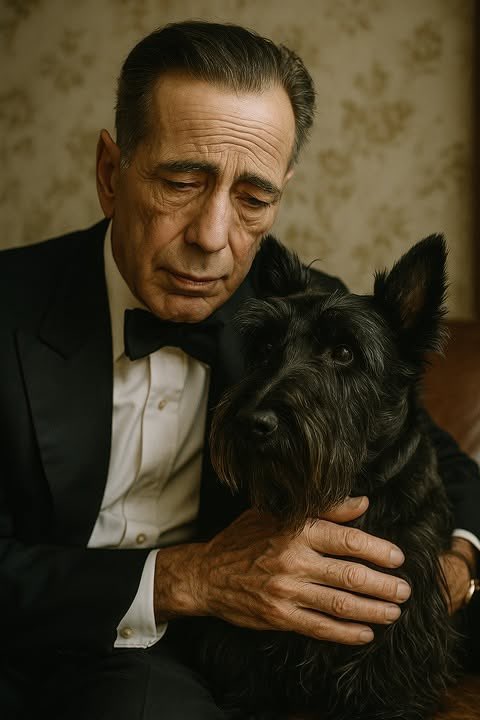
Humphrey Bogart with his dog, Zero, in 1955. Each night, when Bogart returned to his Beverly Hills home, the first to greet him wasn’t his wife, Lauren Bacall; it was Zero, his Scottish Terrier. His ears would be alert, his eyes shining, and his tail wagging furiously - as if Bogie had come back from the ends of the earth, not just a day on set. Zero wasn’t a pet. He was Bogart’s shadow. His family. Bacall would say: “Zero is probably the only creature Bogie ever obeyed without a fight.” Bogart himself once remarked over drinks at Romanoff’s: “A dog doesn’t care about your box office. He’ll lick your face whether you’re broke or famous.” For a man raised in a cold New York household, where affection was scarce, the unconditional love of animals meant everything. Zero lived like a king in the Bogart home. He had his own little corner, complete with a bar and even an ashtray. Bogie joked: “I think Zero likes bourbon more than I do.” During poker nights with Frank Sinatra, Judy Garland, and David Niven, Zero had his own chair at the table. If tempers flared, he’d growl at the guilty party. While filming “The African Queen” in the Congo, Bogart became ill with dysentery and nostalgic for home. In a letter to Bacall, he wrote: “Tell Zero I miss that ugly face more than I thought I could miss anything with four legs. Give him a steak on me.” Bacall tried, but Zero wouldn’t eat it. Instead, he waited until Bogart returned. The actor’s devotion to his terrier was no joke. He had a clause written into his Warner Bros. contract that allowed him to bring a dog on set. When an executive barred Zero from the dressing rooms, Bogart shut the entire production down until the terrier was let in. During the actor’s final months in 1956, as illness wore him down, Zero never left his side. One evening, Bogart lifted a weak hand toward the edge of the bed. Zero leapt up, curled into his chest, and lay still. When Humphrey Bogart died on January 14, 1957, his dog sat motionless beside him until Bacall carried him out of the room. For days he refused to eat, waiting by the steps of the house, as if hoping that his master would walk through the door one last time.
«El miedo en la gente, hábilmente gestionado, puede darte el poder absoluto. La gente con miedo se deja conducir dócilmente».
Africanus: El hijo del cónsul, de Santiago Posteguillo.
Misery (1990) is chilling, captivating and unsettling throughout.
Kathy Bates is brilliant as Annie the crazy fan. She deservedly won an Oscar for her portrayal.
My rating: 7/10