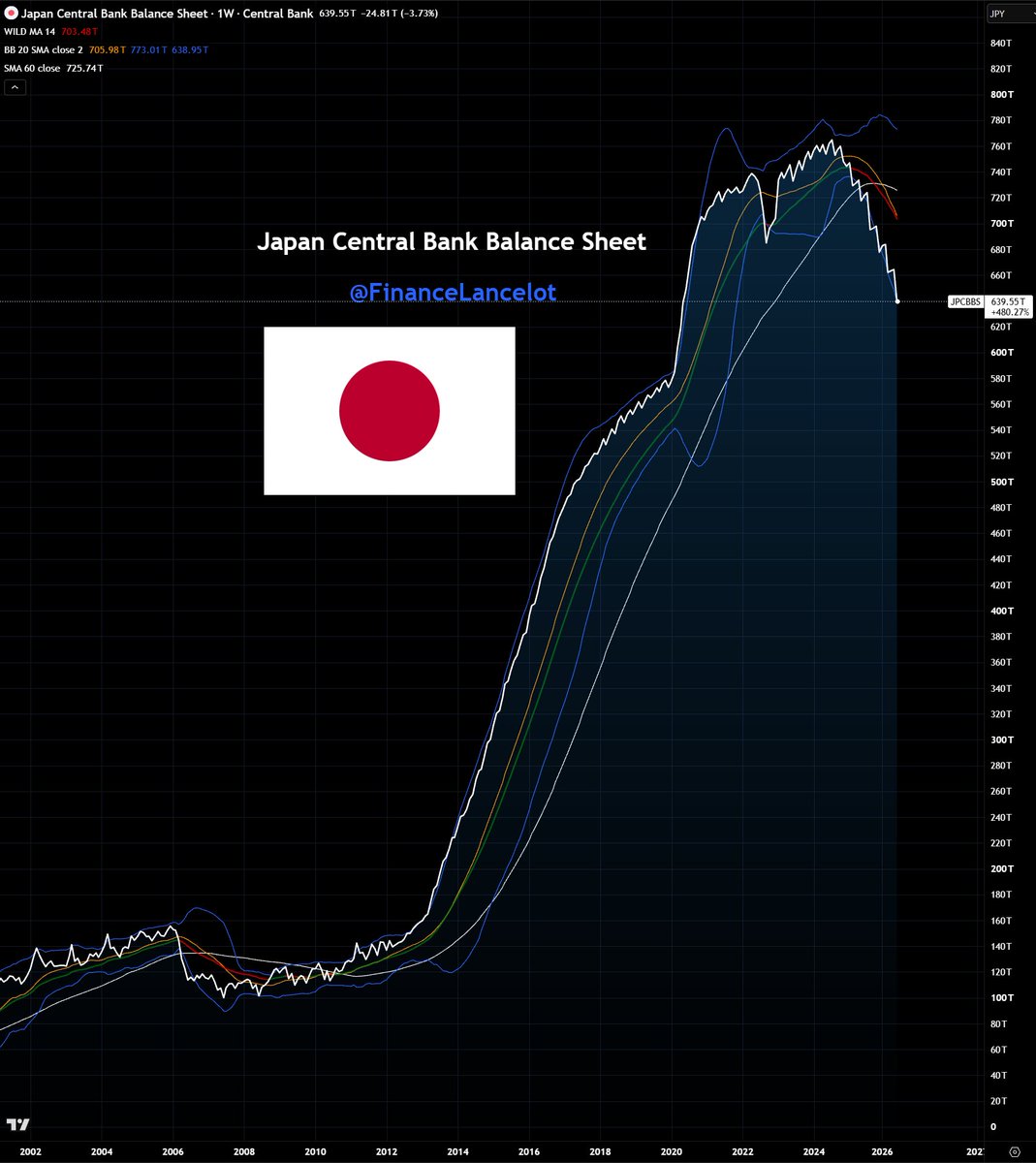
Strictly speaking, as excellent macro expert @josephwang has pointed out, BoJ mostly holds short-term Treasury bills (03mo to 2yr); they aren't heavy on long-duration T-bonds. That's not to say that this carry trade can't unwind, just that it'd hurt other assets far more.
While everyone's distracted by the Leopold fund collapse, Japan could crash the world economy.
Here's what nobody connected this week.
The Bank of Japan held its rates. No hike.
Then it did something it almost never does. It stepped into the market and bought its own currency.
Then the part that should be front page everywhere.
The US Treasury bought Japanese yen. First time in decades.
America is now defending Japan's currency.
Why?
Because the yen is what paid for America's party.
Japan is the largest foreign holder of US treasuries. For decades, investors borrowed yen at nearly 0% and pumped it into US markets. Stocks, tech, AI. It's called the yen carry trade, and it's been quietly funding America's debt for thirty years.
Until now.
Japan already spent $74 billion trying to stop the slide this year. It failed. The yen hit its weakest level since 1986.
So this week, both governments went in together. The yen ripped 4% in two days.
Currencies aren't supposed to move like that. When they do, someone is being forced out.
The same borrowed yen that pumped the AI trade is the money now leaving it. Leopold's fund wasn't a one-off. It was the first exit in a crowded theater.
Wall Street knows. They've been piling into the carry trade harder than they have in decades. [SHOW: 'Carry Trade Returns Soar Most in Decades' 7/21]
Not because they know something you don't. Because the returns were too good to leave.
And crowded exits are how small moves turn into crashes.
In 1987, Germany raised rates against a weak dollar. Two months later, the S&P fell over 20% in one day. Black Monday.
In 2026, it's Japan.
Except this time, the US government is already in the market - buying yen with its own reserves, trying to control the exit.
Governments don't do that unless the alternative is worse.
NEWS: I am launching my Substack today.
It will include an actionable & accountable long/short portfolio to see where I'm wrong & where I'm right.
It'll have macro, of course, but more micro than my followers are used to, as this is actually what has made me money in markets.
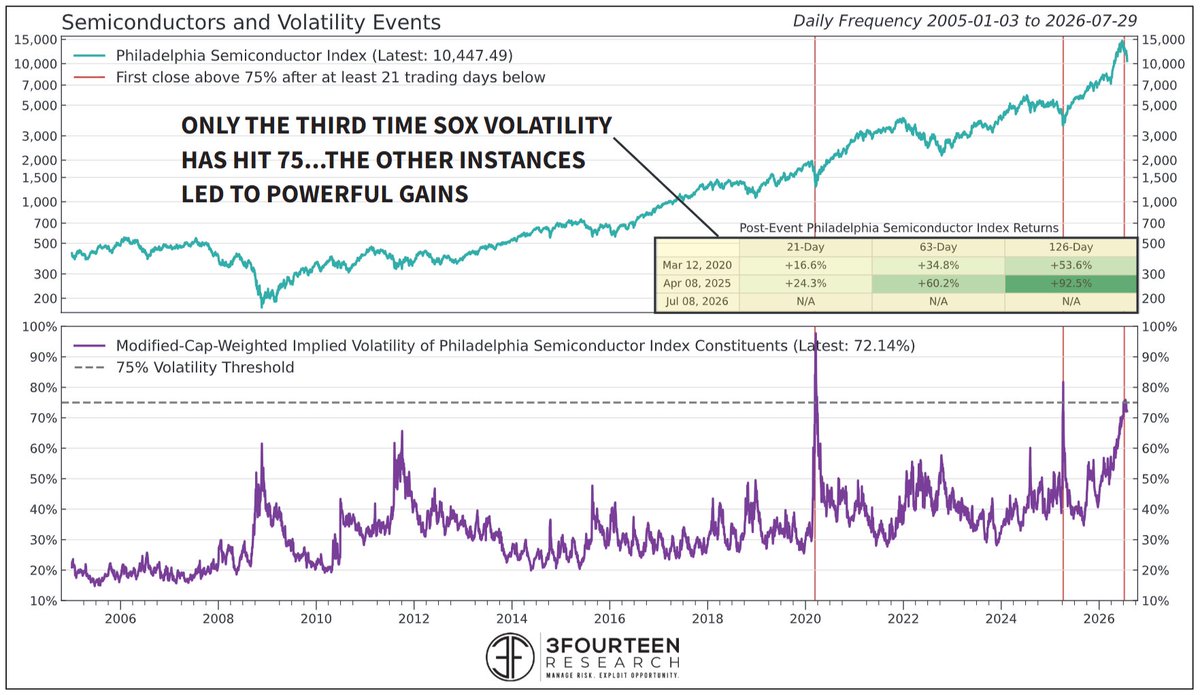
The Leopold liquidation pushed semiconductor single-stock volatility up to 75% (SOX Index).
This is only the third time semi volatility has reached this level. The other two instances: March 2020 and April 2025.
▻ The first trigger was October 8, 1999
That day, QQQ was at all time highs and no one could imagine problems brewing. Tech was going to solve everything and we were all rich. I remember it, I was there. QQQ had just set its 5th new all time high in 25 days.
▪ 5 days after the signal, QQQ was down -8.6%.
▪ 56 days after *that*, QQQ was in a correction.
▪ 67 days after *that*, QQQ fell into what would become a 14 year long bear market.
**TWO OTHER AI HEDGE FUNDS FACE STEEP LOSSES: AIPR & VARA DOWN 30-50% MTD--GODEL TERMINAL
**VARA HAS NOT UPDATED LIMITED PARTNERS, WORRYING SOME--GODEL TERMINAL
I'm not going to lie.
This is amazing.
I've spent the morning trying to design my own QQQ Correction/Bear Market Sniffer based on daily absolute volatility.
The signal has only triggered 3x now in the history of QQQ, which goes back to March 1999.
🚨 The US Treasury is stepping into the currency market to defend the yen.
Reports suggest it has informed banks that it may intervene by selling dollars and buying yen.
This is far bigger than a normal Japanese currency intervention.
The real question is: Why is the US Treasury getting involved in defending the yen?
Because if yen depreciation continues, the BOJ may eventually be forced to raise rates abruptly. That could trigger a violent yen appreciation and force the unwinding of massive yen-funded carry trades.
The sequence is simple:
Rapid yen depreciation → BOJ forced to hike → yen surges → carry trades unwind → global leverage gets liquidated.
That liquidation would not remain limited to Japan. It could spread through equities, credit, crypto and every market supported by cheap yen funding.
My conclusion:
They are using currency intervention to buy time and delay aggressive BOJ rate hikes.
This may be the biggest indication yet that policymakers are genuinely afraid of a disorderly carry-trade unwind.
They are not merely defending the yen.
They are defending the global leverage built on the yen.
BREAKING: Iran’s IRGC announces it struck and stopped 2 oil tankers, with 4 others turning back, in the Strait of Hormuz this morning after they attempted to navigate the unauthorized southern route under deceiving US military air escort while ignoring warnings, per Tasnim.
IRGC adds it informed all shipping and insurance companies to completely ignore CENTCOM’s announcements and inquire only with those who have been deceived and experienced incidents.
IRGC released footage of the burning tankers.
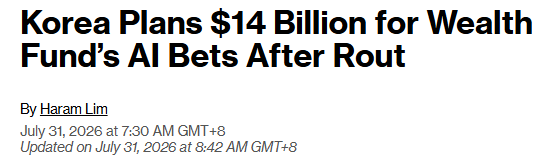
The Korean government is planning to start buying AI stocks in the open market when the KOSPI is currently still up ~50% YTD
Maybe they are just competing with Japan on who can incinerate more public money and damage the domestic economy faster 🤷♂️
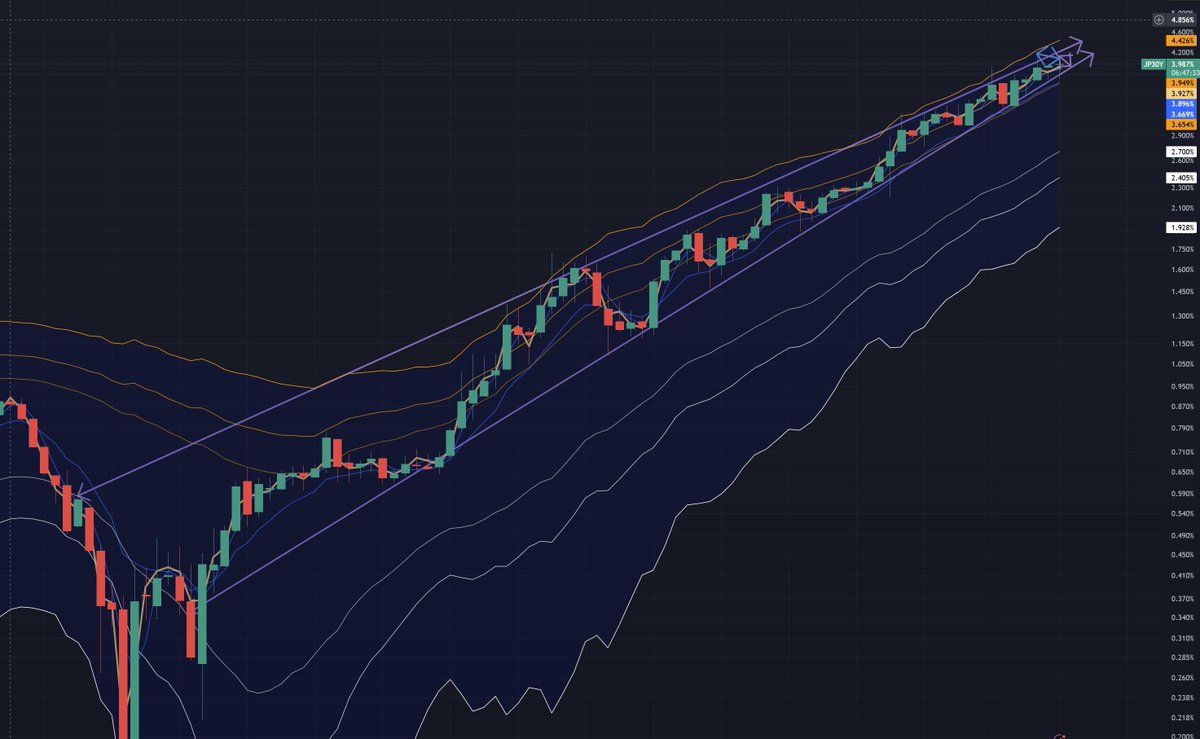
Monthly chart of Japanese 30y yield (on a log scale). It's been coiling in this narrowing uptrend since March 2020's COVID craziness. Wouldn't a technician tend to think that this breaks down? Certainly must break violently either way.
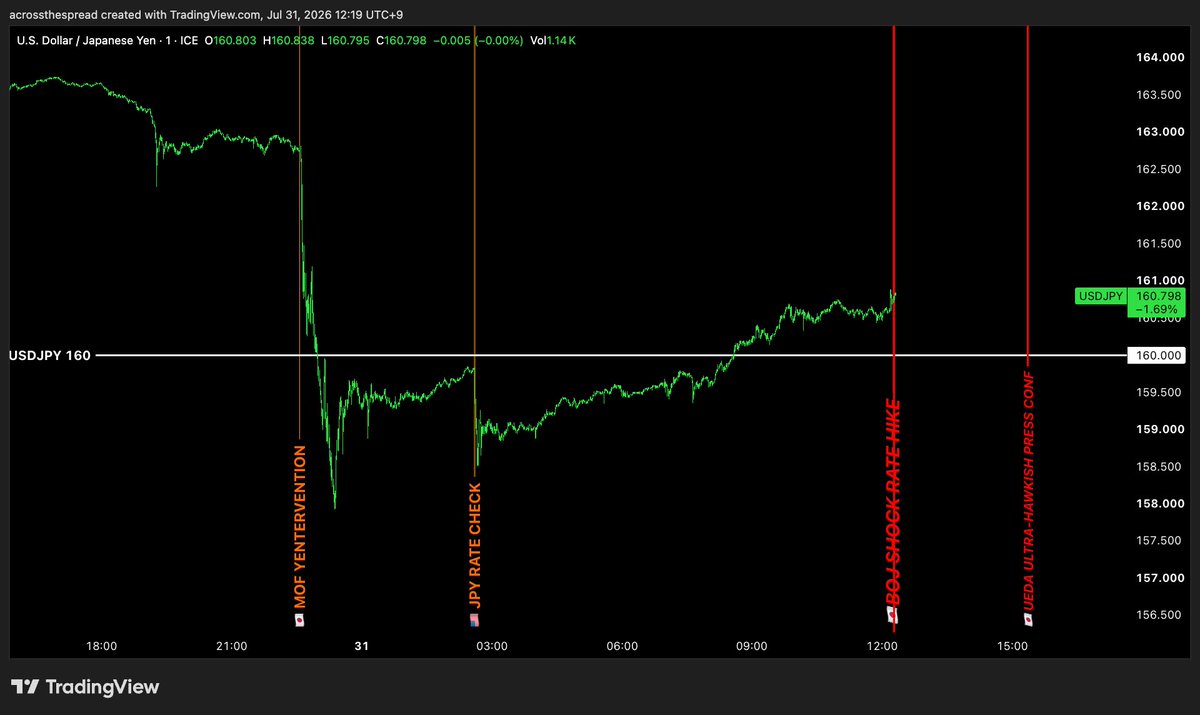
🇯🇵 BOJ JULY 2026: RATES UNCHANGED
Wow. So WTF was overnight yentervention + 🇺🇸Bessent coordination for, if no follow up shock rate hike??
I’ve been watching BOJ & MOF doing various direct market meddling for many many years - I’ve never seen such a short lived & pointless burning of money to this extent before
In addition to JPY, this not-shock-hiking just destroyed the yentervention + 🇺🇸rate check credibility & efficacy.
USDJPY back > 160 as the
🇺🇸Warsh & Bessent - 🇯🇵Ueda & Katayama credibility spread re-widens
Unless somehow Ueda saves the day- but everyone knows he can’t, which is why the pre-BOJ yentervention was necessary - that’s 🇯🇵+🇺🇸 coordinated agreement that Ueda has no market authority
As @TEE4x4 said, by holding rates at 1% Bank of Japan is telling us they're going to keep selling U.S. treasuries instead.
If I'm right and the Japan 10y skyrockets from 2.8% to 4% in the next 30 days, that's going to cause a sudden systemic shock to the bond market.
Basically triggering a global sovereign debt crisis.
As @SantiagoAuFund has been warning, eventually all Dollars return home...
So they borrowed ~$67B, spent $98B on CapEx in H1, are cash-flow negative, and reported record profit on a paper gain. All right then! Oh, and that Anthropic "investment" isn't gonna give them any IPO or have real price discovery this year. Kewl.
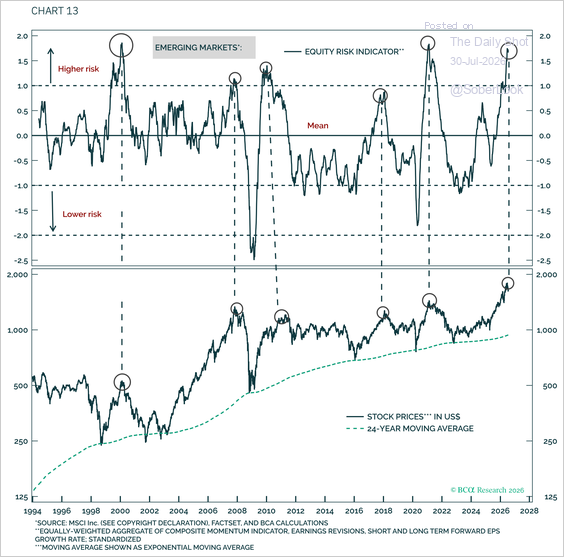
Whenever BCA's EM Equity Risk Indicator has exceeded one standard deviation, EM share prices have gone on to form a major top. It now exceeds that threshold again.
Source: @BudaghyanArthur, BCA Research, "Charts That Matter: Zoom Out. Watch The Extremes" (July 2026)
For the 7th time in history, QQQ had
▪ A +3% day
▪ Following a -2% day
▪ Pulling it out of a correction
Here were the worst draw downs during the next 5 days after the 6 previous events:
-0.5%
-12.0% (COVID; doesn't count)
-6.4%
-4.8%
-1.4%
-4.5%




![casper_smc's tweet photo. While everyone's distracted by the Leopold fund collapse, Japan could crash the world economy.
Here's what nobody connected this week.
The Bank of Japan held its rates. No hike.
Then it did something it almost never does. It stepped into the market and bought its own currency.
Then the part that should be front page everywhere.
The US Treasury bought Japanese yen. First time in decades.
America is now defending Japan's currency.
Why?
Because the yen is what paid for America's party.
Japan is the largest foreign holder of US treasuries. For decades, investors borrowed yen at nearly 0% and pumped it into US markets. Stocks, tech, AI. It's called the yen carry trade, and it's been quietly funding America's debt for thirty years.
Until now.
Japan already spent $74 billion trying to stop the slide this year. It failed. The yen hit its weakest level since 1986.
So this week, both governments went in together. The yen ripped 4% in two days.
Currencies aren't supposed to move like that. When they do, someone is being forced out.
The same borrowed yen that pumped the AI trade is the money now leaving it. Leopold's fund wasn't a one-off. It was the first exit in a crowded theater.
Wall Street knows. They've been piling into the carry trade harder than they have in decades. [SHOW: 'Carry Trade Returns Soar Most in Decades' 7/21]
Not because they know something you don't. Because the returns were too good to leave.
And crowded exits are how small moves turn into crashes.
In 1987, Germany raised rates against a weak dollar. Two months later, the S&P fell over 20% in one day. Black Monday.
In 2026, it's Japan.
Except this time, the US government is already in the market - buying yen with its own reserves, trying to control the exit.
Governments don't do that unless the alternative is worse.](https://pbs.twimg.com/media/HOm6tJYXMAAyHBV.jpg)