Personal update: I’ve joined @Cognition to lead engineering.
I’m grateful to @asha_shar and everyone at Xbox for an amazing year.
Excited for this next chapter with @ScottWu46 and team.
Introducing Devin Security Swarm
A more cost effective and accurate way to find security vulnerabilities in complex codebases, based on a new architecture: Agentic MapReduce.
Conventional model routing sucks. It passes benchmarks but fails to write code you'd actually merge.
Introducing Devin Fusion, a new hybrid-model harness for agentic coding.
In testing, it reduces the cost of Fable-level intelligence by 35% and still feels good to use.
In 1958 Ian Donald published what is now the foundational paper on medical ultrasound for obstetrics. He was so widely ridiculed by his colleagues at the time that they nicknamed him Mad Donald [1], and one said ultrasound would be useful only to "a gynecologist who was blind and had lost the use of both hands" [2]. Another noted that he'd invented a £10,000 device to undertake a task that could be accomplished with a £0.02 rubber glove. [3]
Last week, my wife and I welcomed our first child into the world. She had a rare pregnancy complication that until recently would have meant only a 28% intact survival rate for our newborn. But in 2013 US guidance was updated to add regular preventative screening for her condition at the 20-week ultrasound, and with early detection the survival rate is ~99%. (In the UK, preventative screening is still not recommended, for reasons like "it is not known how accurate screening tests are" [4].)
The entire history of radiology is people expressing skepticism about the work done by innovators. I for one am grateful for folks like @DavidSHolz building new classes of devices that can help us see things in new ways, and I'll be rooting for their success. Hand in hand with my wife and our healthy baby boy.
AI should earn its keep. Introducing the AI Productivity Guarantee.
If Devin delivers less engineering value than you’re paying for, Cognition will fund your usage until it does, up to $10 million.
It’s time for the AI industry to stop maximizing tokens and start maximizing productive output.
This post is completely outdated FWIW. Devin is really good now. One of my favorite tools.
What's good about it:
1. UX is really great and super polished
2. Love how it gives me a video and visual proof of work
3. It actually works now
Some of it is models are better but the UX/harness is also better. I suspect this blog post would not be written today.
Cognition is partnering with @MercedesBenz to accelerate software engineering across their global engineering teams, representing one of the most extensive deployments of AI software engineering in the automotive industry to date.
@ScottWu46 sat down with Katrin Lehmann, Mercedes-Benz CIO, to discuss the work:
The terminal hasn’t changed much since the 1970s. What you do with it has.
Introducing Devin for Terminal: everything we learned building Devin, now as a local agent, available right in your shell.
And when your work outgrows your laptop, hand it off to the cloud.
# The Path Forward for AI Startups
A lot of founders are messaging each other after the SpaceXAI <> Cursor “IPO-deferred acquisition”. Common discussion topic: what is the future for independent startups? Must ~everyone ultimately be acquired by a frontier lab or go extinct?
The data from our direct experience @cognition suggests the opposite. The more startups in a category that defect from independent competition by selling to a lab, the stronger the remaining ones become. We experienced this firsthand last year with Windsurf. When the founders went to Google and we acquired the remaining company, it dramatically accelerated our product roadmap and GTM. Now, cloud agents are ready for prime time, and our usage has exploded. (We’re in the fastest rate of usage growth in Cognition’s history - almost 50% month-over-month growth in Devin enterprise.) We already see the next round of acceleration with yesterday’s news, from prospects and customers to candidate inbound.
In just about every category, there’s a clear market for a winning independent offering that’s not tied to models from any one lab. Especially in a space as dynamic as software engineering, where customers value model flexibility as the rankings from different providers are constantly changing.
For startups to seize that independence opportunity, here are the lessons we’ve learned so far:
1. DIFFERENTIATION
You need to have extremely clear differentiation vs. what’s already offered by the labs. Cursor had stiff competition from Claude Code in self-serve, in part because one tool was substitutable for the other, which presented a challenge.
Our approach has been to differentiate heavily for enterprises, which is the largest market for software engineering. Specifically:
1. We invest as much in forward deployed engineering and AI enablement as we do in core R&D. Our customers treat us as a change management partner, not just an AI software engineering platform. We run 1000-person workshops all around the world to help train developers inside companies on frontier AI adoption. We target specific use cases and outcomes in addition to providing developer tooling.
2. We focus on accelerating the *entire software development lifecycle* at large company scale, not just the writing of code. Devins now spin up automatically for everything from ticket scoping to DeepWiki codebase indexing to security vulnerability remediation and application monitoring alert response.
3. We eat the pain of deployment complexity to work well in the largest and most complex environments imaginable. Cognition can run inside a customer’s virtual private cloud, has a permissioning and team collaboration model that can scale to 100,000+ developers inside one company, runs as well for COBOL mainframes as it does for modern Python. From day 1 each Devin ran in a microVM on its own machine, vs running locally as a CLI tool, which allows arbitrary horizontal scaling and is a better fit for event-driven automation.
Of course, one element of startup differentiation will always be model independence. This is particularly powerful in large enterprises, who value supplier continuity and the ability to centralize tooling without taking on the business risk that they committed to the wrong foundation model. And useful for individual developers, who always want to try the latest models. (If you haven’t yet tried the Windsurf 2.0 release which came out last week, it’s a good day to give it a shot!)
I expect the labs will catch up on some of these fronts at some point. But at that point, we’ll have already made the next leap in differentiation, because…
2. FOCUS
You won’t outcompete the labs in everything, but you can outcompete the labs in *your* thing. Every application domain has fractal complexity at the edges. Lean in to what makes your domain special and offer things no one else can. Does it make sense for a lab to devote training resources to a specialized code review model? Probably not - they’re working on AGI. But for the 3-6 month window where the latest frontier models don’t solve that use case at acceptable performance, cost, or latency, do it yourself and build a better product experience than would otherwise be possible. Rinse and repeat as the frontier of what’s possible via specialization continues to evolve.
3. VELOCITY
One of our values at Cognition is: “Every second counts.” Maniacal urgency helps in every startup, but it counts extra in today’s accelerated AI times where advantages compound faster than before. With sufficient focus, you can out-accelerate the AI labs on any one specific feature or workflow. Do this consistently to stretch the overhang of what’s enabled by each new generations of models, and you can maintain your edge on a differentiated product experience.
-
In many ways the SpaceXAI <> Cursor news is a win for everyone. SpaceX gets a new research team and the chance to become competitive in coding. Cursor gets a meaningful exit and the opportunity to accelerate their research roadmap with much more compute. And the whole ecosystem benefits from increased competitiveness among the foundation model labs. Congrats to the teams on the outcome.
There's a reason @cognition keeps winning deals against companies 10x their size.
@vvkgopalan sat down with @theodormarcu, @bryceehunt and @moritz_stephan (all former founders!) to discuss hiring philosophy, infinity stories, enterprise coding agents, and what it actually takes to compete.
(00:00) Introduction
(03:45) Cognition team & hiring philosophy
(06:00) Infinity stories
(13:15) Product surface area and future goals
(17:20) Activation energy, experimentation, and customer-driven innovation
(19:00) Adoption, operational changes, and ownership
(22:05) Vibe coding hot takes
(24:15) AI-first engineering organizations and managing AI agents
(28:40) Future of software engineering roles and misconceptions about Devin
(30:00) Model development, learnings, and Cognition's journey in vertical integration
(38:10) What should you do as a new grad?
Devin Review caught the axios supply chain attack for multiple Cognition customers before the attack was publicly known.
These attacks will be 10x more frequent in the age of AI; it is critical that repo maintainers start using AI for defense as well.
(showing one example below where Devin Review caught the attack within an hour of its release - text minorly edited for anonymization)
@cognition Internally, we’ve seen our own Devin usage go parabolic as a result of these changes. The Devin session -> Devin review -> autofix feedback loop is a delight!
Introducing Devin 2.2 – the autonomous agent that can test with computer use, self-verify, and auto-fix its work. Try it for free!
We’ve also overhauled Devin from the ground up:
- 3x faster startup
- fully redesigned interface
- computer use + virtual desktop
...and hundreds more UX and functionality improvements.
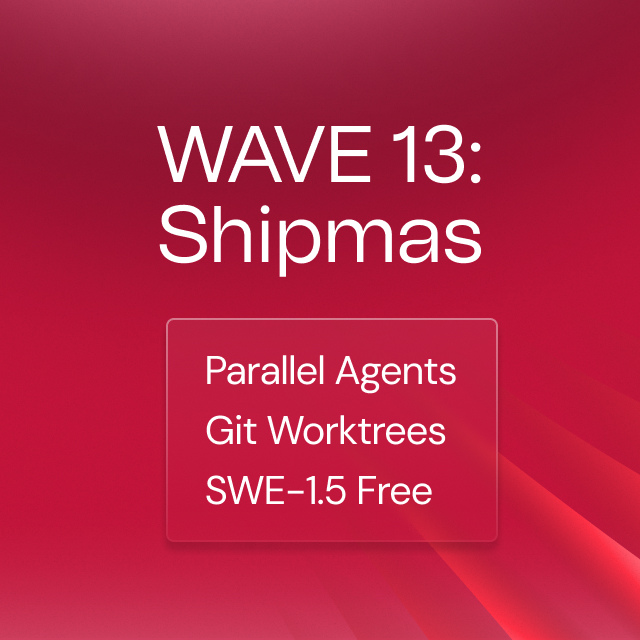
Introducing Wave 13: Shipmas Edition 🎅
- SWE-1.5 Free: The full intelligence of SWE-1.5 at standard throughput, for free for the next 3 months
- True parallel agents with Git Worktrees + multi-pane and multi-tab Cascade
- Dedicated terminal for more reliable command execution
And many other other new features, bug fixes, and performance improvements.
Happy holidays and merry shipping from the Cognition team!
Speed is the next frontier! Very excited to be at the forefront of this; programming looks very different when agents can output code faster than you can think — lots of new paradigms/UX to figure out.
Today we’re releasing SWE-1.5, our fast agent model.
It achieves near-SOTA coding performance while setting a new standard for speed. Now available in @windsurf.
Today we’re releasing SWE-1.5, our fast agent model.
It achieves near-SOTA coding performance while setting a new standard for speed. Now available in @windsurf.





![russelljkaplan's tweet photo. In 1958 Ian Donald published what is now the foundational paper on medical ultrasound for obstetrics. He was so widely ridiculed by his colleagues at the time that they nicknamed him Mad Donald [1], and one said ultrasound would be useful only to "a gynecologist who was blind and had lost the use of both hands" [2]. Another noted that he'd invented a £10,000 device to undertake a task that could be accomplished with a £0.02 rubber glove. [3]
Last week, my wife and I welcomed our first child into the world. She had a rare pregnancy complication that until recently would have meant only a 28% intact survival rate for our newborn. But in 2013 US guidance was updated to add regular preventative screening for her condition at the 20-week ultrasound, and with early detection the survival rate is ~99%. (In the UK, preventative screening is still not recommended, for reasons like "it is not known how accurate screening tests are" [4].)
The entire history of radiology is people expressing skepticism about the work done by innovators. I for one am grateful for folks like @DavidSHolz building new classes of devices that can help us see things in new ways, and I'll be rooting for their success. Hand in hand with my wife and our healthy baby boy.](https://pbs.twimg.com/media/HLR5AeHbgAAEwRZ.jpg)