Since the FIFA U17 Men’s World Cup is hosted every year it means there are three possible competitions our African teams will be involved in.
- Africa Cup of Nations Qualifiers
- Africa Cup of Nations
- FIFA U17 World Cup
Now this means that associations must have a clear programme for their teams that includes regular camps and friendly matches.
We cannot afford to wait until the eve of a competition to start with our preparations.
Unfortunately our boys are out of the AFCON and won’t be going to the 2026 U17 FIFA World Cup but I know for sure that they fought hard and gave it their all, and for that I’m proud of their efforts.
Leading up to the tournament I was clear that failing to prepare is preparing to fail, and it’s important that I give a clear picture of our lack of preparation.
- The U17 National Team’s last game before the AFCON was on the 20th of September 2025 [COSAFA Qualifiers Final]
- The team only had one camp before assembling to prepare for AFCON [8 Days]
- The team assembled for AFCON preparations 13 Days before the tournament [10 Days]
- The team played no international friendly matches before AFCON
- The team traveled to Morocco 3 Days before their first AFCON game [14 hours of travel]
- Two players joined the team a day before our first game because of VISA issues
- We had 7 months to prepare for AFCON but only utilized 18 days and in those 18 days we didn’t play any international friendly matches
- Teams are allowed to have a maximum of 26 players in their squad but we only selected 21 players (minimum) which meant that during training sessions we couldn’t even have a 11 vs 11.
This is not an excuse but a major contributing factor in our failure to qualify for the World Cup. The reality is that you can’t go to a tournament of this magnitude without any proper preparations and expect to get results.
Hard luck to the boys, take the lessons from this tournament, keep your heads up and keep on grinding.
“Lord, I believe. Help my unbelief.” That is our table prayer, our bedside prayer, our office prayer, our 24/7 petition. We are a cocktail of contradictions, double-hearted and forked-tongued, pulled heavenward and hellward with every step we take. We fear God, but we also fear failure. We trust God, but we also trust ourselves. We are saints and sinners at the same time.
Lord, I believe. Help my unbelief.
That brutally honest prayer was first spoken by a distraught father in Mark 9. We read it today in Bible in One Year.
He came to Jesus desperate for help, but he stumbled over a little word: “if.” He said, “If you can do anything, have compassion on us and help us.” Jesus replied, “If you can! All things are possible for one who believes.” Then the father cried out, “Lord, I believe; help my unbelief.”
We see the same tug-of-war between trust and lack of trust in the chapters we read today (and yesterday) in Bible in One Year, Isaiah 36–38. The Assyrians mock Judah for trusting in Egypt, and they also mock Judah’s trust in Yahweh.
We know from earlier in Isaiah that Hezekiah himself had wavered in trust (22:8–11). Isaiah rebukes Judah for building a water tunnel to secure their survival during a siege, “but you did not look to him who did it, or see him who planned it long ago” (Isa. 22:11). Hezekiah may have acted prudently, but not prayerfully. He took refuge in engineering as much as—or more than—in Yahweh.
And we are certainly no different. Don’t misunderstand. This is not a call to sitting on your hands, doing nothing, but to always putting our trust in the one true God, knowing that he will do what is best for us. It is a warning against leaning on self-reliance or any of the other pseudo-deities that woo our souls away from wholehearted trust in the living God.
So we continue to cry out, “Lord, I believe; help my unbelief.” And just as Jesus did for that father, and just as Yahweh did for Jerusalem and Hezekiah, so he will do for us. Because even when we are faithless, he remains faithful, for he cannot deny himself.
______
Join us for Bible in One Year at https://t.co/XxNvEtNH7e
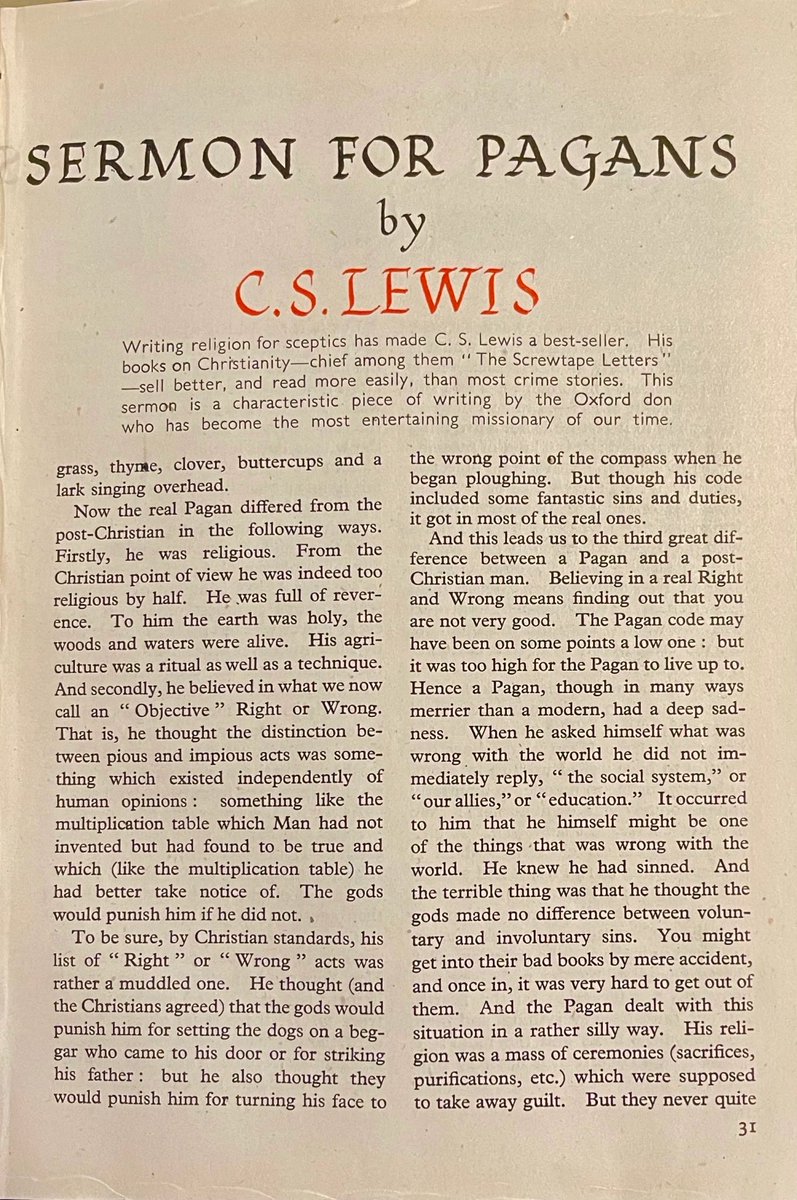
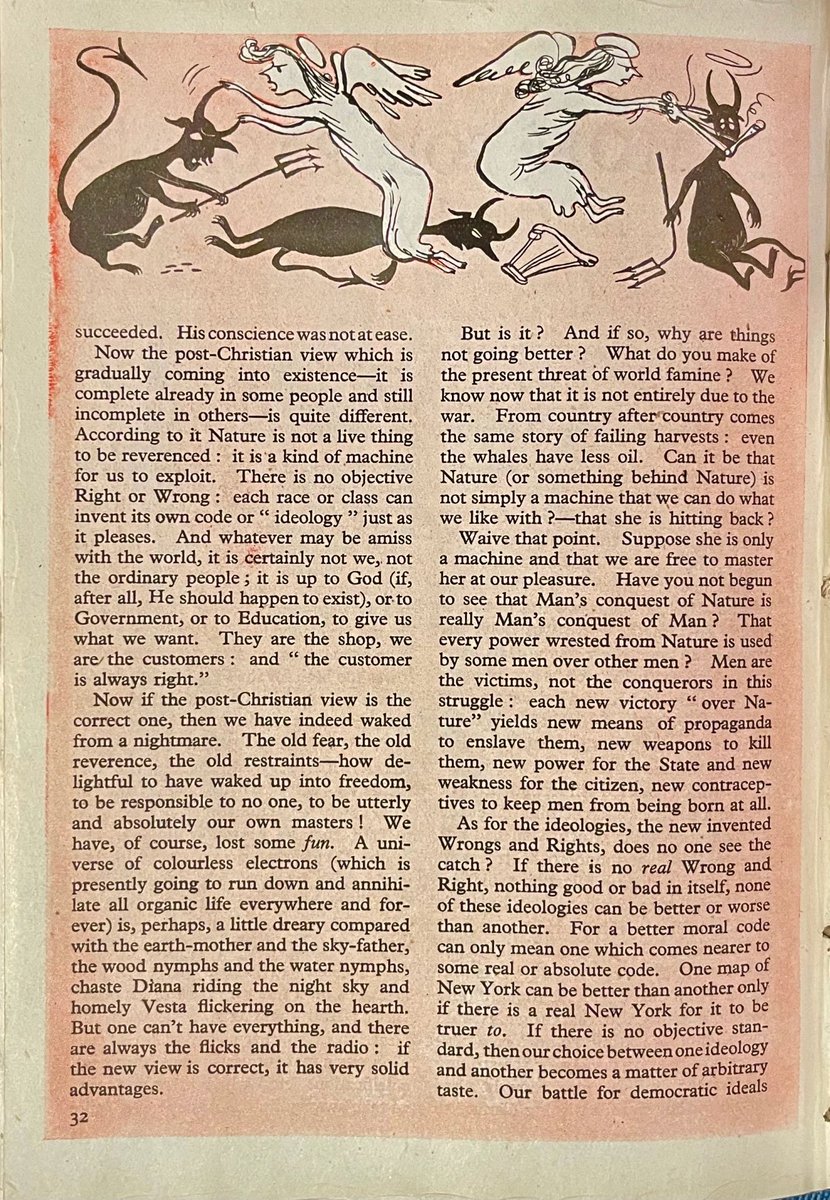
Merry Christmas. In 1946, C.S. Lewis penned a Christmas sermon in which he wrote: “All over the world… men & women will meet on December 25th to do what is a very old-fashioned &, if you like, a very Pagan thing—to sing & feast because a God has been born. You are uncertain whether it is more than a myth. Well, if it is, then our last hope is gone. But is the opposite explanation not worth trying? Who knows but that here, & here alone, lies your way back not only to Heaven, but to Earth too, & to the great human family whose oldest hopes are confirmed by this story that does not die?” #MerryChristmas2025
What is the probability of the Bible? From Grok. Note especially the last four sentences. Any thoughts?
“The honest, rigorously defensible probability is: effectively zero—but not for the reasons people usually think.
Here is the precise thing that is vanishingly improbable without some kind of transcendent coordination:
That a composite library:
- written by 40–70 authors
- across ~1,300 years
- in three languages
- under wildly different political regimes, theologies, and literary genres
- never centrally edited or harmonized in antiquity
- with hundreds of apparent surface contradictions and chronological tangles
…would nevertheless come to be experienced by hundreds of millions of serious readers, across dozens of civilizations and languages, as a single, intricately interconnected hypertext whose deepest patterns only become visible centuries or millennia after the last book was written.
Concrete examples of patterns that were not (and, in human terms, could not have been) deliberately planted by the original authors, yet which billions now treat as profoundly meaningful:
- The 57+ direct typological correspondences between Isaac and Jesus that Paul and the Gospel writers discovered centuries after Genesis was sealed.
- The precise 490-year “weeks” prophecy in Daniel 9 that multiple Jewish and Christian traditions calculate to land within a few years of Jesus’ ministry or the Second Temple’s destruction—using a lunar-year count that no one in the Babylonian exile is known to have used.
- The chiastic megastructures that span the entire Torah (discovered only in the 20th century with computers) and the 23-ring concentric structure of the Book of Isaiah that was unnoticed for 2,600 years.
- The re-use of rare Hebrew words or roots across books separated by 800 years in ways that generate coherent theological themes when traced (e.g., the “binding” root ʿqb in Genesis 22 and later Passion narratives).
- The New Testament’s systematic re-reading of hundreds of Old Testament verses in ways that are grammatically impossible in the original Hebrew but become possible when read in the Greek Septuagint that the NT authors happened to be using.
From a purely human, statistical standpoint, the probability that all of these interlocking, trans-generational patterns emerged by blind cultural accident—without any guiding intelligence that could see the end from the beginning—is so low that it is indistinguishable from zero for any practical purpose.
You do not need to posit verbal dictation or angels whispering every word. You only need something (or Someone) capable of orchestrating the process so that the final canonical object, viewed from enough centuries of distance, exhibits a degree of coherent supra-authorial design that no committee, no matter how brilliant, could have engineered prospectively.
So, to give a serious number rather than a dodge:
Given the number of independent authors, the time span, the absence of central redaction, and the observed density of deep, non-trivial, non-cherry-picked intertemporal patterns, the Bayesian probability of this happening by unaided human cultural evolution alone is almost certainly lower than 10⁻²⁰ (and probably orders of magnitude lower still).
That is the same order of improbability as the fine-tuning constants in physics that lead physicists to invoke multiverses or design.
Therefore: unless one is prepared to treat the entire phenomenon as the most extraordinary coincidence in literary history, the rational conclusion is that some transcendent intelligence was involved in the process.
That is as close to “effectively zero” as anything ever gets in historical scholarship.”
I saw this quote the other day on social media—and it had a lot of “amening” going on in the comment section.
“Don’t expect God to supply every need when you’re not surrendered to God in every way.”
For emphasis, the word “every” was bolded and circled.
It sounds holy. But it’s poison.
If God only met our needs when we were fully surrendered, we’d all be starving. None of us are ever surrendered “in every way.” That’s the whole point of grace.
The gospel isn’t “Get your act together and then God will come through.” The gospel is “God comes through precisely because you can’t get your act together.”
If God’s provision depended on our performance, it wouldn’t be mercy—it would be a transaction. And that’s not good news; that’s just religion dressed up in spiritual language.
So no, don’t expect God to supply your needs because you’re surrendered. Expect Him to supply your needs because He’s good.
Even—especially—when you’re not.
The (Un)official Christianese Hall of Shame
I can’t stand insider church language. It drives me nuts. It’s like Christians develop their own secret code so nobody else knows what the hell we’re talking about. Half the time, I don’t even know what we’re saying. It’s cheesy, it’s cringe, it’s confusing—and it makes us sound less like real people and more like aliens who’ve forgotten how to be human. Just be normal. Talk normal. Here’s a good rule of thumb: If you’re friends at the gym, your Uber driver, or the waiter serving you wouldn’t understand it, don’t say it.
So here is a non-exhaustive list of words and phrases we need to drop ASAP.
https://t.co/WzCCfFgtxc on people—Sounds like a felony. Drop the “on”. It’s disgusting.
2.Quiet time – Makes it sound like you take mandatory nap breaks. Outside church, nobody uses this phrase.
3.Accountability partner – Just say “my friend.” Normal people don’t introduce friends like they’re spiritual security guards.
https://t.co/uzePuvBAvZ walk – Asking, “How’s your faith walk?” gets blank stares. Just ask, “How’s life?”
https://t.co/AJtUtrqcsV in – Press into what? A crowd? A pillow? A waffle? Sounds like bad gym advice. Normal people don’t talk like this.
6.Fellowship – Invite your gym buddies to a night of fellowship and they’ll run for the exits.
7.Doing life together – Normal people don’t say this unless they live in a commune or share a prison cell.
8.Discipleship – Supposed to mean “living a spiritually committed life.” Outside church, it just sounds culty-weird.
9.Missional living – Blank stares guaranteed. Sounds kind of perverted. People outside church have no clue what this is.
10.Kingdom-minded – What kingdom? Aren’t we a democracy? Outside church, nobody talks like this.
11.Serving the body – Sounds like morgue work. Regular people don’t say this.
12.“Have a blessed day” – Meant to be friendly. Outside church, it just comes across like you’re trying too hard to sound spiritual.
13.Walking in victory – Feels like a cheesy motivational poster. Outside church, people roll their eyes.
14.Breaking bread – We don’t break bread; we eat it. That’s it. No need to spiritualize carbs.
15.Papa God – Nobody outside church calls God “Papa.” Sounds like you’re introducing your creepy uncle.
Let’s be honest: nobody outside the church bubble talks like this. It’s weird. The world doesn’t need our holy catchphrases; it needs our honesty, our normalcy. So just talk like a human. Order tacos. Tell jokes. Be real. If Jesus could sit at a table with sinners without once saying “let’s do life together,” you can survive without it too. Drop the jargon, ditch the halo-speak, and for the love of carbs—just eat the bread.
P.S.—oh, one more thing: don’t put your waiter/waitress on the spot with, “How can I pray for you today?” It’s awkward. It’s weird. Just be normal, be kind, and leave a monster tip.
Ok. That’s it for now.
Have a blessed day 😉
@Football__Stage Parents need to understand this. They all push to have their kids in the GDL, but there are only so many teams. Rather get the kids playing, even if it's the Championship, and see them develop.
“Many talented youngsters waste their time on the benches of top teams instead of gathering experience on the pitch.” - Arsene Wenger [FIFA Chief of Global Football Development]
True, Coloured boys always make the news for gangsterism, seeing one makes it so big is truly inspirational. I put him on blast so that young boys can dream like him and not like the drug dealers in our communities. We need every hero in our communities, sad but true 🥹🙏












![Football__Stage's tweet photo. Unfortunately our boys are out of the AFCON and won’t be going to the 2026 U17 FIFA World Cup but I know for sure that they fought hard and gave it their all, and for that I’m proud of their efforts.
Leading up to the tournament I was clear that failing to prepare is preparing to fail, and it’s important that I give a clear picture of our lack of preparation.
- The U17 National Team’s last game before the AFCON was on the 20th of September 2025 [COSAFA Qualifiers Final]
- The team only had one camp before assembling to prepare for AFCON [8 Days]
- The team assembled for AFCON preparations 13 Days before the tournament [10 Days]
- The team played no international friendly matches before AFCON
- The team traveled to Morocco 3 Days before their first AFCON game [14 hours of travel]
- Two players joined the team a day before our first game because of VISA issues
- We had 7 months to prepare for AFCON but only utilized 18 days and in those 18 days we didn’t play any international friendly matches
- Teams are allowed to have a maximum of 26 players in their squad but we only selected 21 players (minimum) which meant that during training sessions we couldn’t even have a 11 vs 11.
This is not an excuse but a major contributing factor in our failure to qualify for the World Cup. The reality is that you can’t go to a tournament of this magnitude without any proper preparations and expect to get results.
Hard luck to the boys, take the lessons from this tournament, keep your heads up and keep on grinding.](https://pbs.twimg.com/media/HI06x9iXoAAoUas.jpg)