@timdexterr @BBSimons I'm always fascinated by his energy, depth of knowledge, and consistency. In the future, we'll need a Bright Simons Institute to memorialize & institutionalize his works. Today, many might take what he's doing for granted but one day we'll understand the value of what he does.
I stopped engaging people who are motivated and hell-bent on tarnishing Nkrumah's image and seeking to steal his glory because their forebears, who belonged to the post-colonial political tradition that was antithetical to Nkrumah’s ideologies, were very much the people, or the stock, from which Nkrumah's enemies came.
And really, there's no point, because the man Nkrumah, has lit a flame that no one can extinguish. He transcends the boundaries of Ghana. He's a global icon.
No amount of propaganda,or rehashing or resurrection of any foolish claims about corruption, would really hold.
I admit that there were policies that led to some overreach or excesses in his government but no one can prove any corruption except to simply assert or parrot claims by his enemies.
@Maukeni_ Great reflections! What is that “national identity”? What does the concept of “national identity” in a multi-ethnic society like Ghana entail??
@JoyNewsOnTV The oppressor will insist on you using the traditional approach that he knows will not work because he has control over that approach. Sometimes, we have to innovate away from traditional approaches to problems that have not been solved.
I'm happy that our politics is shifting from propaganda and ethnic-based politics to data-driven conversations. But we still have a long way to go in terms of closing the education gap so we can bring the grassroots to a level where they can appreciate this data or these numbers and make decisions based on data. With that, we can significantly reduce the autopilot voting patterns! In this day and age, propaganda will not fly among the non-partisan middle class!
There’s a bit of a strawman there! You’ve set a weak premise to defeat it! In 2016, Ronaldo was still young, energetic, and vibrant. Everyone with common sense knew he could not have retired then.
“Leave when the applause is high” does not literally mean leaving immediately after your highest achievement without considering the context of where you are in your career, in this case, in terms of your age in football.
“Leave when the applause is high” means leaving at a point when not leaving will only turn the hero into a villain, or when not leaving will harm your reputation and years of achievements and successes.
If you're looking for a good example, just look at how Messi retired. He didn't leave when he won the World Cup, which would support your premise. But he left when he knew that not leaving would be detrimental to the collective goal, and that is the meaning of the quote.
Thank you.
The Halaand comparison is also weak! CR7 at his age does not have the speed and strength of Haaland today! The way defenders organize to neutralize Haaland because of the threat partly emanating from his energetic nature is not the same way they’ll organize to neutralize a 41yr old legend!
Instead of setting up to collectively maximize the potential of young players and build a solid system to win consistently; they should set up to accommodate the weaknesses of a 41yr old legend to ‘tap in’ in goals? What’s the opportunity cost of setting up a team to accommodate a 41 yr old legend? Any system designed to maximize the dwindling abilities of a 41yr old legend will weaken the qualities of young and energetic players! He’s done excellently for himself and his country! Time to move on!
My assessment is that the list is quite inclusive. Women, and especially the market woman represent the “ordinary” Ghanaian. A departure from “hero” figures. The judiciary, arts and culture, education, and religious sectors are also represented. Then of course, our own Dr. Kwame Nkrumah. I also find the list fairly representative in terms of ethnic diversity. I welcome the departure from the Big Six narrative, which I consider historically problematic. People may have their preferred lists, but overall, I think this is a good one. Inclusivity is my biggest takeaway!
I was vocal about galamsey too. I participated in galamsey protests. I still believe we are far from our goals. I believe those who organized the protests should feel obliged by their conscience to do the same now, and many will participate. However, I follow Asare Donkor (Journalist) closely on Facebook. His updates tell me that military action on the ground is ongoing. It is just proving to be a daunting task because of the complexity of the menace. I think the government must go to more extraordinary lengths than we are seeing now to dismantle this cartel-like venture of environmental suicide.
@BBSimons I agree with you. I think the notion that CSOs are dying is misconceived. But come to think of it, do you realize that the masses don't pay much attention to certain issues when economic indicators are favourable and their pockets are stable or doing well? The same issues would gain a different level of traction under different economic circumstances. When people are struggling financially, they are compelled to connect their economic difficulties to every minor issue. These issues therefore gain a lot of traction and get dramatized, compared with periods when economic conditions are stable. Is this a valid observation? How would you describe it?
I recently put on my *anti-fraud tech* hat (the vocation that pays my bills) to review Traffitech, the new automated traffic ticket/fine system in Ghana. Here is what I found.
1. You would notice that the base Traffitech fine of GHS 240 is more than 11x the minimum wage in Ghana.
2. So, minimum-wage earners must work for 11 days to pay each fine.
3. The median income in Ghana is ~GHS 2130 a month. Among informal workers, it is GHS 1200. And in Greater Accra, it is GHS 3000.
4. It is true that drivers who own their own cars tend to earn higher than the median wage. But a very large number of drivers on the road are commercial drivers who earn around the 3000 - 4000 a month mark.
5. One of the attached charts show you how the fines escalate against the disposable income of such drivers.
6. All of this to say that we should pay attention to COMPLIANCE as a function of AFFORDABILITY. If people simply can't pay, they will not pay. As the fines pile up, the ability to pay worsen.
7. It is not surprising that before the Kenyan scheme was suspended, compliance rate (people actually paying the fine) was a mere 16% and that in Cote D'Ivoire the authorities had to introduce an option to pay in installments.
8. Compare that with compliance rates of 75% in Berlin, 67% in Chicago, and 70% in New South Wales (Australia).
9. Apart from income, I would argue that a major factor for higher compliance rates in the above places compared to what we have seen in Africa is the SENSE OF FAIRNESS.
10. If drivers begin to feel that the whole scheme is arbitrary and it is hard to modify your behavior to avoid fines because the speed limits are hard to scope and determine, compliance will fall and arrears will pile up.
11. Something else will then happen: FRAUD.
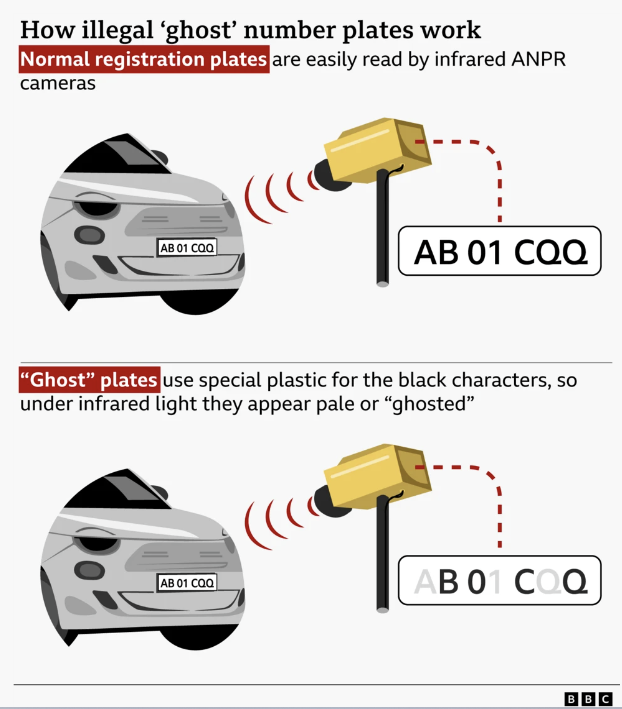
12. Last year, the UK authorities launched operation phantom, an exercise to detect car number plates deliberately tampered with to avoid automated tickets and fines.
13. Special cameras called "Sentio Ghost" were acquired from a company called Redspeed for the effort. Within 2 weeks, 4,335 ghost plates were recorded. Another provider, MAV, detected 1000 such plates at the Dartford Crossing. (Sensys Gatso, Ghana's provider, doesn't seem to have developed such tech.)
14. Researchers at UT Austin (Texas) recently showed how with $100 anyone can create a simple rim unobvious to the naked eye that reduces the performance of even the most advanced cameras by 60%. And now there are simple sprays that do similar things.
15. The situation is made worse by the poor street lighting in Ghana that makes using other spectra beside infra-red much harder.
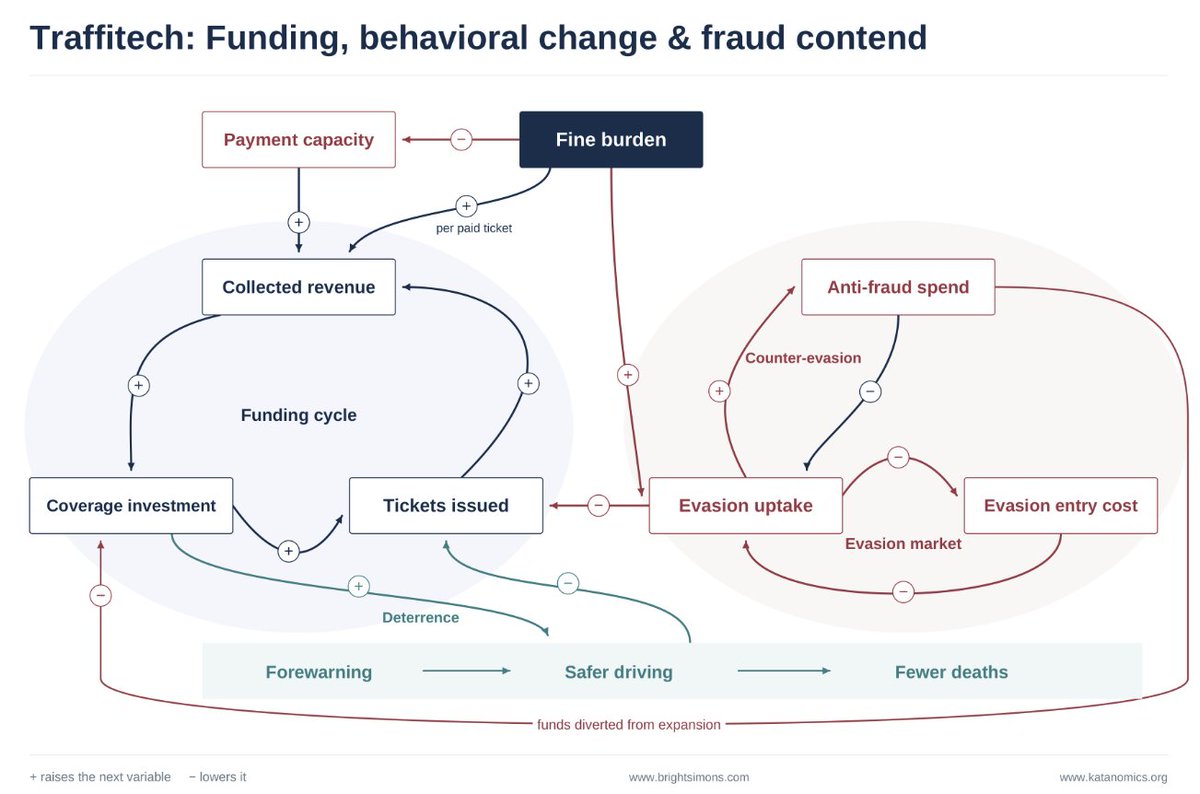
16. Capitalism means that if the number of evaders grow, the supply of "ghosting" tools will increase and costs will fall. Meanwhile, Mr. Frank Osei and Sensys Gatso will counter by pushing for more higher-tier cameras, which will drop revenue. But less revenue would also limit the ability to spread the system. See chart.
17. At any rate, research shows that in this fraud "arms race", the cost advantage is on the side of the criminals.
18. As the chart shows, there aren't easy answers about how to address these complex feedback loops. But, for sure, the idea that fines have to be kept high to serve as a deterrence is not all that smart.
@BBSimons Systems thinking in action! You really take policy analysis seriously! Trade offs are difficult to deal with but understanding them is the first step to finding solutions. Kudos!