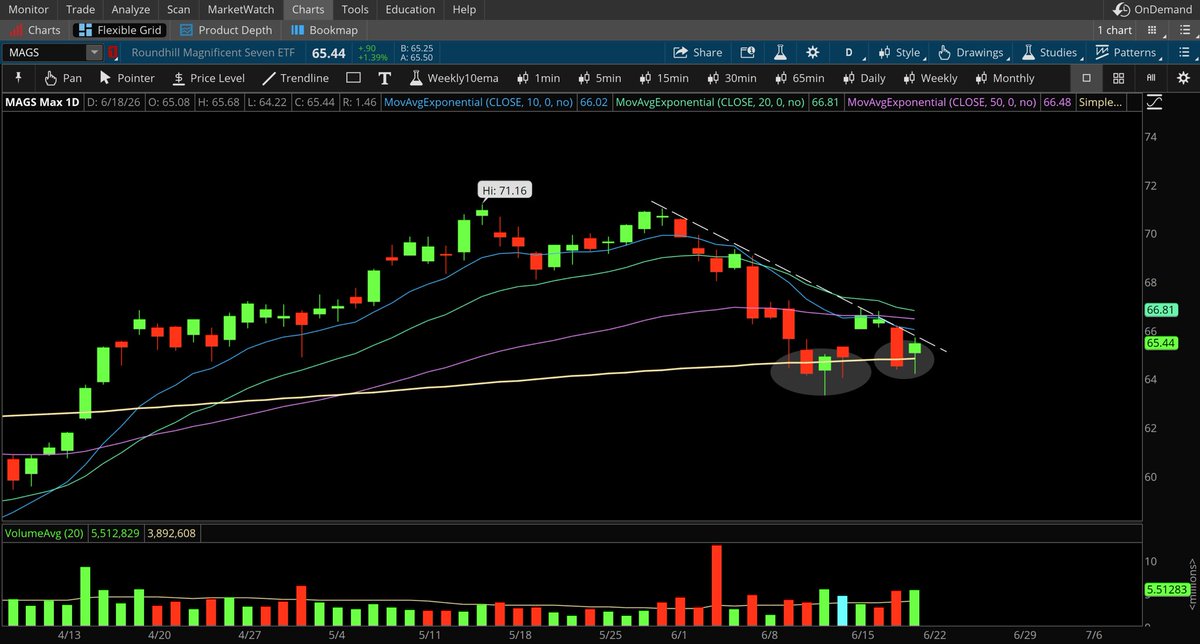
$MAGS
The Mag 7 have definitely been lagging this entire bull run, but now we’re at a key level having bounced twice off the 200day moving average. Time for the Mag 7 to step up.
The best setup in the world can fail if it’s traded in the wrong market environment.
Before focusing on individual stocks, I want to understand what the indexes are telling me.
Looking at $SPY and $QQQ, both remain above their 9 and 21 EMAs, which is constructive and suggests the trend is still intact. As long as buyers continue to support these key areas, the market deserves the benefit of the doubt.
That said, one possibility I’m considering is that the indexes may spend some time consolidating after their recent advance. If that happens, I’ll be paying close attention to how they behave. Do they become choppy and volatile, or do they tighten up and show signs of institutional support?
Personally, I’d like to see some tightness develop. The best moves up are often preceded by periods of contraction where volatility decreases and leadership continues to separate itself from the rest of the market.
One thing that stands out to me is that $QQQ continues to show more relative strength than $SPY. That’s something I’ll be monitoring closely as it can provide clues about where capital is flowing.
Going into next week, I’m watching for:
• Continued support at the 9 and 21 EMAs
• Tight price action and volatility contraction
• Relative strength from leading stocks
• Potential VCPs and constructive consolidations
If the indexes tighten up and break higher, that could provide the foundation for the next leg up. If they become choppy and start losing key moving averages, then I’ll adjust accordingly.
The goal isn’t to try and predict the market. The goal is to identify potential scenarios, prepare for them, and react to what price is actually doing.
This has been on my mind as well recently as I have experienced the same with my recent trades, but I got to ultimately agree with @FranVezz. It’s more important to stick to your system and have a long term outlook. It’s easy to fall into the trap of constantly changing your system when the market decides to change its character as well. And as I always like to remember, it’s better to sell 10% too late, than 100% to early.
Days like today are where FOMO can do the most damage.
When the market gaps up across the board, it’s easy to feel like you’re missing out and start chasing extended entries.
But instead of focusing on what already moved, I’m paying attention to something else:
Which stocks are holding the gap?
Which stocks are closing near their highs?
Which stocks are giving back gains throughout the day?
Anyone can look strong at the open when the entire market is being lifted.
The real leaders separate themselves by maintaining strength after the initial excitement fades.
Today’s watchlist isn’t about finding a trade. It’s about collecting information.
The stocks that hold their gains and finish near the highs are often the names that institutions continue accumulating.
The stocks that can’t hold the gap and fade throughout the session are telling a different story.
Patience is a position.
Don’t let FOMO force an entry. Let the market show you where the real strength is.
That’s often where tomorrow’s opportunities come from.
Weekends are where a lot of trading progress actually happens.
The market is closed. There’s no pressure to make decisions. No charts moving. No positions to manage.
Just time to reflect.
Every weekend, I review my trades and ask myself one question:
Did I follow my process?
Not whether I made money.
Not whether I sold too early.
Not whether the stock kept running after I exited.
Just whether I executed the plan I had before entering the trade.
I go through my winners and losers, save charts, review notes, and look for patterns in my behavior. Sometimes the biggest lessons come from trades that made money for the wrong reasons.
The goal of these reviews isn’t to find a new strategy every week.
It’s to make small improvements and build confidence in the process.
Most traders focus on what stock they’re going to trade next.
I think it’s just as important to focus on becoming a better trader than you were the week before.
The market will always provide new opportunities.
The real edge comes from learning something from the last ones.
One thing the market keeps reminding me of lately:
Stock selection matters more than ever.
A lot of traders spend their time looking for the perfect setup, but the reality is that the same setup can produce completely different results depending on what you’re trading.
Right now, we’re seeing that play out across the market.
Some stocks are grinding sideways, failing on breakouts, and struggling to attract buyers.
At the same time, certain themes continue to attract institutional money and show relative strength, even when the broader market pulls back.
That’s why I spend less time asking:
“Is this a good setup?”
And more time asking:
“Is this a stock institutions actually want to own right now?”
The market is always telling us where money is flowing.
Our job isn’t to fight that flow.
It’s to identify the strongest themes, find the leaders within those groups, and focus our attention there.
A mediocre setup in a true market leader will often outperform a perfect setup in a stock nobody cares about.
The lesson isn’t that entries don’t matter.
It’s that stock selection can make your entries look a lot smarter.
The current market isn’t rewarding everything equally.
It’s rewarding leadership.
Find the themes. Find the leaders. Then wait for your setup.
That’s where the odds start shifting in your favor.
I’ve spent the last two years consuming content, testing ideas, making mistakes, refining my process, and trying to become a better trader.
A lot of what I’ve learned came from people who were willing to share their experiences publicly.
Huge credit to:
@ShakePryzby1@ohiain@SRxTrades@RichardMoglen@FranVezz@ZaStocks@RealSimpleAriel@1ChartMaster@Qullamaggie@CFlanders7@epictrades1@investingluc@alphacharts365@defaultquant@QuantzilIa
Their insights helped shape the way I think about risk, process, and the markets.
I’ve decided it’s time to stop being just a consumer and start contributing.
Going forward, I’ll be posting consistently and documenting my journey—the wins, the mistakes, the lessons, and everything in between.
Not because I have all the answers, but because I think there’s value in sharing the process while you’re still in the middle of it.
If you’re working toward becoming a better trader, investor, or just trying to improve at something difficult, hopefully you’ll find something useful here.
Looking forward to connecting with more of you along the way.