A British biologist looked at 200,000 years of human history and found that the entire reason humans broke out of poverty was not intelligence, not language, not even agriculture, but one mechanism so simple a 6-year-old could explain it.
His name is Matt Ridley.
He is a zoologist by training, an evolutionary biologist by career, and in 2010 he wrote a book called The Rational Optimist that quietly argued the most important fact about human progress had been hiding in plain sight for the entire history of economics.
Naval Ravikant has been telling people to read everything Ridley has ever written for the last 15 years. The reason is the argument inside this one book.
For 200,000 years, anatomically modern humans walked around with the same brain you have right now. Same skull size. Same neural architecture. Same raw capacity for language, planning, and abstract thought.
For roughly 190,000 of those years, almost nothing happened. Generation after generation lived and died inside the same Stone Age toolkit their great-great-grandparents had used. Then somewhere around 50,000 years ago, the line on the chart of human progress started to tick upward. Then it bent. Then it exploded.
The question Ridley spent years on was the only question that mattered. What changed.
It was not the brain. The brain had been the same for 190,000 years. It was not language, which had existed long before the takeoff. It was not even agriculture, which arrived only 10,000 years ago and was actually preceded by the upward bend, not the cause of it.
What changed was that humans started trading with strangers.
This sounds too small to be the answer. Ridley argues that it is the answer to almost everything. The moment one human exchanged a useful object with another human from a different group, something happened that no other species on earth had ever done.
Two ideas that had developed in isolation came into contact. The flint knapper learned what the spear maker had figured out. The fisherman from the coast learned what the hunter from the forest had figured out. The two pieces of knowledge fused into something neither side could have produced alone.
Ridley calls this ideas having sex. The phrase sounds frivolous and it is meant to. The point is that ideas, like genes, get better when they combine with other ideas from different lineages.
An idea sitting inside one head, no matter how brilliant the head, eventually hits a ceiling. The same idea exposed to ten thousand other ideas does something genes do under sexual reproduction. It mixes. It recombines. It produces offspring nobody planned.
The cleanest proof of this argument is the most uncomfortable case study in the book. Tasmania.
Around 10,000 years ago, rising sea levels cut Tasmania off from mainland Australia. A population of roughly 4,000 humans was now isolated on an island, with no possibility of contact with the rest of humanity. They had the same brains. The same language. The same starting toolkit as their cousins 150 kilometers north. The natural experiment was now running.
What happened next is something no economist or geneticist had ever predicted.
The mainland Australians kept inventing. Boomerangs. Spear-throwers. Fishing nets. Bone needles for sewing fitted clothes. Watercraft with paddles. Their technology compounded slowly across the centuries.
The Tasmanians went the other way. They did not just fail to invent the new tools their cousins were developing. They started losing the tools they already had. Fishing was abandoned within a few thousand years. Bone tools disappeared. Fitted clothing disappeared. They forgot how to make fire from scratch and started carrying lit firebrands from camp to camp instead, relighting their fires from a neighbor's whenever their own went out.
By the time European explorers arrived in the 17th century, the Tasmanians had the simplest toolkit of any human society ever recorded. Their material culture had gone backward for 8,000 years.
The archaeologist Rhys Jones called it a slow strangulation of the mind.
Joseph Henrich at Harvard later proved with formal mathematical models that there was nothing wrong with Tasmanian brains. There was something wrong with their network. A toolkit requires a critical mass of people exchanging skills to maintain itself.
The act of teaching a skill is imperfect. Every generation loses a small percentage of what the last generation knew. If your population is large enough and trading widely enough, those losses get caught and corrected by someone else who still remembers.
If your population shrinks below a certain threshold and stops mixing with outsiders, the small losses compound until entire technologies disappear.
This is the part that should haunt anyone reading this in 2026.
Intelligence is not a property of the individual brain. Intelligence is a property of the network the brain is connected to. A genius in isolation will produce less than a mediocre thinker inside a dense exchange of other mediocre thinkers.
The thing your ancestors needed in order to break out of 190,000 years of stagnation was not better brains. It was better connections between brains they already had.
The implication for any individual is direct and uncomfortable. If you are smart and isolated, you will be outproduced by people half as smart who are connected.
The most successful people in any field are almost never the smartest people in it. They are the ones positioned at the intersection of the most idea flows. They are reading more authors than their competitors. They are talking to more people from more disciplines. They are in the rooms where ideas from different lineages bump into each other.
Ridley ends the book on the line that sounds optimistic but is actually a warning its this "The future will be invented by people who connect ideas, not by people who guard them."
Creo que más pronto que tarde veremos una desbandada sin precedentes en el narco @PartidoMorenaMx con tal de salvar su pellejo. Muchos de la cúpula ya están siendo investigados y pronto caerán.
Ponga sus barbas a remojar, van a cosechar lo que sembraron y lo disfrutarán ante la Corte de NY.
Se lo ganaron a pulso, infelices.
Al tiempo.
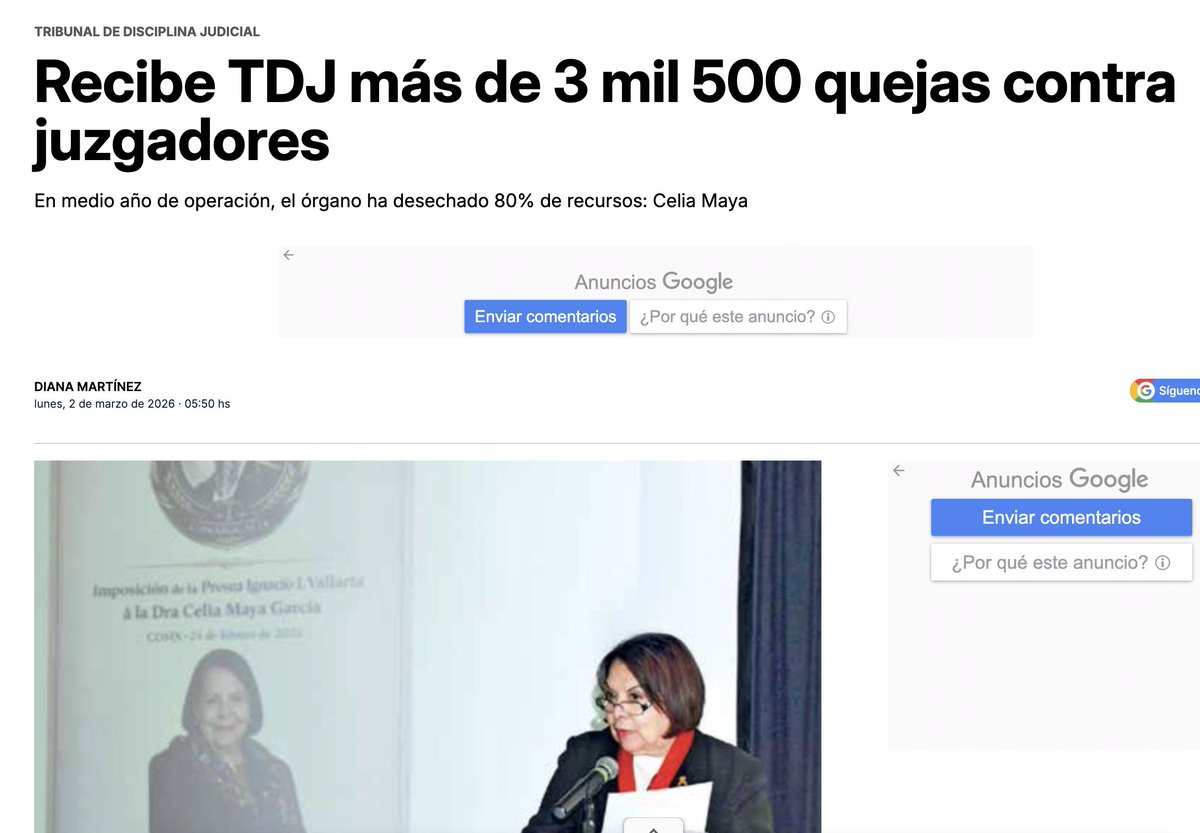
En seis meses el nuevo Tribunal de Disciplina Judicial recibió 3,540 quejas contra jueces. Suena fuerte… hasta que aparece el dato clave: el 80% se desechó por improcedente. Muchas ni siquiera tenían pruebas; otras ni iban contra personal judicial. El número no revela confianza en el sistema. Revela algo más incómodo: un enorme malestar con la justicia y un mecanismo disciplinario que todavía no sabe distinguir entre ruido y verdadera responsabilidad.
Pero lo más delicado está en otra parte. El Tribunal aún no tiene resoluciones finales, pero ya investiga cuando una decisión judicial aparece en los medios y busca firmar un convenio con la UIF para rastrear el patrimonio de jueces. La intención puede ser legítima —combatir corrupción—, pero la historia del poder en México enseña algo elemental: los órganos disciplinarios pueden limpiar… o pueden convertirse en instrumentos de presión.
Ahí está el verdadero debate. La reforma judicial prometió más control y más evaluación. Pero si el nuevo modelo termina midiendo a los jueces con encuestas, productividad y expedientes anónimos, el riesgo es enorme: pasar de una justicia independiente a una justicia vigilada.
https://t.co/TwQlKQWJCX
🚨🇲🇽 | TODO SE LO ROBÓ: Según la Auditoría Superior de la Federación, los megaproyectos del ignorante narcoexpresidente AMLO concentran el 70% del daño al erario detectado en las cuentas públicas 2023 y 2024 con un monto pendiente de aclaración de más de 57 mil millones de pesos.
Scientists have identified a reversal of the long-standing Flynn effect—the roughly 200-year trend of rising average intelligence (measured via IQ and cognitive tests) across generations.
For the first time in modern recorded history, Generation Z (born roughly 1997–2012) shows lower performance than previous generations in key cognitive domains, including attention, memory, literacy, numeracy, executive function, problem-solving, and general IQ—despite spending more years in formal education than ever before.
Neuroscientist and educator Dr. Jared Cooney Horvath, PhD, MEd, testified before the U.S. Senate Committee on Commerce, Science, and Transportation on January 15, 2026, highlighting this shift. In his written testimony, he stated that cognitive development in children across much of the developed world has stalled or reversed over the past two decades, with declines evident in international assessments (e.g., PISA, TIMSS) and other large-scale data starting around the mid-2000s and accelerating post-2010.
Horvath attributes the primary driver not to reduced schooling, but to the widespread integration of digital screens and educational technology (EdTech) in classrooms. He argues that human brains evolved for deep, focused learning through face-to-face interaction and sustained attention, not fragmented skimming or constant task-switching encouraged by devices.
Key points from his testimony include:
- Teens now spend over half their waking hours on screens, with significant portions in school involving computers or tablets—often leading to off-task behavior and shallower processing.
- Evidence from meta-analyses and national/international studies shows a consistent pattern: higher classroom screen exposure correlates with weaker outcomes in reading, math, science, and higher-order reasoning.
- Digital tools may aid narrow, repetitive skill practice in controlled settings, but in core academic contexts, they tend to reduce depth of understanding, retention, and critical thinking.
Horvath describes this as a "structural mismatch" between human cognition and how digital platforms are designed (to capture and fragment attention), warning that unchecked EdTech adoption risks long-term harm to workforce skills, innovation, and societal reasoning.
[Horvath, J. C. (2026). Written testimony before the U.S. Senate Committee on Commerce, Science, and Transportation. U.S. Senate]
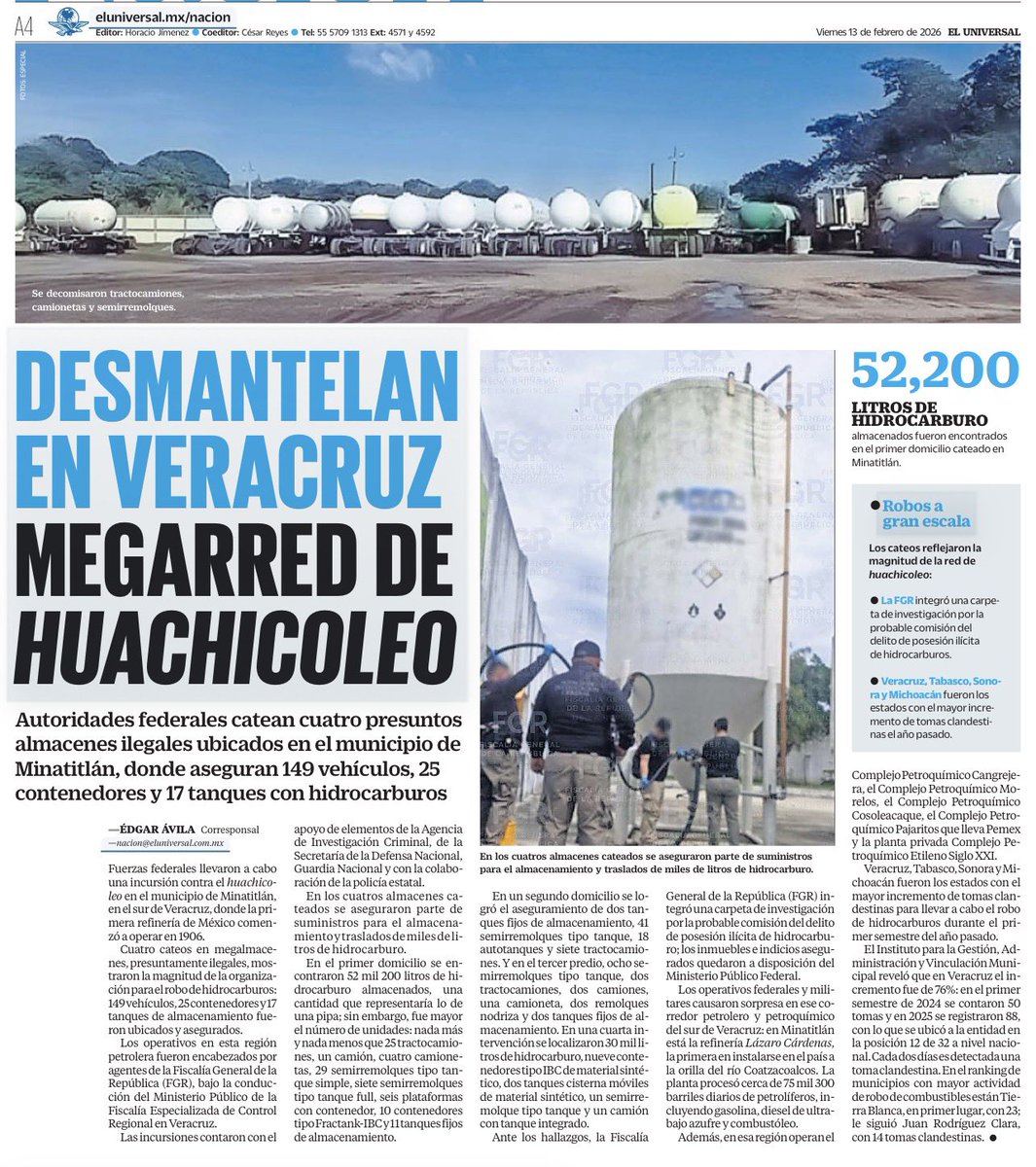
Una red así no se arma en semanas…
Para tener 149 vehículos, 25 contenedores, 17 tanques, infraestructura fija de almacenamiento y operar en una zona petroquímica estratégica se necesitan años de operación y consolidación.
Y luego niegan que ha habido presión de EU.
El que trabaja para el pueblo, en estado de ebriedad.
Van a decir que se le bajó la presión.
En Cuautla apareció el alcalde Jesús Corona Damián en visible estado de ebriedad durante una sesión de Cabildo.
Durante el inicio de la sesión realizada este jueves 12 de febrero en el Ayuntamiento, el presidente municipal presentó dificultades para continuar con su participación, presuntamente por encontrarse bajo los efectos del alcohol.
Una vacuna contra el sarampión cuesta 128 pesos. Vacunar a todos los recién nacidos de México costaría 256 millones de pesos al año.
Y el gobierno de MORENA dejó sin usar 44 mil 457 millones de pesos aprobados para vacunación entre 2022 y 2025.
Eso alcanzaba para vacunar a todas las niñas y niños del país durante más de un siglo.
Hoy enfrentamos un brote epidémico con muertes infantiles.
El dinero estaba. Las vacunas existen. Lo que faltó fue voluntad.
Y mientras este gobierno busca culpar al pasado en vez de admitir sus errores y proteger a la niñez de México,
⚠️ siete de cada diez pesos aprobados para vacunas no se usaron.
La salud pública no admite excusas. Vacunar es salvar vidas.
Los recursos no pueden quedarse en el papel mientras nuestras niñas y niños se enferman.
¡Por fin una buena!
El hombre que tanto daño hizo a la educación de millones de niños, con sus aberrantes libros de texto gratuitos, se va
Hoy despidieron a Marx Arriaga
Pero él se aferra al hueso, y hasta amenaza con salir a las calles
En esas manos prepotentes estuvieron los libros que llegaron a millones de estudiantes
Acompáñenme por @adnnoticiasmx
ARRANCAMOS #RepúblicaMx
En https://t.co/c4Du653uHf y todas las plataformas
Le respondemos a @zoerobledo del IMSS
Los niños que están enfermando y muriendo por sarampión son aquellos que nacieron en los sexenios de @lopezobrador_ y @Claudiashein, los menores de 9 años 👇🏻
El reporte epidemiológico de sarampión lo confirma: el grupo de edad con el mayor número de casos es de 1 a 4 años (1,351 casos), seguido del grupo de 5 a 9 años (1,122 casos)
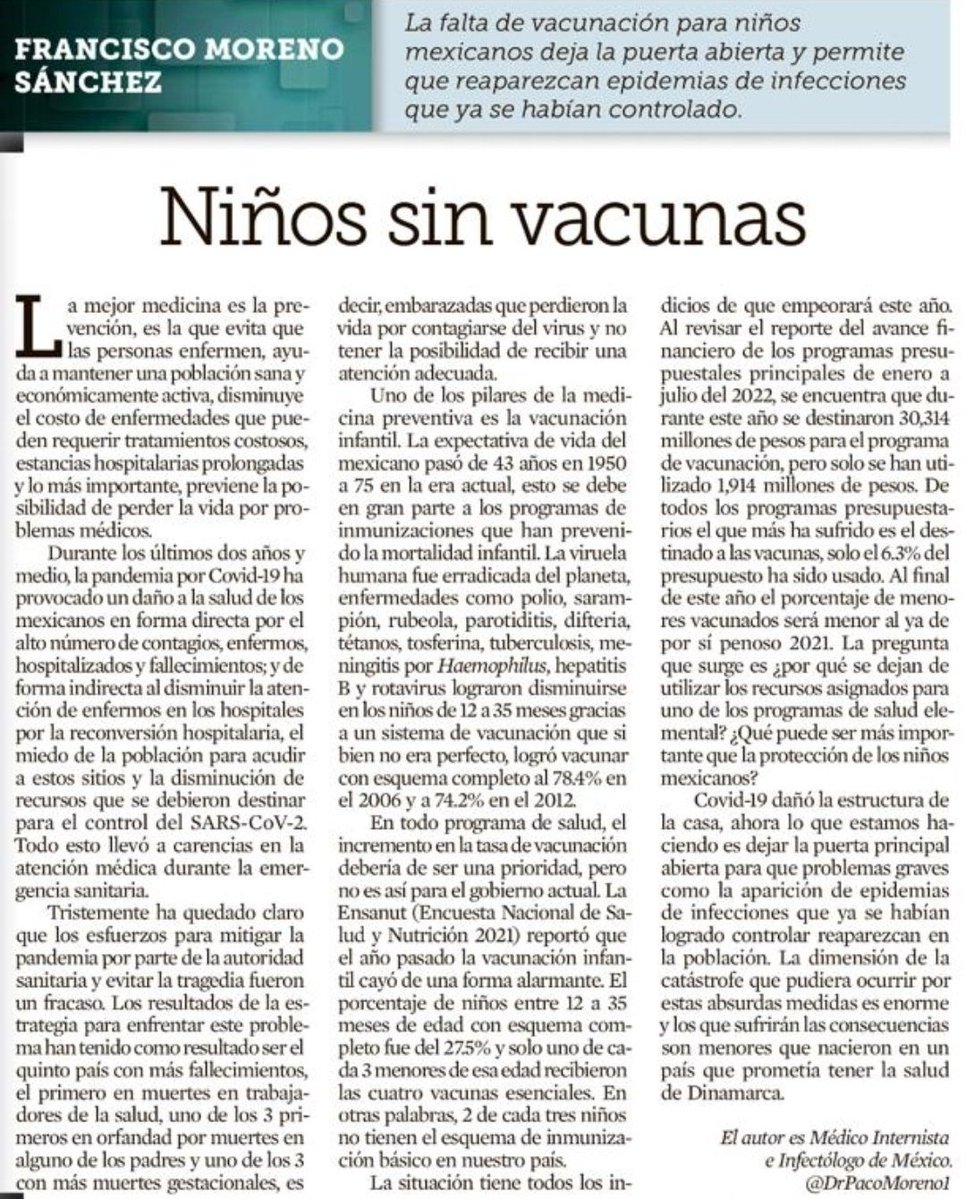
En 2022 escribí esta columna advirtiendo sobre la caída en la vacunación infantil.
Las enfermedades prevenibles no regresan por azar.
Regresan cuando se descuida la prevención.
Las omisiones también tienen consecuencias.
🗳️📌 CULPAN A CALDERÓN Y PEÑA NIETO POR BROTE DE SARAMPIÓN
El director del IMSS, Zoé Robledo, afirmó que el actual brote de sarampión tiene origen en administraciones anteriores.
Señaló que en los gobiernos de Ernesto Zedillo, Vicente Fox y Felipe Calderón no se aplicaron correctamente las segundas dosis de la vacuna.
Dijo que eso dejó generaciones con esquemas incompletos.
Y que ahora se refleja en el repunte de casos.
Aunque no dijeron nada de los subejercicios.
Un análisis en Emeequis señala que no se ejercieron 51 mil millones de pesos destinados al programa de Vacunación.
México fue líder mundial en vacunación infantil, alcanzando una cobertura del esquema básico de entre 75 y 80% de la población. Hoy apenas el 27.5% de los menores entre 12 y 35 meses cuentan con él.
@DrPacoMoreno1 escribe sobre este nuevo y grave problema de salud pública en 🇲🇽.
La deshonestidad profesional de Zoe Robledo, responsable del IMSS, no me sorprende, pero es un intento burdo de engañar a los mexicanos.
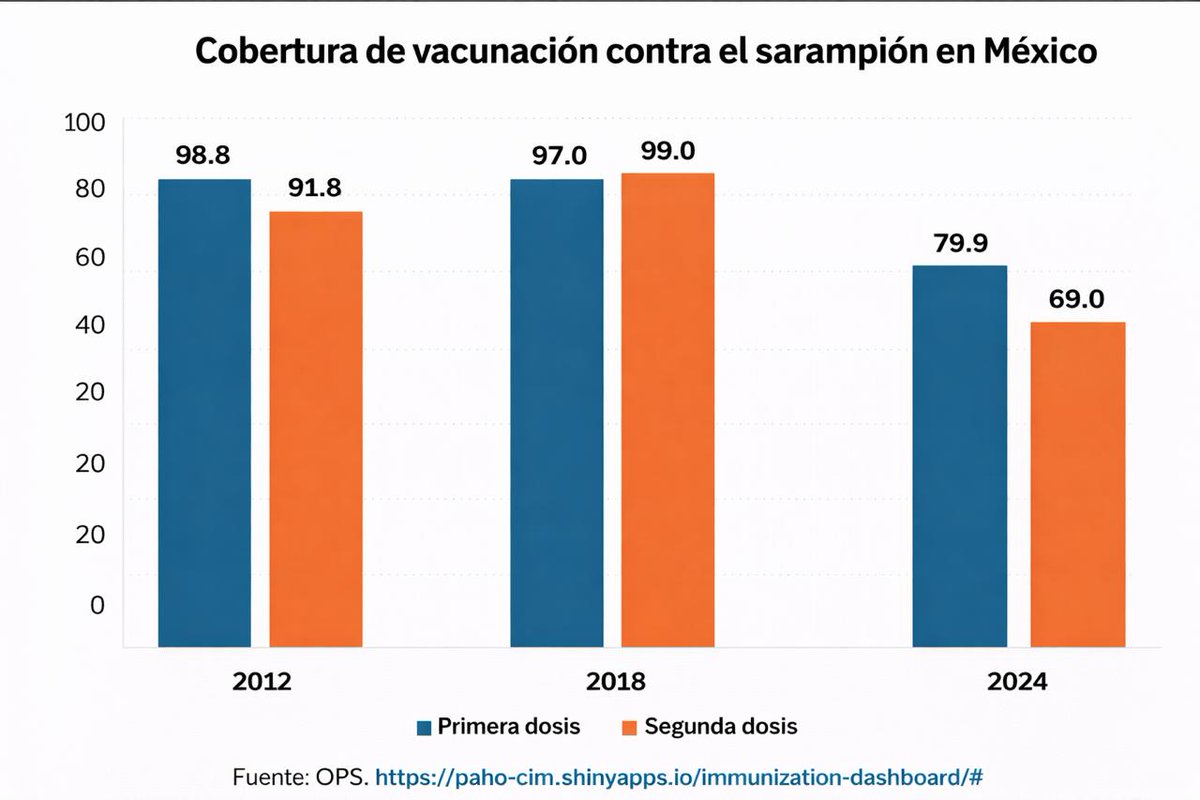
En 2012 la cobertura contra el sarampión era de 98.8% (primera dosis) y 91.8% (segunda).
En 2024, la administración pasada, y en particular el inepto de López Gatell, la dejó en 79.8% y 68.9%.
No son “mis” datos, sino información de la Organización Panamericana de la Salud.
En vacunación no se improvisa: cuando el Estado prefiere “ahorrar” y hacer clientelas, desprotege criminalmente a la infancia.
Cuba 🇨🇺
Se acaba de filtrar un audio que corre como pólvora por los teléfonos de toda la isla, una confesión directa de una militante comunista con acceso privilegiado a la cúpula municipal. La orden bajada desde el Primer Secretario es de cierre total y la lista de calamidades confirmadas es terrorífica: 1) Quedan entre dos y cinco días de electricidad para la población general. 2) El combustible se acabó (cero entradas desde el 8 de diciembre) y lo poco que queda es exclusivo para funerarias y hospitales. 3) Acueducto deja de bombear; la orden es clara: "busquen pozos o recojan lluvia". 4) Solo un central azucarero quedará operativo, el resto se apaga. 5) Se decreta el "Paro Nacional" del transporte interprovincial y municipal; nadie entra ni sale de La Habana o provincias. 6) Suspensión masiva de actividades laborales presenciales y la advertencia final de "preparar leña, candiles y antorchas" porque el país se apaga indefinidamente.
Sin embargo, hay que leer entre líneas. Puesto que el régimen nunca da puntada sin hilo, esta admisión de "derrota total" tiene un fin macabro: bajar el interruptor de las expectativas. Al decirte "no hay nada, ni habrá", buscan desactivar la rabia y convertirla en resignación. De ahí que sea vital preguntarse si este "Paro Nacional" no es también una estrategia de contención militar encubierta. Al inmovilizar el transporte y dejar a la gente sin comunicación ni movilidad, evitan que las protestas se propaguen de un pueblo a otro. Nos quieren a oscuras, incomunicados y aterrados.
El escenario es dantesco, pero la intención es clara: control absoluto a través de la carencia absoluta. Y es que si aceptamos la orden de vivir como animales, habrán ganado la batalla psicológica sin disparar un tiro. ¿Es este el momento final donde el hambre vence al miedo, o dejaremos que nos encierren en nuestras casas a esperar la muerte a la luz de un candil?
✍️Jadir Hernández.







![Rainmaker1973's tweet photo. Scientists have identified a reversal of the long-standing Flynn effect—the roughly 200-year trend of rising average intelligence (measured via IQ and cognitive tests) across generations.
For the first time in modern recorded history, Generation Z (born roughly 1997–2012) shows lower performance than previous generations in key cognitive domains, including attention, memory, literacy, numeracy, executive function, problem-solving, and general IQ—despite spending more years in formal education than ever before.
Neuroscientist and educator Dr. Jared Cooney Horvath, PhD, MEd, testified before the U.S. Senate Committee on Commerce, Science, and Transportation on January 15, 2026, highlighting this shift. In his written testimony, he stated that cognitive development in children across much of the developed world has stalled or reversed over the past two decades, with declines evident in international assessments (e.g., PISA, TIMSS) and other large-scale data starting around the mid-2000s and accelerating post-2010.
Horvath attributes the primary driver not to reduced schooling, but to the widespread integration of digital screens and educational technology (EdTech) in classrooms. He argues that human brains evolved for deep, focused learning through face-to-face interaction and sustained attention, not fragmented skimming or constant task-switching encouraged by devices.
Key points from his testimony include:
- Teens now spend over half their waking hours on screens, with significant portions in school involving computers or tablets—often leading to off-task behavior and shallower processing.
- Evidence from meta-analyses and national/international studies shows a consistent pattern: higher classroom screen exposure correlates with weaker outcomes in reading, math, science, and higher-order reasoning.
- Digital tools may aid narrow, repetitive skill practice in controlled settings, but in core academic contexts, they tend to reduce depth of understanding, retention, and critical thinking.
Horvath describes this as a "structural mismatch" between human cognition and how digital platforms are designed (to capture and fragment attention), warning that unchecked EdTech adoption risks long-term harm to workforce skills, innovation, and societal reasoning.
[Horvath, J. C. (2026). Written testimony before the U.S. Senate Committee on Commerce, Science, and Transportation. U.S. Senate]](https://pbs.twimg.com/media/HBDIc7NagAAWGAb.jpg)