Pongamos que en este hemiciclo se vota una de las propuestas más agresivas y lesivas hacia un derecho fundamental como es la privacidad. Pongamos que eso afectará a 450 millones de europeos.
Este es el quorum de la sesión...
Cada jugador elige la forma de retirarse y todas son respetables.
Pero el que ha sido una estrella y elige que el último coletazo de su carrera sea en el club de su vida renunciando al dinero fácil de otras Ligas tiene un página de oro en el libro del Fútbol.
DON SANTI CAZORLA.
@revenergetica Gracias Xavier, por diseño no están hechas para ser la solución de un apagón, sino la estabilidad para que este no pase. Solución preventiva y no correctiva. Es como decir que un casco no se debería porque cuando te abres la cabeza ya no es una solución
El presidente del Gobierno, @sanchezcastejon, miente sobre las centrales nucleares o demuestra su ignorancia sobre tecnología eléctrica al acusarlas de empeorar el apagón del 28 de abril de 2025.
Las centrales nucleares aportan inercia al sistema eléctrico, ayudando a evitar apagones frente a oscilaciones en la frecuencia, como la que se produjo ayer. En el momento del apagón, la mitad de la potencia nuclear estaba parada, en gran parte debido a los bajos precios de la electricidad y a una desproporcionada carga impositiva sobre las nucleares, que ha aumentado un 71% desde 2019, como explica @PwC_Spain: https://t.co/OmBavzBFIp
@RedElectricaREE, que depende del Gobierno, fue quien autorizó esas paradas, siendo por tanto responsable de que no hubiera suficiente potencia firme de generadores síncronos que podrían haber evitado el apagón. El informe financiero anual de Red Eléctrica, realizado por Ernst & Young, advierte del riesgo de apagones en España tras el cierre nuclear: «Mayor dificultad en la operación del sistema: reducción de potencia firme y capacidades de balance y mayor riesgo de incidentes en la operación que puedan afectar al suministro». Informe número 20462, fechado el 26/02/2025 y publicado por la Comisión Nacional del Mercado de Valores (CNMV): https://t.co/DHQdSYO42y
El Consejo General de Colegios Oficiales de Ingenieros Industriales, @CGCOII, también advirtió al Gobierno que cerrar las centrales nucleares aumentaría la inestabilidad del sistema por la pérdida de potencia firme, así como las emisiones de dióxido de carbono y el precio de la electricidad, debido a su sustitución por centrales de gas: https://t.co/7LXoHceVEg
Cuando las centrales nucleares se desconectan de la red, pasan a alimentarse de ella. Al producirse el apagón, arrancaron automáticamente sus generadores diésel, proporcionando energía a todos sus sistemas esenciales y de emergencia hasta que se recuperó el suministro eléctrico. Lo explica el @CSN_es en su nota de prensa nº 1: https://t.co/g1sNNZuzSp
El mix eléctrico español es equilibrado y cada tecnología cumple una función. Las centrales nucleares no están diseñadas para restablecer el servicio tras un apagón (tampoco lo están la eólica o la solar fotovoltaica), pero sí ayudan a evitarlos gracias a su aportación de inercia, como he explicado, algo que no hacen las renovables variables.
@rtvenoticias "Los que vinculan este incidente a la falta de nucleares demuestran su ignorancia". Pero después procede a hablar de la recuperación del suministro y no de la CAUSA del apagón. Desviando el tema como siempre.
I find very difficult to believe that the Spanish government doesn’t have by now a rough idea of the origin of the blackout. I don’t mean a full root analysis, with chain of events. I mean a rough, but informed, view. @RedElectricaREE has second by second data.
#Apagon
"What the Hell is Going On in Spain?"
At around half past eleven today, Spain and Portugal experienced an almost nationwide blackout.
Small parts of southern France were also briefly affected but reportedly regained power quite quickly.
The Portuguese grid operator currently attributes the likely cause to weather-related oscillations in power lines, which caused the grid to collapse.
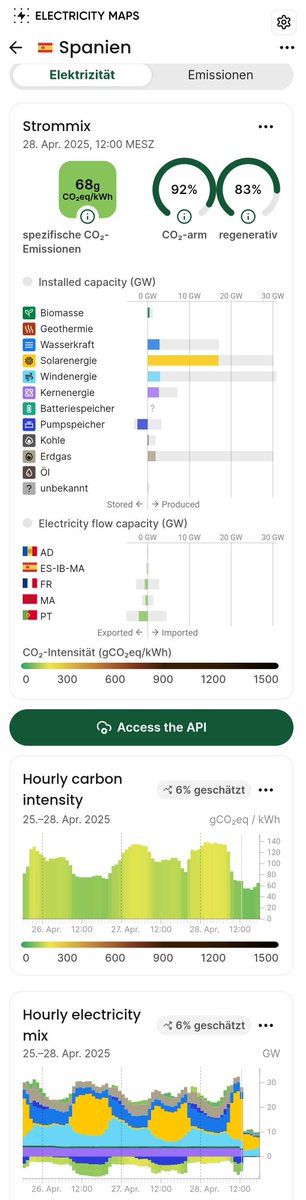
At the time of the load shedding, Spain’s electricity supply was in a very fragile state: 70% of the electricity was generated by producers without grid-synchronous inertia.
Grid-synchronous inertia refers to turbines in nuclear, coal, gas, or hydroelectric power plants that drive the generators of these plants.
The rotational speed of these turbines is synchronized with the frequency of the power grid.
Thus, the grid frequency is directly linked to the rotational energy of the turbines.
If the frequency drops, it means that the load on the grid exceeds the output of the power plants connected to it.
In such a case, the rotational energy of the turbines is converted into electricity to stabilize the grid.
The valves on the turbines respond by opening further to support the grid.
The opposite situation can also occur: if there is excess generation, that energy is absorbed as rotational energy, and the turbine valves close accordingly to adjust to the new load.
Although the rotational energy compared to the grid’s power consumption is not large, it is sufficient to stabilize excessive load fluctuations or absorb surplus generation until the valves have time to react.
This principle of grid-synchronous rotating masses has been the foundation of our power grids for over 100 years, ensuring that at every moment exactly as much electricity is produced as is consumed.
Over the past two decades, Europe has been rapidly building power generation facilities that do not use grid-synchronous turbines, but instead produce direct current, which is converted to alternating current via inverters:
Wind and solar energy.
These inverters can generate high-quality alternating current, but they cannot replace the function of grid-synchronous inertia.
The more wind and solar power is integrated into the grid, the fewer conventional power plants with grid-synchronous turbines remain.
The fewer grid-synchronous turbines there are, the less inertia there is to buffer instantaneous fluctuations in load.
If there is insufficient buffering, even small fluctuations can quickly cause the grid frequency to deviate dangerously from the ideal value of 50 Hz.
Consumers and producers alike respond to this by disconnecting from the grid for self-protection, which can trigger a cascading collapse.
What exactly tipped the balance in Spain remains unclear.
However, we do know that the Spanish grid was in a highly volatile state at the time of the collapse.
Please note:
This text is an AI translation of my orginal German language Tweet.
@AntonioMaestre Nada de lo que Milei no haya avisado. Lo que están haciendo en Argentina es un sacrificio en el corto plazo para tener una economía saneada en el largo plazo. Si les sale bien o no, no se va a ver en solo un año.
@MarisaDoom In Big Bang Theory, Leonard would once say to Penny: “I don't want to be the whole wheat bread for your breakfast that you choose just because it's good for you. I want to be that chocolate donut that you eat because you love it and you enjoy it". This is the case here too.