Pretendo analizar (sic.) el fútbol. Me dicen cangrejo por exigirle a mi selección. Sufriendo la actualidad de mi Depor. Forza Italia y Forza Juve! Goooooya!
Firmen!!! No podemos hacer el ridículo en un mundial otra vez!!!
Boicot al fútbol mexicano - ¡Firma la petición! https://t.co/3mSl2pFIDA a través de @Change_Mex
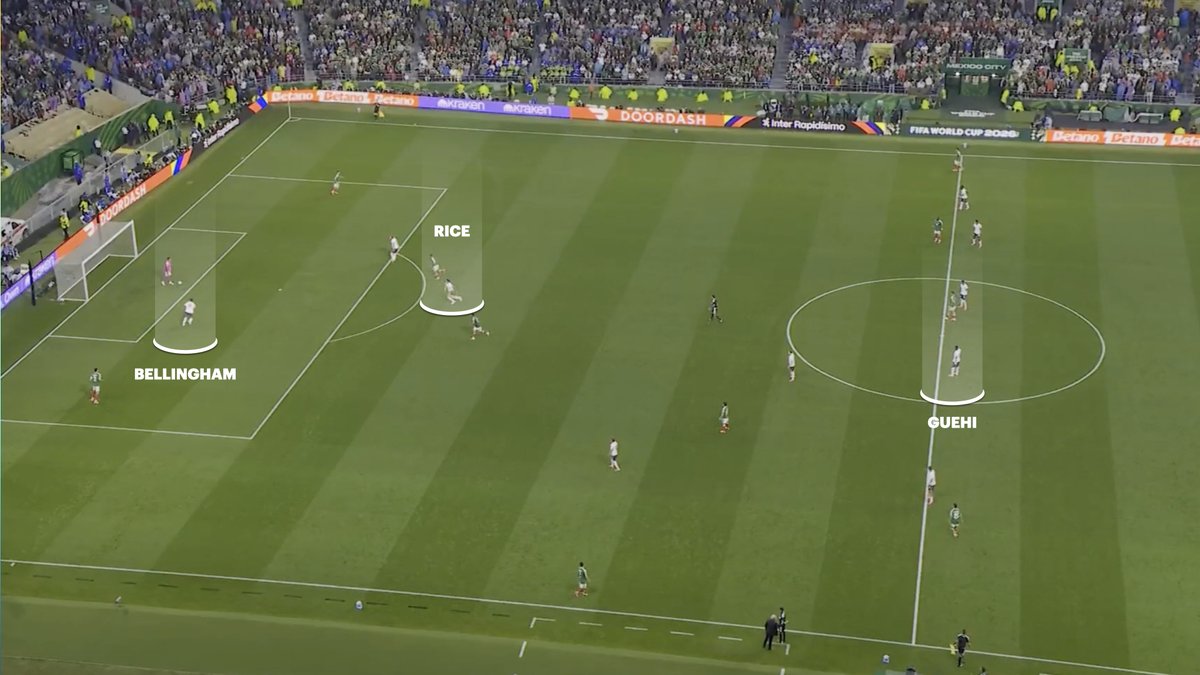
High pressing is still a problem for England. Hasn't looked right all tournament, and they will look better with a lower confrontation line where there are less 'jump' distances to cover.
- Guehi maintains the +1
- Rice divides the double pivot
- Mexico find the spare man
The solution is clear, drop the confrontation line where Anderson and Guehi can jump over shorter distances, but at the moment, England has an aggressive first line of press that is not backed up by the same mentality.
You can still press aggressively from a deeper confrontation line, and England will look better for it.
He visto el partido de nuevo y no cambia mi sensación. México compitió bien y en el descuento del 1T tuvo tres claras para irse 2-2 al descanso, pero en los tres goles ingleses hay un alto grado de complicidad. Y esto se da porque muchos de los futbolistas mexicanos no están acostumbrados al ritmo y físico de esta clase de rivales.
Por más videos que te muestren de Bellingham atacando el área o Rice conduciendo a campo abierto, ya estando en el partido las piernas tienen memoria del día a día y, si no están habituadas, habrá despistes. Es normal.
Por eso en el 0-1 un pequeño espacio a Rice para arrastrar pelota o un seguimiento de marca de Alvarado a Jude cuesta tanto. O la pérdida de Morita ante la presión de Anderson en el 0-2 tras sacar de mitad de cancha. O los duelos de Gordon vs Sánchez. Incluso la falta de contundencia de Edson en el cabezazo que detona el penalti del 1-3.
Es obvio que se necesitan jugadores en las mejores ligas del mundo para tener mayor conocimiento de estos rivales de élite. Otro paso para competir mejor es exportar más, pero sabemos que vienen a comprar y se van corriendo por los altos precios.
Let's talk about Mexican football, about their World Cup, about Gilberto Mora and this new generation of talented midfielders, and about why I believe this match against England can give real hope for the future of Mexican football.
Mexico did a fantastic job at this World Cup. Four wins in a row against South Africa, South Korea, the Czech Republic and Ecuador, without conceding a single goal, before dominating England, one of the tournament favourites, for long periods and being brave enough to impose themselves.
Of course, hosting the World Cup and playing at altitude are significant advantages. But you don't reach this stage of a World Cup because of those factors alone.
I said it a few months ago: I felt Javier Aguirre and his coaching staff had found something. Mexico finally started to develop an identity. Before that, I struggled to understand what kind of team Mexico wanted to be. There wasn't a clear idea of how they wanted to play or what they wanted to represent on the pitch.
Aguirre realised he had an exceptional group of technical midfielders and that he needed to build around them. More importantly, he understood that Mexico had enough quality in midfield to dominate possession and look any national team in the eye. That's why he moved towards a 3-4-3 with a square midfield, allowing him to accommodate players like Erik Lira, Álvaro Fidalgo, Obed Vargas, Bryan Gutiérrez and Gilberto Mora. You can even add more names performing well in Liga MX, such as Marcel Ruiz, unfortunately injured, or Charly Rodríguez.
Mexico found its identity in that 3-4-3. The left winger, usually Julián Quiñones, played inside and enjoyed an outstanding World Cup in that role. Gallardo pushed high from left fullback, while the right back generally stayed deeper. This created a solid 3+2 rest defence that allowed Mexico to remain protected whenever possession was lost.
But the main reason I believe this system suited Mexico is because of the profiles they currently produce. Mexico lacks players who consistently threaten in behind or can punish opponents in transition with pace over long distances. One solution would have been to defend in a low 5-4-1 block and wait for transition opportunities. The problem is that if you don't have players capable of carrying those transitions, sooner or later your game plan collapses. It made a lot of sense for Mexico to be more dominant on the ball and, especially, to press opponents high from goal kicks and other restarts, something they had been doing well for a long time and that led to goals, such as the opener against South Africa.
Interestingly, Aguirre was actually more conservative during the group stage than he was against Ecuador and England. Against South Korea and the Czech Republic, Mexico often defended in a reactive 5-4-1. But against Ecuador and England, they pressed aggressively in a 4-4-2, enjoyed much more possession and controlled large parts of both matches.
There is one name that changed everything, Gilberto Mora.
At just 17 years old, he demanded the ball in front of more than 80,000 people at the Azteca Stadium and gave his teammates the confidence to play with courage. He showed Mexico that if you surround him with intelligent, technical players who can combine with him, this team can compete with anyone.
Suddenly, "Piojo" Alvarado started playing at a much higher level alongside Mora. Mexico began creating relationships, combining through quick one-twos, building wide triangles and, above all, generating dangerous crosses into the penalty area.
Alvarado would drift inside onto his stronger foot before delivering inswinging crosses towards Quiñones and Raúl Jiménez. It became one of the defining images of Mexico's tournament.
Alvarado cuts inside, everyone inside the Azteca rises to their feet, and Raúl Jiménez powers a header into the net. You could hang it in the Louvre.
Yes, we can argue that Mexico struggled in the final minutes against England and that Aguirre made a mistake by introducing too many strikers and relying almost exclusively on crosses. But this is also the same Javier Aguirre who produced two incredibly brave game plans, trusted young players and selected the best performers rather than simply choosing those playing in Europe. In fact, Mexico fielded more Liga MX players than European-based players.
I'm not sure whether this evolution towards a more courageous, possession-oriented style was entirely Aguirre's idea, whether it was driven by Gilberto Mora's emergence, by the players themselves, or by the Mexican public demanding a braver national team. Perhaps it was a combination of all those factors. Whatever the reason, Javier Aguirre will always do what he believes gives his team the best chance of competing.
Now it's time for the Mexican Football Federation to think about the future.
The players themselves are already giving you an identity. You simply need to embrace it.
Everything should start with Gilberto Mora (17) and building a structure that allows him to flourish. Alongside him you have Obed Vargas (20), Bryan Gutiérrez (23), Marcel Ruiz (25) and Erik Lira (26). There aren't many areas of the pitch where Mexico is producing this much talent.
You can even add more players who still need time but have potential: Elías Montiel (20), Iker Fimbres (21), Denzel García (22), Fidel Ambriz (23) and Jordan Carrillo (24). There are more than enough talented young midfielders to build an identity around.
The next step is surrounding them with players who fit that style. If Mexico wants to become a dominant possession team, they need centre-backs capable of defending far from goal, pressing aggressively, covering large spaces and who can contribute in possession.
They already have Johan Vásquez (27), an established European defender who is left-footed, a rare and valuable profile, and perfectly suited to defending high while contributing in build-up. Now Mexico needs to produce more centre-backs with similar characteristics. Diego Campillo (24) could become one of them, but the search shouldn't stop there.
At full-back, the future is promising. Rodrigo Huescas (22) and Mateo Chávez (22) are already playing for FC Copenhagen and AZ Alkmaar at a young age. Both possess the energy and technical quality to overlap, underlap and defend aggressively in open spaces. Neither is particularly dominant aerially, which is another reason why Mexico should aim to defend further away from their own penalty area.
In goal, "Tala" Rangel (26) has shown he can become the right goalkeeper if Mexico continues down a possession-oriented path.
On wide attacking positions, Mexico still needs to produce more wingers capable of consistently winning 1v1 situations. Alvarado (27) and Huerta (25) offer solutions, and Alvarado showed throughout this World Cup that he has the quality to hurt opponents whenever he receives to feet.
But Mexico also needs wide players who can attack depth, stretch defensive lines and create more space for the midfielders to operate between the lines. They need more pace. More players capable of threatening large spaces.
Up front, Santiago Giménez (25) can be a good option. But he still needs to stay healthy more often and reach his best level. Then there's "Hormiga" González (23). He may not receive as much attention, but he has intelligent movement inside the box, consistently scores goals, attacks depth well and contributes aggressively in the press. When so many of your midfielders want the ball to feet and are more technical than athletic, having a striker who constantly stretches the opposition, attacks space and presses with intensity becomes incredibly valuable.
Of course, players like Quiñones and Raúl Jim��nez can continue contributing while Mexico gradually gives more responsibility to younger profiles and develops the next generation of strikers.
Ultimately, this World Cup has allowed Mexico and its supporters to dream again, but there is still plenty of work to do.
Mexico needs to invest more in coach education to produce better Mexican coaches, who will eventually develop better players in the academies.
The federation should also make it easier for young Mexican players to move abroad earlier, even if transfer fees are lower.
And finally, promotion and relegation must return.
Young players develop fastest when they compete under pressure. Few matches are more demanding than fighting against relegation or battling for promotion. Those experiences shape players who can later perform on the biggest stages, like a World Cup.
The encouraging part is that Mexico has started talking about football again. Apart from a few journalists unwilling to evolve, most people have praised the way this team competed. The catastrophism and negativity that have surrounded Mexican football for years are slowly disappearing.
Mexico is a genuine football country, one of the greatest in the world in that respect. Few stadiums roar like the Azteca. Few cities live football like Mexico City. Everywhere you go, people are talking about their national team.
Now it's time for Mexico and its federation to match that passion with a long-term vision.
The potential is there. This team has planted the seed.
No need to telestrate anything because the clips tell the story, but some notes on Mexico's service into the box last night:
- Always settling for half-space/wide service
- ENG able to match up M2M + have protection on the edge > Not pulled out of line.
Spain are easy to misinterpret because so much of what makes them incredible is invisible work.
You watch them circulate the ball, move from side to side, overload wide channels, create passing rondos, reset, and then try again in the other side. It can start to feel like Spain are slow and boring. I understand why some people can’t stand watching Spain play. But why you think they are boring is the same reason Austria found themselves suffocated.
And I don’t think they suffocate teams just because they keep the ball. Lots of teams can keep the ball for long stretches without any real danger or concern. What stood out to me with Spain was how they used possession to set up the next defensive moment before the ball was even lost, and how organized they are doing it.
Cubarsí was always close to the furthest outlet. Laporte usually free and ready to cover Cubarsi. Rodri and Pedri usually around the edge of the penalty area close enough to jump when the ball came out. So when Austria would finally win the ball, and they looked to create a counter, they rarely completed more than 2 passes.
That’s the detail I think people miss when they only talk about Spain as a possession team. The possession is obviously important, but the possession is used to create the conditions for the counterpress, the rest defense, and the inevitable next recovery. Spain do not simply attack, they attack to control and suffocate teams.
Once you start watching them that way, the subtle details become more evident. The danger is not always their progressive passes or when Lamine Yamal megs someone. It’s also Cucurella standing five yards closer to the opponent’s outlet. It is Cubarsi bravely stepping to the first pass out and preventing a turn.
Those details do not always make the social media highlight videos. A lot of the time they are not even on the broadcast camera, but they are a huge part of why Spain make good teams look so below average.
Austria are not a bad team at all. They had played well in this World Cup. They had caused problems for other opponents, like Argentina. But against Spain, there were long stretches where it felt like they could play another full game and still not find a way out of their penalty area.
After a while, it starts feeling like suffocation.
That is the part I would show youth players and coaches. When we talk about attacking football, we often focus on what the players around the ball are doing. But the players further away from the ball are often deciding whether the opposition can maintain possession upon recovery.
Are they positioned to prevent the deep ball? Are they close enough to intercept the first or second pass? Essentially, are they perceiving the next defensive action before the ball is lost?
Spain make possession look calm because the chaos is being managed before it arrives.
Por eso 700 veces elijo analistas que sí se preparan como @PepedelBosque@betogonzalezm_@oscarmendoza02. Urge desplacen a esos pseudocomentaristas viejos que se van a chupar antes de sus programas en lugar de prepararlos.
Roberto Alvarado vs Ecuador. Gran muestra de lo que es. Y lo que suma cuando se toma la libertad de ir invadiendo carriles centrales y del costado lejano. Alto nivel asociativo, en golpeo, en controles y giros. Lo que fue su temporada.
Clave Mora en darle contextos a favor.
Mexico vs England is such an interesting tactical matchup because I’m not sure England know exactly what version of Mexico they’re going to get.
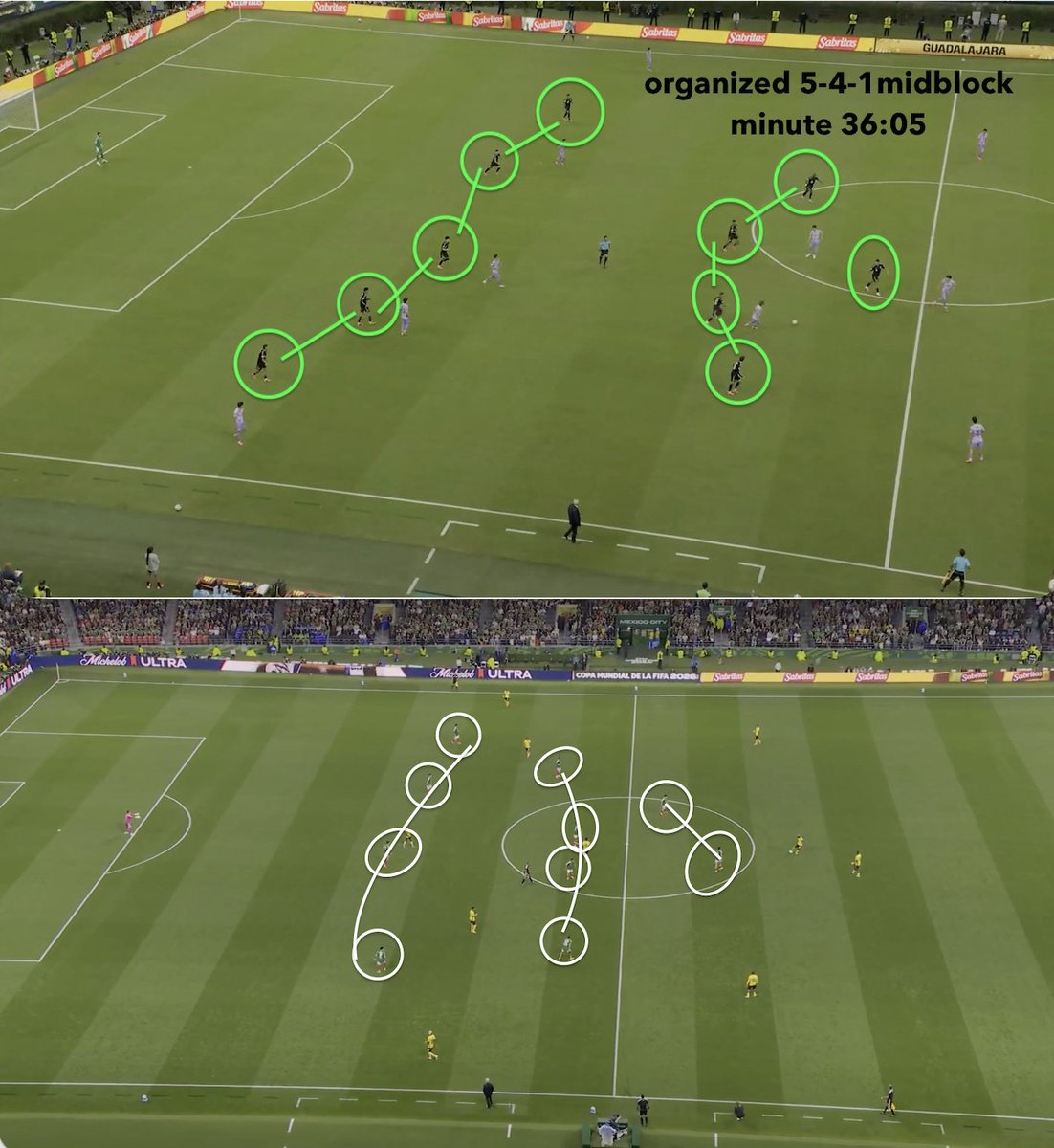
Mexico have shown they can defend in different ways. They’ve dropped into a deeper 5-4-1, spent long stretches against Ecuador in more of a 4-4-2, pressed higher, defended lower, played more direct into Raúl Jiménez, and also built through midfield. So if you’re England the preparation is not totally straightforward. Are you preparing for the Mexico that sits deeper and asks you to break them down or the Mexico that came out against Ecuador with more initiative and confidence playing through the middle?
The first 30 mins could tell us a lot. England may start carefully. Not passive but careful. Don’t concede early, don’t get pulled into a frantic game, and try to figure out what Mexico are doing. But if Mexico start well, the crowd gets into it, the players grow, and suddenly England are not just solving a tactical problem, they are solving a stadium problem too.
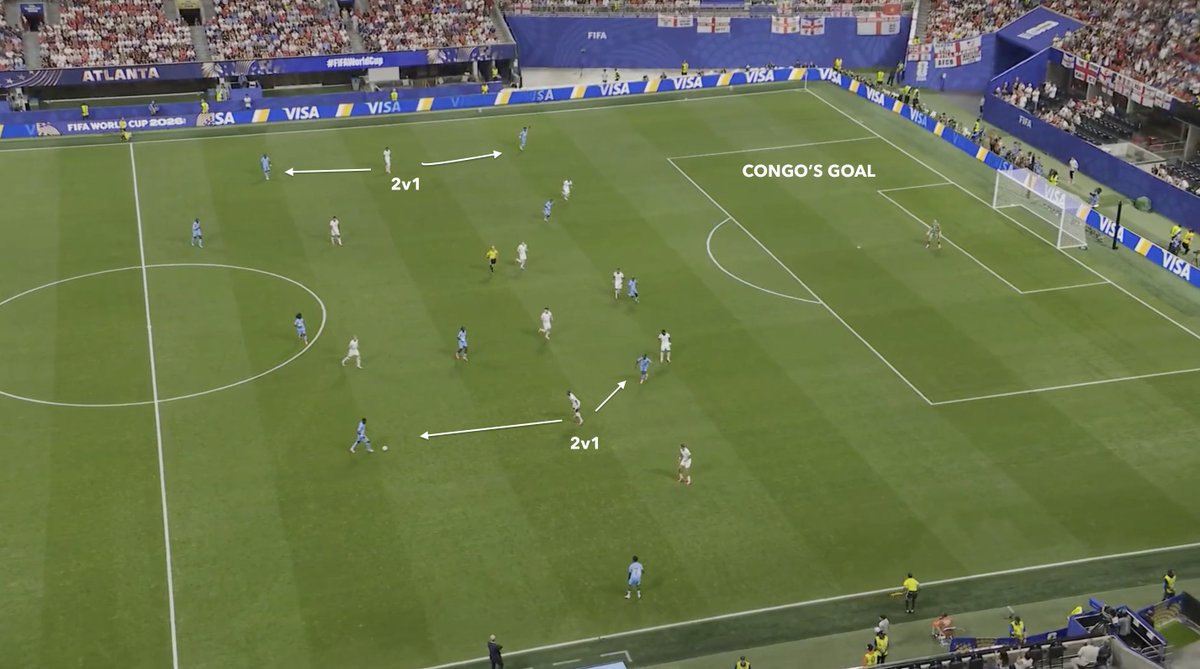
For Mexico, one of the big attacking questions is how they target England’s wide areas. Against Congo, England had issues defending wide when their wingers didn’t recover quickly enough, leaving the fullback in awkward 2v1 situations. That feels like an area Mexico can test.
On the left, Quiñones can attack the space behind England’s right back. On the right, Alvarado, Mora, and Sánchez can create different problems by combining in tighter spaces. If Alvarado comes inside, does the fullback follow? If the fullback follows, who protects the wide space? If the winger doesn’t track Sánchez, does Mexico get a free outlet? If the midfielder jumps, does Mora receive between lines?
That is why I think Mexico can cause England problems. Not because they are going to dominate the game, but because some of their best attacking patterns line up with spaces England have looked vulnerable in.
The risk for Mexico is transition. England are at their best when there is space to attack. Kane can drop and connect, Bellingham can arrive, and their wide players can hurt you quickly if the game opens up. So if Mexico are aggressive, the question is whether they can control the moment after losing the ball.
Mexico have done a good job at times of counterpressing and keeping the ball locked on one side. But if England break that first wave and get into open grass, Mexico’s back line may have to defend more direct, athletic, 1v1 situations
The game comes down to two questions
Can Mexico use their wide and half-space rotations to pull England’s defensive structure apart?
And can England survive those moments long enough to find transition attacks into the space Mexico leave behind?
England probably have more individual quality, but I’m not sure this is a comfortable tactical matchup for them. Mexico have enough variety to make England think, and enough crowd energy to make the game feel very different if they start well
The first 30 minutes will be massive.
Luis de la Fuente atenta contra la naturaleza de sus futbolistas. Un equipo de distancias cortas jugando a distancias enormes, sin ritmo y alejando a sus mejores jugadores.
Gilberto Mora hasn’t just made Mexico’s attack better, he’s changed the feeling of it.
Before him, too many possessions felt safe but stuck: Receive, feel pressure, play back, recycle, go long anyway.
Mora gives them a different first thought: Face forward and make the opponent uncomfortable.
In chronological order from the 1st half, 4 clips of Mexico controlling transitions w/ very aggressive positioning & countermarking:
- *Immediate* sprints to squeeze & kill space
- Caging the box (preventative + adds # to attack)
- M2M responsibilities