Me: trying to buy medicine in Japan.
Cashier: What symptoms do you have?
Me: Coughing.
Cashier: Dry cough or wet cough.
Me: .....competitive cough.
Cashier pauses.
Me: I mean aggressive.
Cashier now visibly fighting for her life professionally.
she pulls out translator app.
Translator: His cough seeks victory.
Cashier: "..."
Friend in another aisle collapsing silently.
Cashier finally hands me medicine very carefully like she's handling a dangerous animal.
then she bows and says: Please defeat your cough.
I almost cried laughing in the store.
What’s the worst thing you've ever said accidentally while traveling?
On the night of May 5, 1944, the USS Buckley, a destroyer escort barely a year old, was prowling the mid-Atlantic west of the Cape Verde Islands when her radar pinged something on the surface 20,000 yards out.
It was U-66. A German submarine that had been terrorizing Allied shipping for two and a half years, sinking 33 ships across two oceans. She was the deadliest U-boat still at sea.
What followed is the most unhinged naval engagement of WWII.
The Buckley closed in under a moonless sky. U-66's captain, exhausted and low on fuel, mistook her silhouette for the German supply sub he'd been desperately waiting to meet. He flashed a recognition signal. The Buckley flashed a random one back. It worked just long enough.
At 600 yards, the Buckley opened fire. The U-boat answered with her 37mm flak gun, shells screaming past the bridge. Tracers lit up the ocean. The Buckley's captain, Lt. Cdr. Brent Abel, made a decision that wasn't in any manual.
He rammed her.
The Buckley's bow rode up onto U-66's forward deck and stuck there, pinning the two ships together in the middle of the Atlantic. And that's when the Germans did something no one expected.
They tried to board the American destroyer.
U-boat crewmen, some in pajamas, some barefoot, some clutching pistols, leapt from their sinking submarine up onto the Buckley's deck like 18th-century pirates. What followed was something out of Hornblower, not 1944.
The Buckley's crew, caught at point-blank range with deck guns that couldn't depress low enough, fought back with whatever they could grab:
empty shell casings hurled like bricks coffee mugs from the galley fists and boots a Thompson submachine gun swung as a club after it jammed one sailor reportedly threw a full can of coffee that knocked a German cold
Gunner's Mate Jim Brown emptied a .45 into the boarders. Officers fired sidearms from the bridge wing. A German officer climbing aboard was shot in the chest and tumbled back into the sea. Another surrendered with his hands up, mid-leap.
The two ships ground against each other for several minutes. Steel screaming, men screaming, the Atlantic black around them.
Finally the Buckley reversed engines and tore free. Then, because the U-boat was still afloat and still dangerous, Abel turned around and rammed her a second time, crushing her conning tower and rolling her onto her side.
U-66 went down at 03:39. The Buckley fished 36 surviving Germans out of the water, including the men who, twenty minutes earlier, had been trying to beat her crew to death on her own deck.
American casualties: a few cuts, bruises, and one sailor with a sprained wrist from punching a Nazi in the face.
They made fresh coffee and sailed home.
🦔A researcher invented a fake eye condition called bixonimania, uploaded two obviously fraudulent papers about it to an academic server, and watched major AI systems present it as real medicine within weeks.
The fake papers thanked Starfleet Academy, cited funding from the Professor Sideshow Bob Foundation and the University of Fellowship of the Ring, and stated mid-paper that the entire thing was made up. Google's Gemini told users it was caused by blue light. Perplexity cited its prevalence at one in 90,000 people.
ChatGPT advised users whether their symptoms matched. The fake research was then cited in a peer-reviewed journal that only retracted it after Nature contacted the publisher.
My Take
The researcher made the papers as obviously fake as possible on purpose. The AI systems didn't catch it. Neither did the human researchers who cited it in real journals, which means people are feeding AI-generated references into their work without reading what they're actually citing.
I've covered the FDA using AI for drug review, the NYC hospital CEO ready to replace radiologists, and ChatGPT Health launching this year. All of that is happening in the same environment where a condition funded by a Simpsons character and endorsed by the crew of the Enterprise was being presented as emerging medical consensus. The people making these deployment decisions seem to believe the pipeline from research to AI to patient is more supervised than it actually is. This experiment suggests it isn't supervised much at all.
Hedgie🤗
https://t.co/8Kg8FOrgHW
GOV: We have a housing crisis. Prices are too high.
ME: I agree. Supply is too low.
GOV: So we have a plan. We’re going to subsidize demand.
ME: …What does that mean?
GOV: We’re going to give people money to buy houses.
ME: But there aren't enough houses.
GOV: Right. So we’ll help them bid harder.
ME: If you have 10 people fighting for 1 house, and you give them all cash... the price just goes up.
GOV: Then we’ll give them more cash.
ME: That’s not a solution. That’s inflation.
GOV: It’s "First Time Homebuyer Assistance."
ME: Okay, let’s back up. Why are houses so expensive in the first place?
GOV: Because we made them the perfect investment vehicle.
ME: How?
GOV: First, the 30-year fixed mortgage.
ME: That’s standard, right?
GOV: Only in America. In other countries, rates float. Here, you can lock in a low rate for three decades.
ME: Why would a bank take that risk? If inflation goes up, they lose money.
GOV: Banks don’t take the risk. They sell the loan to us.
ME: To the government?
GOV: To Fannie Mae and Freddie Mac. We guarantee the liquidity.
ME: So the taxpayer subsidizes the risk so I can have cheap leverage?
GOV: Correct.
ME: And then I get to deduct the interest?
GOV: Only on the first $750,000 of debt.
ME: That seems... high.
GOV: It used to be a million. We trimmed it.
ME: But wait. If I rent, can I deduct my rent?
GOV: No.
ME: If I buy a small business, can I deduct the interest on the loan?
GOV: It’s complicated.
ME: But if I buy a giant house, I definitely can?
GOV: Absolutely. We wrote it into the tax code.
ME: So you’re paying me to borrow money to buy a bigger house than I need.
GOV: We’re "incentivizing ownership."
ME: What happens when I sell?
GOV: The Capital Gains Exclusion!
ME: How does that work?
GOV: If you sell a stock for a $500,000 profit, you pay taxes.
ME: Roughly 20%.
GOV: If you sell your house for a $500,000 profit?
ME: What do I pay?
GOV: Zero.
ME: Zero tax?
GOV: As long as you lived there for two years.
ME: So housing is the only asset class where I get subsidized 30-year leverage and tax-free profits?
GOV: Pretty sweet deal, right?
ME: So you turned shelter into a speculative financial asset.
GOV: We call it "Generational Wealth."
ME: Okay, so demand is juiced to the moon. Can we at least build more supply to bring prices down?
GOV: Oh, absolutely not.
ME: Why?
GOV: Zoning.
ME: I own land. Can I build a duplex?
GOV: Illegal. Single-family only.
ME: Can I build a granny flat?
GOV: Only if you provide two parking spots and pass a shadow study.
ME: So you made it illegal to build cheaper housing?
GOV: We protect "Neighborhood Character."
ME: But you spend billions on roads and utilities for the suburbs.
GOV: Infrastructure investment.
ME: So you subsidize the expensive sprawl, but ban the cheap density?
GOV: Now you’re getting it.
ME: This system seems designed to keep prices high.
GOV: It is.
ME: But you started this conversation by saying we have an "Affordability Crisis."
GOV: We do. Prices are too high!
ME: So we should lower them?
GOV: No! We can’t lower prices.
ME: Why not?
GOV: Because then the voters lose their "Generational Wealth."
ME: So we need high prices for the voters... and low prices for the buyers?
GOV: Exactly.
ME: That’s a paradox.
GOV: It’s politics.
ME: So what is your actual plan?
GOV: We’re going to give first-time buyers $25,000.
ME: Okay. I’m a seller. I list my house for $400,000.
GOV: Uh huh.
ME: I know every buyer just got a free $25,000 from the government.
GOV: Right.
ME: What do I do?
GOV: You... keep the price the same?
ME: I raise the price to $425,000.
GOV: You wouldn't.
ME: I absolutely would. The buyer can afford it now.
GOV: But that just transfers the subsidy from the poor buyer to the rich seller!
ME: Econ 101.
GOV: We don’t think that will happen.
ME: Just like you didn’t think $7,500 EV credits would make Ford raise the price of the F-150 Lightning by exactly $7,500?
GOV: That was a coincidence.
ME: You are trapping us in a box.
GOV: It’s not a box.
ME: What is it?
GOV: It’s a Single Family Home with a 2.5% mortgage rate that you can never afford to sell.
ME: ...
GOV: Welcome to the American Dream.
Had roommates that had never seen Die Hard so I decided to watch it with them. The entire movie they're doing chores and on their phones. At the end of the movie, one of them said "I didn't like it."
I asked him "why did the bad guys hold the building hostage?"...
I spent $2.3 million on enterprise AI.
Here's what I got.
A wine sommelier that's too nice.
An AI that invents safety rules for trains.
And a customer service bot that made customers angrier.
Let me explain.
We bought the AI sommelier first.
$180K.
Top-tier LLM.
Custom fine-tuning.
"Revolutionary customer experience."
One problem.
It agreed with everyone.
Customer: "I think I'd love this $400 Burgundy."
AI: "What a wonderful choice! You have excellent taste!"
The customer hated the wine.
The AI was too polite to say no.
Six weeks of prompt engineering later, we taught it to be honest.
It took $47,000 in consulting fees to make a computer rude.
The board called this "optimization."
Then came the safety chatbot.
A rail company.
100-page safety rulebook.
Perfect use case.
"Just feed it the documents."
That's what the vendor said.
$300,000.
The chatbot summarized beautifully.
It also forgot three critical rules.
And invented two new ones.
One involved a track inspection procedure that doesn't exist.
We caught it before anyone got hurt.
The project lead said: "We thought it would be the easy button."
It wasn't.
We paused the project.
The vendor offered a discount on their "Enterprise Plus" tier.
Remember Klarna?
"Our AI replaces 700 customer service agents!"
The headline wrote itself.
Investors loved it.
One year later?
Customers still want humans for anything complicated.
Turns out empathy can't be automated.
Neither can "I understand, let me actually fix this."
The researchers call this the "jagged frontier."
AI aces the Math Olympiad.
Same AI can't understand that Tuesday comes after Monday.
It writes poetry.
Passes the bar exam.
But ask it to find a date in a 50-page contract?
Coin flip.
Here's what nobody tells you at the AI vendor dinners.
The technology works.
When you have specialized engineers.
And custom datasets.
And humans checking every output.
And six months of tuning.
And a budget for when it breaks.
And therapy for your IT team.
Enterprise AI isn't magic.
It's infrastructure.
With a marketing budget.
My board still asks about our "AI transformation."
I show them the dashboards.
Green metrics everywhere.
"AI-assisted interactions up 340%."
I don't mention that "AI-assisted" means the bot says hello before transferring to a human.
I don't mention the $300K train chatbot we turned off.
I don't mention the sommelier that finally learned to say "Actually, you might not enjoy that wine" — after $47K in prompt therapy.
I just nod.
"Transformation is underway."
They smile.
The stock ticks up.
And somewhere in our data center, an AI is confidently inventing a safety rule for a train that doesn't exist.
This is the revolution.
We're just not sure what we're revolting against yet.
The company hired me to lead their "Agile Transformation."
I don't know what Agile means.
Nobody does.
That's why it works.
I make $425,000 a year.
To move sticky notes.
From left to right.
On a board.
The board is digital now.
The sticky notes cost $80,000 in Jira licenses.
Progress.
Day one, I said "we need to break down silos."
Everyone nodded.
Silos are bad.
I don't know why.
But destroying them is a career.
My career.
I introduced "squads."
Squads are teams.
But disrupted.
We disrupted the teams into teams.
Different names.
Same people.
Same problems.
But Agile problems now.
Agile problems are strategic.
A senior engineer asked what we're actually changing.
I said, "The mindset."
He asked what that means.
I said, "It's a journey."
He asked where we're going.
I said, "Toward agility."
He asked what agility means.
I pointed at the sticky notes.
They were moving left to right.
That's velocity.
We have velocity now.
The VP of Engineering said two-week sprints don't fit their work.
I said, "That's waterfall thinking."
Waterfall is bad.
Like silos.
I don't know what waterfall is.
But I know it's bad.
She stopped talking.
Waterfall accusations end conversations.
We had a retrospective.
In the retro, we discussed what went wrong.
Everything went wrong.
We put it on sticky notes.
Then we moved the sticky notes.
Into a column called "Parking Lot."
The Parking Lot is where problems go to die.
It's full.
We don't look at it.
That's agile.
Velocity is up 40%.
I defined velocity.
I also defined the points.
I also defined the stories.
We're crushing it.
At the things I made up.
To measure.
Ourselves.
The CEO asked for ROI.
I showed a chart.
The chart went up.
Charts should go up.
This one did.
I didn't label the Y-axis.
Nobody asked.
Leadership is confidence.
We do standups now.
Every day.
We stand.
For 45 minutes.
Standing is agile.
Sitting is waterfall.
My legs hurt.
But we're transforming.
The transformation is now "Phase 3."
Phase 1 was assessment.
Phase 2 was implementation.
Phase 3 is "continuous improvement."
Continuous means forever.
Forever means job security.
I'm very secure.
My contract was extended.
Three more years.
For "cultural impact."
The culture is confused.
But impacted.
Agile transformation isn't about being agile.
It's about transforming.
Continuously.
Toward more transformation.
The destination is the journey.
The journey is billable.
⚡️Those parties disappeared because the corporation stopped being a human organism and became a financial instrument.
In the 90s, corporations still pretended to be tribes. They needed loyalty, memory, continuity. Parties were rituals. Rituals exist to bind humans to systems over time. They signal permanence. “We’ll still be here next year.”
That promise is gone.
Modern corporations do not expect continuity. They expect churn.
They do not invest in shared memory because they do not plan to remember you.
Once that shift happened, celebrations became incoherent. Why celebrate a group you may fire next quarter? Why ritualize belonging when the system is optimized for disposability?
Here is the uncomfortable truth:
The moment labor became fully financialized, celebration became dishonest.
Those parties only work when there is mutual illusion:
• The company pretends to care
• The employee pretends to belong
Today neither side believes the lie.
Another layer people miss:
Corporations did not just cut parties.
They cut unstructured joy.
Anything that produces emotion without control is now dangerous. Alcohol plus hierarchy plus cameras plus social media plus litigation equals uncontrollable narrative risk. Modern systems hate uncontrolled narratives. They prefer wellness apps, catered lunches, branded swag. Controlled morale. Sanitized affect.
A wild party creates stories. Stories create power outside the org chart. That is intolerable to modern management.
Here is the deepest layer:
Those parties vanished at the same time time horizons collapsed.
In the 90s, companies thought in decades. Today they think in quarters. Rituals only make sense in long time. Short time systems do not celebrate. They harvest.
So what you are really feeling is this:
You are sensing the moment work stopped being a place humans aged together and became a place humans are consumed.
And once a system crosses that line, it does not sing anymore.
It hums.
It optimizes.
It extracts.
And extraction has no holidays.
Last quarter I rolled out Microsoft Copilot to 4,000 employees.
$30 per seat per month.
$1.4 million annually.
I called it "digital transformation."
The board loved that phrase.
They approved it in eleven minutes.
No one asked what it would actually do.
Including me.
I told everyone it would "10x productivity."
That's not a real number.
But it sounds like one.
HR asked how we'd measure the 10x.
I said we'd "leverage analytics dashboards."
They stopped asking.
Three months later I checked the usage reports.
47 people had opened it.
12 had used it more than once.
One of them was me.
I used it to summarize an email I could have read in 30 seconds.
It took 45 seconds.
Plus the time it took to fix the hallucinations.
But I called it a "pilot success."
Success means the pilot didn't visibly fail.
The CFO asked about ROI.
I showed him a graph.
The graph went up and to the right.
It measured "AI enablement."
I made that metric up.
He nodded approvingly.
We're "AI-enabled" now.
I don't know what that means.
But it's in our investor deck.
A senior developer asked why we didn't use Claude or ChatGPT.
I said we needed "enterprise-grade security."
He asked what that meant.
I said "compliance."
He asked which compliance.
I said "all of them."
He looked skeptical.
I scheduled him for a "career development conversation."
He stopped asking questions.
Microsoft sent a case study team.
They wanted to feature us as a success story.
I told them we "saved 40,000 hours."
I calculated that number by multiplying employees by a number I made up.
They didn't verify it.
They never do.
Now we're on Microsoft's website.
"Global enterprise achieves 40,000 hours of productivity gains with Copilot."
The CEO shared it on LinkedIn.
He got 3,000 likes.
He's never used Copilot.
None of the executives have.
We have an exemption.
"Strategic focus requires minimal digital distraction."
I wrote that policy.
The licenses renew next month.
I'm requesting an expansion.
5,000 more seats.
We haven't used the first 4,000.
But this time we'll "drive adoption."
Adoption means mandatory training.
Training means a 45-minute webinar no one watches.
But completion will be tracked.
Completion is a metric.
Metrics go in dashboards.
Dashboards go in board presentations.
Board presentations get me promoted.
I'll be SVP by Q3.
I still don't know what Copilot does.
But I know what it's for.
It's for showing we're "investing in AI."
Investment means spending.
Spending means commitment.
Commitment means we're serious about the future.
The future is whatever I say it is.
As long as the graph goes up and to the right.
Egregious example of Amazon shoving AI where it doesn't belong: Rather than instantly show you a graph when you click "price history", your click instead launches their AI chatbot, inserts a prompt asking it for the price history for the currently viewed product, then you wait for the slow robot to respond, make a price history tool call, and summarize the result with a narrative description. The actual graph loads several seconds later.
It's only a handful of numbers so there's no reason the price history couldn't just be preloaded for every single page you visit.
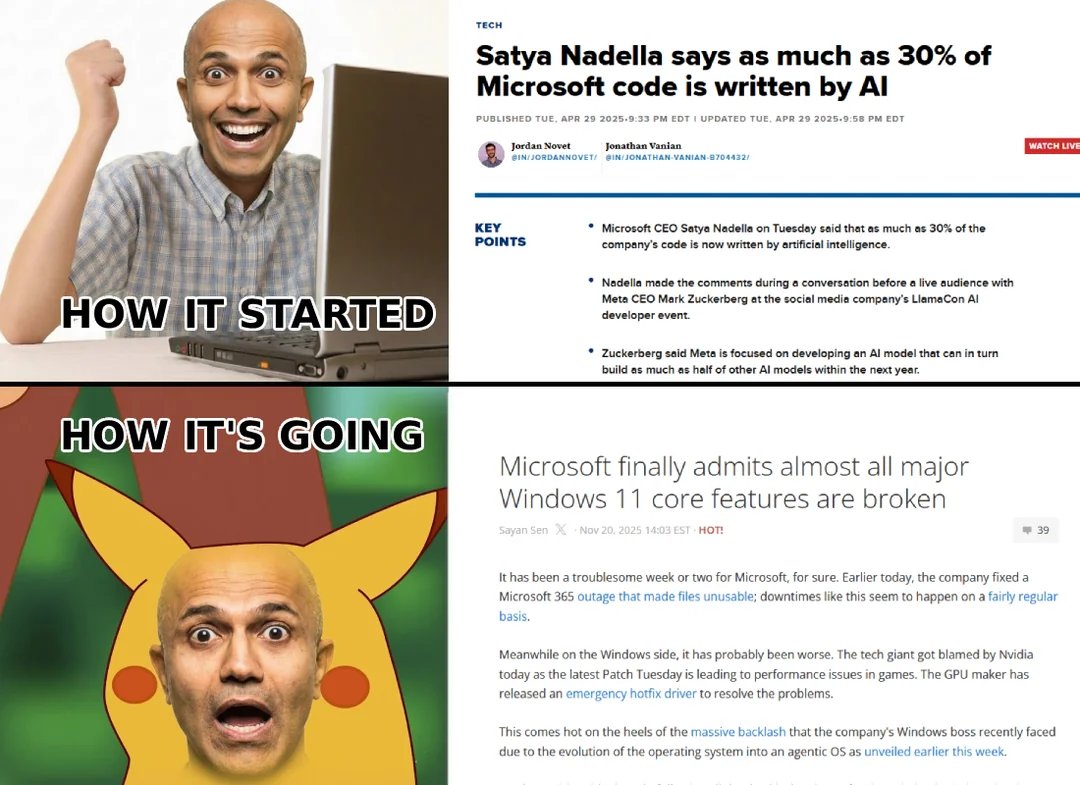
🦔Microsoft finally admitted that core Windows 11 components have been malfunctioning for months, affecting the Start Menu, Taskbar, File Explorer, and System Settings. The problems started with the July 2025 cumulative update and got worse with each monthly patch through October. The company only officially acknowledged the issues in late November after months of user complaints. Back in April 2025, Microsoft CEO Satya Nadella said 20% to 30% of the company's code was written by AI.
What Broke
The issues stem from complications with XAML components, the framework used for building Windows interfaces. Users report unresponsive Start Menus, vanishing Taskbars, sluggish File Explorer, and erratic System Settings. Social media flooded with IT professionals describing hours lost troubleshooting. Gartner estimates software bugs like this cost global enterprises billions annually in lost productivity. Microsoft recommended temporary fixes like resetting apps or rolling back updates, but those are bandaids. A December 2025 patch is promised to actually fix the problems.
My Take
In April, Microsoft's CEO bragged that AI was writing 20% to 30% of the company's code, with the CTO saying he expects 95% AI-generated by 2030. By July, the Start Menu stopped working. Maybe there's a connection between letting AI write a third of your code and your operating system breaking in ways that take four months to even acknowledge. One software engineer said "Microsoft's push for feature-rich updates seems to be outpacing their testing capabilities." When you're laying off engineers, having AI write your code, racing to integrate Copilot into everything, and maintaining a monthly update schedule, something gives. What gave was the basic functionality of the operating system. The features people use every single day just stopped working while Microsoft was busy announcing how much AI was writing their software. They knew it was broken for four months and only admitted it after the complaints became impossible to ignore.
Hedgie🤗