$IREN 2026: The Right Time
AI Sector Topline
In his recent interview, @GavinSBaker tells us that 2026 will be the year the AI revolution for software engineers shows it's wings in other sectors starting with customer services, marketing, and accounting (3). With this increase utility will be increasing token prices and the large jump in AI utility will be the GB300 trained models to be released in 2026. With ChatGPT-5.2, OpenAI is increasing it's output cost 40% from $10/1M-tokens to $14/1M-tokens (1), and ChatGPT-5.2 isn't the model trained on GB300 yet.
This improved tokenomics will back OpenAI's spend with better unit economics and the improved utility will increase confidence to issue debt for OpenAI's GPU capacity expansion.
Whichever of the 4 leading AI labs will gain momentum, OpenAI, Anthropic, xAI, or Google, the demand for compute is clear with each provider hitting capacity and users running out of tokens even on paid plans (7).
Macro
The core part of the current administration campaign push for 2026 midterm elections will be both fiscal and monetary stimulus. With @ForwardGuidance tracking of the changing tone in Fed guidance, it's looking increasingly likely H2 2025 was the pivot away from long term painful medicine to re-industrialize the US to suddenly inflation outlook for 2026 ready to receive stimulus (2). On this week's podcast, @Tyler_Neville_ reasoned that the loosening in credit conditions and stimulus combo will result in a rotation from Mag7 into small caps. @StockMeetUps has been tracking the fiscal stimulus and there will be a lot of liquidity coming from bills like BBB passed in July 2025 but really taking effect in 2026.
The Right Places: Sweetwater, Horizon 5-10, Canada
With $ORCL missing revenue but seeing an increasing backlog and $CRWV seeing delays and also seeing an increasing backlog, $IREN is well prepared to seize the opportunity. IREN has now proven it can serve all three IaaS segments: Hyperscalers in Microsoft, AI Platforms in Fireworks AI/TogetherAI, AI Natives in HumeAI/Poolside. These three sites represent 2.31GW of power with the 1.4GW Sweetwater 1 energizing in April 2026. Sweetwater 2 with 700MW has both a PPA from power provider and more importantly the Interconnection Agreement from the grid to energize late 2027. IREN has public reported an additional 2-3GW pipeline.
In these key sites, 2026 will be the year IREN lands multiple Hyperscalers contracts diversified between Microsoft at Horizon 1-4, either one or two hyperscaler for IaaS at SW1, and another hyperscaler to make use of the retrofit DCs at Horizon 5-10. These contracts improved profitability will be supported by improved tokenomics of better models, increase constraint on power availability, and IREN's improved credibility following's first Microsoft contract.
IREN Cloud in Canada already command amazing margins with 2 year payback on the GPUs locked in with 2 year contracts and existing DCs co-designed for both HPC and BTC mining.
The Additional Rerating
In $ORCL's Q3 earnings report, a lone bright spot was IaaS revenue accelerating from 55% to 68% (4). This is the segment where the customer brings their own orchestration software and deploys it on top of Nvidia foundational software layer of NCCL, cuDNN, cuBLAS, CUDA with Nvidia providing tight software-hardware integration that is also the moat for it's 4.5T valuation.
The market will re-rate IREN once it seems $15B IREN signs multiple IaaS contracts with increased profitability competing for the same customers as $566B $ORCL. $ORCL has already proven out the multi-cloud ecosystem and reported that it's multi-cloud database revenue grew 115% (6). This means AI Natives can architect their software to perform inference on IREN GPUs after setting up open source vLLM and open source Kubernetes/SLURM and then use Oracle Database on OCI.
Customers who can bring their own software stack to complement the foundational software stack Nvidia has already provided is serious: Palantir , TikTok, PaloAlto Networks, Crowdstrike, Uber, Skydance, Snap, Duolingo, Hugging Face, HeavyAI, GE Healthcare, Toyota, Neospace, SoundHound, LumaAI, Baseten, LiveKit, CharacterAI, Suno, Shopify, Meta, HumeAI, Poolside (5). These AI Natives have the ability to maintain high utilization rate among their own customers. With coding agents commoditizing the easier layers of software and Nvidia providing the complex layers software, IaaS will become a large segment of the market. Even AWS and Azure have a large part of their AI Cloud serving IaaS (5) with their major client OpenAI/Anthropic being end users of 1/3 of all GPUs (8). Whether AI ends up being centered around frontier labs or AI Natives, IREN IaaS is a foundation layer that is in pole position to monetize it's 5-6GW power portfolio. The quality factor will be GPU uptime and IREN unlike other BTC miners has a T3 datacenter background. $CRWV have 3x the market cap of IREN but they pivoted from being a failed ETH miner (10) who get their power from $CORZ and $APLD while IREN owns their power rights through renewable grid interconnection and PPAs contracts.
Alternatives Source Of Power
The world doesn't run out of power, it just goes to higher cost solutions.
1. Cheapest and most dependable is grid connected power. This is what IREN has secured from it's BTC mining days.
2. Natural Gas is what many such as Meta, DataOne, $NUAI are exploring.
3. Nuclear, Space DCs and even Underwater DC + Wind (11) are being explore frontier.
The important thing to remember is this: Shale made the US the largest producer of Oil, but Saudi Aramco is still making bank. All of Saudi Aramco's infrastucture is built out and Saudi Aramco is in the collecting cashflow part. Powered GPU is this generation's oil.
Further Research Materials
1. Financial Model WebApp + Key Observations https://t.co/duwSeYr3GZ
2. IREN's T3 Datacenter Background: https://t.co/pXhT2fgLIY
3. IREN's Secured Power Advantage: https://t.co/BLDcv4odis
4. IREN IaaS Market Segment in Cloud: https://t.co/CawM0T97ss
5. IREN Role in Multi-Cloud: https://t.co/fA4EhUm2y0
6. Key Partnership: FireworksAI https://t.co/34DIFer52F
7. Where's the Software-Hardware Vertical Integration: https://t.co/mujZHj1out
8. Full Context of IaaS and PaaS Markets: https://t.co/lZ3gBigik5
9. Why AI Research Breakthrough that drastically Reduces Need for GPUs is Highly Unlikely: https://t.co/iefzZ18GhW
10. Hybrid Edge AI + Centralized Datacenters: https://t.co/DWidjBOmJd
Alot of gratitude to the people who I followed starting from $5:
@FransBakker9812 - digs through tax abatements, satellite images, f5 IREN's website, power contracts
@TheKamaHsutra - digests earnings reports, connects the dots on Nvidia and partner programs, track fiber lines, interconnect agreements
@litigious_dulce - anticipating IREN's potential moves ahead of the curve, builds models, deep dives into significant of rack densities, strategies, advantages
@Umbisam - has a strong nose for BS, connects information from far out, insane close estimates of BTC production, always on top of dilution, very steady and representive of some big European money
@Agrippa_Inv - cleanest written thesis and long research
@benemodi - visits IREN sites in person, texas energy expert
@JarronJackson4 - analyzes institutional holdings, pulls together industry research of other data center projects
@KashRamki - always invest in safe stocks and is risk adverse, for him to be in IREN speaks volumes on how low risk IREN actually is
@scludweed - expert in his own right, high value reposts
@davidwurtz - Cofounder of Google Drive, VP Product at Shopify and sold his Nvidia for IREN, super down to earth
@McnallieM - best Dan Robert interviews
The big whales / seed investors: @BTCYESPLS, @TheBigDegen, @mikealfred, @roberto45580514
PodTech (Merger) founder: @brianfry01
People who have helped me along the way on my $IREN journey:
@MarkosAAIG - the objective investment auditor
@GlobalCollapse - options plays
@Jackie_s_pace/@pei_liu3 - great rebuttles from SpaceX/TSLA POV
@StockMeetUps - Microsoft AI Director
@moninvestor - small caps expert
@DeepValueBagger - retired tech exec
@nanotitan28 - IREN focused TA
@TheTechInvest - Tech Investment expert
More smaller accounts have been key to my journey and I group them into two lists to do filter my X news for investing. These list contains accounts that have relatively lower volume but more concentrated posts (less politics, sports, etc):
Highly Concentrated: https://t.co/KSbh52flpx
Medium Frequency: https://t.co/KSbh52flpx
$IREN: Putting things into perspective
There is really no other way to put it. $IREN's recent price action has been severely disappointing. The stock is now down over 20% YTD and nearly 60% from its all time highs.
I honestly feel for people who first started investing in $IREN over the past ~6 months. $IREN hasn’t been the easiest stock to hold in recent months. There is no doubt about that.
These days, I’m getting messages left and right from friends and family who are positioned in the stock. Most of them are baffled by the price action and are trying to make sense of it, and I think many investors find themselves in a similar situation.
In this post, I’ll lay out my perspective on the matter, providing you with some valuable context on the current situation.
First of all, it’s clear that much of the current sell-off over the past couple of weeks can be attributed to the macro backdrop. Virtually every stock is getting hit hard by a situation outside of management’s control.
Clearly, however, some stocks are getting hit harder, and $IREN finds itself in that bucket.
I see many investors attributing this volatility to the fact that $IREN's market cap is relatively small, but I wouldn’t say that’s the primary reason. After all, the company’s market cap has increased tenfold over the past year, and the stock still pretty much trades the same, with lots of volatility in both directions.
Just consider that $TSLA is a company with a trillion dollar market cap, yet it still trades like many small and mid caps.
The real reason for heightened volatility in some stocks is the gap between diverging opinions around the investment story, not just the market cap itself.
Public companies that have a wide range of differing views will naturally trade with more volatility than something that is more established and has a stronger consensus among market participants.
A great case study is Apple.
Nowadays, $AAPL's price action is far less extreme than it was in the early 2000s.
What changed is that, back then, Apple was still far less established than it is today, and its long-term positioning was much less clear to the market. The company’s moat was nowhere near as obvious as it is now.
Many market participants feared fierce competition from the Windows ecosystem, with some even arguing for the inevitable commoditization of the PC itself.
Then, on the other end of the spectrum, you had $AAPL bulls who saw the company as much more than just a PC vendor after the first iPod launch in 2001 and later the release of the iPhone in 2007. I’m sure some bulls, who were ultimately proven right, argued for 50 to 100x upside in the stock.
So, on the one hand, you had investors arguing for deteriorating financials and eventual bankruptcy, while on the other you had investors calling for a 100x in the stock.
These vastly different ranges of opinion created heightened investor uncertainty, i.e., fear, while at the same time fueling greed among investors looking for the next multibagger.
Greed and fear are the most prevalent emotions in financial markets. More of both always creates more volatility.
Nowadays, Apple is widely viewed as a slower growing but robust company with very predictable earnings and cash flows, so the spread of consensus is much narrower.
There are not many investors who believe $AAPL will pull 10x move any time soon, but at the same time, pretty much no one thinks the company could go bankrupt in the coming years.
$IREN, on the other hand, is still early in its growth story and is operating in a rapidly evolving market that is not yet widely understood.
The volatile price action is largely a reflection of how uncertain the broader investor base still is about the company, with many investors not having done the necessary work to truly understand the business from the inside out.
The only real way to stomach this kind of price action is to have very high conviction in both the company and the investment thesis, and that conviction can only be built through proper due diligence.
The main takeaway here is hyper-growth stocks such as $IREN tend to suffer from stronger sell offs than most other companies, often even for factors unrelated to the company’s underlying fundamentals.
As a reminder, $AAPL crashed by over 60% from its all time highs in the years following a very successful iPhone release because of unrelated macro events. The company even grew its revenue and earnings during the 2008 recession, yet the stock kept falling.
Just let that sink in...
In retrospect, buying $AAPL at $3 during that time, or simply holding the stock through the crash, was the most obvious play.
But that required investors to see through the macro noise and focus purely on the company’s fundamentals.
Just imagine how many good sounding bear arguments were flying around in the midst of what, at the time, seemed like a complete collapse of the financial system.
Today, companies like $IREN are getting punished hard by broader market turbulence, even when the factors driving that volatility have little impact on current business operations or runway.
Nothing has changed for $IREN.
The market is still severely compute constrained, and $IREN is one of the few players with the technical expertise and resources to help fill that void.
Even if the economy were to deteriorate as a result of rising oil prices, demand for AI is one of the last things I would expect to wane. Just like demand for the iPhone in 2008 only accelerated despite a horrible macro backdrop.
I’d recommend everyone revisit their thesis for why they invested in $IREN in the first place. If nothing has changed, then there is no reason to panic.
While my thesis on the stock has materially evolved over the past years, the core essence of the story has not changed one bit and, if anything, has only gotten stronger:
$IREN is one of the best positioned companies for what is shaping up to be the most disruptive technological paradigm shift of our lifetimes, the rise of AI.
As a final note, be aware of stock pumpers hopping from one theme to another.
$IREN is not a trade. At least it is not for me.
Would you have traded out of $AAPL at $3?
In exactly 1 year, I’m going to be the first millionaire among my brothers.
And when they ask how I did it, I’ll tell them the truth.
I bought what the norm wasn’t talking about.
$IREN — AI power infrastructure at $19
$NBIS — European AI compute at $85
$RKLB — the SpaceX alternative at $67
$ONDS — autonomous defense at $9
$AAOI — optical networking at $90
$CIFR — AI infrastructure at $14
$AMPX — next-gen battery tech at $13
$OUST — eyes of AI at $20
$ONDS — eyes of the sky at $8
They’ll say I got lucky.
I’ll say I just paid attention.
While they were watching Netflix, I was studying SEC filings.
While they were complaining about their job, I was building on the side, buying the dip.
The information was public. The opportunity was real.
The only thing required was conviction.
See you in a year in Italy…
-BP
Note: This is NOT financial advice.
Nvidia CEO Jensen Huang just revealed the “five-layer” model of what AI is dependent upon…
These 5 layers include:
1. Energy ~ $NBIS, $IREN, $CIFR, $OKLO
2. Chips ~ $NVDA, $AMD, $TSM, $AVGO
3. Cloud Infrastructure ~ $AMZN, $MSFT, $GOOGL, $CRWV
4. Models ~ $META, $ORCL
5. Applications ~ $PLTR, $TSLA
All these names will see generational upside in 2026 as AI continues to expand rapidly.
Save this for later…
The most critical bottleneck in the AI era—COMPUTE will likely make millionaires because Compute = Revenue.
1. $IREN
2. $CRWV
3. $NBIS
4. $WULF
5. $APLD
6. $CIFR
7. $HUT
8. $BTDR
$IREN Weekly Space 4/19/2026
Join me and @bitcoinbutcher1 for another weekly @IREN_Ltd themed space.
We will open it up for questions and speakers.
See you at 9PM ET.
Will be recorded.
https://t.co/uHWOVxsF5y
there's a specific moment most investors have sometime in year two or three.
you've done the research. you bought the stock. you've held through a couple of rough patches.
and then one day you check the app and you're up 80%. and you don't feel joy.
you feel anxiety. because now you have something to lose.
that's the moment the game changes. you went from hoping it goes up to being afraid of giving back the gains.
the people who compound wealth over decades have figured out how to hold through that feeling without acting on it.
they've accepted that 80% can become 40% before it becomes 200%.
most people haven't. most people protect the 80% gain and walk away from the 200%.
i'm not sure there's a shortcut to getting comfortable with that feeling.
i think you just have to sit in it a few times until it stops controlling your decisions.
-BP
Not financial advice.
$IREN is expected this month to announce energizing one of the largest data centers on the planet: SW1 (1.4GW).
Based on the CEO and CCO most recent interviews, the deadline is unchanged.
The worst mistake you might ever make is selling your stocks when they crash when it’s the right time to buy.
Unfortunately, stocks are the only products that get hate when they go on sale.
Your stocks fundamentals are the key metrics for making buy or sell decisions, not the red or green.
I would buy these stocks today regardless of the current Hormuz situation.
$IREN
$NBIS
$WULF
$APLD
$CIFR
Breaking: OpenAI fired Leopold Aschenbrenner at 22. Three years later, he manages $5.5 billion.
And is quickly becoming one of the best AI investors out there
Today, we're launching a tracker to trade alongside his picks, automatically. Here's his full portfolio:
1. Power & Energy:
$BE — Bloom Energy (29%) → fuel cells powering data centers
$EQT — EQT Corp (4%) → largest US natural gas producer
$CRWV — CoreWeave (4%) → GPU cloud infrastructure for AI
$SEI — Solaris Energy (3%) → energy infrastructure
2. Bitcoin Miners:
$CORZ — Core Scientific (14%) → Bitcoin miner turned AI data center host
$IREN — Iris Energy (11%) → Bitcoin mining + AI cloud
$APLD — Applied Digital (9%) → AI data center infrastructure
$CIFR — Cipher Mining (5%) → Bitcoin mining / HPC
$RIOT — Riot Platforms (3%) → largest US Bitcoin miner
3. Semiconductors & AI Hardware:
$SNDK — Sandisk (8%) → memory/storage for AI workloads
$COHR — Coherent (3%) → laser/photonics for data centers
$TSEM — Tower Semiconductor (3%) → analog chip foundry
$INTC — Intel (2%) → US chip manufacturing bet
$LITE — Lumentum (2%) → optical networking for AI infra
You can now mirror the portfolio automatically on Autopilot.
Just connect your broker, choose his tracker, and you're good to go
Link below
You are NOT bullish enough!
Here's why?
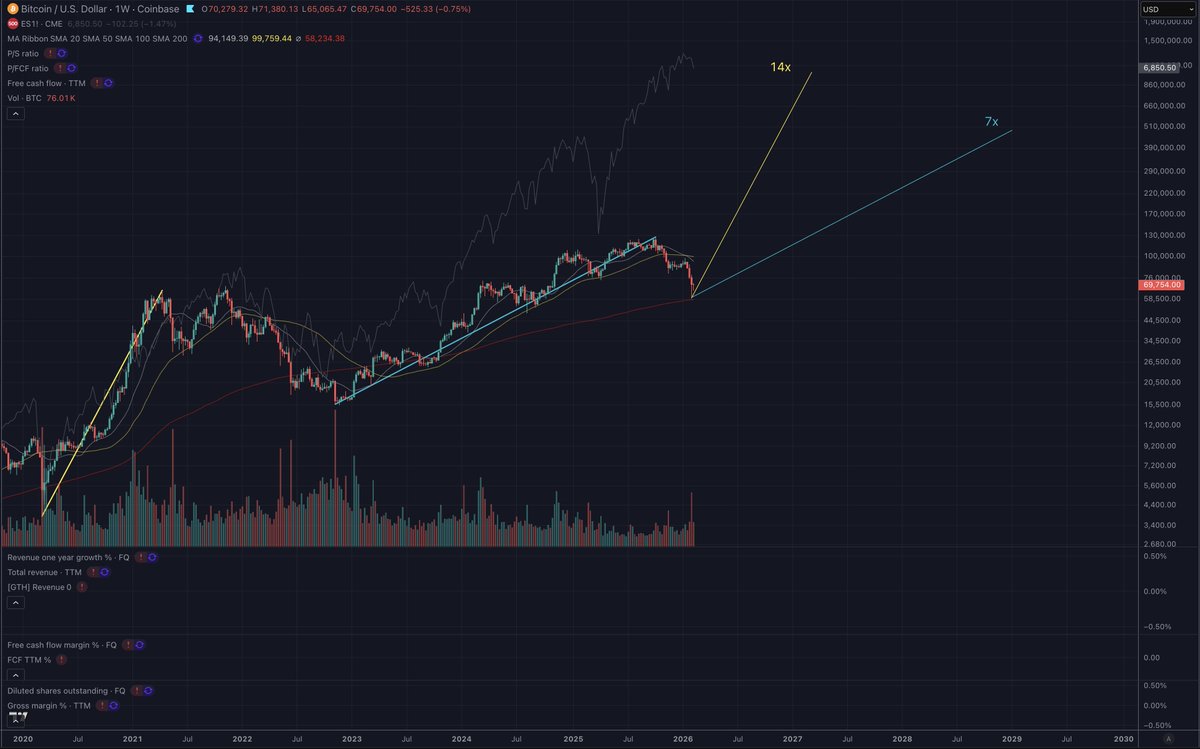
In the next 3 years, we might see a 7x to 14x move in Bitcoin. Just imagine what that will do to your growth portfolio.
Here's the exhibit. Bitcoin's last two moves from covid low in 2020 and post inflation low in 2022 has generated 14x and 7x returns respectively.
I think markets are poised to make another run like that. No one is ready for this. But if you position yourself right. Your portfolio can 10x in the next 3 years.
Bitcoin is at critical support. Once the next move starts, I believe we are going to see something that mimics somewhere between 2020 and 2022 moves.
A 10x in Bitcoin is a very real possibility. The stocks I own are high beta with sector tailwinds for a reason.
I am extremely bullish and my portfolio represents that.
Continuation of my thoughts on AI and its impact on software (and other impacted spaces):
Unless I’m being tailgated, I try not to drive looking in the rearview mirror.
We’re at the point where the person tailing you is experiencing road rage in traffic (not my driving) when in reality they should have just left for their destination earlier.
Earnings revisions drive multiples. Yes, the expensive starting point matters but it’s not the whole story. A lot of these businesses have slowed from a rate of change perspective, albeit still growing. That doesn’t make them bad businesses, but in software the stock price is part of the business. It’s a comp tool, a recruiting currency, and a barometer for health and future prospects.
The narrative has shifted. People are now questioning terminal value and how much moat these businesses actually have to protect. Meanwhile public investors want management to protect the stock with buybacks. Solving a business operations question with financial engineering has never been the answer and investors pushing that playbook need to look at private markets and get their mind right. I’d rather see insiders step up and buy stock with their own money than use the company balance sheet to do their talking.
Turn your attention to the lending environment. It has tightened and the flywheel has changed but remember during good times lenders are more relationship managers. And keep in mind the PE guys aren’t walking away from their portfolio companies like public investors are, and are using reporters and interviews to try and impact sentiment before it gets away from them... They’re not handing keys to lenders. They’re consolidating, exiting what they can, rolling into continuation vehicles, and avoiding down rounds even though mark to market becomes an issue once every financial engineering mechanic to avoid new, lower marks meets reality.
Kick the can in private while public stocks re-rate violently after they overshot to the upside.
These aren’t isolated problems from my perch. They’re more like interlocking gears. Stock price drives recruiting and retention. The lending environment dictates the financial engineering options. The narrative shift hits customer confidence, which hits revenue, which feeds back into everything else (perhaps they try introducing a new KPI). When one gear slows, the friction transfers across all of them.
The same interconnectedness that created the (perhaps in hindsight questionable) compounding premium on the way up is now compounding the discount on the way down.
Cc @buccocapital who is putting in a lot of effort thinking through the state of affairs in AI, saas, software, et al