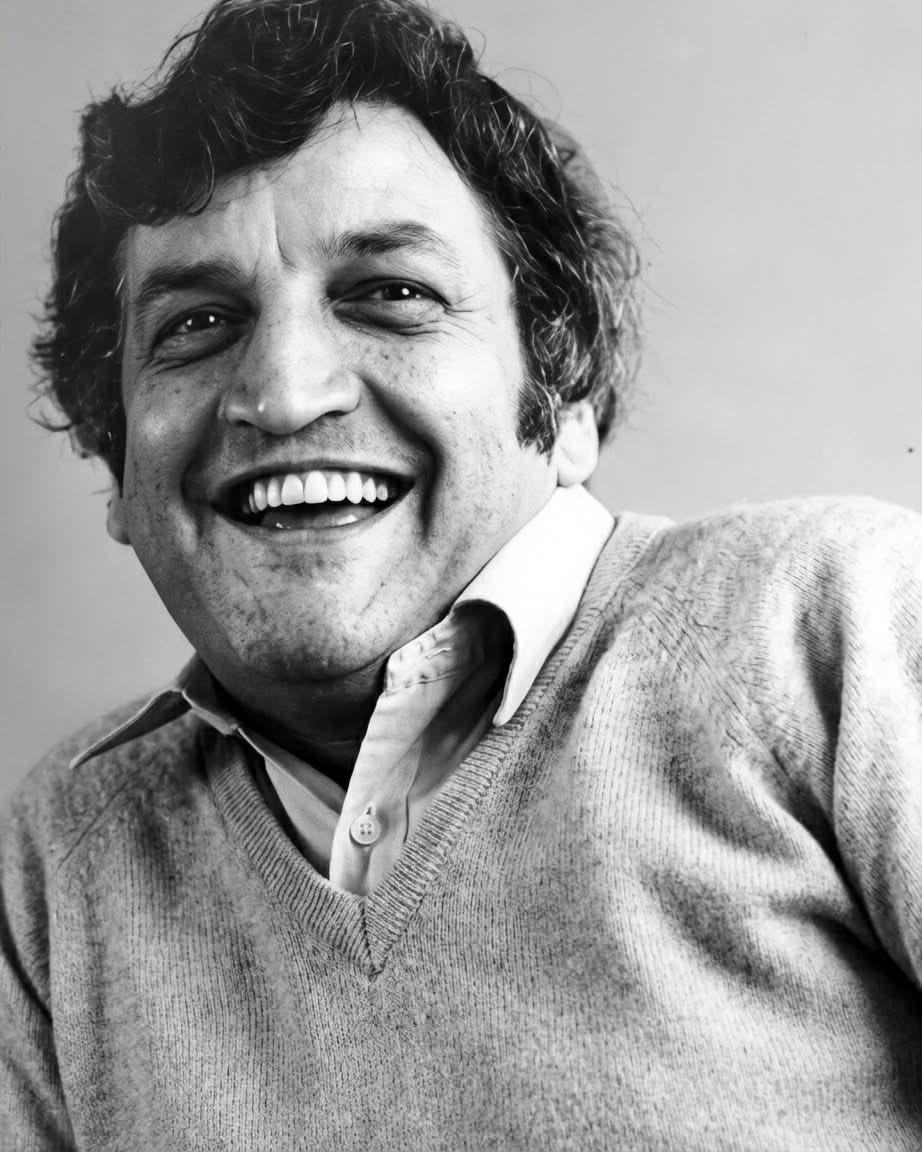
When the President of France visited the United States in April 1960, he asked the FBI to help him find a man.
The man he was looking for was an American citizen. He was sixty-four years old. He had been awarded fifteen French military decorations and — six months earlier, in a ceremony in Paris — had been made a Knight of the Légion d'honneur, the highest civilian honor France can give. The medal had been pinned to his chest by the President himself, who had publicly called him un véritable héros français. A true French hero.
The FBI located the man within a few days.
He was operating an elevator at Rockefeller Center in New York City.
The elevator operator's name was Eugene Bullard. He had been born in Columbus, Georgia, in 1895, the son of a man whose own father had been a slave.
He had run away from Columbus at the age of eleven, after watching a white mob nearly lynch his father.
He spent the next several years drifting through the American South. At sixteen, he stowed away on a German freighter at Norfolk, Virginia. He landed in Aberdeen, Scotland. From there he made his way to London, where he learned to box. By 1913, at eighteen, he was prizefighting in Paris.
When Germany invaded France in August 1914, Bullard was nineteen years old. He had no legal obligation to fight. He had no French citizenship.
He went to the recruiting office on October 19, 1914, and signed up for the French Foreign Legion.
He spent the next eighteen months as an infantryman in some of the worst fighting of the war — at the Somme, at Champagne, at Verdun. He was wounded three times. The third wound, on March 5, 1916, tore open his thigh and left him with permanent damage to his leg.
He was twenty years old. The doctors told him he would not return to the infantry.
He decided he wanted to fly.
In a Paris café in the spring of 1916, while he was recovering, Bullard mentioned to three white American friends that he was thinking of joining the French air service. A Mississippian named Jeff Dickson laughed.
Gene, Dickson said, you know damn well there aren't any Negroes in aviation.
Bullard answered: Sure do. That's why I want to get into it. There has to be a first to everything, and I'm going to be the first.
Dickson bet him two thousand dollars he would not make it.
Bullard took the bet. He earned his pilot's license on May 5, 1917. He won the bet.
He reported to the front in August 1917 and flew approximately twenty combat missions over the next three months in a SPAD VII. The fuselage was painted with a bleeding heart pierced by a knife and the French phrase Tout le Sang qui Coule est Rouge — All Blood that Flows is Red.
He carried, on every combat flight, a small capuchin monkey named Jimmy in the front of his flight jacket.
The French press began calling him L'Hirondelle Noire — the Black Swallow.
When the United States entered the war in 1917, Bullard immediately applied to transfer to the U.S. Army Air Service.
His application was rejected.
The U.S. Army Air Service had a policy, in 1917, of not accepting Black pilots. The other American pilots flying for France in his unit, all of them white, were transferred to the U.S. Air Service.
He was the only one who was not.
For the next twenty years, he was one of the most familiar faces in the Montmartre nightlife of Paris between the wars. He owned a nightclub called L'Escadrille. He spoke fluent French, English, and German. Hemingway drank there. Fitzgerald drank there. Langston Hughes drank there. Josephine Baker performed there. Louis Armstrong was a personal friend.
When Germany invaded Poland in 1939, Bullard was forty-four. His fluent German and his ownership of a nightclub frequented by German officers made him useful to the French Resistance. He became an intelligence agent — eavesdropping in his own bar on conversations between German officers who did not know he understood every word.
When France fell in June 1940, friends in the Resistance smuggled him across the Spanish border before the Gestapo could arrest him.
He came back to the United States for the first time in twenty-eight years.
He arrived in New York with thirty dollars in his pocket and a permanent limp.
He did not return to a hero's welcome. He returned to a country that had no idea who he was.
He worked at a perfume counter. He worked as a security guard. He worked at the Staten Island shipyards. By the late 1940s, he had taken the job that he would hold for most of the rest of his life.
He operated the elevator at Rockefeller Center.
He was wearing the elevator uniform on the day a producer from NBC came down from the studios upstairs to ask if he was the man Charles de Gaulle had been looking for.
A few weeks later, NBC sent a film crew to interview him in the lobby. The studios where NBC produced The Today Show were on the floors above. He had operated the elevator that took the network executives up to those studios every morning for nearly ten years. He had not been recognized as he did it.
He went back to operating the elevator the following Monday.
He died of stomach cancer on October 12, 1961, three days after his sixty-sixth birthday.
He was buried in the French War Veterans' section of Flushing Cemetery, in Queens, in the uniform of the French Foreign Legion. The casket was draped with the French flag.
In 1994 — thirty-three years after his death — the United States Air Force formally commissioned Eugene Jacques Bullard as a Second Lieutenant, posthumously.
It was the first commission the U.S. military had ever offered him.
He had been the first Black combat pilot in American history.
The French had been calling him a hero since 1917.
The Americans got around to it in 1994.
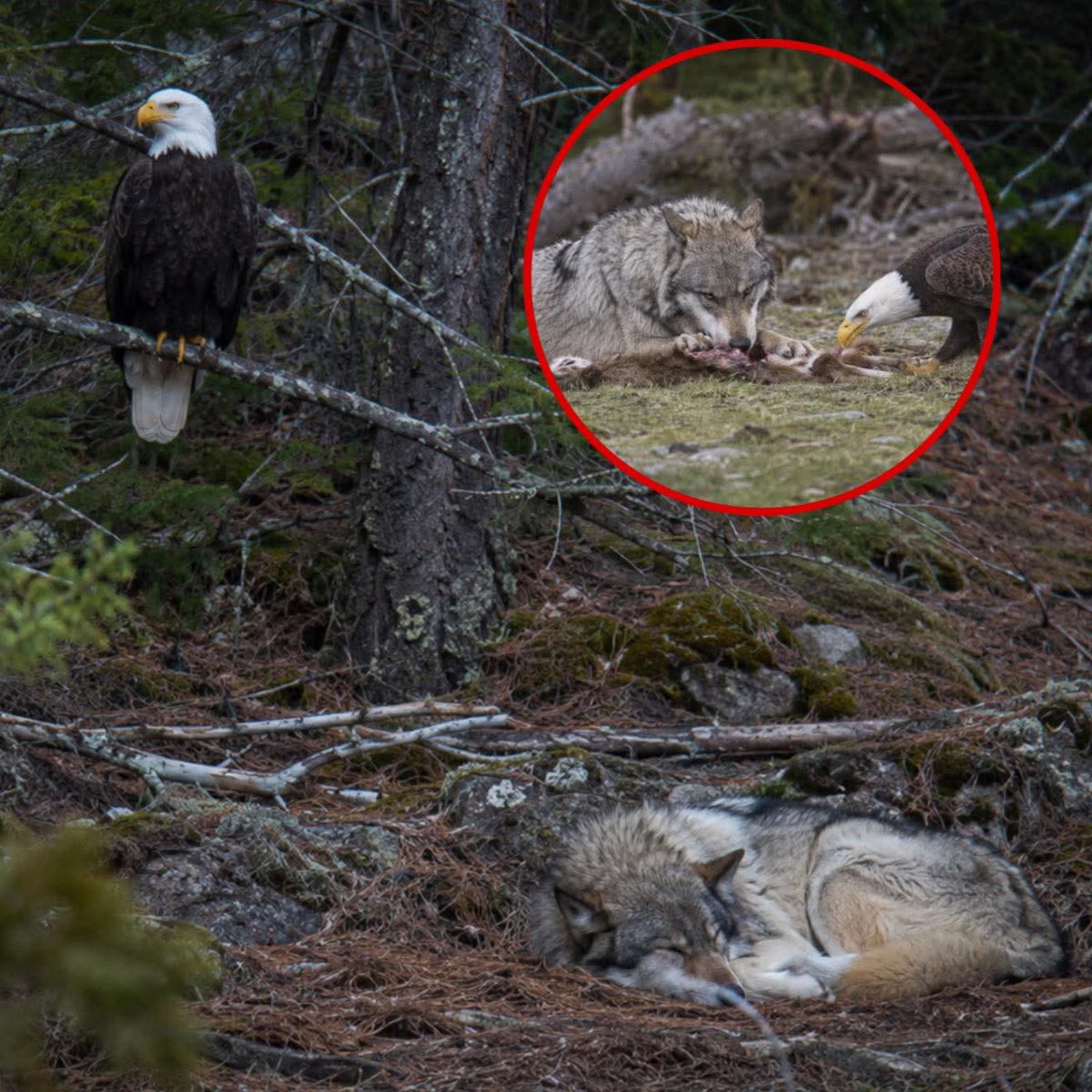
Wolf left to die until an eagle showed up. A group of researchers had been following the same wolf pack for weeks when they noticed one wolf falling farther and farther behind. It was limping badly, stopping every few steps, and by sunset, the pack had disappeared into the trees without it. One photographer stayed back, thinking he was about to capture one of the hardest parts of nature to watch: an injured animal too weak to keep up, left alone in the woods with no pack, no protection, and almost no chance. He said the wolf curled under a tree like it had already given up.
But the last photo he expected to take turned into the one nobody could explain. A bald eagle landed above the wolf and stayed there, not feeding, not circling, just watching. For days, it returned while the wolf slept, almost like it was guarding the only animal in the forest weaker than itself. Then the wolf got strong enough to move, and cameras caught something even stranger. The eagle began flying low over the brush, pushing small prey toward the wolf, and when the wolf made the catch, it let the eagle eat beside it. What started as a heartbreaking scene became something researchers never thought they would see: a wounded wolf and a wild eagle learning to survive together.
The richest man in America signed a document that could have gotten him hanged, and when someone sneered that he was safe because no one would know which Charles Carroll to come for, he picked up the pen and told the British exactly where to find him.
His name was Charles Carroll, and the colonies were crawling with men who shared it. His own father was Charles Carroll of Annapolis. So when the Declaration of Independence came to him for signing in 1776, a delegate made a cruel little joke. He said Carroll risked nothing by signing. There were so many Charles Carrolls that the King's men would never know which one to hang.
Carroll didn't argue. He leaned over the page and added three words to his signature: "of Carrollton." The name of his estate. His address. He was the only signer in the entire room who wrote down where he lived, and he did it on purpose, so that if the British wanted to come hang the traitor, they would know exactly which door to knock on.
That is who Charles Carroll of Carrollton was.
Here is what makes the moment even sharper. He was not a man with little to lose. He was the single wealthiest man in the thirteen colonies and the largest private landowner among them. While George Washington and John Hancock get talked about as rich men, it was Carroll who topped them all. When he signed, he was wagering the biggest personal fortune in America against a noose.
And he was the last man anyone would have expected to be there at all. Carroll was Catholic. In colonial Maryland, a colony founded as a Catholic refuge that had since turned on its own, Catholics could not vote. They could not hold public office. They could not worship in public. The most educated, wealthiest man in America was, in the eyes of the law, a second-class subject barred from the very government he was helping to create. He had spent seventeen years being educated by Jesuits in France and spoke five languages fluently, and back home he still could not legally cast a ballot.
So he became the only Catholic to sign the Declaration of Independence, putting his name on a revolution that he hoped would build a country with room for men like him. That was its own enormous bet, made by a man the existing system had already shut out.
Then he simply outlived everyone.
Thomas Jefferson and John Adams both died on the same astonishing day, July 4, 1826, exactly fifty years after the Declaration. When they were gone, Charles Carroll of Carrollton was the last living signer left on earth. For six more years he was the final human link to that room in Philadelphia, the last hand that had signed, a living relic of the founding that ordinary Americans traveled to see and shake.
He finally died in November 1832 at the age of ninety-five, fifty-six years after he wrote his address on a treason document and dared the empire to come find him.
The richest man in America. The only Catholic. The last one standing. He had more to lose than any of them, every legal reason to stay quiet, and he signed his full address anyway.
We remember the names we were handed in school. We forget the man who made sure his couldn't be mistaken for anyone else's.
Which Founding Father do you think history shortchanged the most?
The Navajo Code Talkers were recruited because their language, unwritten, complex, and spoken only within the Navajo Nation, was impossible for enemy cryptographers to break. During WWII, they developed a full tactical code on top of their own language, allowing Marines to transmit battlefield messages in seconds rather than minutes. Their speed and accuracy became legendary, especially in chaotic, high‑casualty island battles where communication failures could cost entire units.
Their impact was so decisive that Marine officers openly credited them with turning the tide in key operations. During the brutal assault on Iwo Jima, one commander said the Marines would never have taken the island without the Code Talkers. Over three days, they sent and received more than 800 error‑free messages under constant fire. Not a single transmission was ever decoded by the Japanese, making it the only unbroken code of the entire war.
Because the code was so valuable and because many American troops had never encountered Navajo people before Code Talkers were assigned bodyguards. These guards protected them from friendly‑fire incidents and from the possibility of capture. If a Code Talker were taken alive, the entire Pacific campaign could be compromised. Their service remained classified until 1968, meaning they returned home without recognition, carrying the weight of a contribution the world didn’t yet know they had made.
The Navajo Code Talkers didn’t just speak Navajo, they built an entire “code within the code,” a second encrypted layer that even fluent Navajo speakers couldn’t understand. This meant that when the Japanese captured a Navajo soldier, he still couldn’t decipher a single intercepted message, leaving his captors furious and confused .
The system was so fast it outperformed U.S. encryption machines: one Code Talker famously transmitted, decoded, confirmed, and returned a message in two minutes and thirty seconds, compared to the four hours required by standard cipher equipment .
A darker, rarely discussed layer is the irony and trauma behind their service. Many Code Talkers had been punished as children for speaking Navajo, beaten or forced to wash their mouths with soap in government boarding schools, only to be asked years later to use that same language to save American lives . And while they were indispensable on the battlefield, they were also assigned bodyguards because some U.S. troops mistook them for Japanese soldiers, and because their capture would have jeopardized the entire Pacific campaign.
Their heroism remained classified until 1968, meaning they returned home to silence, poverty, and a country that still denied many Navajo families basic infrastructure like running water.
#archaeohistories
For nearly 5 months, a massive stray pit bull followed a female Chicago police officer during her overnight patrols.
Always at a distance.
Always silent.
Always watching.
Then one freezing night, two armed men stepped out of an alley.
And the dog took a bullet protecting her.
Her name is Officer Marisol Vega-Durand.
She’s 29 years old and works overnight patrol on Chicago’s West Side.
For years, she learned how to look fearless.
Even when she wasn’t.
She worked East Garfield Park from 10 p.m. to 6 a.m. the kind of neighborhood where you stop reacting to distant gunshots because you hear them too often.
One night in June 2025, after responding to an overdose call, she noticed a huge gray pit bull standing under a flickering streetlight near an alley.
Scarred shoulders.
Torn ear.
Amber eyes.
The dog stared past her, scanning the street behind her.
When she walked away, he followed.
Not close.
Never aggressive.
Just… there.
Every single night after that, he appeared near the same intersection and quietly trailed behind her patrol route.
The other officers started calling him “Ghost.”
Nobody knew where he came from.
Some people thought he escaped a dogfighting ring.
Others believed he belonged to a man killed the year before.
But everyone agreed on one thing:
The dog hated violence.
If people started fighting, Ghost reacted instantly.
One night, two drunk men started swinging at each other outside a corner store.
Before Officer Vega-Durand could intervene, Ghost charged between them barking so violently both men backed away immediately.
He never bit anyone.
He just protected.
Eventually she started leaving treats for him near an alley around 1 a.m.
For months, he wouldn’t let her get close.
And when he finally did, he flinched every time she moved too fast.
That’s when she realized somebody had hurt him badly before.
Then came November 18th.
2:11 a.m.
Near an old liquor store off Pulaski Road, two men stepped out from an alley.
One had a knife.
The other had a revolver.
The gunman told her not to touch her radio.
She drew her weapon, but they were already too close.
Then the man with the knife lunged.
Before she could react, something gray exploded across her vision.
Ghost hit the attacker so hard both of them slammed into a parked car.
The second man fired instantly.
The bullet tore through Ghost’s shoulder.
But even after being shot, he kept fighting.
He latched onto the gunman long enough for Officer Vega Durand to disarm him.
Backup arrived three minutes later.
Ghost spent those entire three minutes pressed against her legs, bleeding onto the sidewalk while she begged him not to die.
“Please don’t die.
Please don’t die.”
He survived surgery that morning.
And when she visited him afterward still wearing her uniform, his tail started thumping weakly against the kennel floor.
She broke down crying beside him.
Then the story went viral.
Donations flooded the veterinary clinic.
A retired firefighter eventually recognized the dog from the news.
Ghost’s real name was Titan.
Years earlier, Titan had been rescued from an illegal fighting operation by the firefighter’s nephew a paramedic who was later killed during a carjacking.
After the nephew’s death, Titan disappeared.
Until now.
When the retired firefighter reunited with Titan, the dog collapsed into his chest shaking and whining like he couldn’t believe it was real.
But after the reunion, the man looked at Officer Vega-Durand and smiled.
“He already picked his person.”
Titan lives with her now.
He sleeps beside the front door every night.
Loves peanut butter treats.
Hates vacuum cleaners.
The Chicago Police Department even awarded him a civilian bravery commendation.
They gave him a blue bow tie for the ceremony.
He wore it proudly.
Officer Vega-Durand says Titan changed her too.
Not because she stopped being afraid.
But because she finally admitted she was.
For the first time in years, she no longer feels alone.
“The plane went silent.”
That’s what passengers aboard British Airways Flight 9 remembered most.
Not screaming.
Not alarms.
Silence.
On June 24, 1982, the Boeing 747 was flying over Java at 37,000 feet with 247 passengers onboard when Senior Engineer Barry Townley-Freeman noticed engine temperatures rising dangerously fast.
Then passengers started calling flight attendants:
“There’s something glowing outside the window.”
Blue light flickered through the engines.
White sparks danced across the wings.
It looked beautiful.
In the cockpit, Captain Eric Moody watched Engine 4 fail.
Then Engine 2.
Then 1.
Then 3.
Within minutes, all four engines were dead.
A fully loaded 747 became a powerless glider descending toward the Indian Ocean.
No thrust.
Barely any radio communication.
No idea what caused it.
Passengers woke from sleep to something deeply unnatural:
The absence of engine noise.
At 37,000 feet, a jetliner should roar.
Instead, there was only wind.
Captain Moody got on the intercom and delivered one of aviation history’s most famous announcements:
“Ladies and gentlemen, this is your captain speaking. We have a small problem. All four engines have stopped. We are doing our damnedest to get them under control.”
Some passengers thought it was a joke.
The flight attendants’ faces said otherwise.
What nobody onboard knew was that the plane had flown directly through a volcanic ash cloud from Mount Galunggung.
The ash was made of microscopic glass particles.
Inside the engines, the particles melted at extreme temperatures and coated the turbines like cement, suffocating all four engines one by one.
At 15,000 feet, oxygen masks deployed.
At 12,000 feet, the crew prepared for a night ditching into the ocean.
Captain Moody knew the odds of surviving a water landing in a 747 were almost nonexistent.
Then he tried restarting the engines one final time.
Engine 4 sputtered.
Caught.
Then another.
Then another.
All four engines roared back to life.
But the nightmare still wasn’t over.
The volcanic ash had sandblasted the cockpit windshield so badly the pilots could barely see through it.
Captain Moody had to land a damaged 747 at night using only a tiny clear section of the side window while his first officer called out altitude and distance manually.
Against every odd, the aircraft landed safely in Jakarta.
Every single person onboard survived.
After the incident, volcanic ash became a globally monitored aviation hazard.
And Captain Eric Moody’s calm announcement became legendary — still taught today as a masterclass in crisis leadership:
Tell the truth.
Stay calm.
Give people dignity.
Even when you’re falling out of the sky.
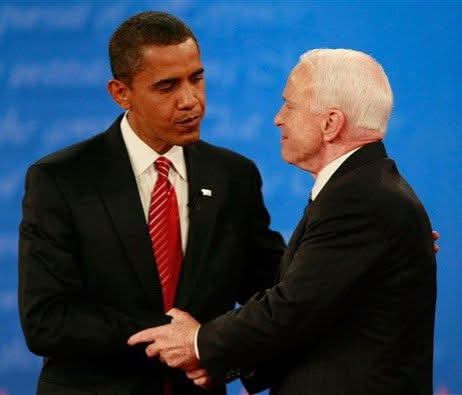
"Circa early 2018, somewhere in the quiet of his beloved Cornville, Arizona ranch, John McCain — living with the knowledge that his days were growing shorter — made a decision that was so perfectly, mischievously, achingly him that it made the whole country smile through their tears when they finally heard about it: he picked up the phone and called Barack Obama, the man who had defeated him for the presidency a decade earlier, and asked him to speak at his funeral. Obama later said that when that call came, he felt 'sadness and also a certain surprise' — and then, with the warmth that defined him, he recognized exactly what McCain was doing, telling mourners at the Washington National Cathedral on September 1, 2018 that the invitation showed McCain's 'irreverence, his sense of humor, a little bit of a mischievous streak' — because, as Obama put it to a cathedral that erupted in laughter through their grief, 'what better way to get a last laugh than to make George and I say nice things about him to a national audience?' It was John McCain's final act of political theater, and it was genius — choosing the two men who had each defeated him for the presidency to stand before the nation and celebrate his life, sending a message louder than any speech he could have given himself: that in America, rivalry and respect are not opposites, that the man you run against can still be the man you trust with your legacy, and that decency is not weakness but the most durable form of strength. Obama stood at that altar and told the packed cathedral that McCain had 'made this country better,' that he had made Obama a better president, and that when all was said and done, despite every disagreement, 'we never doubted the other man's sincerity or the other man's patriotism' — and in the front pew, Cindy McCain wept, because her husband had arranged, from the very edge of his life, one last beautiful lesson in what it means to be an American.
Retiring from the British Army can be complicated...
Lt. Colonel Robert Maclaren retired from the British Army in 2001 after a long fulfilling career. On the day that he retired he received a letter from the Personnel Department of the Ministry of Defence setting out details of his pension and, in particular, the tax-free ‘lump sum’ award, (based upon completed years of service), that he would receive in addition to his monthly pension.
The letter read:
“Dear Lt. Colonel Maclaren,
We write to confirm that you retired from the Royal Scots Dragoon Guards on 1st March 2001 at the rank of Lt Colonel, having been commissioned into the British Army at Edinburgh Castle as a 2nd Lieutenant on 1st February 1366.
Accordingly your lump sum payment, based on years served, has been calculated as £68,500. You will receive a cheque for this amount in due course.
Yours sincerely,
Army Paymaster”
Col Maclaren replied:
“Dear Paymaster,
Thank you for your recent letter confirming that I served as an officer in the Royal Scots Dragoon Guards between 1st February 1366 and 1st March 2001 – a total period of 635 years and 1 month.
I note however that you have calculated my lump sum to be £68, 500, which seems to be considerably less than it should be bearing in mind my length of service since I received my commission from King Edward III.
By my calculation, allowing for interest payments and currency fluctuations, my lump sum should actually be £6,427,586,619.47p.
I look forward to receiving a cheque for this amount in due course.
Yours sincerely,
Robert Maclaren (Lt Col Retd)”
A month passed by and then in early April, a stout manilla envelope from the Ministry of Defence in Edinburgh dropped through Col Maclaren’s letter box, it read:
“Dear Lt Colonel Maclaren,
We have reviewed the circumstances of your case as outlined in your recent letter to us dated 8th March inst.
We do indeed confirm that you were commissioned into the Royal Scots Dragoon Guards by King Edward III at Edinburgh Castle on 1st February 1366, and that you served continuously for the following 635 years and 1 month.
We have re-calculated your pension and have pleasure in confirming that the lump sum payment due to you is indeed £6,427,586,619.47p.
However,
We also note that according to our records you are the only surviving officer who had command responsibility during the following campaigns and battles:
*The Wars of the Roses 1455 -1485 (Including the battles of Bosworth Field, Barnet and Towton)
*The Civil War 1642 -1651 (Including the battles Edge Hill, Naseby and the conquest of Ireland)
*The Napoleonic War 1803 – 1815 (including the battle of Waterloo and the Peninsular War)
*The Crimean War (1853 – 1856) (including the battle of Sevastopol and the Charge of the Light Brigade)
*The Boer War (1899 -1902).
We would therefore wish to know what happened to the following, which do not appear to have been returned to Stores by you on completion of operations:
*9765 Cannon
*26,785 Swords
*12,889 Pikes
*127,345 Rifles (with bayonets)
*28,987 horses (fully kitted)
Plus three complete marching bands with instruments and banners.
We have calculated the total cost of these items and they amount to £6,427,518.119.47p.
WE have therefore subtracted this sum from your lump sum, leaving a residual amount of £68,500, for which you will receive a cheque in due course.
Yours sincerely . . . .”
May 15, 1963.
Astronaut Gordon Cooper climbed into a capsule barely larger than a phone booth and launched into space aboard Faith 7.
The mission was simple on paper:
Orbit Earth 22 times.
Stay in space for a full day.
Come home alive.
For most of the flight, everything worked perfectly.
Then, on the 19th orbit, the warning lights came on.
First, a faulty sensor falsely reported reentry.
Then the electrical system failed.
One by one, the automated controls died.
Guidance system: dead.
Orientation system: dead.
Reentry calculations: dead.
At 165 miles above Earth, Gordon Cooper suddenly had no functioning instruments to bring him home.
And reentry is unforgiving.
Too shallow, and the capsule skips off the atmosphere into space forever.
Too steep, and friction turns it into a fireball.
The difference between life and death was fractions of a degree.
Mission Control could only watch.
So Cooper became the computer.
He drew reference marks on the capsule window with a pen.
He stared at the stars he had memorized before launch and used them to orient the spacecraft by eye.
He strapped a wristwatch to his arm and timed everything manually.
Then he did the math in his head.
No autopilot.
No navigation system.
No backup computer.
Just a man, a watch, and the stars.
At exactly the right second, Cooper fired the retrorockets manually.
The capsule dropped into Earth’s atmosphere.
For several minutes, communication vanished as plasma wrapped the spacecraft in fire.
Nobody on Earth could contact him.
Then the parachutes opened.
Faith 7 splashed down just 4.4 miles from the recovery ship USS Kearsarge — the most accurate splashdown of the entire Mercury program.
Later, Cooper described it simply:
“I used my wristwatch for time, my eyeballs out the window for attitude.”
That’s it.
In one of the most dangerous moments in early spaceflight history, a human being outperformed the machines.
We live in a world obsessed with automation and software.
But Gordon Cooper’s flight is a reminder that when everything breaks, the final backup system is still the human mind.
Calm under pressure.
Thinking clearly.
Making the call when nobody else can.
It was true in 1963.
It still is.