Data loss creates a chain reaction.
Data disappears.
Systems stop.
Customers get frustrated.
Then you spend money fixing the original problem.
The real cost of data loss is rarely just the data.
Setup Capsule for free - https://t.co/E6VTwVu6Qx
Automate your backups.
If your backup depends on someone remembering to run it, eventually someone will forget, but Capsule doesn't
https://t.co/E6VTwVu6Qx
Small businesses often think:
"We're too small to be a target."
Data loss doesn't care about company size.
A business can lose data by: failed drive, stolen laptop, compromised account, or one accidental deletion.
https://t.co/E6VTwVu6Qx
Ask your team one question:
"If our production database disappeared right now, how quickly could we restore it?"
If nobody knows...
that's a problem.
The answer should be concrete, not someone's best guess.
Start for free - https://t.co/E6VTwVu6Qx
Customers trust businesses with their data.
Lose that data and you may lose more than information.
You may lose their confidence.
And trust is much harder to restore than a database.
Get a backup strategy - https://t.co/E6VTwVu6Qx
Your business can survive a bad quarter.
It can survive losing a customer.
It may even survive losing an employee.
But losing critical business data can trigger all three problems at once.
Protect your data with https://t.co/xHwwhkIWB7
Most businesses think data loss is an IT problem.
It isn't.
It's a business continuity problem.
Lost data can mean: Lost time. Lost revenue. Lost customers. Lost trust.
Your backups aren't optional
Setup backup for free - https://t.co/urFA7zQjpo
If your database disappeared today, how long would your business survive?
An hour?
A day?
A week?
If you don't know the answer, you don't have a disaster recovery strategy.
You have hope.
Reference: https://t.co/V56zYXlbN3
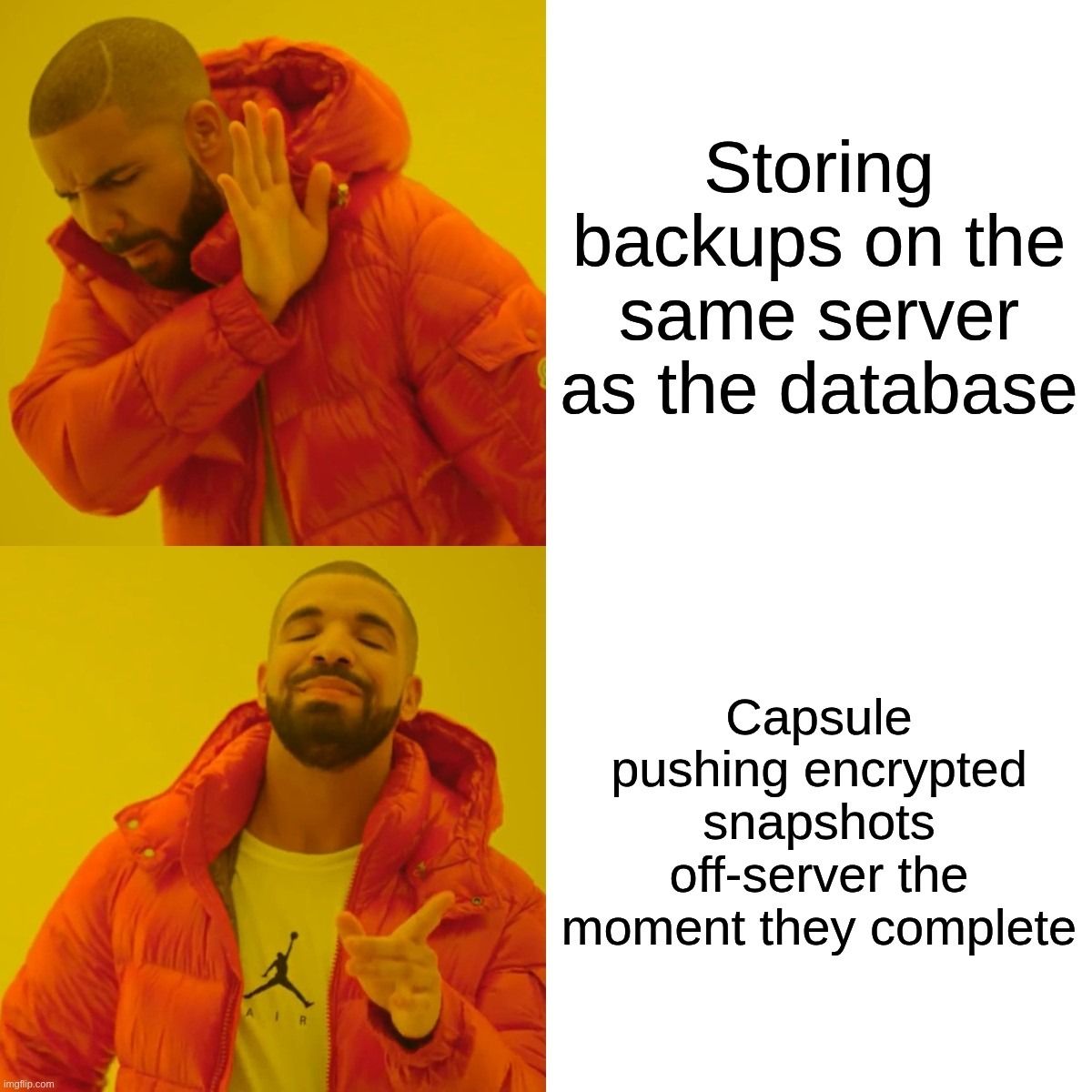
Your cron job that copies files to the same server isn't a backup. It's a second copy of what you're about to lose.
"I'll set up backups later" is the sentence every developer regrets at 2am.
Backup for free.
→ https://t.co/urFA7zQjpo
@prpatel05 Another safe way would be to setup Capsule.
Capsule backups or restore the database on your command.
The undo button on the database layer is why capsule exists.
Start for free. https://t.co/urFA7zQjpo
@hiarun02 This is the reason why capsule exist.
To give your database an undo button, because you can't really tell when disaster might happen or when you might mistakenly get careless.
start backups for free https://t.co/urFA7zQjpo
@_ROB_29 This is the reason why capsule exist. To give your database an undo button, because you can't really tell when disaster might happen or when you might mistakenly get careless.
start backups for free https://t.co/urFA7zQjpo
@nilbuild This is the reason why capsule exist.
To give your database an undo button, because you can't really tell when disaster might happen or when you might mistakenly get careless.
start backups for free https://t.co/urFA7zQjpo
It's free to start. No credit card.
If you self-host anything with a real database, this is the one thing you've been putting off setting up.
Don't wait for the 3am panic.
→ https://t.co/urFA7zQjpo
Someone ran `DROP TABLE users;` in production. 6 years of user data. Wiped in 0.05 seconds. The query didn't ask "are you sure?" and SQL doesn't do undo but with Capsule... "undo" exist. #database, #backup, #backend, #devops, #startups, #selfhosted
→ https://t.co/urFA7zQjpo