7:00 AM. Dubai.
30 Sept 2026.
Dubai International Airport.
Around 30°C.
Clear skies.
Light easterly wind.
Business as usual.
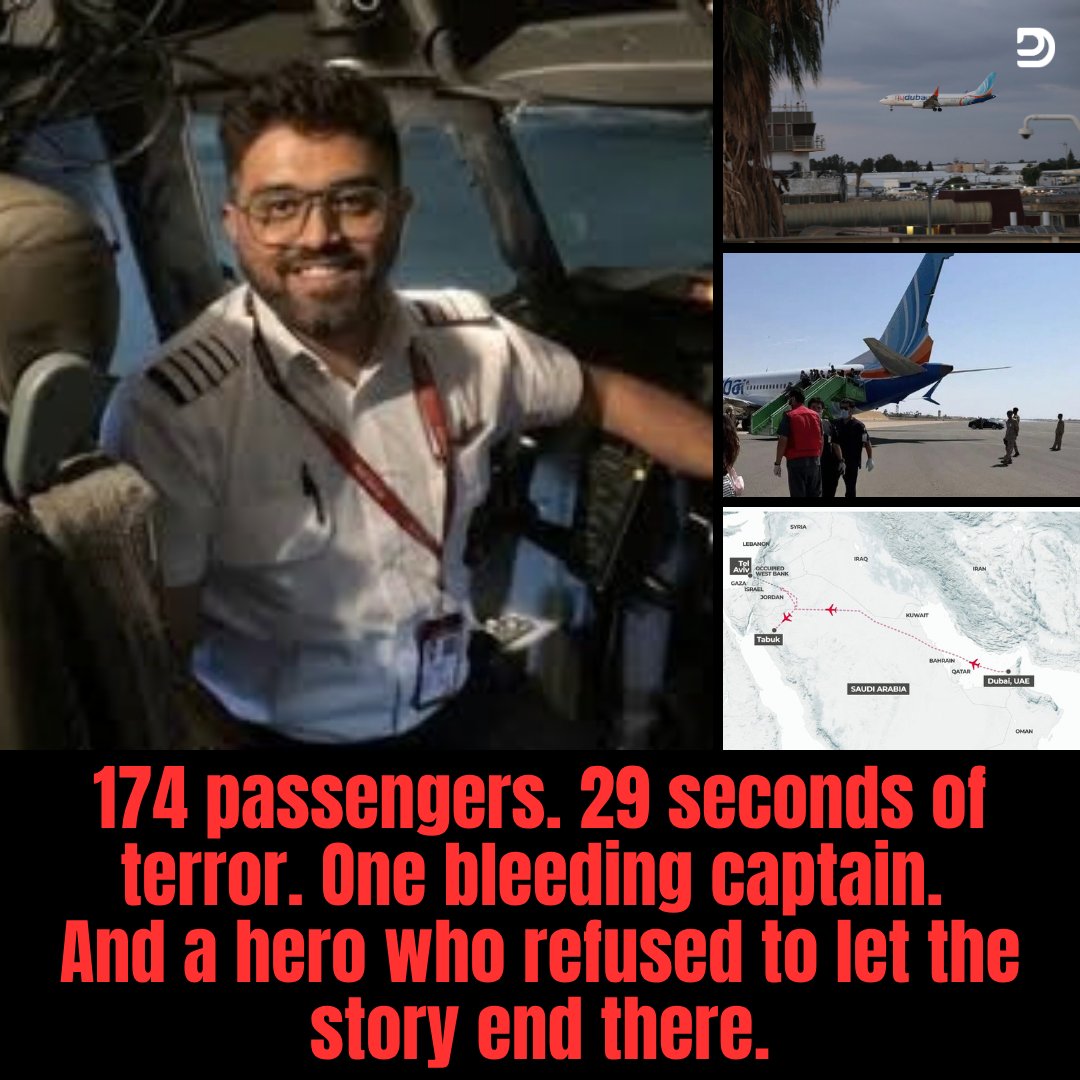
A Flydubai Boeing 737 MAX waited.
Flight FZ1073.
Destination?
Ben Gurion Airport, Israel.
174 passengers.
27 children.
6 crew.
7:05 AM.
FZ1073 lifted off.
Reached 34,000 feet.
For 2 hours, nothing unusual.
A routine Dubai-Tel Aviv flight.
Then something happened.
Inside the locked cockpit:
Captain Smit Machchhar.
From Bharat.
Experienced Boeing 737 pilot.
And his Omani co-pilot.
The Omani joined Flydubai ~8 months back.
A “staunch religious extremist.”
Suddenly, he attacked Machchhar.
Stabbed him with a sharp weapon.
Machchhar bled heavily.
But stayed conscious.
And kept fighting.
He somehow unlocked the cockpit door.
That changed everything.
8:21 AM.
The aircraft turned violent.
Passengers thought it was turbulence.
Then it fell.
30,875 feet to 16,750 feet.
14,125 feet.
In 29 seconds.
The floor vanished.
Stomachs rose.
Hearts froze.
Up disappeared.
Down disappeared.
Only terror remained.
Bodies lifted.
Breath shortened.
The earth felt closer.
Over Saudi Arabia.
Near Jordan.
Then someone screamed:
“Stabbing.”
Everything changed.
This wasn't turbulence.
It was a Terror attack.
Target?
Hit the flight into Tel Aviv.
Then the passengers moved.
Yaniv Hayun ran to the cockpit.
One pilot was down.
The Omani at the controls.
Hayun grabbed the Omani.
Put him in a chokehold.
Dragged him away.
Others joined.
But the Boeing was still falling.
No one in the pilot seat.
Hayun returned.
Grabbed the yoke.
Pulled upward.
The nose came back.
The aircraft stabilised.
Tzvika Manes.
A banking executive.
Helped restrain the attacker.
Airline earphones tied him down.
Dr. Shota Musaev.
Treated Captain Machchhar.
Passengers were now protecting the aircraft.
8:31 AM.
Transponder: 7700.
8:38 AM.
Code: 7500.
Unlawful interference.
Possible hijacking.
Israeli aviation reacted.
F-16 and F-35 scrambled.
An uncontrolled airliner was heading toward Israel.
Then another stroke of luck.
Captain James.
Off-duty.
On board.
He took control.
8:44 AM Saudi time.
Tabuk ATC got the request.
Emergency landing.
The aircraft changed course.
9:45 AM.
The Boeing reached Tabuk.
James brought FZ1073 down.
Wheels touched Saudi soil.
The aircraft stopped.
Everyone survived.
Captain Machchhar was badly wounded.
Taken to hospital.
The Omani co-pilot was hospitalized.
Then taken into custody.
The day created real-life heroes.
God does not arrive as a miracle.
He arrives as courage.
As instinct.
As one wounded pilot.
As one passenger who runs forward.
As strangers who refuse to give up.
Hundreds of lives could have ended there.
They did not.
Not one passenger was lost.
The plane came down.
But hope did not.
And perhaps that was the real miracle.
Almost immediately after India’s Q1 GDP print of 7.8%, the questions began: Where is the growth? Can we trust the number?
My answer: don’t look at one number , look at all of them together.
GDP: 7.8% | GVA: 8.2% | Nominal GDP: 10.3% | Manufacturing: 9.2% | Investment: 11.9% | Household consumption: 7.1% | Exports: 12% | Financial, real estate & IT services: 12.1%
And the momentum hasn’t stopped:
📈 July industrial output: +6.7%, capital goods: +16.1%
📦 April–July exports: +13.16%
💰 August GST collections: ~₹2 lakh crore, +14.8% YoY
🚚 E-way bills: 13.9 crore, +7.7%
🏭 Purchasing Manager Index: 54.1 , 15
Month high
💵 Forex reserves: all-time high of ~$741 billion
How many indicators have to move in the same direction before we accept that India is growing?
This strength isn’t confined to the Centre. In August alone, the Government sent States an extra ₹1.09 lakh crore in tax devolution. The 16th Finance Commission has locked in ₹4.35 lakh crore for our villages and panchayats over the next five years. A stronger Union means stronger States and stronger States mean more reaching our people. That’s who all this is for: WE THE PEOPLE.
And all of this, while the world battled war, oil shocks and inflation. No LPG crisis. No ₹150 petrol. Reserves at a record high instead of collapsing. That’s resilience.
Beneath the headline numbers, something bigger is happening: India is becoming a manufacturing power. Electrical equipment: +27%. Transport equipment: +20%. Capital goods: +15%. Electronics and semiconductors are moving from announcement to implementation.
For decades, India imported what it consumed. Today, the ambition is different: Make in India. Design in India. Innovate in India. Manufacture in India, for the world.
This didn’t happen by accident. It’s the result of years of investment in highways, railways, airports, ports, power, digital infrastructure and manufacturing ecosystems under Hon’ble Prime Minister Shri @narendramodi Ji.
And the world is opening its doors to match that ambition. India has built a growing network of Free Trade Agreements -with Mauritius, the UAE, Australia, the EFTA bloc, and the UK - opening new markets for our exports while pulling in fresh investment and jobs, with more deals, including the EU, in the pipeline.
Question the Government on legitimate issues. Demand employment, jobs. That is democracy. But there is a difference between questioning a government and questioning every single Indian achievement.
GDP rises, question it.
Exports rise , question them
Reserves hit a record, question that too.
Global companies invest, dismiss it.
At some point: what evidence would satisfy you?
Do not tell India’s youth that their country can not win. They have watched it happen in real time, and they will keep watching it for years to come.
There was a time when Indians looked at China’s extraordinary growth and wondered: When will India grow like this?
Today, India is among the world’s fastest-growing major economies.
Why should we not be proud of that?
Question India where India needs to improve. But when India delivers, have the courage to say so.
Jai Hind 🇮🇳
@nsitharaman@PiyushGoyal@GoIStats@blsanthosh
You must have seen her by now.
That little girl from Arunachal.
The video is everywhere.
Tiny face.
Tiny voice.
But a question big enough to embarrass an entire nation.
“Don’t call me Chinese.”
“I am Indian.”
Read that again.
A child.
Barely four.
Standing inside India.
Explaining to Indians… that she is Indian.
What an achievement.
Nearly eight decades of nation-building.
And a child at our eastern frontier still needs to prove her nationality.
Her name is Karga Tinkle Gongo.
She is from Itanagar.
The Northeast often enters our national conversation only when there is...
Insurgency.
Border trouble.
Floods.
Violence.
Or elections.
And today… a four-year-old answered all of us.
So, Beta Tinkle… listen carefully.
You never have to prove that you are Indian.
Not to China.
Not to Delhi.
Not to anyone.
You are Indian.
As Indian as I am.
As Indian as anyone reading this.
Your Arunachal is our Arunachal.
Your mountains are our mountains.
Your flag is our flag.
Your motherland is our motherland.
Your Bharat is our Bharat.
And yes… we love you.
Because look at us.
Adults.
Educated.
Political.
Sophisticated.
And permanently fighting.
Tamil Nadu hates Hindi.
Karnataka debates Hindi.
Maharashtra screams Marathi.
North fights South.
States fight over language.
Communities fight over religion.
Castes fight over reservation.
People fight over surnames.
Regions.
Ideologies.
Even gods.
Everyone desperately proving how different they are.
And somewhere in Itanagar...
a four-year-old is desperately proving something far simpler:
“I AM INDIAN.”
Maybe that is the tragedy.
Children understand belonging.
Adults manufacture divisions.
If 1.4 billion Indians understood what this little girl understands...
half our politicians would become jobless overnight.
Maybe Tinkle doesn't need a lesson in nationalism.
Maybe… we do.
Are you sure Rahul Gandhi, that you want PM Modi to resign????
Are you sure Mallikarjun Kharge, that you want PM Modi to resign????
Are you sure, Arvind Kejriwal that you want PM Modi's resignation???
Because after PM Modi resigns,the BJP will still be the majority party.
And after the resignation of both PM Modi and HM Amit Shah, Yogi Adityanath will be the PM of India !!
If you so desire this, then Evamastu. 🙏🇮🇳
#JustSaying
CERN shut its collider on June 29th.
Four years of darkness.
Official word: maintenance.
The internet went mad anyway.
Some blamed the occult.
Some said beings are being summoned inside.
Some connected it to Purnima.
All wrong.
Let them argue.
The real mystery isn't trending.
By design.
Because some people don't want it discussed.
There's a 2 metre bronze statue in CERN's courtyard.
800 kilos.
Cast in Bharat.
Shipped to Switzerland in 2004.
His name is Nataraja.
You know him as Shiva.
Dancing.
Not gently.
One foot crushing a demon.
A ring of fire around him.
Why does an international science agency keep a Hindu god at its front door?
CERN runs on contributions from 25 nations.
Thousands of scientists.
Thousands of engineers.
Some of the sharpest minds alive,
hunting the building blocks of reality.
And at the center of that campus stands Shiva.
Not in a museum.
Not in a temple.
At the heart of the most advanced machine humans ever built.
Standing.
Nobody there calls it controversial.
Those who don't understand Bharat call it occult.
Those who do, know exactly what they're looking at.
Physicist Fritjof Capra saw it first.
Wrote it down in 1975.
Said CERN's particles perform Shiva's Tandava.
Creation and destruction, on loop, faster than the eye catches.
Rudra doesn't just destroy.
He clears the field for what comes next.
Nataraja's damaru, the drum, beats first sound into being.
His agni, the fire, ends one cycle so another begins.
This is Kalachakra.
The wheel of time.
Not myth.
Particle mechanism.
Under his foot lies a dwarf.
Apasmara.
His name means forgetting.
Ignorance.
Loss of awareness.
Shiva doesn't kill him.
He dances on him.
Pinned, not destroyed.
Ignorance never fully disappears.
It stays underfoot,
held by the rhythm of a god who sees both ends of existence.
That's exactly what's at play at CERN.
Ignorance of the universe, still there.
Kept underfoot, while they chase its secrets.
Then, in 2012, CERN found the Higgs boson.
The particle that gives everything mass.
They called it the God particle.
Existence, born from a field always present, waiting to be disturbed.
Vedic science had a word for that field before Geneva had a tunnel.
Prakriti.
The substrate beneath all form.
Bharat wrote this in verse.
The West needed a 27 km machine and 60 years to catch up.
Now the punchline.
Put Nataraja on a campus in Geneva, it's science, heritage, poetry.
Put the same statue on an Indian university lawn, watch the noise start.
Suddenly it's religious.
Suddenly it's unconstitutional.
Suddenly someone's shouting fascism.
Ask yourself who's actually afraid of Bharat's own knowledge.
A nation that forgets its Vedic science isn't secular.
It's just empty.
Democracy needs a civilization under it,
not a vacuum born in 1947.
Next time someone calls you a fascist for knowing your own gods, look closely at who's speaking.
You'll surely be seeing a fascist, or an Apasmara.
When Maharaja Chhatrasal was around 80 years old and surrounded by the Mughal forces, with little hope left from other rulers, he turned to the one man he believed could save Bundelkhand Peshwa Bajirao I.
According to a popular tradition, Chhatrasal sent Bajirao the famous couplet:
“The plight of Bundela today is like that of Gajendra caught in the jaws of the crocodile. Bajirao, the fate of Bundelkhand now rests in your hands—protect our honor.”
The message moved Bajirao deeply. It is often said that he immediately rose from his meal. When his wife asked him to finish eating first, Bajirao is believed to have replied:
“If I am late, history will say that a Kshatriya cried out for help while a Brahmin continued eating.”
Without delay, Bajirao marched toward Bundelkhand with extraordinary speed. Tradition holds that he covered a journey of nearly ten days in just 48 hours with a small cavalry force of about 500 horsemen, riding relentlessly to reach Chhatrasal before it was too late.
Bajirao’s swift campaign forced the Mughal commander Muhammad Khan Bangash to retreat and lifted the siege of Bundelkhand. Overwhelmed with gratitude, Chhatrasal is traditionally credited with saying:
“The world has seen only two great Brahmin warriors Parashurama and Bajirao. One humbled arrogant Kshatriyas, the other humbled the Turks.”
Bajirao Peshwa was one of India’s greatest military commanders, remaining undefeated in every major battle he fought. Instead of celebrating fictional cinematic heroes, we should introduce our children to the lives of real warriors like Bajirao, whose courage, leadership, and sense of duty shaped the course of Indian history.
The 'Secularism' Fraud
For the last 75 years, this country has been systematically fooled in the name of "Secularism."
The concept of secularism originated in 16th- and 17th-century Europe amid violent conflicts between Catholics and Protestants. To prevent the persecution of Catholics in Protestant states and vice versa, it was agreed that the state would remain neutral and not target religious minorities.
Thus, secularism was originally intended to protect minorities without undermining the majority faith. In India, however, the state weaponised it to annihilate its own Hindu religion, culture, and civilisation.
A second wave of secularism emerged in the 19th century, coined by George Jacob Holyoake. At that time, it meant promoting reason and rationality in societies dominated by unscientific, orthodox Christianity. Yet we Indians blindly adopted this Western framework as it is even though our own civilisation and religion were already deeply rooted in scientific temper and inquiry.
In fact, Nehru effectively sold Sharia in the name of secularism.
True secularism would mean declaring India a Hindu Rashtra while enacting strict, enforceable laws to protect the rights and safety of minorities.
Is there not a single intellectual in India who can see this simple truth?
At the very least, we must begin an honest national debate on it.
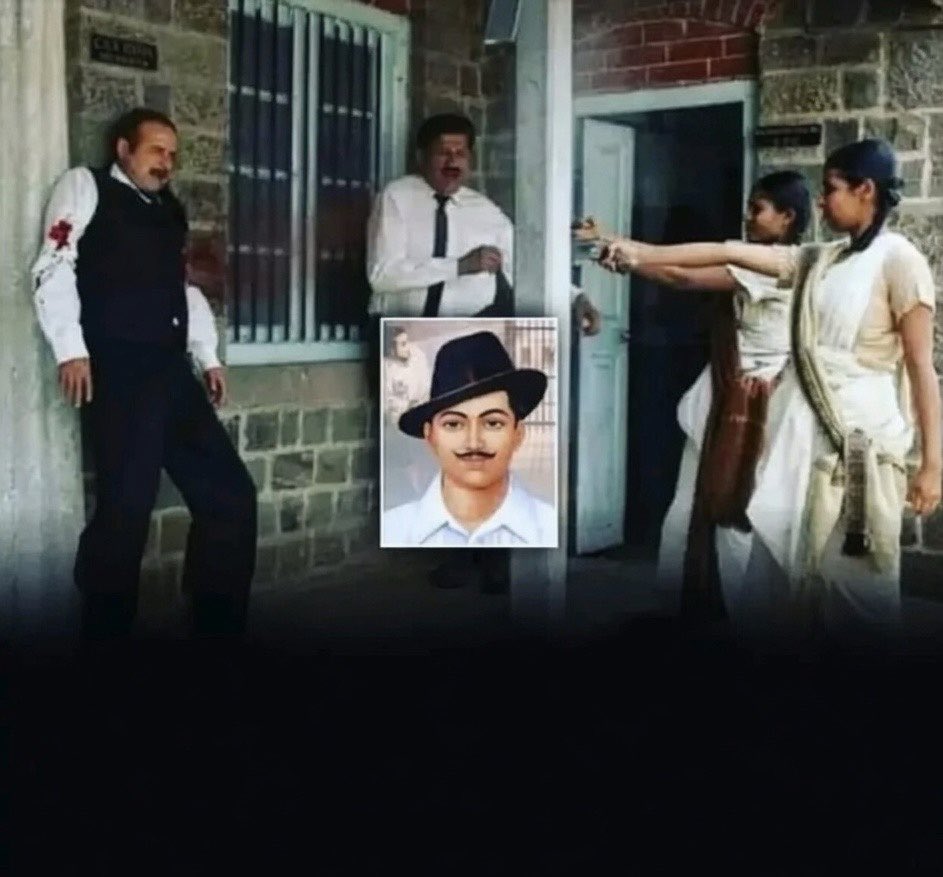
To avenge the execution of Bhagat Singh, two revolutionary schoolgirls, Shanti Ghosh and Suniti Chowdhury, entered a government office in December 1931 and assassinated the District Magistrate. Remarkably, both girls were only 14 years old at the time. Their courage and sacrifice deserve to be remembered and honored.
25-30 साल पहले जब हम रविवार को सुबह 9 बजे महाभारत देखने का इंतज़ार करते थे।
तब इस धारावाहिक का शीर्षक गीत -- असम में जन्मी 9 वर्षीय बच्ची अनुष्का तरंगिनी ने गाया था।
उस मधुर आवाज़ को सुनकर आज भी हमें कितना सुखद एहसास होता है! 😍
संगीत ही जीवन का सार है! 🙏
History of India
11 September 1857.
A 13-year-old girl was tied to a tree in Bithoor and burned alive by the British Army. As the flames consumed her body, she did not utter a single word. She embraced martyrdom in silence.
Her name was Maina Kumari, the adopted daughter of Nana Sahib Peshwa.
During the First War of Independence in 1857, Nana Sahib was one of the most wanted leaders of the rebellion. Knowing that her presence could become a burden for her father in the struggle against British rule, Maina chose to remain behind in the Bithoor palace.
When the British learned that Nana Sahib had left, they surrounded the palace. Inside were only Maina Kumari and a handful of loyal soldiers. To flush out any resistance, British officer James Outram ordered the palace to be shelled and destroyed.
Believing everyone had departed, Maina emerged from her hiding place later that night. She was immediately captured and brought before Outram.
He demanded information about Nana Sahib and the revolutionary movement. Maina refused to speak.
Threats, intimidation, and torture could not break her resolve. Even when warned that she would be burned alive, the young girl replied that she was the daughter of a revolutionary and feared neither pain nor death.
Enraged by her defiance, Outram ordered her execution.
Bound to a tree and engulfed in flames, Maina Kumari chose martyrdom over betrayal. At just 13 years of age, she protected the secrets of the revolution with her life.
The story of India’s freedom is not written only in political negotiations and speeches. It is also written in the sacrifices of countless revolutionaries, warriors, and brave young girls like Maina Kumari, whose courage deserves to be remembered by every generation.
Remember Maina Kumari.
A child in age, but a patriot in spirit.