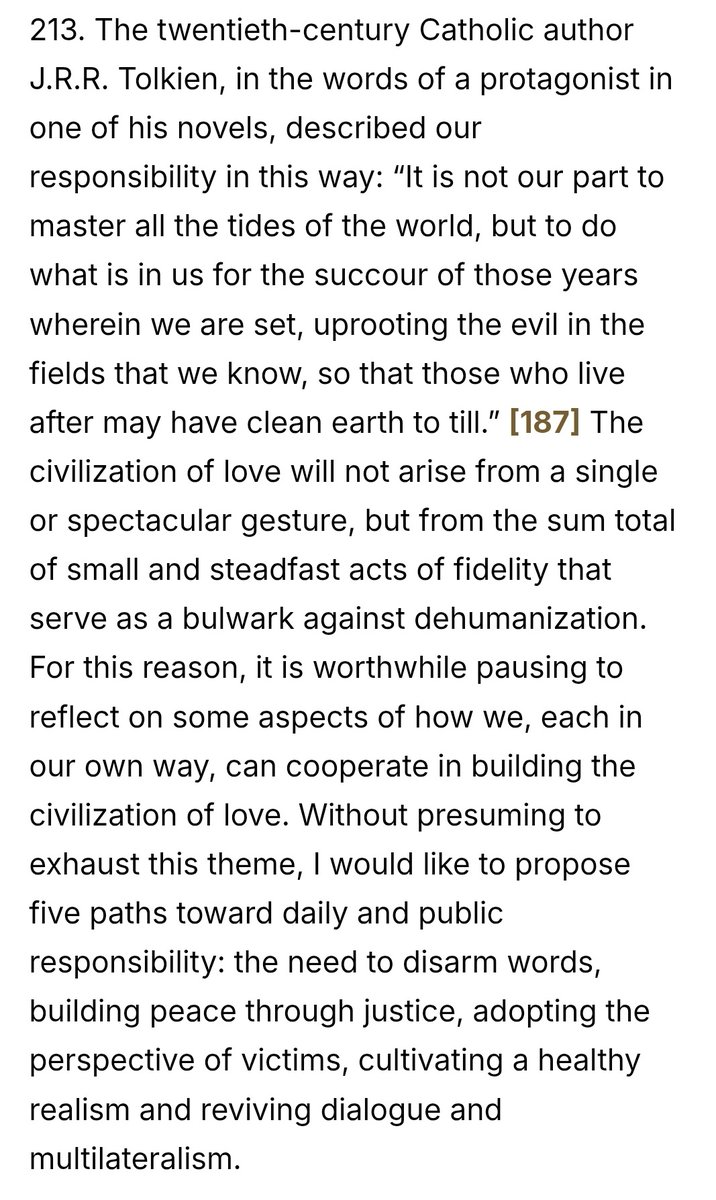
@mrremoraman I, myself, have a PhD in 20th & 21st Century American literature, and my Master's coursework emphasized, inter alia, 20th Century literature.
And I vastly prefer Tolkien to most. Even though I dearly love Pynchon, Cather, Kesey, Woolf, etc.
“If in days to come you remember the words of Melian, it will be for your good: fear both the heat and the cold of your heart, and strive for patience, if you can.”
- Melian to Túrin (Tolkien, The Children of Húrin)
@lymanstoneky Let's also not forget that they can elect to take portions of their retirement as disability, which forever secures that from ever being equitably divided in a property division or as alimony or child support.
If we confuse generative AI’s ability to produce text with consciousness, we risk assigning moral responsibility to chatbots—and not to their makers, Ted Chiang argues. https://t.co/Cptx3aWppI
Artificial intelligences do not undergo experiences, do not possess a body, do not feel joy or pain, do not mature through relationships, and do not know from within what love, work, friendship or responsibility mean. Nor do they have a moral conscience, since they do not judge good and evil, grasp the ultimate meaning of situations, or bear responsibility for consequences. They may imitate or even simulate, but they do not understand what they produce, for they lack the affective, relational, and spiritual perspective through which human beings grow in wisdom. #MagnificaHumanitas
“So-called artificial intelligences do not undergo experiences, do not possess a body, do not feel joy or pain, do not mature through relationships and do not know from within what love, work, friendship or responsibility mean. Nor do they have a moral conscience, since they do not judge good and evil, grasp the ultimate meaning of situations, or bear responsibility for consequences. They may imitate language, behavior and analytical skills, or even simulate empathy and understanding, but they do not understand what they produce, for they lack the affective, relational and spiritual perspective through which human beings grow in wisdom. Even when these tools are described as capable of ‘learning,’ their way of doing so is different from that of a human person. It is not the experience of those who allow themselves to be shaped by life and grow over time through choices, mistakes, forgiveness and fidelity. Rather, it is a form of statistical adaptation based on data and feedback, which can be very effective, but does not imply inner growth.”
—Pope Leo XIV, Magnifica Humanitas
Humanity, created by God in all its grandeur, is today facing a pivotal choice: either to construct a new Tower of Babel or to build the city in which God and humanity dwell together. In Jesus Christ, this humanity in its grandeur becomes the Way, the Truth and the Life, opening the path for each of us to grow toward fullness. #MagnificaHumanitas
https://t.co/6i9MWs6LJl
In the era of #ArtificialIntelligence, when human dignity is threatened by new forms of dehumanization, ours is the pressing duty to remain profoundly human. We must lovingly safeguard the grandeur of humanity bestowed upon us and revealed in its fullness in Christ, the splendor of which no machine can ever replace. #MagnificaHumanitas
https://t.co/6i9MWs6LJl
We must, then, avoid the “Babel syndrome,” namely the idolatry of profit that sacrifices the weak, a uniformity that neutralizes differences, and the pretense that a single language — even a digital one — can translate everything, including the mystery of the person, into data and performance. This is the risk of dehumanization: building a future that excludes God and reduces the other to a means.
JUST IN: Vatican releases Pope Leo XIV’s first encyclical, Magnifica Humanitas, on safeguarding the human person in the time of AI. https://t.co/6Zn5OMJvdn
On Transhumanism and Posthumanism, Pope Leo XIV writes:
“If the human being is treated as something to be perfected or surpassed, it becomes easier to accept that some lives are less useful, less desirable or less worthy. In the name of progress, ‘necessary sacrifices’ may begin to be justified, placing the burden on the most vulnerable in pursuit of a supposed optimization of the species. … For this reason, a clear distinction must be made. It is one thing to integrate technology within a human-centered, relational vision; it is quite another to be guided by an outlook that devalues human limits and promises a purely technical form of ‘salvation.’”
Read the encyclical here: https://t.co/6Zn5OMJvdn
A.I. has a place: to do slavish work. We have invented many things to do such work for us (e.g. washers, power tools, etc). Overall, the existence of these things is good. They give us more time for higher things. But thinking AI can or should replace human *thought* will end us.
As evidenced by the unbridled promotion and implementation of technology at the expense of human dignity, we are truly experiencing an eclipse of the sense of what it means to be human. It is imperative to recover an understanding of the true meaning and grandeur of humanity as intended by God. It is in this sense that the challenge we currently face is not technological, but anthropological, and it is my hope that the Encyclical Letter to be published within a few days will contribute to answering this challenge.
Baron Wenckheim's Homecoming (Krasznahorkai)
The Will to Battle (Palmer)
The Wizard Knight (Wolfe)
The Coffin of Honey (Morrison)
Ashbery, assorted poems
The Corrections (Franzen)
A Table for Fortune (hopefully) (Vollman)
The Maximus Poems (Olson)
Maybe Middlemarch or Moby Dick