Ok, here’s my honest take.
Every piece snapping into place like clockwork.
China has spent years dodging Western oil sanctions by quietly sourcing from Venezuela and Iran, keeping its economy insulated from USD pressure. Trump’s non-negotiable mission is to obliterate BRICS, bury de dollarization for good, and reinstall the USD as the unchallenged global reserve currency for the next century. To refinance America’s towering debt load he needs interest rates driven into the ground. To steamroll the 2026 midterms he needs stock markets in full blown euphoria. The cleanest, fastest way to deliver both at once?
Precision geopolitical conflict that spikes energy prices, supercharges defence and industrial stocks, floods the system with liquidity, and forces every player back onto America’s chessboard.
Connect the dots because they’re not random:
- The US moves decisively on Venezuela, securing its enormous oil reserves, lithium, gold, and rare earth minerals.
- Canada now fully aligned and openly supporting the US steps up with comprehensive diplomatic cover, logistical bases, intelligence sharing, and even limited expeditionary support. Ottawa’s move instantly locks down the entire Western Hemisphere energy corridor, creates a seamless North American fortress, and sends an unmistakable signal to every ally and adversary: “The West is unified, and America is back in charge.” China’s first major lifeline is severed overnight.
- Beijing, panicked, doubles down on its Iranian supplies.
- Then, literally last night, Trump green-lights “Operation Epic Fury” devastating precision strikes (with Israeli support) that target the Iranian regime’s command centers, nuclear sites, and oil infrastructure while broadcasting direct calls for the Iranian people to rise up. China’s second critical lifeline is gone in hours.
That leaves only Russia.
But here’s the masterstroke that’s still flying under the radar…Russia and the US I think are already in back channel talks for a historic deal on energy, trade, and security that brings Russian oil and gas flooding into Western markets. Canada’s rock solid alignment gives Trump the perfect geopolitical bridge…a bulletproof North American energy bloc plus Russian resources creating an unbreakable alliance that completely isolates China.
BRICS is dead in one decisive stroke.
Once China is totally cut off it has zero leverage left. Beijing will be forced to come crawling back to the United States for everything…oil, minerals, technology, and market access. Trump’s response? “Hold our debt.”
America sets the terms.
China is handed massive tranches of US debt at favorable rates, the dollar undergoes a controlled, orderly reset, and the entire global financial system realigns under Washington’s leadership. Central banks worldwide have been stockpiling physical gold for exactly this moment as the ultimate backstop and hedge against the transition.
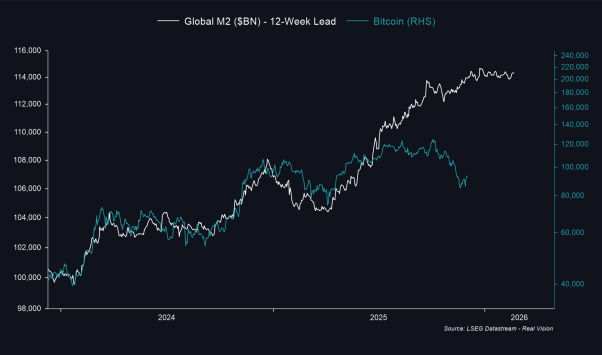
And here’s what happens to Bitcoin in the next phase because crypto is the missing piece that turns this from dominance into total supremacy:
As the conflict premium hits energy markets and defense budgets explode, liquidity floods risk assets.
Bitcoin, already positioned as digital gold and the ultimate inflation hedge, breaks out violently first surging past $200k on pure market momentum and institutional FOMO.
Then, once the Russia deal is signed and the dollar reset is underway, Trump drops the bombshell…an executive order establishing a strategic US Bitcoin Reserve. Using seized Venezuelan assets and windfall revenues from the new energy alliance, America becomes the world’s largest sovereign Bitcoin holder overnight. This single move does three things at once:
1. It legitimizes Bitcoin under American control, pulling it away from Chinese mining dominance forever;
2. It gives retail and institutional investors the green light to pile in without regulatory fear;
3. It supercharges the market rally needed for midterm victories.
Everyone thinks the crypto selloff is crypto-native. The real story is a TradFi entity running a multi-leg carry trade that unwound.
Follow the funding chain. A HK entity borrows yen at 0.75% (the BOJ’s highest rate in 30 years, up from near-zero). Uses that cheap leverage to build a multi-leg position across IBIT options, Binance crypto, and precious metals. Three asset classes, one funding currency, zero margin for error.
Oct 10 was the first crack: $19.16B in crypto liquidations, the largest single-day wipeout ever. Prime broker gives them 90 days to recover. So they double down on precious metals, which had been ripping. Gold and silver were up 65% and 145% respectively in 2025. Looked like a reasonable recovery bet.
Then Kevin Warsh gets nominated as Fed Chair on Jan 29. Markets read that as hawkish dollar policy. Gold drops 11%. Silver drops 31% in its worst day since 1980. The recovery trade is now a second hole in the balance sheet.
Feb 5 was the margin call heard across three asset classes simultaneously. IBIT traded $10B in volume (284 million shares, shattering its prior record). Put options hit 25 volatility points above calls, the highest skew ever recorded. Silver plunged another 20% to below $71 before bouncing. Bitcoin fell from $73,100 to $62,400 intraday, its first time below $70K in 15 months.
Here’s what most people are missing. Nasdaq removed position limits on IBIT options in January 2026. That regulatory change allowed exactly this kind of concentrated leveraged exposure to build up in a single ETF. One entity could now take a position large enough to move the entire market on unwind.
The 13F filings drop Feb 14. That’s when we’ll see which single-asset funds based in Hong Kong were holding outsized IBIT positions. But the story isn’t who. The story is the plumbing.
Cheap yen funded the trade. IBIT options concentrated the risk. Precious metals were supposed to be the hedge. When all three legs failed in sequence, the forced selling cascaded across crypto, metals, and options simultaneously. Michael Burry called this a “collateral death spiral” earlier this week, where falling crypto collateral forces liquidation of metals positions, which triggers more margin calls, which forces more crypto selling.
This is what happens when carry trade leverage meets concentrated ETF options meets thin commodity liquidity. Three separate markets, one funding source, and when the music stops, they all sell at once.
The crypto market crashed because a currency trade went wrong on the other side of the Pacific, and the new ETF options infrastructure made it possible to concentrate that bet at a scale that could move $10B in a single session.
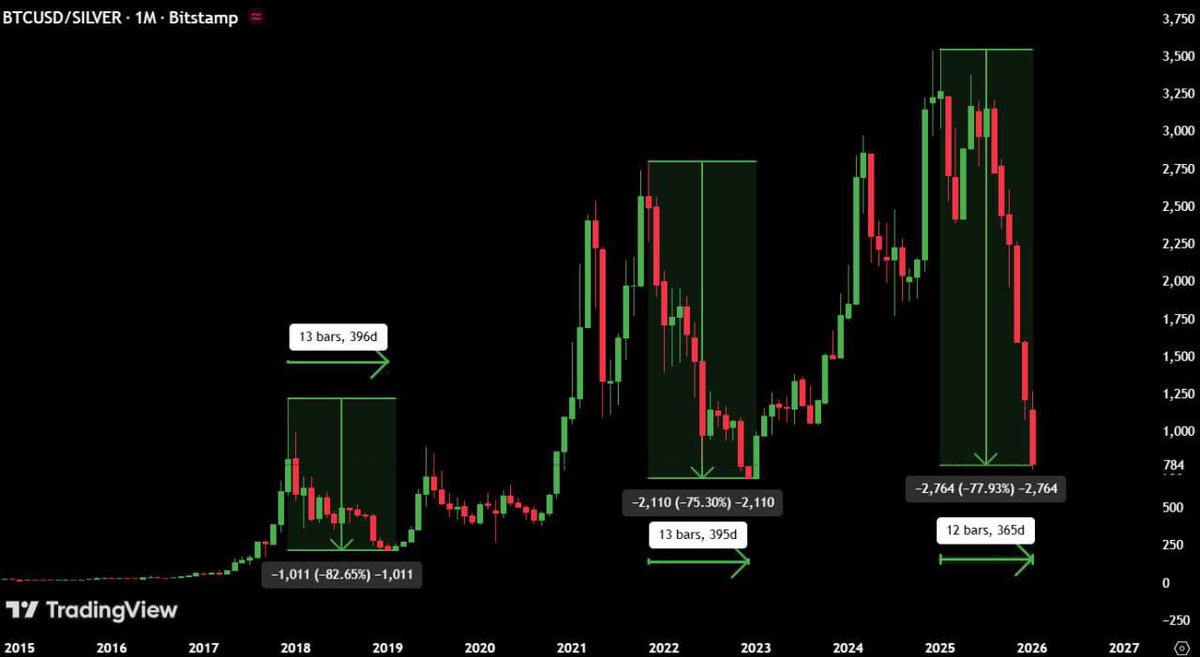
BTC/Silver historically bottoms 13 months after its peak with a 75%-85% dump.
We are now in 12th month with a 78% crash.
Money rotation from silver to Bitcoin will be absolutely INSANE.
If you were ever jealous of people buying crypto on the cheap, and able to hold them through the cycles, think about what they did in moments like this.
Here is how the liquidity arrives:
•TGA drawdowns: ~$700B
•End of QT: ~$500B
•Repo & reserve interventions: ~$250B
•Stablecoins: $500B–$1T (velocity-adjusted)
•Fiscal expansion: ~$1.5T
•Regulatory reform (eSLR): Up to $3–5T effective liquidity
•Dollar weakness / rising global M2: $1–2T+
Not a forecast—a mathematical necessity.
#macro #bitcoin #crypto #liquidity
I wanted to give everyone something meaningful, a gift…
This comes from Global Macro Investor (GMI) and a deep, long-running body of research developed by @RaoulGMI and myself.
Many of you already know The Everything Code, which is our framework for understanding the macro landscape and why major central banks are debasing their currencies to manage aging demographics and overwhelming debt loads.
I call this a gift because these four charts, while only scratching the surface of The Everything Code, give you the big-picture context you actually need in moments like this.
They stop you from getting lost in every Bitcoin pullback and explain why Raoul and I never panic, even when, to borrow one of his expressions, everyone’s acting like monkeys throwing poo at each other.
Once you understand The Everything Code, you stop trading short-term noise and expand your time horizon. You cannot unsee it.
The starting point is what we call The Magic Formula:
GDP growth = population growth + productivity growth + debt growth.
Population growth and productivity growth have been falling for decades. Debt growth is the only thing filling the gap.
The private sector has been deleveraging since 2008, mainly households, but debt levels are still around 120% of GDP. The public sector sits at roughly the same level.
Here’s the problem…
If the government is running debt at 100% of GDP and the private sector is sitting on another 100%, and for simple math we call rates 2% even though they are really closer to 4%, then the entire 2% trend growth of the economy is being consumed by servicing private-sector debts. That is a completely unproductive use of GDP. And then there’s the issue of public-sector debts. There’s just not enough organic growth to service the existing debt load.
To understand why this dynamic persists, you need demographics.
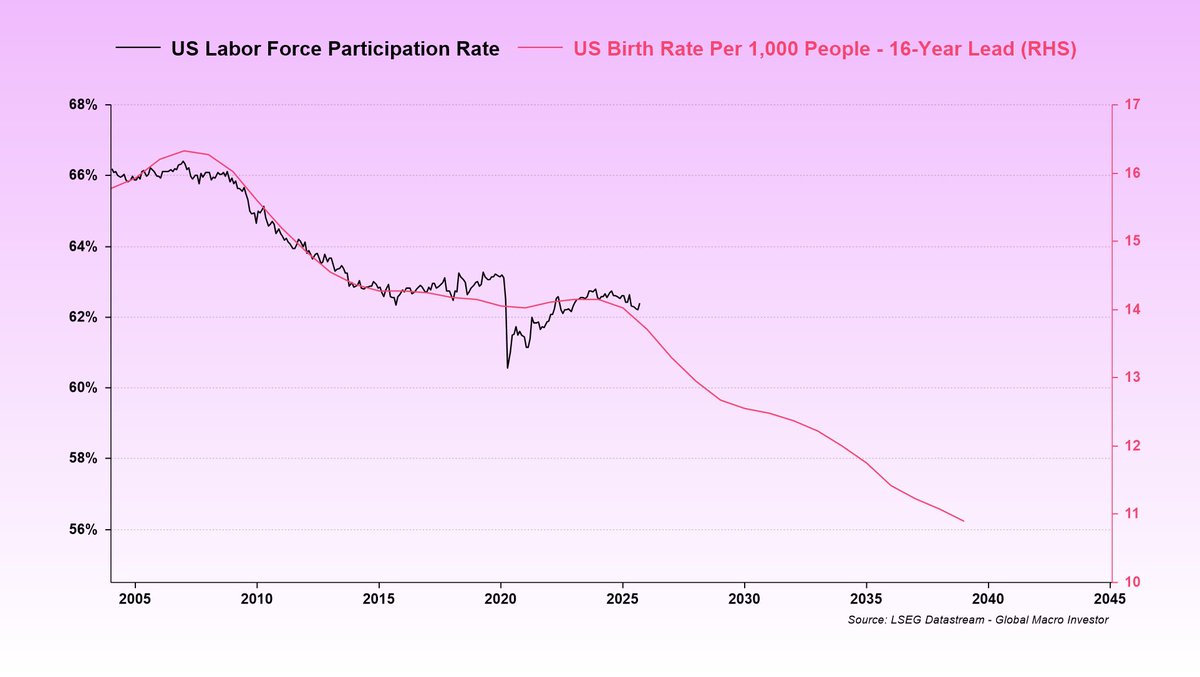
Birth rates peaked in the late 1950s and have been declining ever since. This shows up about sixteen years later in the labor force participation rate as each generation enters the workforce (chart 1).
That means the labor force participation rate is not going to rise any time soon. It is set to keep drifting lower. This is a structural problem.
Aging populations, falling birth rates, and rapidly expanding automation make the backdrop even more deflationary. AI and robotics are replacing humans at scale, and we are only at the beginning. This reinforces the need for ongoing stimulus to keep the system functioning.
With weak population growth and sluggish productivity, the only way to keep GDP expanding is through debt.
Now here’s where it gets interesting…
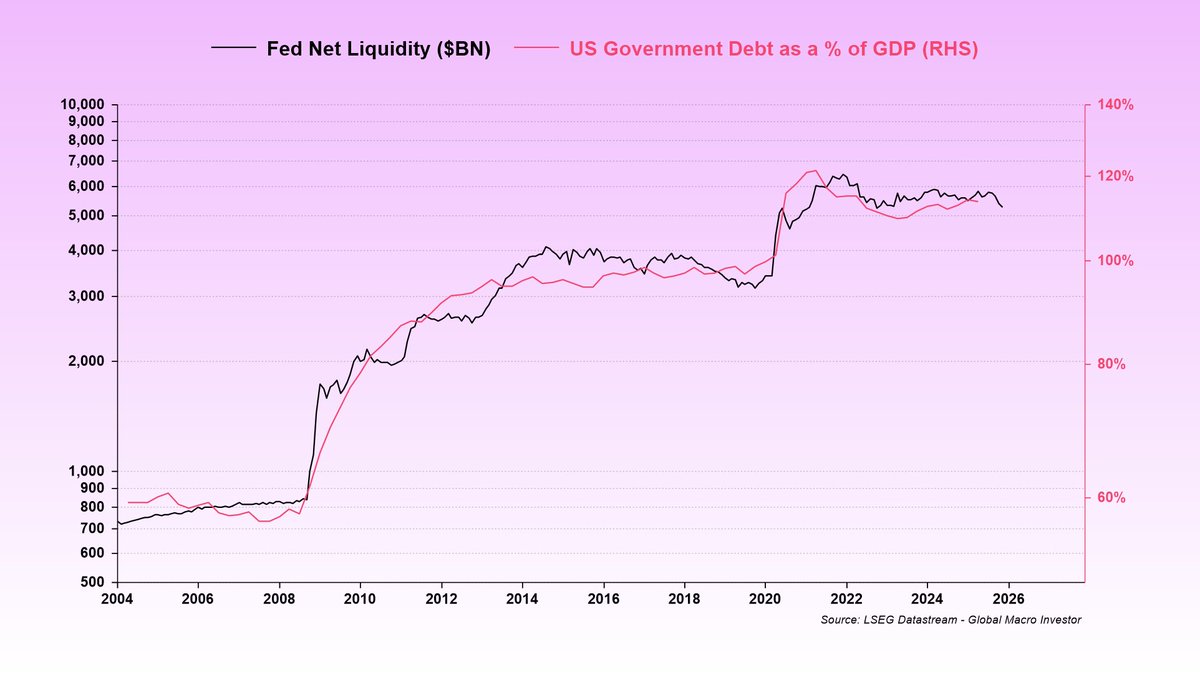
Government debt growth is completely offsetting the demographic decline and policymakers know exactly what they are doing (chart 2).
And what happens next?
All debt growth in excess of GDP gets monetized (chart 3).
Basically, since 2008, magic money has effectively been paying the interest. Governments issue new debt to cover old interest, and once rates fall enough, central banks absorb it onto their balance sheets.
So to wrap this up, demographics drive the decline in the labor force. Governments offset that decline with more debt. That debt eventually gets monetized through quantitative easing (QE) style operations, not always directly by the Fed, but through the coordinated ecosystem of the Fed, the Treasury, and the banking system. And the bottom line is that there’s still a massive wall of interest that needs to be monetized, far more than GDP can ever cover. Liquidity is literally the only game in town.
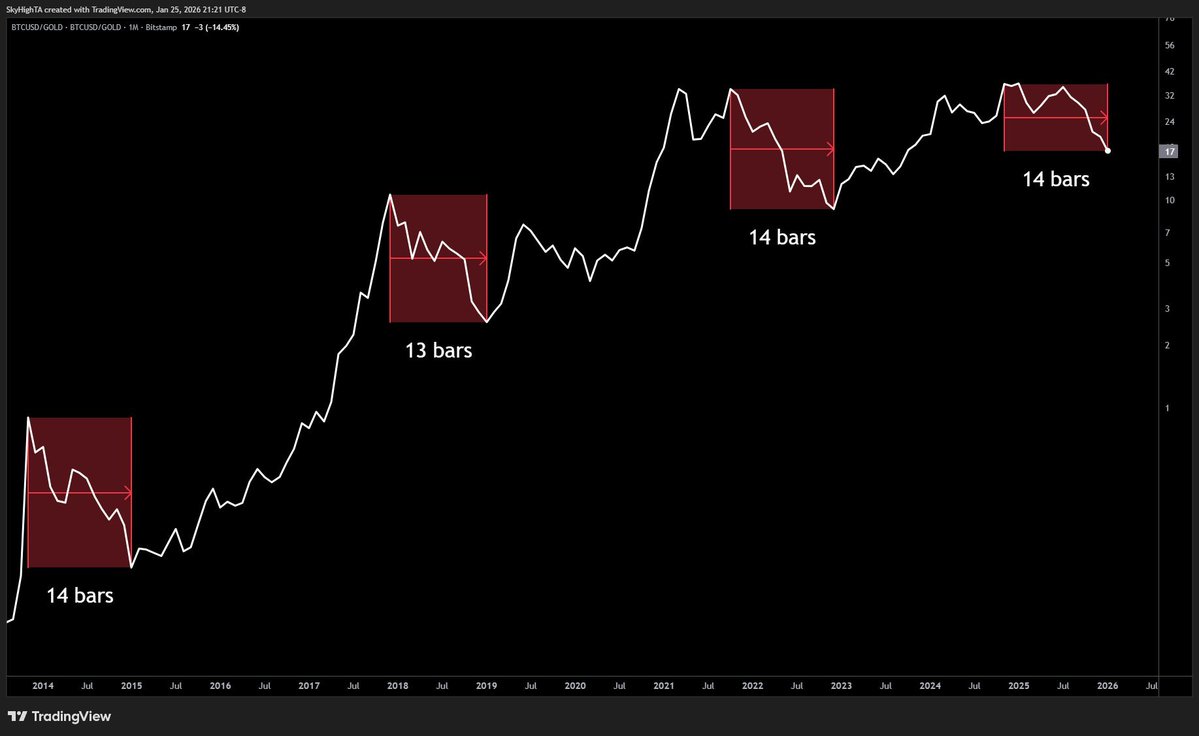
And what thrives in a world of perpetual debasement? Bitcoin (chart 4).
I know this correction has been painful, but it’s all part of the journey. These periods feel brutal in the moment, then they fade and the trend resumes. This too shall pass…
To quote Walter White from Breaking Bad, later echoed by @LynAldenContact, nothing stops this train.
MOAR COWBELL (liquidity) = number go up over time. Zoom out and be more bullish…
@RaoulGMI I’m sorry you have to take so many arrows online. Just know, however quiet the voices may be, you are changing countless life’s and unfucking many futures.
It doesn’t go unnoticed that you could just fuck off to travel the world with your gf and friends and leave us all in the dust.
The direction and path feel impeccable.