South Africa’s proposed digital ID system is being presented as voluntary and convenient.
But at @LexLibertasOnX, we believe citizens should be very concerned. Even though it is called voluntary today, systems like these tend to become compulsory in practice.
Once banks, employers, and government departments start requiring the digital version, your physical ID card becomes second-class. What starts as optional can quickly become mandatory.
This system also creates a central record of where you go and what you access — powerful surveillance infrastructure in the hands of a government that has repeatedly shown admiration for highly centralised authoritarian models.
That’s why Lex Libertas has made an official submission to the Department of Home Affairs.
We need to show, however, that our concern is not a lone voice. If you are concerned about government overreach and the steady erosion of freedom and privacy, we need you to act with us.
Register your support, and add your voice to this campaign. The more people who take a stance, the harder it is for them to ignore us. Register your support at the link in the comments.
@Pat_Stedman I agree, it's the entitled attitude that is the actual problem. Maybe that's more of a society issue? Degrees don't automatically mean entitled jerk, I think those people tend to start out with that attitude and titles/credentials just enhance it.
@LastCupKidd@Pat_Stedman I don't disagree that men would prefer a pleasant and feminine women as a partner. Perhaps this is more region specific. Here in SA I would say it is more of the exception for a highly educated women to be arrogant and unpleasant.
@RiseAgainstEvil A few weeks ago I drove through Durban city instead of taking the N2 to save time, what a mistake. Apart from the heartbreaking decay I felt very afraid and was just glad to have gotten out unscathed. Avoid the city at all costs.
Air Rhodesia Flight 825 was on its final leg of the journey to Salisbury, Rhodesia when it was shot down by ZIPRA terrorists supplied with a soviet Strela-2 surface-to-air missile.
38 of the 52 civilian passengers died in the emergency landing; but the worst atrocity was committed when the terrorists found the wreckage and rounded 10 more survivors up and massacred them with automatic gunfire, including four women and two girls aged 11 and 4.
A few survived the initial burst of rifle fire and were bayoneted, including a mother and her 3-week-old baby.
Despite this horrific act of savagery, the global media largely refused to report on the attack, and many of you reading this now are learning about it for the first time.
Why?
Because Rhodesia was the canary in the coal mine.
They were a warning to the rest of Christendom, that what happened to them will happen to us.
A warning of what's to come if we don't reject communism and return to our Christian roots.
That's why we refuse to let the history of Rhodesia die.
It's more than just T-shirts that tell a story.
It's about the legacy of Christendom itself.
For us, we wear that legacy on our chest.
Only a few Rhodesia in the Sun shirts left, before they're gone for good. Snag yours at https://t.co/wlnxBoamvL 🏴
To effectively dismantle the MyMzansi Digital ID concept, mass non-compliance, similar to how we resisted E-tolls, is our best course of action.
Starting a petition could help, but given the government's arrogance and belligerence, they would likely dismiss such a passive form of protest.
The British have already made it clear they won't comply, and considering their typically compliant nature, this is a significant stand.
South Africans have a strong tradition of resisting unjust initiatives. Many rejected the COVID vaccines, stood against E-tolls, and we continue to see a decline in tax compliance.
We shouldn't assume the government's incompetence will automatically prevent the digital ID from being rolled out. As I've pointed out before, the Democratic Alliance and the African National Congress are two sides of the same coin. One is deeply corrupt, dysfunctional, and ineffective, while the other, though less corrupt, is infinitely more competent.
#DigitalID
#ResistDigitalID
The video of Iryna Zarutska is one of the saddest things I've ever seen.
The poor girl didn't know what happened until it was too late. One of the last things she saw was that of her murderer standing over her. Then she only had a few seconds to discover what had happened. She saw the wounds in her neck and the blood flowing from it. She covered her face, began crying and then lost consciousness. I don't even think she had time to process the pain.
Meanwhile the nearby passengers saw what had happened and pretended not to know.
This is what the death penalty is for. But more than that, she is a victim of a justice system that has failed society. Not just in America, in the Western world in general.
If the West falls, it's not because of external forces. May the Western world rediscover its spine.
I have never seen a country treat its farmers with such contempt.
It allows them to be murdered, it offers very little support, it threatens to expropriate land and dismisses every question/protest with contempt.
Yet they still farm and we should be eternally grateful to them.
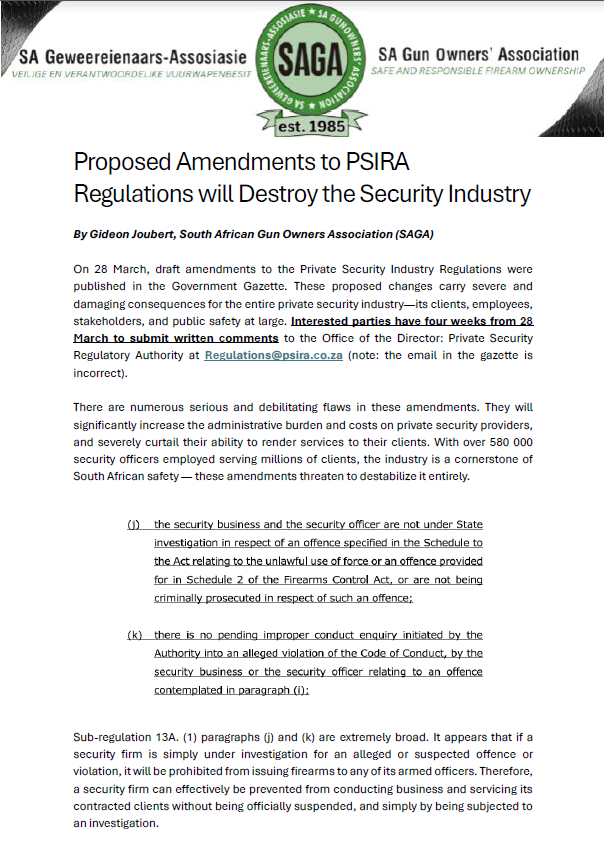
🚨 URGENT: Proposed PSIRA Amendments Will Cripple South Africa's Security Industry 🚨
On 28 March, sweeping regulatory amendments were quietly slipped into the Government Gazette—amendments that, if passed, will decimate South Africa’s private security sector.
With over 580,000 security officers serving millions of clients and plugging gaps left by a failing SAPS, the industry is a cornerstone of national safety. And yet, these PSIRA proposals threaten to:
❌ Ban armed guards from working if their company is merely under investigation—not convicted, just accused.
❌ Restrict firearm use in public spaces like malls, churches, and even homes.
❌ Impose undefined limits on ammunition (what's a "reasonable quantity"?)
❌ Mandate annual psych tests with no clarity on standards—employer-funded, of course.
❌ Outlaw vital tools like rubber bullets, water cannons, and even Tasers (yes, really).
❌ Demand impossible-to-meet tech like firearm tracking devices that don’t even exist.
❌ Clamp down on semi-auto rifles—crippling high-risk units and mine security.
This is bureaucratic overreach masquerading as reform. Instead of targeting rogue firms and fake contractors exploiting PSIRA and SAPS inefficiencies, the proposals kneecap legitimate companies trying to keep South Africans safe.
💥 Bottom line? These regs are a regulatory scorched-earth policy. If enacted, expect widespread job losses, collapsed security firms, and a vacuum in public safety that criminals will rush to fill.
🗣️ We cannot allow this. There’s still time.
🛑 Comments close: 25 April 2025
📧 Email objections to: [email protected]
Let’s flood that inbox. This isn’t just about regulation. It’s about national security.
@WineRiaan@LibertarianZA Perhaps it wouldn't if we weren't in such a precarious situation already, but loss of US support will only hasten the ongoing decline.
@ContraryMar_i@uMarhobane Thanks, that makes sense! Hopefully, those involved in these initiatives will gain an understanding of the issues you've highlighted and proceed accordingly.
A lot of people are quibbling over the Expropriation Act and what it may mean.
But the situation is way worse, because it is not a standalone piece of legislation.
The worst of these is the Land Courts Act, which has been passed and signed but not yet promulgated.
At present, the Expropriation Act allows a large number of state entities (including the Land Affairs Ministry, run by the PAC) to seize land before a trial, and to calculate the value of the land against the value of any development the state intends to perform on that land.
Other criteria for expropriation include if the property "is being used for speculation purposes" - this is hard to define, and leaves a lot of leeway for the state to confiscate any property not directly owned by its residents.
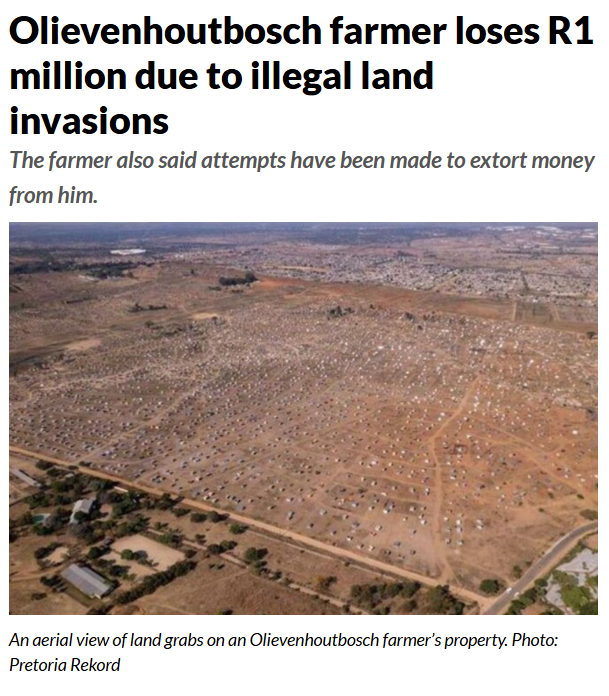
A most concerning one is if the land is "unused" or "abandoned". This can include land which has been seized by squatters.
The Ramaphosa administration has also passed an Act which prevents anyone from removing squatters or preventing entrance into their property by any means except a verbal warning, and forces them to resort exclusively to the police (who seldom respond in any reasonable time) to defend their property.
If the squatter sets up any form of structure (this can be as little as an outhouse-sized tin shack and a folding chair), they cannot be removed except by court order.
The court can, and has in many instances, ruled that the occupiers have a right to remain until alternative housing has been provided by the state or the property owners, and in some cases, has expropriated property in order to transfer the land to the state or the residents for the purpose of township upgrades - free housing, water and electricity reticulation.
These strict squatters rights laws are defended by the PIE and ESTA Acts. And in the past, these expropriations had to be compensated. Now they don't.
This is very similar to the methods used by Robert Mugabe to seize farms - they were simply seized, and transferred after the fact.
In many cases in South Africa, these land grabs include building hijackings, and on open land, ANC and EFF branch members and organised crime plotting out swathes of land which they then extract rent from.
This is widespread, and lucrative.
But so far, we have had the courts to resort to for removals, even if it is expensive, sluggish and often unsuccessful, and the court system still allows landowners to appeal expropriation under the new Act (after the land is already taken - they will have 40 days to clear out once they have received notice)
This is why the Land Courts Act is so much more pernicious.
This Act of Parliament establishes a new court system explicitly for the streamlining of accelerated expropriation. It will be selected directly by the Presidency, and the JSC will act only in an advisory capacity.
It will have equal jurisdiction to the High Courts, leaving only the Supreme Court of Appeal and the Constitutional Court itself as a means of appeal.
The judges of this court will also be immune from all forms of prosecution or legal summons except for acts of domestic violence.
"13. (1) Proceedings under this Act may be instituted by-
(a) the Commission;
(b) any person acting in their own interest;
(c) any person acting on behalf of another person who cannot act in their own name;
(d) any person acting as a member of, or in the interests of, a group or class of persons;
(e) any person acting in the public interest; or
(f) any association acting in the interests of its members."
This opens the way for anyone to launch proceedings to expropriate any piece of land for any purpose, from an expropriating authority, to a historic land claimant, to just someone who wants something they like.
Witnesses and anyone who accompanies them to court are to be monetarily compensated.
And here’s the kicker - hearsay, and documents without providence have the same weight as any official document:
"21. (1) The Court may, in the case of claims under the Restitution of Land Rights Act admit evidence, including oral evidence, which it considers relevant and cogent to the matter being heard by it, whether or not such evidence would be admissible in any other court of law.
(2) Without derogating from the generality of subsection (1), it is competent for any party before the Court to adduce-
(a) hearsay evidence regarding the circumstances surrounding the dispossession of a land right or rights and the rules governing the allocation and occupation of land within a claimant community at the time of such dispossession; and (b) expert evidence regarding the historical and anthropological facts relevant to any particular land claim.
(3) The Court must give such weight to any evidence adduced in terms of subsections (1) and (2) as it deems appropriate.
(4) Whenever a judgment, order or other record of the Court is required to be proved or inspected or referred to in any manner, a copy of such judgment, order or other record duly certified as such by the registrar of the Court under its seal is prima facie evidence thereof without proof of the authenticity of such registrar's signature."
Additionally, the Court will have the right to deny the submission of any evidence it wishes if it will speed up the process and reduce cost.
This means that we will utterly abolish the right to a fair trial.
The defences of this particular kind of court lie, however, in traditional "African ways of knowing", where oral history is regarded as equally valid to written state records.
Whether the Constitutional Court system will buy this is anyone's guess, but it strikes me as an enormous gamble to pretend that sense and justice will prevail in this case.