After 5 yrs of data collection, our WARN-D machine learning competition to forecast depression onset is now LIVE! We hope many of you will participate.
If you share a single thing of my lab this year, please make it this competition.
https://t.co/BeYDExi6qZ
1/2
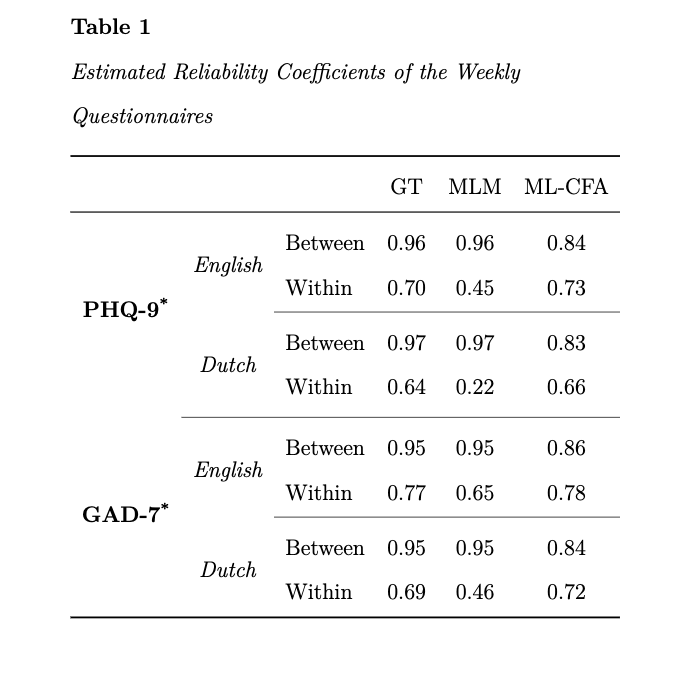
Our new preprint shows how to estimate internal consistency reliability in EMA data:
➡️n~1150, 3 months data, 4 scales
➡️6 nomothetic & idiographic methods
➡️2 timescales (4/day, 1/week)
➡️2 languages (ENG vs NL)
➡️separation of between & within person reliability.
New preprint by @b_siepe & WARN-D team.
We collected information on sleep, tiredness & stress with both EMA and sensor data, and try to find out to which degree these are associated contemporaneously in a large dataset (n~800) with many timepoints (t~360).
Brief 🧵
1/8 New tutorial preprint led by @b_siepe in which we present different descriptive statistics & data visualization techniques with the goal to better understand EMA item functioning.
Preprint: https://t.co/3RsnEuup3l
Brief overview thread 🧵:
1/4 FRED is online, our free open source software to provide feedback to participants in EMA studies.
We (led by @AljoschaRimpler) programmed the software to provide feedback at scale to our ~2000 WARN-D participants. Hope it will be useful to researchers & clinicians alike!
Excited that our WARN-D protocol paper is now published #OpenAccess, introducing the rationale, design, objectives, & measures of WARN-D.
It took us a year to build the measurement battery: it's available in supplementary & we hope others will use it.
https://t.co/gG6Bq99xTJ
Preprint on Bayesian estimation and testing for idiographic networks (https://t.co/UrwPqhfgFQ)🎉
Networks on n=1 data are popular, but they often contain a lot of noise. How can we test if networks that look different reflect more than sampling variability?
🧵below
📣amazing symposium I’m chairing Fri 4pm Holme’s West ‘The power of integration: leveraging multimodal data & methods to increase description, prediction, & understanding of mental health problems’ @DepressionLab@NC_Jacobson@carlottarieble @MyrtheVeenman @EikoFried @CheriLev
1/5 We're @UniLeiden researchers creating an early warning system for #depression in 🇳🇱 students (@ERC_Research). To do so we're collecting unique data we will share with the community #openscience.
We desperately need your help to reach more diverse students.
What can you do?
We'll be hiring a 3 year postdoc for our WARN-D project to build a warning system for #depression, based on 2 years of data in ~2000 students (incl. smartwatches & smartphones).
Would appreciate if you shared w colleagues :). Thx!
Short summary 🧵
https://t.co/hDYSo6chjs
🥁 Calling all network enthusiasts and critics 🥁
Have you ever engaged with the network approach to psychopathology or had reasons not to?
We are curious to hear your thoughts on the (non)applicability of network analyses and the network approach:
https://t.co/ltYqyfR0vv
🥁 Researchers & teachers in 🇳🇱: we need your help!
We are researchers at @UniLeiden, following 2000 students for 2 years using smartphones & -watches to build an early warning system for depression.
We want to recruit a diverse pool of participants. How can you help? ⬇️
(1/4)
🥁🥁🥁 After 1.5 years of hard work, I'm super duper excited to share the preprint of our protocol paper for WARN-D (with @RProppert & @carlottarieble), our study to build a personalized early warning system for depression. 1/4
https://t.co/xc1UCuubHQ
Then reach out to [email protected]. Bonus points for applicants with R experience and/or Dutch proficiency. More info on the project: https://t.co/1vYoK5SJaB
Looking forward to working with you! :-)
So happy to have been a part of #apschi22! I talked about the personalized reports we give our EMA participants in the WARN-D study as a reward for participating. Huge shout out to @aljoscharimpler for his hard work on the underlying tool FRED (Feedback Reports on EMA Data).